The Optimal Time to Exercise: A Guide to Aligning Your Workouts with Your Biology
When is the best time to exercise? The most accurate answer is not a single, prescribed hour, but rather a window of time that aligns with your unique physiology and health objectives.
While consistency is the cornerstone of any effective fitness regimen, timing your workouts can provide a distinct advantage, amplifying your results in weight management, muscle development, and metabolic health. Ultimately, the optimal time is determined by your primary goal.
Identifying the Best Time to Exercise for Your Health Goals
Determining the ideal time to exercise can seem complex, but the underlying principle is simple: synchronize your physical activity with your body's natural internal clock. This is a powerful component of any longevity strategy, ensuring you work with your biology, not against it.
Whether your aim is to build strength, manage your weight, or enhance your cardiovascular resilience, timing can offer a significant advantage.
Large-scale population studies support this concept. While any exercise is beneficial, certain windows appear to better support body composition goals. A recent analysis found that participants with the healthiest BMI tended to be active either in the morning (9–11 a.m.) or evening (6–9 p.m.). This suggests that once a consistent habit is established, you can fine-tune your schedule toward these windows to optimize your outcomes. You can read more about the research on exercise timing from Purdue University.
Key Benefits by Time of Day
Each workout window offers its own unique advantages. Understanding these allows you to make an informed decision that aligns with your lifestyle and health ambitions.
- Morning Workouts: Often associated with enhanced fat metabolism. Furthermore, it is an effective way to ensure daily responsibilities do not interfere with your exercise commitment.
- Afternoon Workouts: Your body's core temperature and muscle strength typically peak during this time, making it ideal for performance-focused training such as heavy lifting or high-intensity intervals.
- Evening Workouts: Can be particularly effective for managing blood glucose levels post-dinner. For many, it also serves as an excellent method to de-stress and prepare for a restful night's sleep.
The primary objective is to build a routine that is sustainable long-term, supports your health, and helps preserve vital muscle mass as you age. You can learn more about the critical link between muscle health and longevity in our guide on The Silent Accelerator of Aging: Why Muscle Loss Is One Problem You Can't Ignore.
To simplify this further, the table below provides a concise overview to help you match your schedule with your goals.
Workout Timing at a Glance: Match Your Goal to the Optimal Window
This table provides a summary of the primary benefits associated with exercising at different times of the day, helping you align your routine with your specific health objectives.
Time of DayPrimary BenefitsBest ForMorningEnhanced fat oxidation, improved consistency, mood elevationWeight management, establishing a routine, metabolic healthAfternoonPeak strength & performance, lower injury risk, optimal power outputMuscle development, strength training, HIIT, achieving personal recordsEveningBlood glucose regulation, stress reduction, potential for improved sleepMetabolic regulation, muscle growth, unwinding after a demanding day
Remember, these are guidelines, not rigid rules. The most effective exercise plan is the one you consistently follow. Use this information to experiment and discover what feels optimal for your body and integrates seamlessly into your life.
How Your Body Clock Dictates Workout Performance
Your body operates on a highly sophisticated internal schedule, a 24-hour cycle known as the circadian rhythm. Consider it an internal orchestra where every system—from your metabolism to your hormones—is programmed to perform specific actions at precise times.
Timing your workout is akin to scheduling a performance when every musician is warmed up, energized, and ready to play in perfect harmony. When you work with this natural rhythm, you can achieve superior results with less effort.
This internal clock governs the rise and fall of key biological processes that directly impact your physical capabilities. Upon waking, your body naturally increases cortisol, a hormone that promotes alertness and mobilizes energy. As evening approaches, it releases melatonin to prepare you for rest and recovery. This is precisely why a 9 a.m. workout feels fundamentally different from a 7 p.m. session—you are operating in a completely different physiological environment.
The Science of Your Internal Clock
Understanding this rhythm allows you to strategically align your exercise with your body’s natural peaks. For instance, your core body temperature, a critical factor in muscle flexibility and efficiency, is lowest in the early morning. It gradually rises throughout the day, peaking in the late afternoon. Exercising when your body is naturally warmer can lead to enhanced performance and a reduced risk of injury.
This extends beyond temperature. Your metabolic rate and hormone levels also fluctuate in predictable patterns, affecting everything from how efficiently you burn fuel to your capacity for strength and endurance. Synchronizing your activity with these patterns is a cornerstone of any intelligent wellness plan. For those seeking to refine this approach, expert guidance in areas like hormone optimization can help ensure your internal systems are perfectly aligned to support your health goals.
Your circadian rhythm is not merely a sleep-wake cycle; it is the master conductor of your physiological performance. By learning its tempo, you can schedule your workouts for when your body is biologically primed for success, enhancing results and minimizing strain.
This visual timeline breaks down the primary benefits you can expect from exercising at different times of the day.
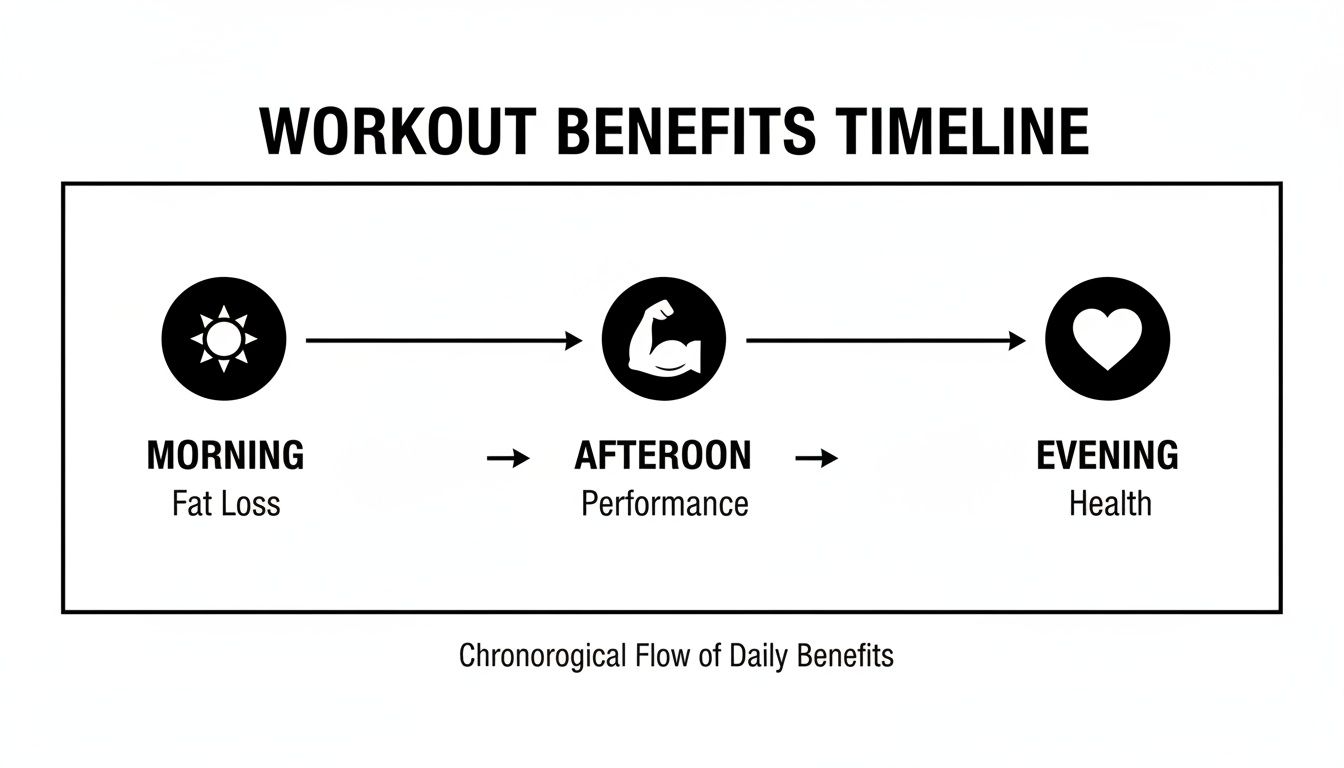
The key insight here is that each window offers a distinct advantage. This allows you to tailor your schedule to what you want to achieve, whether it's tapping into enhanced fat metabolism in the morning or reaching peak power in the afternoon.
Morning Workouts to Ignite Your Metabolism
Initiating your day with exercise offers unique advantages, particularly if your goals revolve around metabolic health and, equally important, long-term consistency. When you exercise in the morning, you are working in concert with your body’s natural hormonal rhythm. You can harness the early surge of cortisol for energy and set a productive, focused tone for the rest of the day.

From a metabolic perspective, there is compelling evidence that morning exercise, particularly before eating, can enhance fat oxidation. This means your body is more inclined to utilize stored fat for fuel—a subtle but powerful advantage for anyone focused on weight management.
Morning workouts also deliver a significant cognitive benefit. The immediate increase in blood flow and release of endorphins sharpens mental clarity, improves focus, and elevates mood. This is a clear advantage before a demanding workday or any complex tasks you have scheduled.
Building an Unwavering Routine
One of the most compelling arguments for morning exercise is its effectiveness in habit formation. By completing your workout before the day’s complexities—such as unexpected meetings, errands, and decision fatigue—fully emerge, you protect a dedicated time for your health. This significantly increases the likelihood of long-term adherence.
That consistency is the bedrock of any successful wellness plan. Consider it a daily investment in your health account, one that compounds over time to deliver remarkable results. An early session ensures that a late meeting or dwindling evening energy will not derail your commitment.
An early morning workout is more than a physical task; it is a strategic decision. It prioritizes your health first, creating a positive ripple effect that influences your nutrition, focus, and energy for the remainder of the day.
Navigating Potential Drawbacks
While the benefits are clear, morning exercise is not without its challenges. Your core body temperature is at its lowest immediately after waking, which can leave muscles and joints feeling stiff and more vulnerable to injury.
This makes a thorough warm-up entirely non-negotiable. Avoid jumping directly into high-intensity work. Instead, dedicate 5-10 minutes to dynamic movements that gradually elevate your heart rate and increase blood flow to your tissues.
Consider these simple preparatory steps:
- Dynamic Stretching: Focus on gentle leg swings, arm circles, and torso twists. These movements activate your muscles and improve mobility without overstretching cold tissues.
- Light Cardio: A few minutes of a brisk walk or a slow jog is sufficient to prepare your cardiovascular system for more strenuous activity.
- Hydration: Begin with a glass of water. It is a simple yet crucial step for rehydrating your system after a night of rest.
To overcome morning grogginess, preparation the night before can be highly effective. Lay out your workout clothes and have a small, easily digestible snack ready if needed. By addressing these minor hurdles, you can make an early workout a sustainable and exceptionally rewarding part of your health strategy.
Afternoon and Evening Exercise for Peak Performance
As the day progresses, your body reaches its physiological peak, creating a natural window for optimal physical output. If your goals are centered on strength, power, and high-intensity performance, the afternoon provides a clear biological advantage. This is when your body is naturally primed and ready for exertion.

Unlike the cooler, stiffer state you might experience first thing in the morning, your core body temperature gradually rises, peaking in the late afternoon. This natural warmth enhances metabolic reactions and improves the elasticity of your muscles and the speed of your nerve function.
The result is a body that is more powerful, more responsive, and less prone to injury during demanding workouts. This makes the hours between approximately 2 p.m. and 6 p.m. an ideal time for any exercise requiring significant strength and coordination.
The Peak Performance Window
During this afternoon window, several key physiological markers align to support maximum effort. It is not just that you are warmer; your entire system is operating at peak efficiency.
Here is what is happening internally:
- Muscle Strength: Research consistently demonstrates that both anaerobic and aerobic performance improve as the day progresses, enabling you to lift heavier and push harder.
- Reaction Time: Your reflexes are at their sharpest, which is highly beneficial for complex lifts or agility-based training.
- Endurance: Your body’s capacity to take up and utilize oxygen can be more efficient, helping you sustain high-intensity efforts for longer.
This biological alignment makes the afternoon the ideal time to engage in weight training, tackle a high-intensity interval training (HIIT) session, or pursue a new personal best.
Evening Exercise for Metabolic and Cardiovascular Health
While the afternoon may be optimal for raw performance, the evening holds a powerful key to metabolic health and longevity. Light-to-moderate activity after your final meal can have a profound impact on how your body manages blood glucose—a critical factor in preventing age-related metabolic issues.
An evening walk or a gentle bike ride is not just a pleasant way to unwind. It is a strategic intervention that can significantly improve your glycemic control and insulin sensitivity overnight, supporting your long-term cardiovascular health.
This simple post-dinner movement helps your muscles absorb excess glucose from your bloodstream. This prevents the sharp blood sugar spikes and subsequent crashes that can disrupt sleep and contribute to chronic inflammation over time. It is a simple but highly effective tool for anyone focused on healthy aging.
New research using wearable technology demonstrates just how powerful this can be, especially for individuals managing metabolic conditions. One large-scale study tracked nearly 30,000 adults with obesity for almost eight years. It found that participants who engaged in most of their moderate-to-vigorous exercise between 6 p.m. and midnight had the lowest risk of premature death and death from cardiovascular disease.
For anyone seeking advanced health strategies, this is compelling evidence for making evening movement a consistent part of your routine for weight control and heart protection. You can discover more about how the timing of physical activity can influence health outcomes in this recent study.
Designing Your Personalized Exercise Timing Plan
Translating the science of workout timing into real-world results is a personalized process. The ideal plan is not found in a generic template; it is constructed by aligning your body's natural rhythms with your specific objectives.
The first step is to understand your chronotype—your innate tendency to feel alert and energetic in the morning versus the evening. Honoring this preference is the key to long-term consistency, and consistency is what truly drives success.
Aligning Your Chronotype with Your Goals
Once you determine whether you are a "morning lark" or a "night owl," you can schedule your workouts to maximize their benefits. A morning person pursuing fat loss, for example, may see excellent results from fasted cardio. In contrast, a night owl focused on building strength will likely feel more powerful and lift heavier in the afternoon or early evening.
But what if your goal is longevity rather than pure performance? When deciding “what time is best to exercise” for a long and healthy life, consistency often outweighs the precise time of day.
That said, some research indicates an afternoon advantage for cardiovascular health. An observational study following over 90,000 adults found that individuals who exercised primarily in the afternoon (around 3 p.m.) had a lower risk of heart disease and premature death. The key takeaway for patients integrating exercise into their clinical care is simple: the best time is whatever time allows you to meet your weekly activity goals without fail. You can explore the findings on afternoon exercise and health outcomes from this large-scale research.
The most effective exercise schedule is a blueprint, not a rigid prescription. It should feel intuitive and sustainable, allowing you to consistently meet your physical activity targets without creating unnecessary stress or friction in your daily life.
For anyone undergoing specific medical treatments, expert guidance is essential. Specialized programs in physical medicine and rehabilitation can help structure a plan that safely supports your recovery and amplifies your therapeutic outcomes.
Sample Weekly Schedules Based on Your Health Goals
Consider these schedules as starting points, not strict rules. They are designed to provide a framework for structuring your week. The best approach is to listen to your body, adjust the times based on your chronotype, and create a routine that is truly effective for you.
GoalOptimal TimingMondayWednesdayFridayFat LossMorning (Fasted)30-min moderate cardio (e.g., incline walk)45-min HIIT session30-min steady-state cyclingMuscle BuildingAfternoonFull-body strength training (heavy lifts)Upper body focus (compound movements)Lower body focus (squats, deadlifts)LongevityAfternoon/Evening45-min moderate cardio (e.g., jogging)30-min strength training + 15-min walk60-min recreational sport or brisk walk
Ultimately, the best workout plan is the one you can adhere to consistently. Whether you are an early riser or a night owl, aligning your exercise with your body’s internal clock is the most sustainable path to achieving your health and longevity goals.
Answering Your Top Questions About Workout Timing
Determining the best time to exercise often raises common questions. Here, we address some of the most important ones with practical, science-backed answers to help you optimize every session.
Does a Consistent Workout Time Really Matter?
Yes, absolutely. While any movement is preferable to none, establishing a consistent time helps your body’s internal clock, or circadian rhythm, work in your favor. Your body learns to anticipate the physical demand, ensuring energy systems are primed when you need them.
If your schedule is unpredictable, do not be concerned. Simply aim for consistency on at least 3-4 days per week. This is sufficient to establish a powerful rhythm and achieve better long-term results.
Should I Eat Before a Morning Workout?
This depends on your objective for that particular day. If your primary goal is fat loss, some individuals find that training in a fasted state can promote the use of stored fat for fuel.
However, if performance is the priority, a small, easily digestible snack 30-60 minutes before you begin can make a significant difference. That small amount of fuel is often what is needed to push harder and lift heavier. As always, it is best to consult your physician for personalized advice.
Deciding whether to eat before a morning workout is a strategic choice. Are you prioritizing fat metabolism or peak performance? Neither is universally superior—the correct answer depends entirely on your specific goal for that workout.
Will Exercising Late at Night Disrupt My Sleep?
This is highly individual, and the answer depends on the intensity of the exercise. For most people, a low-to-moderate evening workout, such as a brisk walk or gentle yoga, can actually improve sleep quality by promoting relaxation.
However, a high-intensity session too close to bedtime can elevate your heart rate and core body temperature, which may make it more difficult for some individuals to fall asleep.
The best practice is to complete any vigorous exercise at least 90 minutes before bed. This allows time for a proper cool-down and a relaxation routine to help your body transition smoothly into a state of rest. Ultimately, your body will provide the clearest feedback on what works best for you.
At Longevity Medical Institute, we design personalized, physician-led programs that integrate advanced diagnostics with targeted therapies to help you achieve peak performance and extend your healthspan. Discover how our science-backed approach can help you reclaim your vitality by visiting Longevity Medical Institute.
Considering Stem Cell Therapy in Los Cabos?
Los Cabos offers a unique setting for patients seeking advanced regenerative therapies in a medically licensed environment, with convenient access for international travelers.
Longevity Medical Institute’s Los Cabos clinics operate under physician oversight and established medical standards, providing regenerative and longevity therapies within a structured clinical framework. Patients benefit from coordinated care, clear eligibility screening, and a focus on safety and outcomes.
Learn more about regenerative care in Los Cabos.
Author
Dr. Kirk Sanford, DC — Founder & CEO, Longevity Medical Institute. Dr. Sanford focuses on patient education in regenerative and longevity medicine, translating complex therapies into clear, practical guidance for patients.
Medical Review
Dr. Félix Porras, MD — Medical Director, Longevity Medical Institute. Dr. Porras provides clinical oversight and medical review to help ensure accuracy, safety context, and alignment with current standards of care.
Last Reviewed: December 3, 2025
Short Disclaimer
This information is for educational purposes only and is not medical advice. It does not replace an evaluation by a qualified healthcare professional. For personalized guidance, please schedule a consultation.