

Your Guide to Longevity: Advanced Cardiovascular Biomarkers
You feel well. You exercise, eat carefully, sleep reasonably well, and your annual physical may even come back “normal.” Yet that still leaves a nagging question many health-conscious adults ask at some point: What isn't showing up on a standard checkup?
That question matters because longevity medicine isn't only about treating disease once it becomes obvious. It's about identifying patterns early, when the body is still adaptable and prevention is still practical. A routine screening can catch important basics, but it rarely offers a detailed map of cardiovascular risk, metabolic strain, inflammatory burden, hormone signaling, thyroid function, digestive resilience, organ performance, and healthy aging all at once.
At Longevity Medical Institute Treatments and Resources, we publish educational guidance for patients who want that deeper view. In our clinical model, a longevity biomarker panel is not a collection of disconnected lab values. It's a structured way to understand how the body is aging in real time, where stress is accumulating, and which interventions deserve attention first.
Introduction A New Standard in Preventive Health
Many people arrive at preventive medicine from a place of uncertainty, not illness. They aren't trying to solve a crisis. They want clarity. They may have a family history of heart disease, shifting energy, more stubborn body composition changes, brain fog, slower recovery, or the intuition that “normal labs” don't always mean optimal health.
That instinct is often correct. A basic physical is useful, but it works like a wide-angle photo. A thorough longevity panel works more like a high-resolution scan. It shows detail, pattern, and relationship. Instead of asking only whether something is obviously wrong, we ask a more useful question: How is this body functioning across the systems that drive healthspan?
The growth of advanced diagnostics reflects that shift in medicine. The global cardiac biomarkers market was estimated at USD 20.81 billion in 2025 and is projected to reach USD 49.31 billion by 2033, growing at a CAGR of 11.5%, according to Grand View Research's cardiac biomarker market analysis. That expansion mirrors a broader clinical reality. Physicians and patients are using deeper biomarker data to support earlier intervention and more precise prevention.
Why a standard panel often misses the full story
A conventional screening usually focuses on a narrow set of values. That can miss early warning signs that sit between disease and health. A person may have acceptable LDL cholesterol but still carry meaningful cardiovascular risk. Another may have glucose in range while insulin is already signaling metabolic strain. A third may feel exhausted because thyroid conversion, adrenal signaling, nutrient status, and inflammation are all interacting.
Clinical perspective: The most important longevity questions usually don't come from one abnormal lab. They come from patterns across many labs.
That's why we evaluate more than 140 biomarkers across cardiovascular health, metabolic health, hormonal balance, thyroid function, inflammation, immune function, digestive health, organ performance, cancer screening, and healthy aging. The purpose isn't to overwhelm you with numbers. It's to translate complex physiology into a practical, personalized plan.
For readers exploring a heart-focused starting point, our overview of preventive cardiology shows how advanced risk assessment fits into modern proactive care.
What a comprehensive longevity panel actually does
A strong biomarker panel should help answer questions such as:
Cardiovascular risk: Are plaque-driving particles, inflammation, or inherited lipid factors present?
Metabolic status: Is insulin resistance developing before diabetes appears?
Hormone balance: Are sex hormones, adrenal hormones, and growth signals supporting vitality or contributing to fatigue and aging?
Thyroid function: Is the thyroid axis functioning well, or is there a hidden conversion or autoimmune issue?
Whole-body resilience: Are the gut, liver, kidneys, immune system, and coagulation pathways supporting recovery and long-term health?
That integrated view is the key value of advanced cardiovascular biomarkers and the broader longevity panel around them.
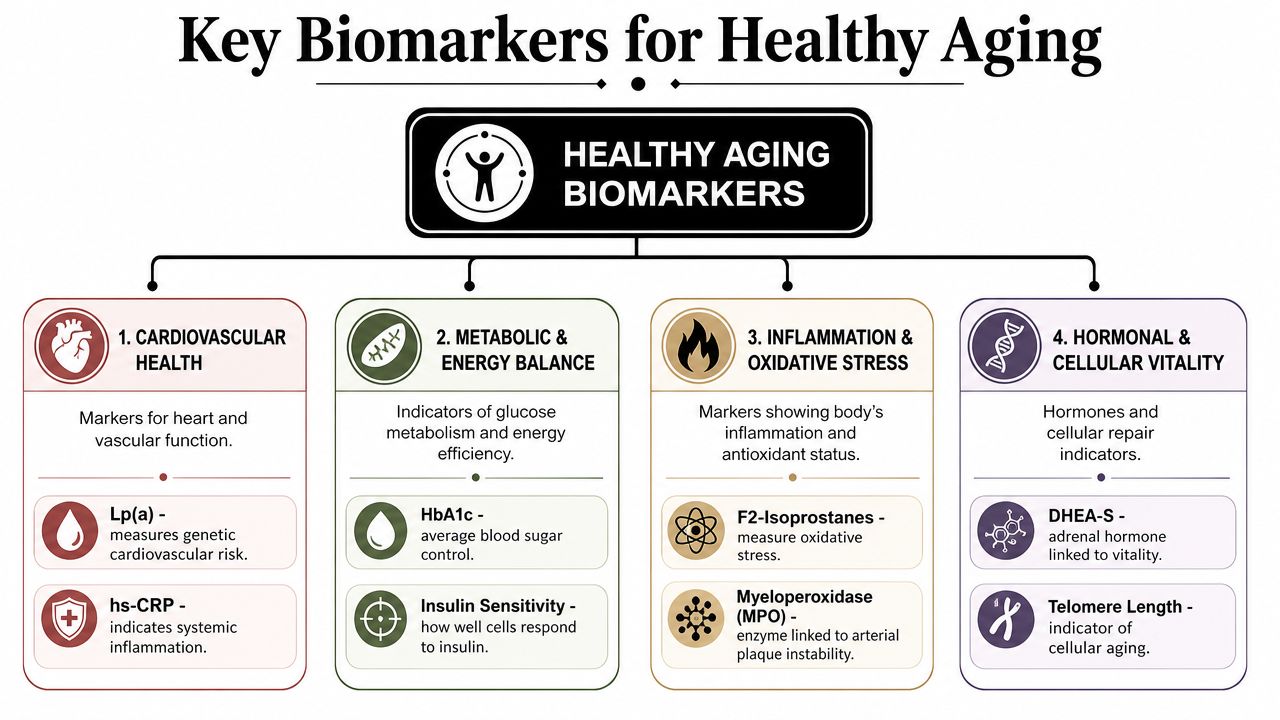
Featured Biomarkers for Healthy Aging
Not every biomarker carries equal weight. Some provide disproportionate insight because they reveal risk early, connect multiple body systems, or explain why a person feels poorly despite “normal” routine labs.
The markers that often change the conversation
ApoB deserves special attention. It reflects the number of atherogenic lipoprotein particles moving through the bloodstream, which is often more clinically useful than looking at cholesterol content alone. Lipoprotein(a), or Lp(a), adds another critical layer because it reflects inherited cardiovascular risk that a standard lipid panel won't show.
ApoB and Lp(a) are identified as strong independent predictors for heart attack risk, and Lp(a) levels above 50 mg/dL or 125 nmol/L are endorsed as thresholds for significantly increased risk in the review available through PubMed Central.
hs-CRP helps us assess inflammatory burden. It doesn't diagnose one specific problem, but it can show whether the internal environment is more inflamed than it should be. Homocysteine adds context around methylation, vascular stress, and nutrient-related metabolic pathways.
The metabolic signals patients commonly overlook
Many patients focus on fasting glucose and miss the more revealing upstream markers. Insulin and the HOMA Index, often referred to clinically as HOMA-IR, can uncover metabolic strain before blood sugar clearly deteriorates. That matters because metabolic dysfunction often develops subtly.
IGF-1 adds another longevity layer. It relates to growth signaling, tissue maintenance, recovery, and aging physiology. It isn't interpreted in isolation. It becomes useful when viewed alongside body composition, nutrition, exercise status, and hormonal context.
A sophisticated panel doesn't ask whether one number is high or low. It asks whether your biology is moving in a direction that supports long-term function.
NT-proBNP is another featured marker because it helps assess cardiac strain. In a preventive setting, it contributes to the larger heart-health picture rather than serving as a standalone answer.
Hormonal and thyroid anchors of healthy aging
Some biomarkers shape how you feel every day. Vitamin D influences immune tone, musculoskeletal health, and overall resilience. Testosterone and DHEA-S can affect energy, strength, motivation, recovery, and body composition in both men and women, though interpretation must always be individualized.
Thyroid testing should never stop at a single number when symptoms are present. A complete thyroid function evaluation can include:
TSH: A central signal from the brain to the thyroid.
Total T4 and Total T3: Broader hormone production markers.
Free T4 and Free T3: The unbound, biologically available forms.
T-Uptake and Free Thyroxine Index: Older but still useful context in certain panel interpretations.
Protein-Bound Iodine: A historical and contextual thyroid-related measure.
Anti-Thyroid Peroxidase Antibodies and Anti-Thyroglobulin Antibodies: Autoimmune markers that can explain symptoms even when standard thyroid values look acceptable.
For patients who want to understand how this kind of testing is organized in practice, our in-house clinical lab overview explains how broad biomarker assessment supports preventive and longevity-focused care.
Featured biomarkers in one clinical snapshot
| Biomarker | Why it matters |
|---|---|
| ApoB | Particle-based cardiovascular risk |
| Lipoprotein(a) | Inherited atherosclerotic risk |
| hs-CRP | Systemic inflammatory burden |
| Homocysteine | Vascular and methylation context |
| Insulin | Early metabolic dysfunction |
| HOMA Index | Insulin resistance pattern |
| IGF-1 | Growth and repair signaling |
| NT-proBNP | Cardiac stress context |
| Vitamin D | Broad resilience and immune support |
| Testosterone | Vitality, recovery, body composition |
| DHEA-S | Adrenal reserve and vitality |
| Thyroid Function | Energy regulation and metabolic pace |
Cardiovascular Metabolic and Longevity Biomarkers
Heart health, blood sugar regulation, inflammation, and biological aging are tightly linked. In practice, they rarely break down one at a time. They influence each other continuously, which is why a meaningful preventive panel has to read them together.
Looking beyond standard cholesterol
A standard lipid panel remains useful, but it doesn't tell the whole story. We still evaluate Total Cholesterol, Triglycerides, HDL Cholesterol, LDL Cholesterol, VLDL Cholesterol, and Atherogenic Index, because these values provide broad context. Then we add more specific markers that sharpen interpretation.
That expanded cardiovascular set includes:
Apolipoprotein A1
Apolipoprotein B
ApoA1/ApoB Ratio
Lipoprotein(a)
Lipoprotein-Associated Phospholipase A2 (Lp-PLA2)
NT-proBNP
Creatine Phosphokinase (CPK)
D-Dimer
High-Sensitivity C-Reactive Protein (hs-CRP)
Interleukin-6 (IL-6)

Lp-PLA2 can help assess vascular inflammation more specifically. NT-proBNP provides insight into cardiac wall stress. D-Dimer and Fibrinogen contribute to clotting and vascular-risk context. CPK can be useful when evaluating muscle injury or cardiac-related enzyme patterns in the right clinical setting.
Why combinations matter more than isolated values
One of the clearest lessons in advanced cardiovascular biomarkers is that risk becomes more visible when markers are interpreted together. A multi-biomarker approach found that adults with high levels of Lp(a), remnant cholesterol, and hsCRP had nearly triple the risk of a heart attack, with risk increasing stepwise as more markers were at high levels, according to the American Heart Association newsroom summary.
That's clinically important because it shifts the conversation from “Is this lab abnormal?” to “What pattern is forming?”
Practical rule: A single marker can suggest concern. A coordinated pattern can define strategy.
For patients who want a broader diagnostic framework around these labs, an advanced preventive heart assessment may combine biomarkers with imaging and rhythm evaluation for a more complete cardiovascular picture.
Metabolic markers that drive cardiovascular aging
Cardiovascular disease and metabolic dysfunction often travel together. That's why this section of the panel also includes:
Glucose
Insulin
HOMA Index
Hemoglobin A1c
Glucose is the snapshot. Insulin often tells the earlier story. HOMA Index helps estimate insulin resistance. Hemoglobin A1c gives a broader picture of blood sugar exposure over time. When these values drift in the wrong direction, the cardiovascular system often feels the effects first through endothelial stress, inflammation, and lipid disruption.
Longevity markers with cardiovascular relevance
Two markers often connect the heart and aging conversation in a useful way.
Homocysteine can point toward methylation inefficiency, nutrient issues, and vascular stress. It's one of those values that rarely deserves panic, but often deserves attention.
IGF-1 belongs in a longevity discussion because growth signaling affects repair, muscle maintenance, recovery, and aging biology. Too little or too much signaling can be clinically meaningful depending on age, symptoms, training status, and the broader hormonal environment.
A cardiovascular and metabolic longevity panel is strongest when it reads these values as a network, not a checklist.
Hormonal Thyroid and Nutritional Biomarkers
Hormones are the body's coordination system. They influence energy, sleep quality, mood, motivation, sexual health, muscle maintenance, cognition, and recovery. When they're out of sync, people often feel that something is off long before a routine lab flags a problem.
Sex hormone biomarkers and daily function
A complete hormonal picture usually includes:
Estradiol
Total Testosterone
Free Testosterone
Luteinizing Hormone (LH)
Follicle-Stimulating Hormone (FSH)
Prolactin
Progesterone
Dihydrotestosterone (DHT)
Sex Hormone-Binding Globulin (SHBG)
These markers help answer practical questions. Is the body producing hormones appropriately? Are symptoms coming from low production, poor signaling, altered binding, or an imbalance between hormones? Is a patient's fatigue hormonal, thyroid-related, nutritional, inflammatory, or some combination?
A patient with low free testosterone, for example, might not have low total testosterone. SHBG may be the reason. A woman with irregular cycles, poor sleep, and low resilience may need estradiol, progesterone, adrenal review, and thyroid interpretation together, not one isolated test.
Adrenal and growth signaling
The adrenal and growth axis matters just as much in longevity medicine. We commonly evaluate:
| Biomarker | Clinical value |
|---|---|
| Cortisol | Stress response and circadian signaling |
| DHEA | Adrenal hormone output |
| DHEA-S | Longer-view adrenal reserve marker |
| IGF-1 | Growth and tissue repair signaling |
These values should always be interpreted with symptoms. A “normal” cortisol in someone with fragmented sleep, burnout, and low daytime stamina may still be clinically unhelpful if the broader rhythm is disrupted.
Hormones don't operate in separate rooms. Thyroid, adrenal function, nutrient status, inflammation, and sex hormones all influence each other.
Our comparison of a standard lab panel versus a function-focused health evaluation explores why a broader interpretive model often gives patients more useful answers.
Thyroid biomarkers that deserve deeper interpretation
Thyroid testing is one of the most misunderstood areas in preventive medicine. Many patients are told their thyroid is “fine” because TSH falls within reference range, even when symptoms suggest otherwise.
A robust thyroid review can include:
Thyroid-Stimulating Hormone (TSH)
Total Thyroxine (T4)
Total Triiodothyronine (T3)
Free Thyroxine (FT4)
Free Triiodothyronine (FT3)
T-Uptake
Free Thyroxine Index
Protein-Bound Iodine
Anti-Thyroid Peroxidase Antibodies
Anti-Thyroglobulin Antibodies
This broader lens helps identify under-conversion, altered binding, and autoimmune activity. That matters because symptoms often come from physiology that is technically in range but functionally suboptimal.
Nutritional biomarkers that support resilience
Nutrients are not an afterthought. They are part of the operating system.
Key markers include Vitamin D, Vitamin B12, Serum Iron, Ferritin, Magnesium, Calcium, and Phosphorus. These values affect oxygen delivery, nerve function, muscle contraction, bone health, methylation, and energy production.
We also review protein and mineral context through markers such as:
Total Proteins
Albumin
Globulin
Sodium
Potassium
Chloride
When patients feel depleted, cold, weak, foggy, or slow to recover, this nutritional layer often explains more than they expect.
Immune Infectious Autoimmune Digestive and Organ Health Biomarkers
Aging doesn't happen only in the heart, hormones, or metabolism. It also reflects how well the immune system regulates inflammation, how the gut handles digestion and barrier function, and how efficiently the liver and kidneys process the demands placed on them.
The foundational blood count and inflammation picture
The Complete Blood Count (CBC) remains one of the most useful starting points in all of medicine. It gives practical insight into oxygen-carrying capacity, immune activity, clotting support, and broader physiologic stress.
That includes:
Erythrocytes
Hemoglobin
Hematocrit
Mean Corpuscular Volume (MCV)
Mean Corpuscular Hemoglobin (MCH)
Mean Corpuscular Hemoglobin Concentration (MCHC)
Red Cell Distribution Width (RDW)
Platelets
Mean Platelet Volume (MPV)
Leukocytes
Lymphocytes
Monocytes
Eosinophils
Basophils
Segmented Neutrophils
Band Neutrophils
Erythrocyte Sedimentation Rate (ESR)
Blood Group
Rh Factor
These markers help frame questions that matter clinically. Is there anemia, altered immune tone, allergy patterning, latent inflammatory activity, or platelet-related vascular context? On their own they are foundational. In combination with the rest of the panel, they become much more informative.
Autoimmune and infectious context
Persistent fatigue, inflammation, pain, skin symptoms, digestive complaints, and cognitive complaints sometimes trace back to immune dysregulation or chronic infectious burden. Depending on history and symptoms, a broader workup may include:
Anti-Borrelia burgdorferi IgG
Anti-Borrelia burgdorferi IgM
EBNA IgG
VCA IgG
VCA IgM
ANA IFA
Rheumatoid Factor
This kind of testing is not about chasing diagnoses carelessly. It's about using history and biomarkers together to decide whether a hidden immune or infectious contributor deserves further attention.
Some patients don't need more medication first. They need a clearer explanation of why inflammation persists.
Digestive and stool biomarkers
Gut health often shapes systemic health far more than patients realize. A detailed stool review can evaluate:
Thorough Stool Analysis
Fecal Biomarkers
Digestive Function Markers
Gut Inflammation Markers
Microbial Balance Markers
Occult Blood
Pancreatic Function Markers
Nutient Absorption Markers
This helps identify whether poor digestion, microbial imbalance, intestinal inflammation, occult bleeding, or impaired pancreatic support may be contributing to symptoms and downstream inflammation.
Liver, kidney, pancreatic, and fluid-balance markers
A longevity panel should also evaluate the organs doing the daily work of detoxification, filtration, digestion, and biochemical regulation. That includes:
| Organ system | Biomarkers |
|---|---|
| Kidney function | Urea, Blood Urea Nitrogen (BUN), Creatinine, Glomerular Filtration Rate (GFR), Uric Acid |
| Liver and biliary function | Total Bilirubin, Direct Bilirubin, Indirect Bilirubin, AST, ALT, Gamma-Glutamyl Transferase (GGT), Alkaline Phosphatase (ALP), Lactate Dehydrogenase (LDH) |
| Pancreatic support | Amylase, Lipase |
| Protein status and fluid balance | Total Proteins, Albumin, Globulin, Sodium, Potassium, Chloride |
These are not glamorous markers, but they're often decisive. They tell us whether the body has the reserve to recover, adapt, and tolerate more advanced therapies when needed.
Cancer Screening Urinalysis and Coagulation Biomarkers
Preventive testing should also include careful screening tools that identify patterns requiring follow-up. These biomarkers are not used as simplistic yes-or-no answers. They are context markers, and context matters.
Cancer screening markers in preventive care
Tumor markers can support risk review and follow-up when interpreted appropriately. Common examples include:
Total PSA
Free PSA
Free PSA Index
CA-125
CA 15-3
CEA
AFP
CA 19-9
Beta-hCG
These tests are best used as part of a broader clinical picture that includes symptoms, imaging, physical examination, personal history, and family history. A marker may prompt more investigation. It should not be mistaken for a standalone diagnosis.
Urinalysis as a quiet source of major clues
A complete urinalysis can reveal much more than many people expect. It can contribute to the assessment of hydration, kidney stress, glucose handling, possible infection, bleeding, protein loss, and urinary tract irritation.
Markers commonly reviewed include:
Color
Appearance
Glucose
Bilirubin
Ketones
Specific Gravity
Hemoglobin
pH
Proteins
Urobilinogen
Nitrites
Leukocyte Esterase
Leukocytes
Pus Cells
Erythrocytes
Epithelial Cells
Bacteria
Mucus Filaments
Casts
Crystals
Yeasts
For patients curious about how these labs are processed and organized in a clinical setting, this video tour of the clinical lab and biomarker workflow provides useful background.
Coagulation and clotting balance
Blood must clot when needed and flow freely when it should. That balance is central to cardiovascular and procedural safety.
A coagulation panel may include:
Prothrombin Time (PT)
International Normalized Ratio (INR)
Activated Partial Thromboplastin Time (aPTT/PTT)
Fibrinogen
These values matter for cardiovascular risk, inflammatory states, procedural planning, and broader vascular assessment. In a preventive context, they help complete the picture rather than standing alone.
Conclusion Your Personalized Path to Longevity
An extensive longevity biomarker panel is valuable because it turns scattered symptoms and routine lab snapshots into a connected clinical picture. More than 140 biomarkers across cardiovascular health, metabolism, hormones, thyroid, inflammation, immunity, digestion, organ function, cancer screening, urinalysis, and coagulation help reveal how your body is functioning now, not just whether overt disease is present.
That depth allows physicians to move beyond generic wellness advice. If cardiovascular risk is being driven by ApoB, inherited Lp(a), and inflammation, the strategy should look different than it would for a patient whose primary issue is insulin resistance, thyroid imbalance, nutrient depletion, gut inflammation, or immune dysregulation. The same principle applies in regenerative medicine. Better diagnostics support better timing, better selection, and better personalization.
At Longevity Medical Institute, those findings can inform broader programs that may include advanced heart evaluation, imaging, peptide strategies, hyperbaric support, sleep medicine, regenerative therapies, and allogeneic cell-based protocols produced in our biotechnology lab, including placental, Wharton's jelly, adipose, endometrial, and dental pulp cell lines.
If you want to continue learning, detailed educational guides are also available for major topics including ApoB, Lipoprotein(a), hs-CRP, Homocysteine, HOMA-IR, Biological Age Testing, Hormone Biomarkers, Thyroid Biomarkers, Cancer Biomarkers, Gut Health Biomarkers, and Advanced Cardiovascular Biomarkers.
If you're ready to explore your health with greater precision, Longevity Medical Institute offers physician-led consultations that pair advanced diagnostics with personalized longevity planning. An extensive review can help clarify your cardiovascular risk, metabolic status, hormone balance, biological aging patterns, and next best steps for prevention and performance.
Author
Dr. Kirk Sanford, DC, Founder & CEO, Longevity Medical Institute. Dr. Sanford focuses on patient education in regenerative and longevity medicine, translating complex therapies into clear, practical guidance for patients.
Medical Review
Dr. Félix Porras, MD, Medical Director, Longevity Medical Institute. Dr. Porras provides clinical oversight and medical review to help ensure accuracy, safety context, and alignment with current standards of care.
Last Reviewed: June 25, 2026
Short Disclaimer
This information is for educational purposes only and is not medical advice. It does not replace an evaluation by a qualified healthcare professional. For personalized guidance, please schedule a consultation.