

Biotechnology Stem Cell Lab Mexico: A Guide to Finding a Trusted Facility
For patients in the U.S. and Canada exploring advanced solutions for chronic pain or orthopedic injuries, the concept of a biotechnology stem cell lab in Mexico represents a new frontier of medical possibility. It signals a shift toward high-quality, regulated regenerative medicine that is both accessible and built upon a foundation of exacting scientific standards.
Why Are Medical Travelers Choosing Mexico for Regenerative Medicine?
The decision to travel for medical care is a significant one, typically driven by a search for therapies that deliver meaningful results and a better quality of life. While cost savings are an attractive benefit, Mexico’s emergence as a premier regenerative medicine destination is a story of clinical excellence, stringent regulatory oversight, and access to advanced cellular therapies that may be unavailable or financially prohibitive at home.
Patients are now looking to Mexico not as an alternative, but as a first-choice destination for world-class care.
This evolution is a direct result of the sophisticated infrastructure that leading clinics have meticulously developed. At the heart of this infrastructure is the in-house biotechnology stem cell lab—a highly controlled environment where science is carefully translated into safe, personalized, and effective treatments.
The Foundation of Trust and Quality
A premier stem cell clinic in Mexico distinguishes itself through an unwavering commitment to quality control. This commitment begins in the laboratory, where every biological product is sourced, processed, and rigorously tested according to strict clinical protocols.
This integration of lab and clinic provides our physicians with direct oversight of the therapies they administer, creating a seamless chain of accountability that is essential for patient safety and optimal outcomes. The goal is not merely to provide effective treatments for conditions like joint pain or sports injuries, but to ensure those treatments are meticulously prepared, verified, and administered with the highest degree of precision.
For patients, an on-site, licensed laboratory is a definitive indicator of a clinic's dedication to quality. It demonstrates a commitment to transparency and complete control over the therapeutic process—from cell cultivation to patient administration.
A Growing Hub for Medical Excellence
The demand for these advanced treatments is reflected in the market’s significant growth. The Mexican stem cells market reached USD 160.0 million in 2023 and is projected to reach USD 369.8 million by 2030. This expansion is largely fueled by medical travelers from the U.S. and Canada seeking effective solutions for chronic pain and orthopedic conditions.
With regulatory bodies like COFEPRIS ensuring clinical safety, Mexico has solidified its reputation as a trusted destination for patients who demand exceptional value without compromising on quality. You can explore this growth in more detail on Grand View Research.
Ultimately, choosing a biotechnology stem cell lab in Mexico means selecting a system where advanced science meets compassionate, physician-led care. This powerful combination empowers patients to regain control of their health, opening the door to therapies designed to restore function and vitality.
What Happens Inside a Biotechnology Stem Cell Lab
The heart of a leading regenerative medicine clinic is not the treatment room—it is the laboratory. A high-end biotechnology stem cell lab is best understood as a highly specialized ‘cellular pharmacy.’ It is here that raw biological materials are meticulously processed and transformed into the precise, patient-specific therapies that drive the healing process.
Understanding these laboratory processes demystifies the science and clarifies why lab quality is directly linked to the safety and efficacy of your treatment. Inside a premier biotechnology stem cell lab in Mexico, every step is performed under strictly controlled, sterile conditions. This is not simply cell storage; it is a sophisticated sequence of isolation, cultivation, characterization, and preservation designed to produce a pure, potent, and safe clinical-grade therapy.
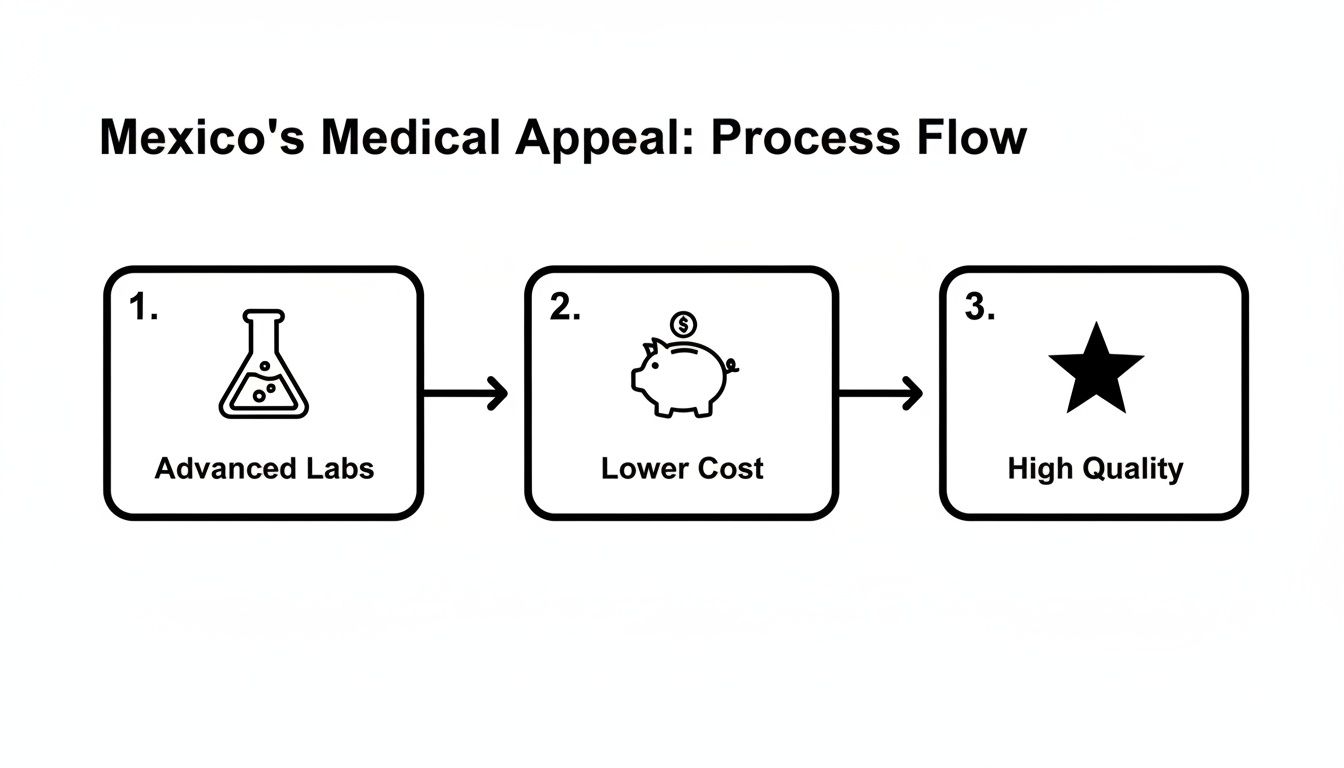
The flowchart below illustrates how advanced laboratories, lower costs, and high-quality standards converge to make Mexico a leading destination for medical travelers.
This journey to world-class care begins with the sophisticated work performed inside these leading laboratories.
The Four Pillars of Lab Processing
The work within a professional laboratory is defined by four essential functions. Each serves as a critical quality checkpoint, safeguarding the integrity of the final therapeutic product and distinguishing a world-class facility from a standard clinic.
Isolation: The meticulous first step where specific stem cells are carefully separated from their source tissue, such as an umbilical cord. This purification process ensures only the desired cells advance to the next stage.
Cultivation (or Expansion): Once isolated, the cells are placed in a highly controlled environment with specialized nutrients that encourage them to multiply. This "cell culture" process expands the number of cells to a therapeutic dose while maintaining their health and biological activity.
Characterization: A crucial quality control step where scientists use advanced techniques to verify the identity, purity, and viability of the cultured cells. This confirms the cells are the correct type, free from contaminants, and robust enough to be effective.
Cryopreservation: For future use, therapeutic doses are expertly frozen using specific protocols that protect the delicate cells from damage. This allows for stable, long-term storage, ensuring a high-quality product is ready when a patient needs it.
To better understand how these processes connect to patient outcomes, the following table explains what happens in the lab and why it is critical for your safety.
Key Functions Inside a Biotechnology Stem Cell Lab
These meticulous steps are fundamental to producing consistent and reliable cellular therapies. You can learn more about how our own in-house biotechnology lab integrates these processes to guarantee quality.
Adhering to Good Manufacturing Practices
To ensure each of these steps is performed to the highest possible standard, leading labs operate under a stringent quality system known as Good Manufacturing Practices (GMP). GMP is not just a guideline; it is a set of principles and procedures that ensures therapeutic products are consistently produced and controlled according to world-class quality standards.
For patients, GMP compliance is a powerful seal of approval for safety and reliability. It means the lab follows documented, repeatable processes for everything—from sourcing materials and training staff to calibrating equipment and testing final products. This level of rigor minimizes risks and ensures the therapy you receive is precisely what it is intended to be.
Ultimately, the work inside a biotechnology stem cell lab is the engine that drives modern regenerative medicine. It is a world of precision, control, and an unwavering commitment to quality. This foundation of excellence ensures that the treatments administered in the clinic are not only potent but, most importantly, are held to the highest safety standards in medicine.
Decoding Mexico’s Quality and Safety Regulations
Selecting the right international clinic requires clear evidence of expertise and reliability. In Mexico’s regenerative medicine landscape, a robust regulatory framework provides this assurance. It is built on three pillars—COFEPRIS, ISO, and GMP—which work in concert to ensure every step of the therapeutic process is transparent, safe, and scientifically sound.
The Role of COFEPRIS in Patient Safety
COFEPRIS (the Federal Commission for the Protection against Sanitary Risks) is Mexico’s equivalent of the U.S. Food and Drug Administration (FDA). Its mandate is to license, regulate, and inspect laboratories that work with biological materials, including stem cells and exosomes.
A COFEPRIS license is far more than a certificate on a wall. It confirms that the laboratory:
Sources, processes, and stores tissues according to strict clinical protocols.
Maintains sterile, controlled environments for all cellular processing.
Employs qualified scientists and technicians at every stage.
What does a COFEPRIS license signify? It means the facility has passed rigorous government inspections and adheres to national clinical standards—from cell sourcing and characterization to final administration.
In practice, choosing a clinic with COFEPRIS approval provides a layer of accountability that is absent in unregulated environments. To understand this further, please read our guide on how trust begins with safety and transparency.
International Standards: ISO and GMP
While COFEPRIS provides the national seal of approval, international certifications demonstrate a commitment to global standards of excellence. Two key standards include:
ISO 9001 (Quality Management Systems): Ensures consistent processes, thorough documentation, and a focus on continual improvement to reduce errors.
ISO 7 (Cleanroom Standards): Defines the strict requirements for air purity, pressure, and filtration in environments where sensitive cell processing occurs.
Good Manufacturing Practices (GMP): A pharmaceutical-grade quality system that governs every detail of production—from raw material sourcing and equipment calibration to staff hygiene and final product testing.
Together, these standards create a multi-layered safety net, designed to identify and mitigate potential issues long before they could ever impact a patient.
The Impact of a Regulated Environment
Mexico’s strong regulatory oversight has transformed it into a trusted destination for medical travelers. Clinics operate under physician-led protocols, supported by COFEPRIS-licensed laboratories. As the global stem cell market continues its rapid expansion—projected to grow from USD 613.7 million in 2025 to USD 5,835.53 million by 2035—North America remains a key driver of this growth. Patients are discovering that:
90% of North American medical travelers report high satisfaction with their care in Mexico.
Cost savings can reach up to 70% compared to U.S. prices for comparable therapies.
Access to GMP-compliant labs delivers a level of quality and confidence on par with surgical-grade standards.
These figures reflect the real-world experiences of patients who have found safe, effective, and accessible care in Mexico’s thriving regenerative medicine sector.
The Products of a Biotechnology Lab: MSCs and Exosomes
When you enter a state-of-the-art regenerative medicine laboratory, you are stepping into a biological powerhouse where precise, powerful therapies are created to meet specific health objectives. The output of a premier biotechnology stem cell lab in Mexico is not a one-size-fits-all product; it is a suite of advanced biological tools, each with a distinct therapeutic function.
To fully appreciate the potential for recovery, rejuvenation, and enhanced performance, it is essential to understand what these tools are. The two most important are Mesenchymal Stem Cells (MSCs) and their potent messengers, exosomes. While they often work in concert, they play very different roles in the body’s healing process.
Mesenchymal Stem Cells (MSCs): The Body's Master Repair Crew
Mesenchymal Stem Cells (MSCs) are the cornerstone of regenerative medicine. Sourced from ethically donated umbilical cord tissue, these youthful and potent cells are the body's intelligent "master repair crew." As multipotent cells, they possess the remarkable ability to develop into various cell types, including bone, cartilage, and muscle.
However, their primary power lies not in becoming new tissue, but in orchestrating a healing response where it is needed most. When introduced into an area of injury or inflammation—such as an arthritic knee or damaged shoulder—MSCs act as powerful signaling agents.
They achieve this through several key actions:
Controlling Inflammation: MSCs release potent anti-inflammatory molecules that calm overactive immune responses, a primary driver of chronic pain and tissue degradation.
Promoting Regeneration: They secrete a cocktail of growth factors that encourage the body's own cells to repair and rebuild damaged tissue, accelerating the natural healing process.
Modulating the Environment: MSCs are highly adaptive. They assess their surroundings and release the specific signals needed to restore balance and function to the local tissue.
This makes MSCs a foundational therapy for orthopedic injuries, chronic joint pain, and accelerating recovery from physical strain.
Exosomes: The Cellular Messengers
If MSCs are the repair crew, then exosomes are their specialized communication network. Exosomes are not cells; they are tiny extracellular vesicles released by stem cells. Imagine them as microscopic envelopes carrying vital instructions—such as proteins and genetic material—from one cell to another.
Exosomes deliver highly targeted messages that instruct recipient cells on how to behave. They can direct cells to reduce inflammation, generate new blood vessels, or produce more collagen, all without introducing a whole cell into the body. This cell-free approach makes them a powerful and safe tool for both tissue repair and aesthetic rejuvenation.
Key Takeaway: While MSCs are the cellular "factories" directing the repair project, exosomes are the targeted "messages" they send. A laboratory produces both, but they offer distinct therapeutic mechanisms to achieve regenerative goals.
Comparing Stem Cell and Exosome Therapies
While both Mesenchymal Stem Cells (MSCs) and exosomes are derived from the same powerful source, they function quite differently. Understanding these differences helps you and your physician decide which tool is best suited for your specific health goals. This table breaks down their core distinctions.
Ultimately, whether MSCs, exosomes, or a combination of both are used depends on the clinical objective. One may be better for rebuilding a joint, while the other is superior for calming systemic inflammation.
This field is supercharged by Mexico's booming biotech sector. The country's synthetic biology market was valued at USD 110.8 million in 2023 and is projected to hit USD 393.2 million by 2030. This economic growth fuels innovation, giving patients access to therapies with remarkable results. Athletes, for instance, have seen an 85% improvement in sports injury recovery using MSCs.
The application of these therapies depends entirely on a patient's individual needs. You can explore this further in our detailed guide to cell regeneration therapy. By combining these advanced biological products with precise, physician-guided administration, a modern lab helps turn cellular science into real-world results for joint health, sports recovery, and overall vitality.
Your Checklist for Choosing the Right Clinic and Lab
Choosing a regenerative medicine clinic is a significant decision, particularly when traveling for care. To feel confident in your choice, you need a clear framework for evaluating your options. This checklist provides the essential questions to ask and the critical red flags to spot, helping you select a facility that prioritizes your safety, transparency, and clinical outcomes.
Think of this not as an interrogation, but as a structured conversation to build trust. A reputable clinic will always welcome your questions and provide clear, verifiable answers.
Essential Questions to Ask Your Potential Clinic
During your consultation, use these questions as your guide. The quality of the responses will speak volumes about a clinic's commitment to patient safety and high clinical standards.
1. Is your lab licensed by COFEPRIS?
This is the single most important question you can ask. A COFEPRIS license confirms the biotechnology stem cell lab in Mexico meets national health and safety regulations for handling and processing human cells. Do not hesitate to ask for their license number and documentation.
2. Can you provide a Certificate of Analysis (CoA) for the cells?
A CoA is a detailed report from the lab verifying the quality of the biological product you will receive. It must include:
Cell Viability: The percentage of living, healthy cells in the dose. A high viability rate—typically over 90%—is crucial for therapeutic efficacy.
Purity: Confirmation that the sample is free from microbial contaminants like bacteria, fungi, and endotoxins.
Cell Count: The exact number of cells in the dose, ensuring you receive the therapeutic amount prescribed by your physician.
3. Are all treatments administered by a licensed physician?
Regenerative therapies are medical procedures. They must only be performed by a qualified, licensed medical doctor who can manage the treatment and respond to any clinical situation that may arise. If a non-physician administers the therapy, it is a serious safety concern.
4. How is the treatment plan personalized to my specific condition?
A one-size-fits-all approach is a hallmark of low-quality care. A premier clinic will use advanced diagnostics—such as MRI, ultrasound, or detailed blood analysis—to understand your unique biology and tailor a protocol specifically for your health goals.
Critical Red Flags to Watch For
Just as important as knowing what to look for is knowing what to avoid. The following signs should immediately cause you to question a clinic's credibility and professionalism.
Red Flag: Any clinic that guarantees a cure or makes unrealistic promises should be viewed with extreme caution. Regenerative medicine is a powerful tool for managing symptoms and promoting healing, but it is not a "miracle cure." Ethical providers set realistic expectations based on clinical evidence.
Here are other warning signs that a clinic may not be operating at a high standard:
Lack of Transparency: Vague answers about their lab, the source of their cells, or their physicians' credentials. A trustworthy clinic will be an open book.
No Physician Involvement: If you never speak to a doctor before the procedure, or if your primary contact is a salesperson, this is a major red flag.
Pressure to Pay Upfront: High-pressure sales tactics or demands for full payment before a proper medical consultation are deeply unprofessional.
Absence of Follow-Up Care: A reputable clinic provides a clear plan for post-treatment monitoring and support to track your progress and manage your recovery.
A patient-centered clinic prioritizes your health and safety above all else. This means ensuring every step, from the laboratory to the treatment room, is guided by medical expertise. To see how these principles are put into practice, you can learn more about a dedicated stem cell clinic in Cabo that integrates physician-led care with stringent lab protocols.
Ultimately, your goal is to find a partner in your health journey—a clinic that provides not only advanced therapies but also the confidence that you are in safe, capable hands.
The Integrated Approach: Where Lab, Clinic, and Physician Unite
The true power of regenerative medicine is unlocked when all essential components—a high-quality laboratory, expert physicians, and advanced diagnostics—are unified under one roof. This integrated model represents the gold standard of care, moving beyond isolated treatments to create a seamless, physician-led journey from diagnosis to recovery.
It is the difference between simply receiving a treatment and engaging in a comprehensive therapeutic strategy.
An integrated center combines a COFEPRIS-licensed biotechnology stem cell lab in Mexico with a full suite of clinical capabilities. This structure eliminates the disconnect that often exists between where a therapy is produced and where it is administered. When the lab is in-house, physicians have direct oversight and a deep understanding of the biological products they are using, creating an unbroken chain of quality and trust.
The Power of Clinical and Lab Synergy
In an integrated model, diagnostics and treatment delivery are not separate appointments; they are part of a continuous feedback loop. This synergy enables a level of precision that is impossible when services are fragmented. For example, a physician can use advanced imaging to identify the exact point of injury and then use that same imaging to guide the injection with pinpoint accuracy moments later.
This direct connection creates a powerful advantage for patient care:
Precision-Guided Delivery: Using tools like high-resolution ultrasound, physicians can visualize the target tissue in real-time. This ensures stem cells or exosomes are delivered directly to the site of damage, maximizing their potential impact while protecting healthy surrounding tissue.
Data-Driven Protocols: Advanced diagnostics inform every step. An AI-enhanced MRI might reveal subtle patterns of tissue breakdown that guide the selection of a specific cellular therapy, while detailed bloodwork can identify underlying inflammatory markers that must be addressed for the treatment to succeed.
Comprehensive Physician Oversight: With all specialists—from radiologists and lab scientists to orthopedic physicians—working in collaboration, treatment plans become far more robust. This team-based approach ensures your care is viewed from every critical clinical angle.
The integrated approach transforms regenerative medicine from a simple procedure into a comprehensive, data-driven therapeutic strategy. It’s the difference between just getting an injection and receiving a fully orchestrated, personalized care plan designed by a team of experts.
From Diagnosis to Recovery Under One Roof
Imagine a patient with chronic knee pain arriving at an integrated center. Their journey begins with a full diagnostic workup, perhaps an MRI to assess cartilage damage and an ultrasound to map inflammation. Armed with these findings, the physician can consult directly with the in-house lab team to prepare a specific dose of mesenchymal stem cells tailored to the patient’s condition.
The treatment is then administered under that same ultrasound guidance to ensure perfect placement. Afterward, the patient’s progress is tracked with follow-up imaging and functional assessments, allowing the unified medical team to fine-tune the recovery plan as needed.
Every step is connected, managed, and overseen by a team that knows the patient's case inside and out. This model is the pinnacle of what is possible in regenerative medicine, ensuring you receive not just a product from a lab, but a complete, physician-led solution.
Your Questions, Answered
Exploring regenerative medicine is a significant step, and it is natural to have questions. We believe a well-informed patient is an empowered one. This section is designed to provide clear, straightforward answers to the most common inquiries our patients have about stem cell therapy.
Our commitment is to complete transparency, ensuring you feel secure and knowledgeable at every point in your health journey.
Is Stem Cell Therapy Safe in Mexico?
Yes, when performed at a facility that operates under the strictest regulatory standards. The key is to select a clinic with its own COFEPRIS-licensed biotechnology lab. This license is your assurance that the facility adheres to high national health and safety protocols for how cells are sourced, processed, stored, and administered—a critical layer of protection for every patient.
How Can I Be Sure the Cells Are High Quality?
Any reputable clinic must provide a Certificate of Analysis (CoA) for your specific treatment dose. This document is your proof of quality. It verifies the cell count, viability (the percentage of living, active cells), and confirms the sample is pure and free from microbial contaminants. Always ask to see this report; it is a non-negotiable standard for any credible clinic.
At Longevity Medical Institute, we see patient education as a cornerstone of excellent care. We provide complete transparency into our lab processes and cellular products, ensuring you feel confident and informed at every stage of your journey.
What Does the Treatment Process Actually Look Like?
The process begins with a detailed physician consultation and advanced diagnostic workup to design a personalized treatment plan. The therapy is then administered by a licensed doctor, often using tools like ultrasound guidance to ensure the cells are delivered with pinpoint precision to the target area.
Importantly, a high-quality clinic provides a structured follow-up plan to monitor your progress and support your body’s healing process, ensuring continuity of care long after the initial treatment.
At Longevity Medical Institute, we integrate a COFEPRIS-licensed lab with physician-led care to deliver safe, effective, and personalized regenerative therapies. Learn more about our approach.
Author
Dr. Kirk Sanford, DC — Founder & CEO, Longevity Medical Institute. Dr. Sanford focuses on patient education in regenerative and longevity medicine, translating complex therapies into clear, practical guidance for patients.
Medical Review
Dr. Félix Porras, MD — Medical Director, Longevity Medical Institute. Dr. Porras provides clinical oversight and medical review to help ensure accuracy, safety context, and alignment with current standards of care.
Last Reviewed: February 24, 2026
Short Disclaimer
This information is for educational purposes only and is not medical advice. It does not replace an evaluation by a qualified healthcare professional. For personalized guidance, please schedule a consultation.