

DEKA SmartXide Tetra: Patient Guide to Resurfacing
You've probably seen the same promise three different ways already. One clinic calls it CoolPeel, another calls it a fractional CO2 resurfacing treatment, and a third shows polished before-and-after photos without saying much about the settings behind them. The DEKA SmartXide Tetra sits at the center of that confusion because it isn't one fixed procedure, it's a tunable laser platform, and the experience can change a lot depending on how it's used.
That distinction matters if you're trying to compare comfort, recovery, and results. The device appears in the U.S. National Library of Medicine's GUDID record as a 10,600 nm CO2 laser with Device ID 08057017760290, Device Record Status: Published, and Commercial Distribution Status: In Commercial Distribution. Its public version date is 2020-05-26, with a device publish date of 2020-05-18, and the later FDA 510(k) summary for the SMARTXIDE TETRA PRO, dated March 12, 2024, describes a 10,600 nm carbon dioxide laser with 40 W maximum power and substantial equivalence for its intended use (GUDID device record).
If you're weighing this treatment, the useful question isn't whether the laser has a glamorous brand name. The useful question is what setting your provider plans to use, what tissue effect that setting creates, and how much downtime you're willing to accept. For broader aesthetic context, Longevity Medical Institute also presents its aesthetic rejuvenation services as part of a physician-led care model.
Why Patients Are Asking About the DEKA SmartXide Tetra
A patient usually starts looking at this laser after the easier choices have already felt too limited. Creams have not changed much, light peels may feel modest, and a long recovery can interfere with work, family plans, or travel. That is why the DEKA SmartXide Tetra keeps appearing on premium clinic menus, it sits between gentle maintenance and more aggressive resurfacing.
Why the device keeps coming up
The main reason is flexibility. In the FDA-linked records, the SmartXide Tetra family is documented as a general/multiple surgical carbon dioxide laser system intended to incise, excise, ablate, vaporize, and coagulate soft tissues across multiple specialties. That broader platform identity is why it shows up in dermatology, surgical, and rejuvenation settings instead of belonging to only one narrow use.
It also explains why public language can become confusing. Many patients hear “CoolPeel” and assume that is the whole treatment, but the platform is more adjustable than a single branded facial. The value is not the label, it is the operator's ability to choose a lighter or deeper plan based on skin type, concern, and recovery tolerance. Those settings determine whether the result feels subtle or more pronounced.
The practical question is simple. Ask whether the clinic is describing the device, the protocol, or the recovery profile. Those are different things, and mixing them up makes comparisons harder.
For patients comparing options, the conversation should feel careful and clear, not promotional. If a provider can explain settings, healing expectations, and why one pass is chosen instead of another, that is a better sign than a polished before-and-after gallery alone. This article gives you that vocabulary so your consultation feels like a real clinical discussion, not a branding exercise. For broader aesthetic context, Longevity Medical Institute also presents its aesthetic rejuvenation services as part of a physician-led care model.
How a Fractional CO2 Laser Actually Works
A CO2 laser works because water in tissue absorbs its wavelength efficiently. The SmartXide Tetra uses 10,600 nm, which is why it can target skin in a controlled, predictable way rather than heating tissue randomly. That same physics is why CO2 devices have long been used in medicine, not just aesthetics, because they can cut, vaporize, and coagulate tissue with precision.
Fractional means part of the skin is left intact
Fractional technology changed the recovery story. Instead of treating every millimeter of skin surface at once, the beam is delivered in a pattern of microscopic columns, with untreated skin between them. Think of aerating a lawn, not stripping the whole yard. The untreated areas help the skin recover faster, while the treated columns trigger remodeling where the tissue needs it most.
That pattern matters because it creates two useful effects at once. First, there's ablation, which removes damaged tissue in a controlled way. Second, there's a surrounding thermal effect that encourages remodeling in the deeper layers, which is why patients often see texture improvement and softening of lines over time. The same combination explains why the platform can also be used in selected soft-tissue procedures, not just facial resurfacing.
The plain-language takeaway is simple. A fractional CO2 laser isn't trying to “fry” the skin. It's creating a controlled injury pattern that tells the body to repair itself more cleanly. When the settings are conservative, the change is subtle and downtime stays lighter. When the settings are stronger, the tissue response is greater, and healing takes longer.
A helpful visual for this concept is available in the dermatology and dermatological surgery resource, because the same physics shows up across many procedural contexts. Patients usually understand the device much faster once they see that the laser's job is controlled remodeling, not blanket destruction.
Why this matters to your expectations
The result you get is tied to how much energy is delivered, how densely the skin is treated, and whether the operator is aiming for light refinement or deeper resurfacing. That's why two people can both say they had a SmartXide Tetra treatment and leave with very different recovery timelines. The machine is one part of the story, the settings are the other half.
Pulse Modes, Energy, and Spot Size Explained
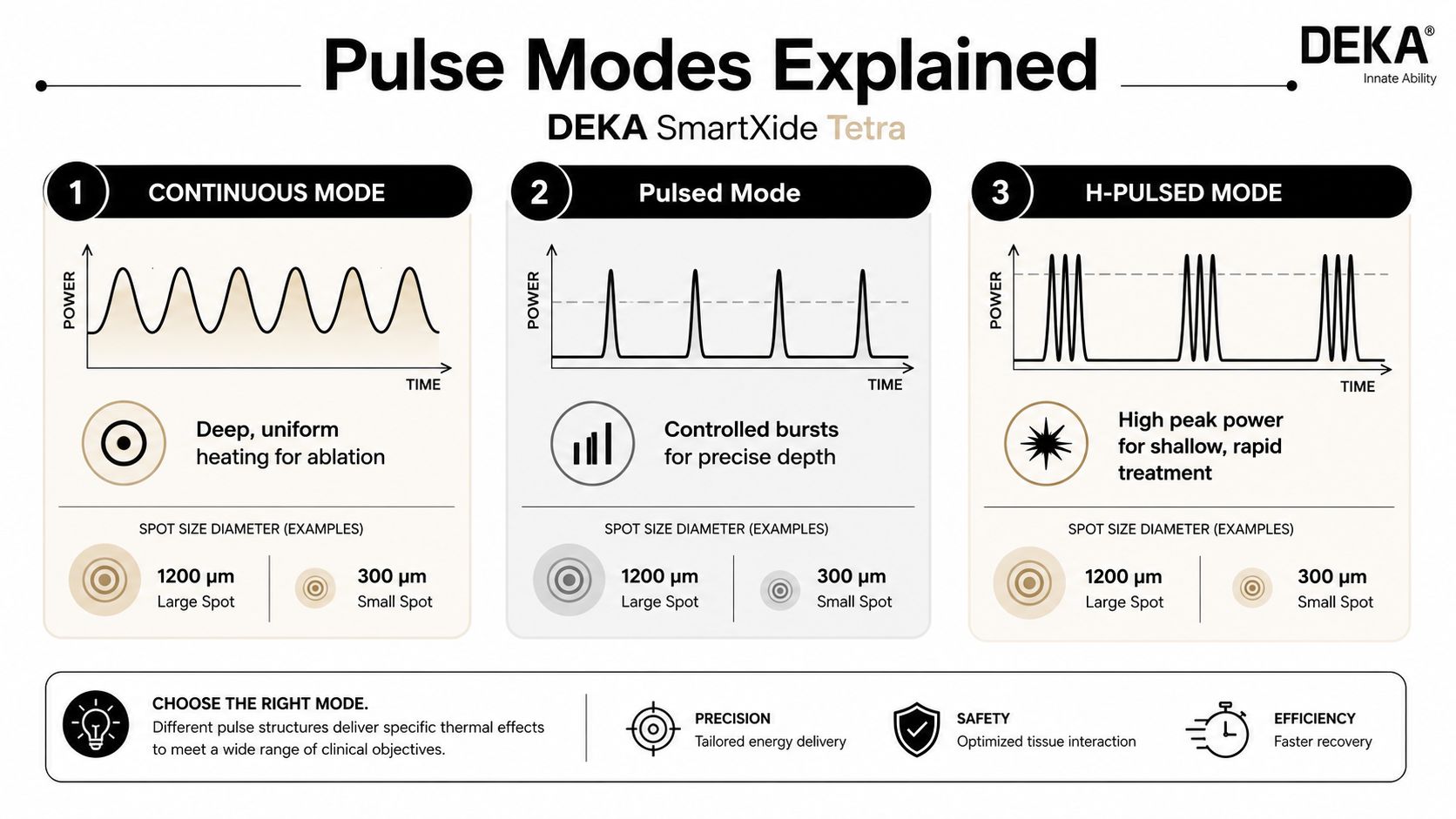
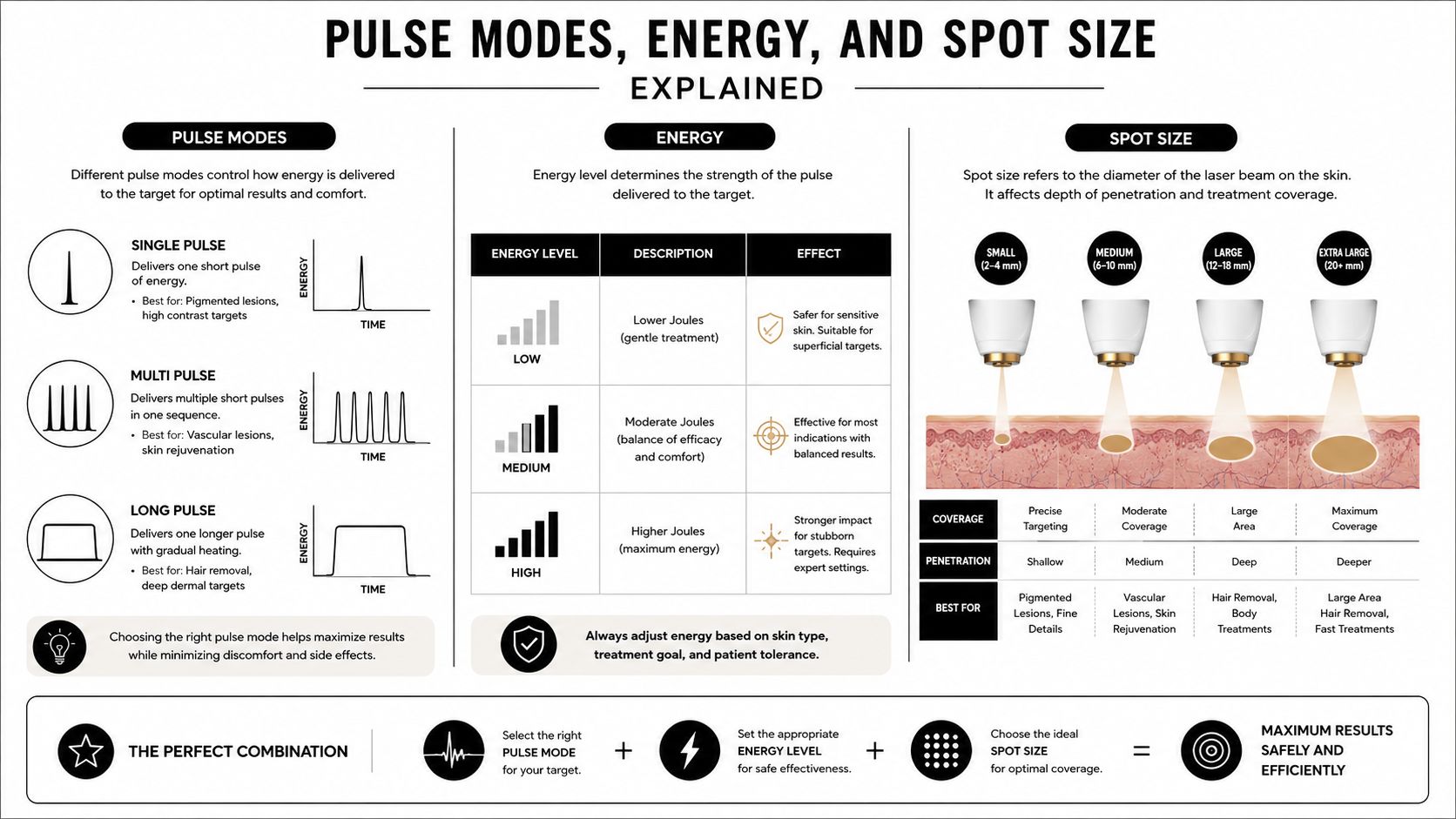
The SmartXide Tetra family includes multiple pulse modes, including SP (Smart Pulse), DP (DEKA Pulse), HP (High Pulse), and a standard continuous-wave mode (device listing). Those modes matter because they shape how quickly energy is delivered, how much peak power reaches tissue, and how that energy feels during treatment.
What changes between modes
A steady continuous-wave pass delivers uniform heating. Pulsed modes break the energy into bursts, which gives the operator more control over depth and tissue effect. HP, or High Pulse, is designed for high peak power over a shorter interaction time, which is why it's often used when a more superficial, faster pass is desired. The patient doesn't need to memorize the acronyms, but they do need to understand that these modes are not cosmetic flavor names. They're actual delivery patterns.
One listed configuration reports maximum power of 120 W, maximum energy of 30 mJ, pulse duration of 0.1 to 100 ms, and spot size of 120 to 4000 μm (market listing). Another CoolPeel-compatible listing reports energy output up to 250 mJ per pulse and a spot size range of 80 μm to 2000 μm (device listing). Those ranges tell you the platform can be dialed from delicate to much more assertive.
Clinical insight: spot size and pulse pattern often matter as much as the brand name. A smaller, more controlled pass can feel very different from a broader, denser treatment, even on the same platform.
Why this creates real-world confusion
Patients often hear “CoolPeel” and assume the experience must always be light. That's not accurate. The same machine can be used for a very restrained pass or a more intensive resurfacing session, and the downtime changes with the protocol. A provider who explains only the device name, without explaining settings, is leaving out the most important part of the decision.
That's why a detailed consultation should include the likely intensity, the expected surface response, and the reason those settings were chosen. If you ask about pulse mode, energy, and spot size, you'll usually get a much clearer answer about what kind of result the clinician is trying to produce. For a broader skin-health view, Longevity Medical Institute's dermatology and skin health resource fits naturally with that conversation.
What a Treatment Session Looks Like
A treatment visit starts before the laser is switched on. The clinician reviews your goals, checks for recent sun exposure or irritation, and decides whether your skin is better suited to a lighter pass or a more aggressive protocol. The team then usually cleans the skin, takes photos, and applies topical numbing if that is part of the clinic's process.
The in-room experience
Once the device is in use, most patients notice warmth, a prickly sensation, or a quick snapping feeling as the laser moves across the skin. The scanning pattern keeps that pass controlled, because the beam is rastered across the surface in a deliberate pattern rather than swept around by hand (FDA clearance summary). That controlled delivery is one reason many clinics use the platform for resurfacing.
The sensation is usually focused rather than overwhelming, especially when the area is small or the settings are conservative. The sound of the device is part of the experience too, and patients often want reassurance that it is expected, not a sign that something is going wrong. In practice, it tends to feel like a series of brief, intense moments instead of a constant burn.
A consultation with a physician-led aesthetic program should make the treatment flow easier to picture, and a short video overview of the overview of the dermatology program can help you understand how the visit is usually organized before you book.
Aftercare is part of the treatment
After the pass is complete, the skin may look pink, warm, or windburned. That appearance does not mean something has gone wrong, it means the tissue has been deliberately stimulated and now needs calm recovery support. Most clinics give straightforward instructions about cleansing, sun avoidance, and when to restart active skincare.
The more useful question is not only what the session feels like, but what the next few days are meant to look like. A good provider should be able to tell you what is normal, what is not, and when to call if something seems off. That kind of clarity often separates a thoughtful experience from a rushed one.
CoolPeel, Light Resurfacing, or Deep Resurfacing
The biggest source of confusion around this platform is the assumption that CoolPeel and fractional CO2 resurfacing mean the same thing. They don't. CoolPeel-style treatment is the lighter end of the spectrum, while deeper fractional passes are still very much part of the same device family, just delivered with different settings and different expectations.
Three practical intensity tiers
A light CoolPeel-style pass uses short pulses and a conservative thermal profile, which is why patients often like it for subtle brightening and texture refinement. A medium fractional setting pushes further and is better suited to more noticeable texture work, fine wrinkles, and surface irregularity. A deep resurfacing pass is aimed at stronger correction and a more visible remodeling response, with a recovery window that is longer because the tissue has more to heal.
The important point is that recovery is not really a marketing feature. It's a consequence of how much energy the skin receives and how densely it's treated. A patient who wants minimal disruption may prefer a light protocol, while someone seeking more dramatic resurfacing has to accept a more visible healing phase. Those are trade-offs, not flaws.
| Intensity Tier | What It's For | What It Usually Means Practically |
|---|---|---|
| CoolPeel-style | Subtle texture refinement and light brightening | Minimal downtime, lighter surface response |
| Light fractional | Mild lines, texture irregularity, modest resurfacing | More redness and peeling than CoolPeel-style treatment |
| Deep fractional | Stronger resurfacing and more aggressive correction | Longer recovery and a more obvious healing phase |
A patient should never be surprised by recovery. If the plan is deeper, the downtime has to be discussed before the first pulse is fired.
Some configurations pair CO2 energy with bipolar RF to increase dermal heating without necessarily increasing surface injury, but the practical point for patients is still the same, the protocol is what drives the outcome. If you hear “CoolPeel,” ask whether that's the actual treatment plan or just a familiar label being used loosely. The answer should be specific.
Clinical Indications and What They Address
A patient may hear one name, SmartXide Tetra, and assume it describes one narrow cosmetic procedure. In practice, the platform is built for several tissue goals, because a fractional CO2 laser can be set up to treat skin very differently depending on how much energy is delivered and how densely it is applied. The device is described in the GUDID JSON record as a general/multiple surgical carbon dioxide laser system that can incise, excise, ablate, vaporize, and coagulate soft tissue. That broader label helps explain why the same system can show up in different specialties and why patients should not assume it only addresses one aesthetic concern.
What different concerns mean in practice
For photoaging, the aim is usually to soften fine lines and improve the surface quality of the skin. For acne scars and some surgical scars, clinicians use the controlled injury pattern to encourage remodeling in uneven tissue, much like a skilled repair process after a worn surface has been gently reworked. For pigment irregularity, treatment may improve the look of mottled or rough surface tone, but it is not an eraser. Change tends to be gradual, and that is the right expectation for most patients.
The same platform can also be used for benign skin lesions and selected soft-tissue applications, depending on the clinician's specialty and the plan being followed. In some practices, it is part of gynecologic soft-tissue care rather than purely facial rejuvenation. That range makes the system versatile, and it is also why a careful consultation matters. A good conversation, like the kind encouraged by your personalized aesthetic journey led by a physician's expertise, starts with the tissue problem, not the device name.
| Common Clinical Indications for the DEKA SmartXide Tetra | Tissue Effect | Typical Recovery |
|---|---|---|
| Photoaging and fine lines | Surface renewal and collagen stimulation | Varies by settings |
| Acne scars and surgical scars | Remodeling of irregular tissue | Varies by depth of treatment |
| Uneven texture and enlarged pores | Controlled resurfacing of the skin surface | Usually lighter with conservative passes |
| Pigment irregularities | Surface refinement and tone improvement | Depends on treatment intensity |
| Benign lesions and soft-tissue applications | Incision, ablation, vaporization, or coagulation as indicated | Procedure-specific |
The clinical question is simple, even if the technology is not. What tissue are you trying to change, and how much healing time can you realistically accept? That framing keeps expectations grounded and prevents the common mistake of treating a tunable platform as if every setting produced the same result.
Candidacy, Safety, and Who Should Wait
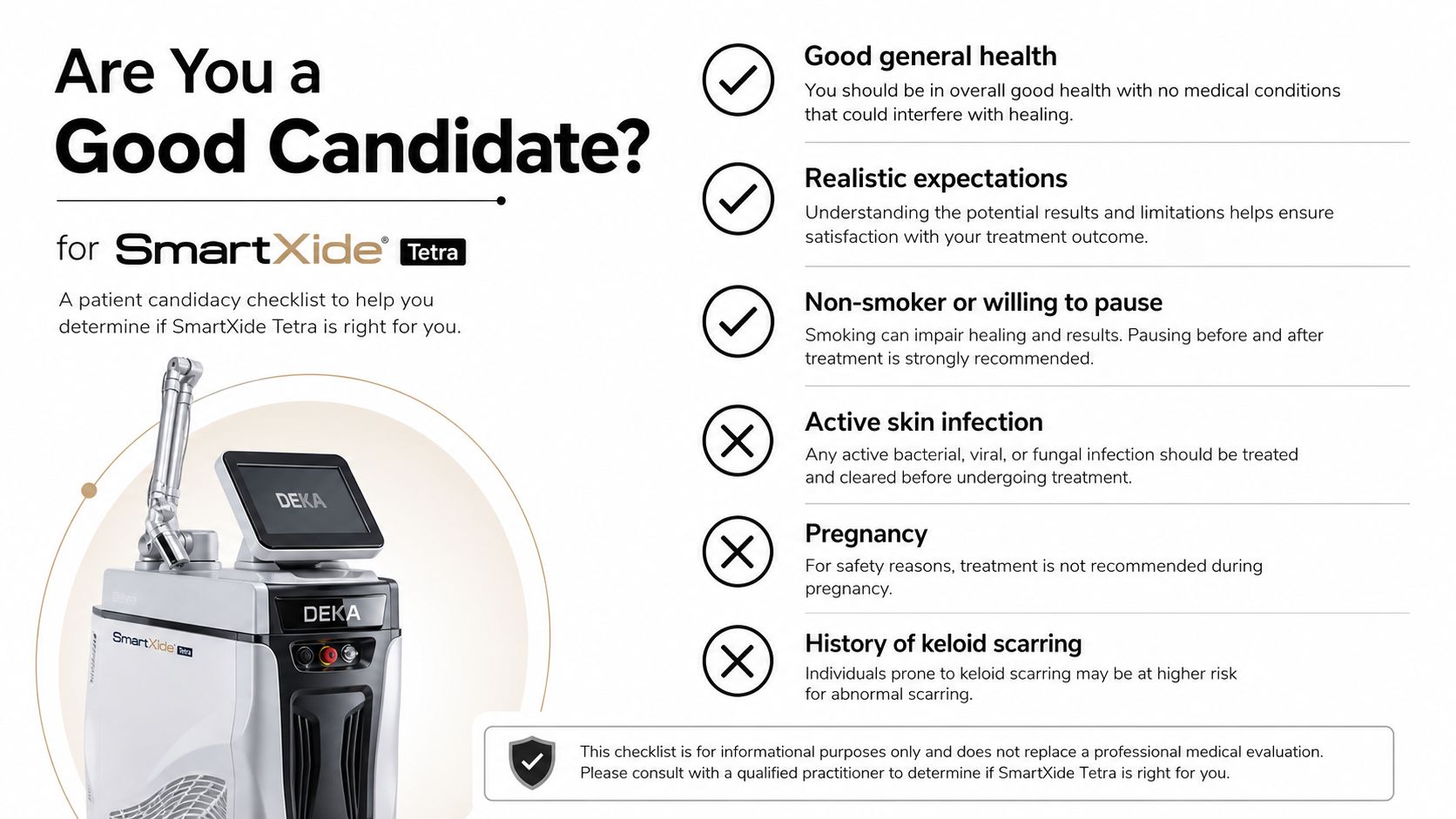
A good candidate is usually an adult in generally good health, with a skin concern that fits the platform's strengths and the patience to follow preparation and aftercare. Expectations matter as much as skin type or age. If someone wants a major change with no recovery time, no fractional CO2 laser is the right place to start.
When a provider should slow down
Active skin infection, pregnancy, and a history of abnormal scarring are common reasons to pause or reconsider treatment. Recent isotretinoin use and certain autoimmune or healing concerns also deserve a careful conversation, because the skin may not respond in a predictable way. These are not arbitrary hurdles. They are the questions that reduce avoidable risk.
The SMARTXIDE TETRA PRO has FDA-linked clearance dated March 12, 2024, and the device is described there as a 10,600 nm carbon dioxide laser with 40 W maximum power and substantial equivalence for its intended indications. That regulatory standing matters because it gives patients and clinics a clearer framework for accountability and appropriate use. A device with a documented record is easier to evaluate than one marketed loosely without a clear clinical trail.
If a provider glosses over contraindications, that is a reason to ask more questions, not fewer.
Patients often worry that being “turned away” means they are not a candidate forever. Usually it means the timing, the settings, or the treatment choice needs adjustment. A careful consultation should feel collaborative, not dismissive.
Why a Premium Clinic Chooses This Platform
Clinics choose a tunable CO2 system when they want one platform that can be adjusted for different skin goals instead of buying a tool that only does one thing. That matters in a physician-led setting because resurfacing, scar revision, and other soft-tissue applications don't all require the same intensity or recovery profile. A device family with documented variation in power and spot size gives the operator more room to match treatment to the patient, rather than forcing the patient into a one-size-fits-all protocol.
That logic also helps explain why clinics interested in a premium, education-first model invest in detailed consent conversations and precise treatment planning. Longevity Medical Institute's personalized aesthetic journey led by a physician's expertise fits that same philosophy.
The SmartXide Tetra's regulatory record, its multiple device variants, and its wide therapeutic range make it a reasonable choice for a clinic that values flexibility and documentation over hype. If you're evaluating a practice, ask whether they can explain not just what device they own, but how they decide between a light pass and a deeper one. That answer tells you a lot about their standard of care.
If you'd like a consultation that treats DEKA SmartXide Tetra as a medical decision rather than a buzzword, visit Longevity Medical Institute to explore physician-led aesthetic rejuvenation and ask which resurfacing approach fits your skin, schedule, and recovery tolerance. The team can walk you through settings, candidacy, and aftercare so you know exactly what to expect before you commit to treatment.