

Hormone Replacement Therapy: A Clinician's Guide 2026
You're 51, your sleep is lighter, your training recovery is slower, and the hot flashes are starting to show up at the worst possible moments, during meetings, in traffic, or right after you finally fall asleep. For many people, that's the moment Hormone Replacement Therapy becomes less of a theory and more of a practical question: what's happening, what can be improved, and what's the safest way to do it?
Hormone Replacement Therapy is best understood as restoring chemical signaling, not chasing youth or taking a shortcut. Hormones act like a conversation between glands and organs, and when that conversation gets quieter or more erratic, the body often shows it first through sleep disruption, mood changes, hot flashes, libido shifts, and slower recovery. The goal of treatment is usually not to push levels to some mythical peak, but to bring signaling back into a range that supports daily function, symptom relief, and long-term safety.

What Hormone Replacement Therapy Actually Does
A useful way to think about Hormone Replacement Therapy is as a medical translation service. Your body used to make certain hormones in amounts and patterns that felt normal for you, then age, menopause, surgery, or other changes altered that pattern. Treatment tries to restore enough signaling to reduce symptoms and protect tissues that depend on hormonal input.
From symptom relief to signal restoration
That distinction matters because Hormone Replacement Therapy is not the same thing as anabolic steroid use, “anti-aging” marketing, or unmonitored biohacking. It's a prescribed therapy, which means the right dose, route, and follow-up matter as much as the molecule itself. In practice, clinicians are asking a simple question, what signal is missing, and what is the safest way to restore it?
The body rarely loses all hormonal function at once. More often, one or two systems become out of sync first, sleep gets lighter, body temperature regulation becomes unstable, vaginal tissues become drier, or training tolerance drops. That's why a thoughtful evaluation starts with patterns, not with a single lab result.
Practical rule: If a treatment plan is not tied to a clear symptom pattern, the dose can drift into guesswork.
Hormone Replacement Therapy is also not one product. It's a category of care that may involve different hormones, different delivery methods, and different targets depending on whether the patient has a uterus, still ovulates, is postmenopausal, or has another endocrine issue. The best version of treatment aims for functional balance, not hormone maximalism.
Why this feels different from a typical prescription
People often expect hormone therapy to behave like an antibiotic or a blood pressure pill, one drug, one outcome. It doesn't work that way. Hormones affect multiple tissues at once, so good care has to account for sleep, bone, vascular risk, mood, cognition, and reproductive anatomy together.
That's why the first consultation should feel more like a precision assessment than a quick refill. If the plan is done well, the patient leaves with a clear explanation of what's being replaced, why it's being replaced, and how success will be monitored.
The Hormones Clinicians Commonly Replace
The four hormone families most often discussed in Hormone Replacement Therapy are estrogen, progesterone, testosterone, and thyroid hormones. Each one does something different, and each one creates a different symptom picture when it's too low, poorly timed, or mismatched to the body's needs.
Estrogen, progesterone, and testosterone
Estrogen is often the hormone people notice first because it affects hot flashes, bone, skin, vaginal tissue, and brain function. When estrogen signaling falls, people can feel the change in dryness, sleep disruption, and body composition before they can measure it on a lab report. Progesterone works more like a stabilizer, especially for sleep and uterine protection. In women with a uterus, it becomes a safety issue as much as a symptom issue.
Testosterone is not just a male hormone. In women, it often shows up clinically through libido, drive, and recovery, though the decision to use it is individualized and should be tied to symptoms, not just curiosity. If a patient feels flat, less resilient, or less interested in sex, clinicians may consider whether testosterone belongs in the broader picture.
Thyroid as the metabolic thermostat
Thyroid hormone deserves separate attention because it influences the pace of nearly every cell. When thyroid signaling is off, people may describe cold intolerance, constipation, fatigue, brain fog, or sluggish training recovery. It's one of the clearest examples of why hormone care can't be reduced to a single number.
A good clinician never treats labs in isolation. A result only becomes meaningful when it matches the patient's actual experience, because hormone values can look “acceptable” on paper while the person still feels distinctly unwell. That's the reason symptom history, menstrual history, medications, and physical changes all matter before any prescription is written.
For a more structured hormone-focused clinical pathway, see the Hormone Optimization service overview.
Bioidentical vs Synthetic and How the Route Changes Risk
Patients usually think they're choosing between “natural” and “synthetic,” but that's not the most useful split. The more important decisions are molecular identity and route of delivery, because a hormone's path through the body changes what risks it carries.
What bioidentical actually means
Bioidentical means the molecule is structurally identical to what the body makes. That does not automatically mean it's safer, weaker, or more effective. Safety depends on dose, route, the presence or absence of a uterus, and the patient's baseline cardiovascular and clotting risk.
Synthetic hormones are not automatically wrong, and bioidentical hormones are not automatically perfect. The right choice depends on clinical goals. A patient who needs symptom relief and uterine protection may need a completely different combination than a patient without a uterus who mainly needs estrogen support.
Clinical anchor: Match the molecule to the deficiency, then match the route to the risk profile.
Oral versus transdermal, and why the liver matters
The route often matters more than the label. Oral hormones pass through the liver first, while transdermal forms such as patches, gels, and sprays enter circulation differently. That distinction helps explain why the same estradiol can have different clotting implications depending on how it's taken.
Here's a practical comparison.
| Route | Examples | Clinical Notes |
|---|---|---|
| Oral | tablets, capsules | Passes through the liver first, so clotting and vascular trade-offs matter more |
| Transdermal | patch, gel, spray | Bypasses first-pass liver metabolism, often preferred when clot risk is a concern |
| Vaginal | creams, tablets, rings | Used mainly for local symptoms rather than full-body replacement |
| Pellet | subcutaneous implant | Long-acting, but harder to adjust once placed |
| Injection | injectable forms | Can produce sharper peaks and requires careful supervision |
| Topical cream | compounded or commercial | Depends heavily on formulation and consistency |
For women with a uterus, estrogen plus a progestogen is usually needed to reduce uterine-cancer risk. Estrogen-only therapy is generally reserved for women who don't have a uterus, where that protective layer is no longer necessary. That single anatomical detail changes the entire treatment plan.
Diagnostic Workup Before Starting HRT
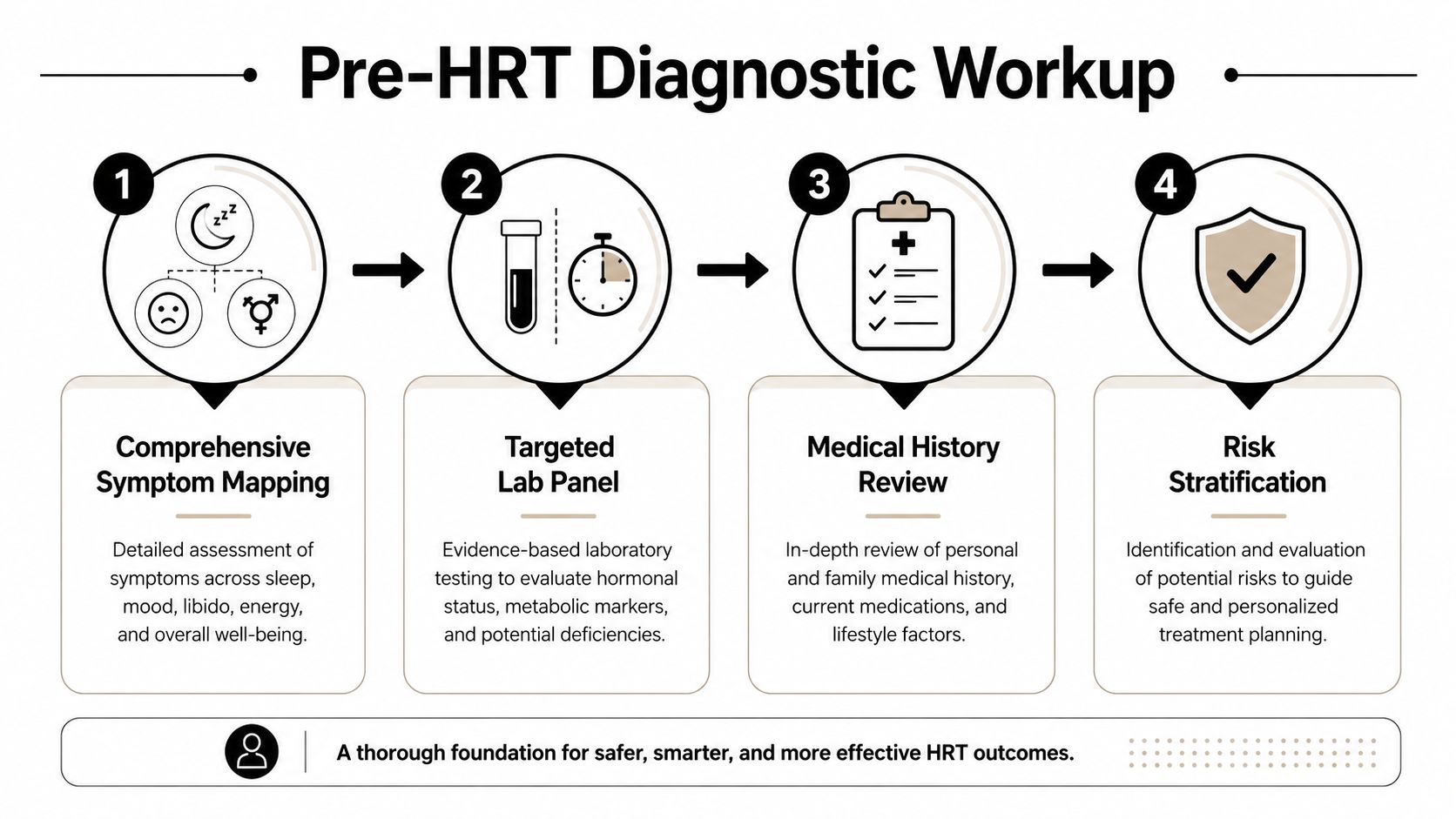
A responsible pre-treatment workup starts with symptoms, not with a prescription pad. Sleep, cycles, libido, mood, cognition, body composition, and exercise recovery all help map what kind of hormonal shift may be present.
What a careful evaluation actually includes
In a longevity-focused setting, the workup often includes a broad in-house lab panel of approximately 120 biomarkers across sex hormones, thyroid function, metabolic markers, inflammatory markers, and nutrient status. That gives a clinician a much wider view than a one-off estrogen result.
Imaging and cardiac screening matter too, especially when there's any concern about silent vascular disease, structural issues, or unrelated findings that would change the risk-benefit conversation. An AI-integrated full-body MRI can help identify problems that don't show up in symptoms alone, and an advanced heart evaluation can add another layer of safety before treatment begins.
The point is not to over-test for its own sake. The point is to avoid starting a hormone plan in someone who needs a different priority, such as vascular workup, cancer evaluation, or another endocrine pathway.
Red flags that change the plan
A few findings move a patient out of the standard pathway fast. Active unexplained bleeding, a recent clotting event, uncontrolled medical disease, or concerning imaging findings all need attention before hormone therapy can be considered.
The same idea applies to the clinical history. A medication list, surgical history, migraine history, smoking status, and family history all shape the risk profile. A hormone plan that ignores those details isn't personalized, it's incomplete.
For readers who want to see how broad testing fits into the care model, the in-house clinical lab overview shows how biomarker-driven care is built into the workup.
Risks, Contraindications, and the Timing Question
Hormone safety often causes the most confusion, because public discussion has swung between fear and easy reassurance. The full picture sits between those extremes, and it starts with asking who is being treated, for what reason, and at what point in the menopause transition.
Timing matters more than a yes or no label
The best-known shift in prescribing came after the 2002 Women's Health Initiative era, which changed how clinicians thought about Hormone Therapy around the world. Later analyses summarized in Circulation reported a meta-analysis of 19 randomized controlled trials involving 40,410 postmenopausal women and found no significant increase in all-cause mortality, cardiovascular death, or myocardial infarction with Hormone Therapy overall. Those same analyses also showed that starting earlier, especially in women younger than 60 or within 10 years of menopause onset, is associated with a lower cardiovascular risk profile for symptom treatment (Circulation review).
That is the timing hypothesis in plain language. Starting close to menopause is not the same as starting much later, because the vascular environment changes over time. A later review of the Women's Health Initiative data also showed why trade-offs have to be weighed carefully, because for 10,000 healthy postmenopausal women using HRT for one year, there were 7 more coronary artery disease events, 8 more invasive breast cancers, 8 more strokes, and 8 more pulmonary emboli, but also 6 fewer colorectal cancers and 5 fewer hip fractures (WHI review).
What risks look like in real terms
Route matters. Oral estrogen increases venous thromboembolism risk about 1.3-fold, oral progestogens about 2.4-fold, and both estrogen-only and combined therapy increase stroke risk by about 1.3-fold. A U.K. safety update also reported an overall CHD odds ratio of 0.99, which means randomized trials did not show a measurable coronary heart disease benefit from HRT (UK safety update).
For patients, the practical takeaway is simple. HRT can be reasonable for the right person, but it does not override vascular biology, clotting risk, or cancer history.
Absolute contraindications still matter. Active thromboembolic disease, a recent major cardiovascular event, active breast cancer, unexplained vaginal bleeding, and active liver disease require direct medical evaluation before treatment. Recent boxed-warning changes also show that the field is still refining how risk is communicated, which is why informed consent needs to be clear, specific, and free of scare language.
For patients building care across borders, this risk review should happen in the same setting that coordinates labs, imaging, and treatment planning. The integrative anti-aging programs in Los Cabos are one example of how that kind of coordination can be organized.
How HRT Fits Inside a Regenerative Longevity Program
Hormone treatment works best when it's part of a larger plan, not a standalone fix. If sleep is poor, recovery is slow, inflammation is high, or metabolism is under strain, the endocrine system has to be addressed alongside the rest of the physiology.
Why hormonal balance supports other therapies
In a regenerative program, hormonal signaling helps create the metabolic conditions that other therapies rely on. That includes allogeneic stem cell protocols derived from placental, Wharton's jelly, adipose, endometrial, and dental pulp sources, as well as peptide protocols, targeted IV and nutraceutical infusions, hyperbaric oxygen sessions, the Longevity Recharge Station, and Trifusion EBOO with UV and PBM. When the body is under-treated hormonally, those inputs may still be useful, but the response is often less efficient.
This is also where sleep medicine, advanced cardiac evaluation, and MRI-based imaging become part of the same conversation. If a patient has untreated sleep fragmentation, hidden vascular disease, or an unexpected structural issue, hormone dosing should be adjusted with that information in mind. A therapy stack only works well when the data beneath it is solid.
Sequencing matters for medical tourists too
For patients traveling for care, sequencing becomes practical as well as clinical. A clinic that can evaluate labs, imaging, sleep, cardiovascular risk, and treatment planning under one roof reduces the chance that a patient flies home with half an answer. The integrative anti-aging program framework is one example of how those pieces can be assembled into a single pathway.
Longevity Medical Institute is one option that places hormone optimization within a wider regenerative and diagnostic setting, rather than treating it as a disconnected prescription service. That matters when the goal is not just symptom relief, but a plan that can evolve as the patient's biology changes.
Monitoring, Dosing Principles, and Adjusting Over Time
A good Hormone Replacement Therapy plan isn't fixed. It's reviewed, adjusted, and sometimes stopped if the risk picture changes.
What follow-up should look like
At minimum, follow-up should include symptom check-ins, repeat labs, and a conversation about side effects or changing health history. If a patient feels better but develops new bleeding, a migraine pattern change, or a vascular concern, the plan needs to change with it.
Dose titration works better than rigid dosing because response varies so much between people. The goal isn't to chase a perfect lab number in isolation, it's to line up lab values and symptom relief together. That balance is especially important across perimenopause, post-menopause, and hormone loss after surgery.
How programs adapt over time
Some patients need shorter adjustments during the first months, while others stay on therapy longer with periodic reassessment. If symptoms return, side effects appear, or a new diagnosis changes the risk profile, the plan should be revisited rather than defended out of habit.
For patients tracking broader longevity data, the longevity biomarkers resource is useful context for how repeat measurements fit into long-term care.
In a medical tourism setting, this follow-up can be coordinated with concierge travel, on-site diagnostics, and a return-home plan so the patient isn't left to guess what comes next.
Medical Tourist Considerations and Patient FAQs
Patients traveling from the U.S. or Canada usually want to know three things first, how long they'll need to stay, how much can be done in one visit, and what happens after they go home. The cleanest approach is to pair the diagnostic workup with the treatment discussion, then leave with a clear monitoring plan and local follow-up instructions.
Travel, timing, and continuity
For patients considering care in San José del Cabo, the logistics matter as much as the medical plan. The medical tourism stem cell treatments Cabo page gives a sense of how travel coordination can be integrated with physician evaluation, diagnostics, and follow-up. Refrigerated or injectable medications need specific handling, so the travel plan should account for storage, timing, and whether the medication can be administered on site instead of transported.
Useful question to ask: Can the labs, imaging, and hormone consult be sequenced so I only travel once for the initial workup?
FAQ
How soon will I feel better? Some people notice sleep or hot flashes improving early, while other changes take longer. The exact pace depends on the hormone, the dose, and how long the body has been out of balance.
Is testosterone ever appropriate for women? Sometimes, yes, but it should be tied to symptoms and a clinician's judgment, not used casually. Libido, drive, and recovery are the usual clinical reasons it comes up.
What happens if I want to stop? The plan should be tapered or discontinued under supervision, with symptoms and labs followed during the transition. Stopping is part of responsible care, not a failure.
Can I travel with refrigerated or injectable medication? Yes, but only with a clear storage and transport plan. That's one reason coordinated medical tourism is safer than trying to improvise after the prescription is written.
If you're considering Hormone Replacement Therapy and want a plan that includes symptom review, advanced diagnostics, and the option to coordinate it with regenerative and longevity care, visit Longevity Medical Institute to explore a physician-guided consultation. Our team can help you review whether hormone optimization belongs in a broader program that also includes imaging, lab testing, and practical travel support.