

Longevity Biomarkers: Uncover Your Biological Age
Individuals who seek out longevity care already sense a quiet mismatch. Their calendar age may say one thing, while their energy, recovery, sleep, focus, or body composition suggest something else entirely. They exercise, eat well, and stay engaged with their health, yet they still wonder whether they're aging as well as they could be.
That's where longevity biomarkers become useful. They give structure to what you feel but can't see. Instead of relying on guesswork, they let a physician examine how your metabolism, cardiovascular risk, inflammatory state, and biological aging patterns are behaving beneath the surface.
For a health-conscious patient, this isn't about chasing trivia on a lab report. It's about building an internal map. The right biomarkers can show whether your current routine is protecting long-term health, whether hidden risks are developing early, and whether a treatment plan is changing your trajectory in a meaningful way.
Your Chronological Age vs Your Biological Age
A patient may be in their fifties, still active, traveling often, working at a high level, and doing many things right. On paper, they look healthy. Yet one person recovers quickly from exercise, sleeps soundly, and maintains steady cognition, while another feels inflamed, tired, and metabolically less resilient. Their birth certificates match their chronological age. Their biology does not.
That difference is the heart of longevity medicine. Chronological age is the number of years you've been alive. Biological age reflects how your tissues and systems are functioning in real time. It's the difference between a luxury car's model year and the actual condition of the engine, brakes, and electronics after years on the road.
For many people, the first sign that this matters is not a diagnosis. It's a pattern. Belly fat becomes harder to lose. Morning glucose drifts upward. Recovery after travel takes longer. Focus softens. Skin, joints, sleep, and stamina all start sending subtle messages.
Your body is always reporting on itself. Longevity biomarkers help us read that report before disease becomes the headline.
This is why advanced diagnostics feel enabling rather than alarming. They move the conversation away from “Are you sick yet?” and toward “How well are you aging, and what can we improve now?” If you're considering a deeper assessment, comprehensive longevity diagnostics can help translate broad wellness goals into measurable findings.
Understanding Longevity Biomarkers
Standard lab work often looks for obvious abnormalities. Longevity biomarkers do something more refined. They help clinicians evaluate the efficiency, strain, and aging pace of important body systems before a problem becomes clinically obvious.
The Formula 1 dashboard analogy
Think of routine blood work as the warning lights on a car dashboard. They're useful, but they often activate when something is already off. Longevity biomarkers are closer to the live telemetry from a Formula 1 race car. They show temperature shifts, system stress, fuel efficiency, and performance trends while the vehicle is still moving.
That distinction matters. A standard panel may tell you whether a value has crossed a conventional threshold. A longevity-focused panel asks a more ambitious question: how is this body performing over time, and where is aging pressure accumulating?
Why they matter in preventive medicine
The body rarely changes in isolation. Metabolism influences inflammation. Inflammation influences vascular health. Vascular health influences cognition, exercise tolerance, and long-term organ resilience. Biomarkers help connect those dots.
An advanced longevity program uses biomarkers in several ways:
To detect early drift before symptoms become loud
To personalize interventions rather than relying on generic wellness advice
To monitor response so a plan can be adjusted with precision
To clarify priorities when many health inputs compete for attention
Patients often get confused, assuming a biomarker is either “good” or “bad.” In practice, the deeper value is context. A single number may be informative, but a pattern across several markers is far more revealing. The goal isn't to collect data for its own sake. It's to identify which levers are most likely to improve healthspan.
The Key Types of Longevity Biomarkers
Some biomarkers track metabolism. Others track cardiovascular risk, inflammation, or the pace of biological aging itself. The most useful interpretation comes from understanding what category a marker belongs to and what kind of question it answers.
Epigenetic clocks
Among the most advanced tools in this field are epigenetic clocks, which analyze DNA methylation patterns. These clocks don't just estimate age. Certain models examine how fast aging is occurring.
According to evidence-based insights on longevity science biomarkers, DunedinPACE is considered the current gold standard for biological age assessment because it measures the pace of aging rather than offering a static age estimate. That distinction is clinically important. Two people of the same chronological age can age at very different rates.
The same source notes that DunedinPACE correlates with markers such as hs-CRP and HbA1c, which helps clinicians build a broader picture that links epigenetic, inflammatory, and metabolic aging signals.
Clinical perspective: An epigenetic clock is less like a portrait and more like a speedometer. It helps reveal whether your physiology is aging at a calm cruising speed or moving faster than expected.
A related research perspective is also worth noting. In longevity trials, methylation-derived biomarkers such as GDF15 are used as validated surrogate endpoints to provide earlier insight into whether an intervention may support healthspan or lifespan, as described in this peer-reviewed review on biomarkers in longevity trials.
Metabolic biomarkers
Metabolic health remains one of the most actionable areas in longevity care. HbA1c is a central example. It reflects average blood sugar over the prior two to three months, and an optimal range below 5.4% (36 mmol/mol) for longevity-focused care.
The same source explains why HbA1c matters so much. High levels are strongly associated with cardiovascular disease, dementia, kidney disease, and accelerated biological aging. It also notes that this marker is especially useful because it reflects metabolic health, which drives several major chronic disease pathways.
Cardiovascular particle markers
ApoB is one of the most important longevity biomarkers for cardiovascular risk assessment. Rather than measuring only how much cholesterol is present, it counts the number of atherogenic particles. That's why it can be more informative than standard LDL cholesterol alone.
According to Superpower's guide to longevity biomarkers, the optimal range for ApoB is below 80 mg/dL, with an ideal target below 60 mg/dL. The same source describes ApoB as one of the most reliable predictors of cardiovascular risk and notes that tracking ApoB over time is more useful than relying on a single measurement.
Patients who want a deeper look at this category often benefit from exploring advanced cardiovascular biomarker testing.
Inflammatory, imaging, and systems-level markers
Not every important longevity biomarker is a single blood value.
Some fall into broader categories:
Inflammatory markers help identify whether the immune system is running in a chronically activated state.
Imaging biomarkers reveal structural changes in the brain, heart, vessels, spine, and organs that blood tests cannot show.
Composite indices combine multiple signals into a more integrated interpretation of biological aging or disease risk.
Functional biomarker patterns look at how markers interact rather than treating each one as a separate silo.
Telomere length, proteomic markers, and metabolomic signatures are also part of the broader conversation around aging biology. In clinical practice, however, the most useful biomarkers are the ones that can be interpreted in context and followed over time.
Overview of Key Longevity Biomarker Categories
| Biomarker Category | What It Measures | Primary Longevity Insight |
|---|---|---|
| Epigenetic clocks | DNA methylation patterns and aging pace | How quickly biological aging is occurring |
| Metabolic markers | Glucose regulation and metabolic control | Whether metabolic health is supporting or accelerating aging |
| Cardiovascular particle markers | Atherogenic particle burden | A more precise view of vascular risk |
| Inflammatory markers | Immune activation patterns | Whether chronic inflammation may be affecting long-term resilience |
| Imaging biomarkers | Structural and organ-level changes | Hidden risk or early tissue changes not visible on blood work |
| Composite indices | Multiple biomarker domains together | A higher-level view of biological age and systems health |
How Biomarker Testing and Interpretation Works
The testing process is usually simpler than patients expect. The complexity is in the interpretation, not the sample collection.
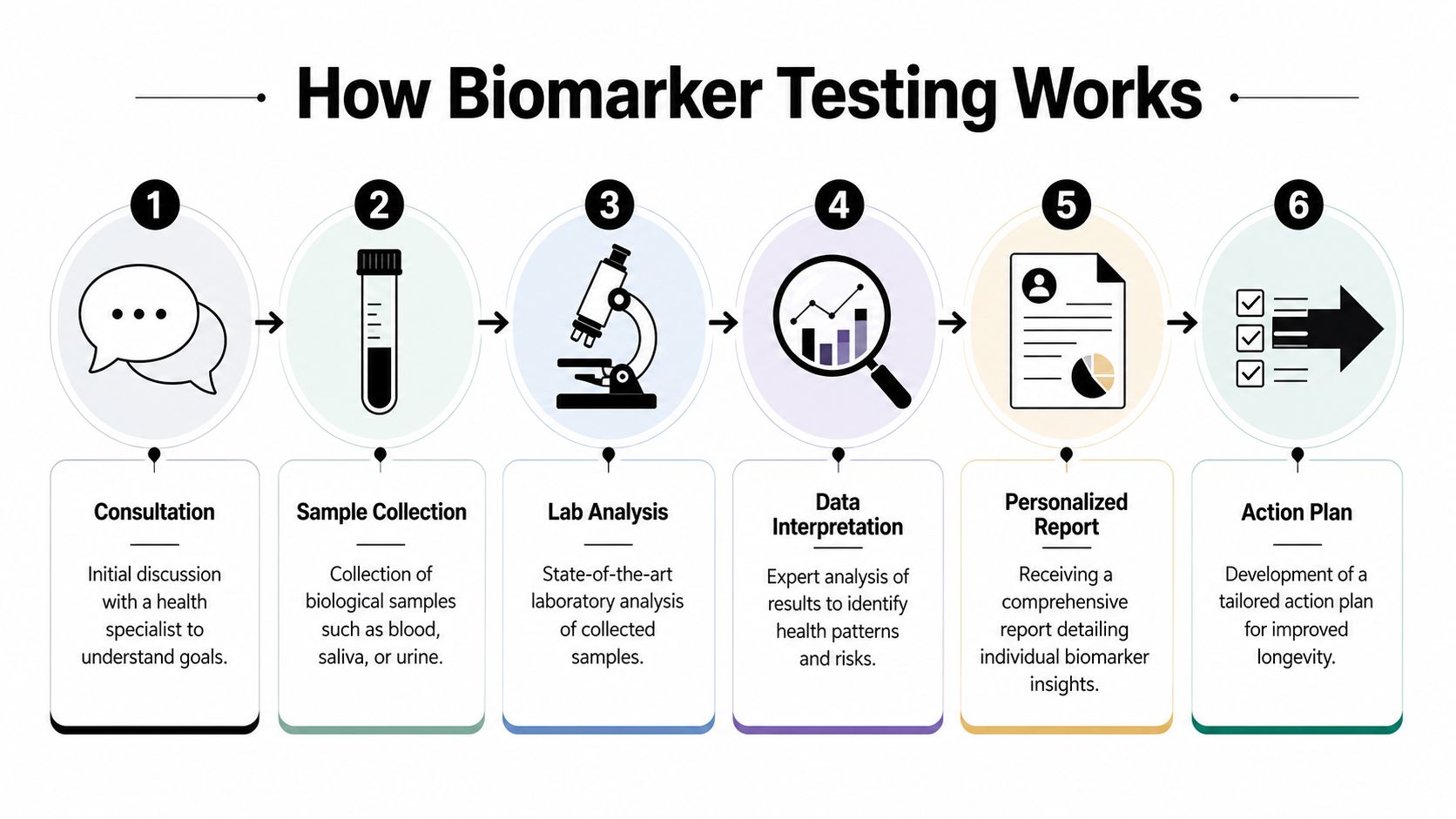
Collection is straightforward
Biomarker data can come from several places. Blood testing is the most familiar route, but clinicians may also use saliva-based testing and imaging, depending on the question being asked.
Most patients do well when they think about testing in three layers:
Basic collection through blood or other biological samples
Analytical review to identify relevant patterns
Clinical interpretation that turns results into decisions
If you want a clearer sense of how broad lab testing differs from more strategic analysis, this comparison of a lab panel versus function health interpretation is a useful reference point.
The meaning is in the pattern
A biomarker should rarely be judged as a pass-fail score. One HbA1c value, one ApoB result, or one inflammatory reading can be informative, but the larger question is whether the trend is improving, worsening, or staying stagnant.
This is especially important because some validated longevity markers are explicitly designed for trend analysis. The HbA1c source above recommends annual testing as part of a full panel, with retesting every 3 to 6 months if someone is actively working to improve levels, and again after 8 to 12 weeks following a meaningful lifestyle or supplement intervention. That model reflects a core principle of longevity medicine. We don't just measure status. We monitor direction.
A sophisticated biomarker program doesn't ask, “Is this number normal?” It asks, “What story do these results tell together, and where is that story heading?”
The Clinical Power and Scientific Limitations
Longevity biomarkers are powerful because they help physicians act earlier, personalize care more intelligently, and verify whether a plan is working. They can sharpen the difference between generic wellness advice and a targeted medical strategy.
Where they shine
In practice, biomarkers are most useful when they answer one of three questions:
What risk is gradually emerging
Which intervention deserves priority
Is the current plan changing the trajectory
That matters because many patients look well until you examine the deeper layers. Someone may have acceptable routine labs yet still show meaningful metabolic strain, increased particle-related cardiovascular risk, or signs that their biological aging pace isn't where it should be.
Where caution is needed
This field is also evolving. Not every marker has the same level of validation. Not every abnormal result has a direct treatment pathway. And not every direct-to-consumer report offers interpretation that's clinically mature enough to guide decisions.
A common mistake is treating a biomarker report like a personality test. Patients see a highlighted value and assume it defines their future. It doesn't. Biomarkers are tools, not verdicts.
Another limitation is context. A number can't interpret itself. A physician has to consider symptoms, imaging, medical history, medications, family history, and lifestyle. That's why safety, method, and transparent clinical oversight matter so much. Patients who value that approach often appreciate a framework built on safety and transparency in clinical care.
The best use of longevity biomarkers is neither fear nor fascination. It's disciplined decision-making.
From Data to Action at the Longevity Medical Institute
The most meaningful longevity care happens when diagnostics and treatment planning live in the same ecosystem. Data becomes far more useful when it can be translated into a concrete care pathway rather than filed away as interesting information.
Building the full picture
At Longevity Medical Institute, that process begins with layered diagnostics rather than a single test. The clinic's ecosystem includes an in-house clinical lab measuring 140 biomarkers, AI-integrated full body MRI, and advanced heart evaluation. Each tool answers a different question.
Blood biomarkers show physiology in motion. MRI can reveal structural patterns that labs cannot. Cardiac assessment adds another level of risk clarification. Together, these create a more complete map of the patient sitting in front of the physician.
Biomarkers become stronger when cross-checked against anatomy and function. A metabolic signal on a lab panel may gain urgency when paired with imaging findings. An inflammatory pattern may carry more weight if a patient's recovery, pain profile, or cardiovascular data supports the same story.
Turning findings into a program
Once that profile is assembled, the next step is interpretation across systems. A patient with metabolic dysfunction may need a plan centered on nutrition strategy, exercise dosing, sleep repair, peptides, nutraceutical support, and structured retesting. A patient with inflammatory burden may need a broader regenerative approach.
In some cases, increased inflammatory patterns and tissue-level concerns may lead a clinical team to consider therapies such as allogeneic stem cell therapy, peptide protocols, hyperbaric oxygen therapy, or Trifusion EBOO with UV and PBM. It's worth being precise here. The focus is on allogeneic care, not autologous approaches. The biotechnology lab produces five different stem cell types, including placental, Wharton's jelly, adipose, endometrial, and dental pulp.
That integrated model is easier to understand when you see it in motion:
Why integration changes the patient experience
Patients often arrive with folders full of disconnected data. A cholesterol panel from one office. An MRI from another. A supplement plan from somewhere else. No one has translated it into a single narrative.
An integrated institute can do that more effectively because the diagnostics, medical review, and regenerative options are already connected. If a patient's profile suggests metabolic inefficiency, cardiovascular particle risk, recovery impairment, and inflammatory stress, the care plan can reflect those relationships rather than treating each issue as unrelated.
This is also where advanced longevity care becomes tangible. Biomarkers stop being abstract numbers. They become decision tools that guide what to watch, what to repeat, what to treat, and what to leave alone.
Begin Your Journey to a Longer Healthspan
Longevity biomarkers give patients a more honest view of aging. Not a dramatic one. Not a fatalistic one. A useful one.
They help answer the question many health-savvy adults are already asking: am I getting older, or am I aging well? The answer rarely lives in a single test. It emerges from patterns across metabolism, cardiovascular risk, inflammation, and biological aging pace, interpreted by clinicians who know how to connect them.
If you're ready to move from curiosity to clarity, tools that bring your data into one place can help. A connected view, such as the Longevity Patient App and its 360-degree health view, makes long-term tracking more practical and more meaningful.
The goal isn't to collect more numbers. It's to use the right numbers to shape a better future.
A personalized longevity program starts with understanding how your body is aging today. If you'd like to explore advanced diagnostics, physician-led interpretation, and regenerative treatment pathways, schedule a consultation with Longevity Medical Institute.
Published at Treatments and Resources at Longevity Medical Institute
Author
Dr. Kirk Sanford, DC, Founder & CEO, Longevity Medical Institute. Dr. Sanford focuses on patient education in regenerative and longevity medicine, translating complex therapies into clear, practical guidance for patients.
Medical Review
Dr. Félix Porras, MD, Medical Director, Longevity Medical Institute. Dr. Porras provides clinical oversight and medical review to help ensure accuracy, safety context, and alignment with current standards of care.
Last Reviewed: June 26, 2026
Short Disclaimer
This information is for educational purposes only and is not medical advice. It does not replace an evaluation by a qualified healthcare professional. For personalized guidance, please schedule a consultation.