

Hyperbaric Oxygen Chamber: A Guide to Healing & Longevity
You may be looking at a hyperbaric oxygen chamber from two very different starting points.
One person arrives after hearing about wound healing, radiation injury, or recovery from a serious medical event. Another arrives from the longevity world, asking whether oxygen under pressure can support resilience, energy, recovery, and tissue repair. Both are asking the same deeper question: Can we create a better internal environment for healing?
That's the right question. A hyperbaric oxygen chamber isn't just a place where you breathe more oxygen. It's a controlled clinical environment that changes how oxygen moves through the body. That distinction matters. It's why hyperbaric oxygen therapy has long been used in hospital medicine, and it's also why it attracts so much interest in regenerative care.
The confusion usually starts with the word “oxygen.” A common misconception is that the treatment is just a stronger version of an oxygen mask. It isn't. The chamber's pressure is what changes the equation. Pressure alters oxygen delivery in ways ordinary breathing cannot, and that's the part patients deserve to understand clearly.
An Introduction to Advanced Oxygen Therapy
Healing depends on more than fixing damage after it appears. In many cases, the body needs the right terrain to repair well. If you think of recovery like restoring a high-value property, oxygen is not the paint on the walls. It's the electrical system, plumbing, and structural access that allows every other repair team to do its job.
That's why a hyperbaric oxygen chamber is so interesting in both medicine and regenerative care. It creates a temporary internal environment where oxygen availability changes dramatically. When tissue has been stressed, inflamed, poorly perfused, or slow to recover, that shift can matter.
A patient-friendly way to think about it is this: normal breathing delivers what the body can manage under everyday conditions. Hyperbaric therapy creates a more favorable setting, one designed for repair rather than maintenance. That's the difference between idling and rebuilding.
In advanced recovery medicine, the question isn't only “What therapy are we using?” It's also “Have we prepared the body to respond well to that therapy?”
This is one reason hyperbaric treatment often appears alongside broader regenerative strategies. It doesn't replace nutrition, sleep, circulation, rehabilitation, or physician-guided treatment. It helps support the biological conditions those systems rely on. For readers interested in the broader logic of regenerative care, this overview of the power of regeneration is a useful companion.
The modern medical view is precise. Hyperbaric oxygen therapy is a pressure-based treatment, not a casual wellness add-on. That precision is what makes it credible, and it's also what helps patients make better decisions.
How Pressurized Oxygen Unlocks Cellular Healing
The simplest explanation starts with a familiar example. Open a carbonated bottle and you see gas escaping. While the bottle is sealed under pressure, more gas stays dissolved in the liquid. Hyperbaric oxygen therapy works on a related principle.
When a patient enters a chamber and breathes 96%+ oxygen at 1.5 to 3 atmospheres absolute, or about 1.5 to 3 times normal air pressure, oxygen dissolves into blood plasma, the lymphatic system, and tissues far beyond what room air can achieve, as described in this review of hyperbaric oxygen therapy. That pressure is the key mechanism. Without pressure, you're not getting the same biological effect.
Why pressure changes everything
Under ordinary conditions, most oxygen is carried by red blood cells. That system is efficient, but it has limits. Hyperbaric treatment increases the oxygen dissolved in plasma, the liquid portion of blood. That matters because plasma can move into areas where delivery may be less efficient or where tissue demand is high.
For patients, the practical takeaway is straightforward:
More dissolved oxygen: Pressure helps oxygen move beyond its usual limits.
Better reach: Tissues under stress may receive oxygen support they couldn't access as easily under normal conditions.
A stronger repair environment: Cells involved in recovery function best when oxygen delivery is adequate.
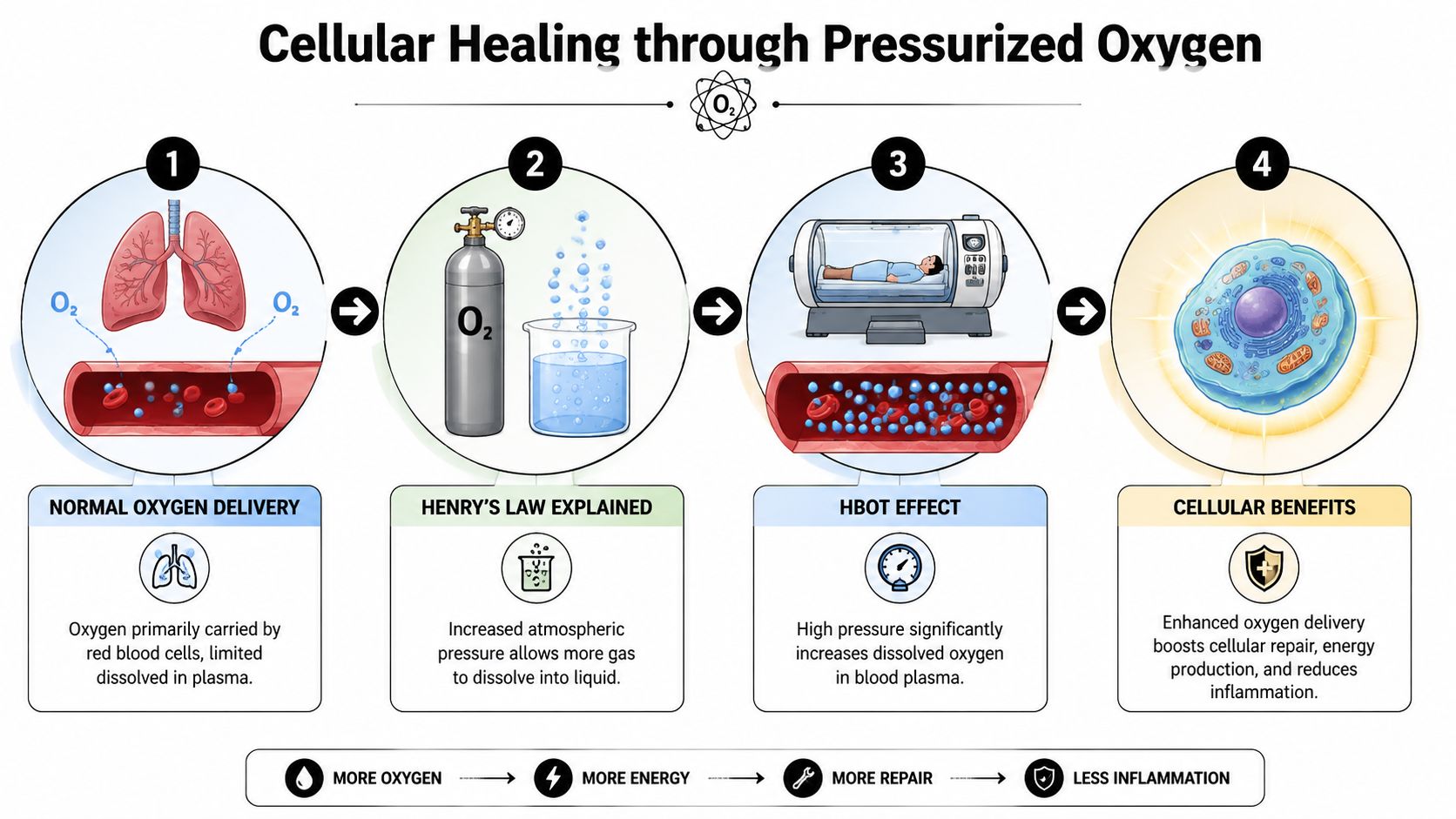
The result isn't magic. It's physiology under different conditions.
What cells do with that oxygen
Cells use oxygen to generate energy, coordinate repair, and support normal immune behavior. In plain language, oxygen helps tissues do their work. When delivery improves, the body may be better positioned to manage inflammation, support healing responses, and recover from stress.
Readers often misinterpret the information. They hear a long list of possible benefits and assume the chamber itself “heals everything.” A better way to think about it is that the chamber changes the supply conditions. The body still has to do the healing.
Practical rule: A hyperbaric oxygen chamber doesn't replace biology. It improves the environment biology works within.
That idea aligns well with how the body already renews itself. If you want a useful lens on how ongoing tissue turnover supports recovery, this article on the body creating 250 billion new cells every day helps connect the concept.
Understanding Monoplace and Multiplace Chambers
Patients often ask a very practical question first: What kind of chamber will I be in? That's worth answering clearly, because chamber design affects comfort, workflow, and how oxygen is delivered.
The two main clinical formats are monoplace and multiplace chambers. A monoplace chamber is built for one patient. A multiplace chamber accommodates multiple patients at once. Neither format is automatically “better” in every setting. The right choice depends on the medical program, staffing model, and the patient experience being created.
How the experience differs
In a monoplace chamber, the patient is typically alone inside the chamber. That often feels more private and can be more straightforward for a single-person treatment experience. In a multiplace chamber, patients sit or rest together in a room-like pressurized environment, according to health facility guidance for hyperbaric units.
Hyperbaric Chambers at a Glance
| Feature | Monoplace Chamber | Multiplace Chamber |
|---|---|---|
| Capacity | One patient | Multiple patients |
| Environment | More private, enclosed personal setting | Shared, room-like clinical setting |
| Oxygen delivery | Chamber-based therapeutic setup varies by system | Pure oxygen typically delivered through mask or hood |
| Staff interaction | Continuous monitoring from outside the chamber | Direct in-chamber workflow may be part of operations |
| Patient feel | Quiet, individual experience | More like a supervised treatment suite |
For many patients, this comparison reduces anxiety immediately. They aren't just asking about engineering. They're asking what treatment will feel like, how supervised it is, and whether they'll be comfortable.
If you'd like to see a clinical overview of chamber benefits in a visual format, this video resource on the benefits of hyperbaric oxygen chambers offers helpful context.
Clinical Indications vs Wellness Applications
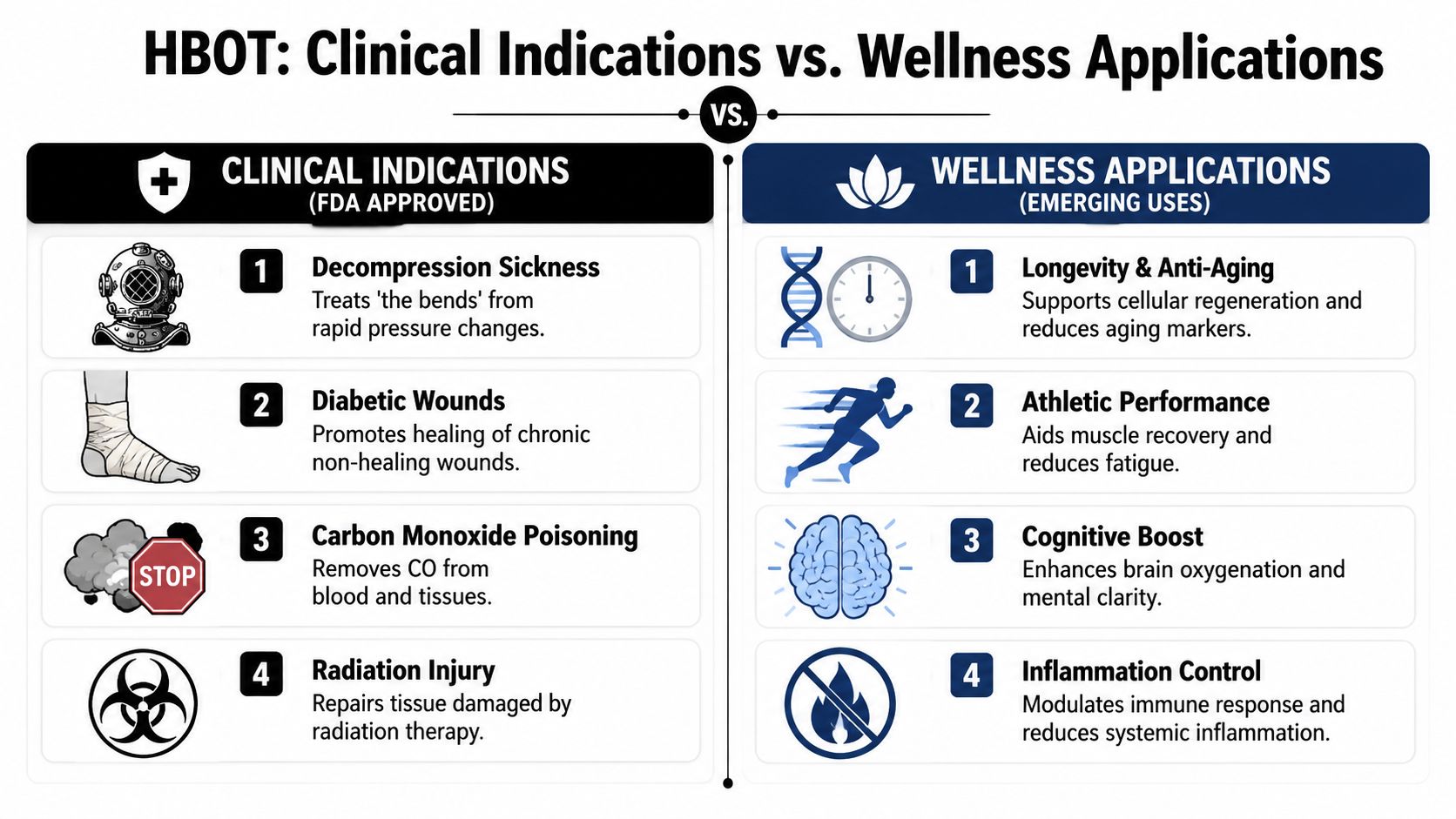
The public conversation often becomes muddy. A hyperbaric oxygen chamber is used in recognized medical care, but it's also marketed in broad wellness language. Those aren't the same thing, and patients deserve a clean distinction.
Mainstream medical guidance recognizes specific uses for hyperbaric oxygen therapy. Those include conditions such as decompression sickness, carbon monoxide poisoning, and diabetic lower-extremity wounds, among other defined indications, as outlined by UT Southwestern's overview of hyperbaric oxygen therapy.
What are the benefits of hyperbaric oxygen therapy?
With the proper dose, hyperbaric oxygen therapy has the ability to boost certain cellular processes and pathways within the body – similar to the way a drug activates or suppresses individual genes.
Some benefits of hyperbaric oxygen therapy include:
Improving circulation, inducing development of new blood vessels
Increasing the number and activity of stem cells, which are crucial for the body to repair damaged tissues
Improving the production of collagen, a protein that provides the structure for connective tissues, including skin, tendons, cartilage, and bone
Controlling inflammation and reducing swelling
Reducing scarring and hardening in tissues that have been exposed to radiation or multiple surgeries
Limiting damage that occurs when blood flow returns to areas that lost blood supply (ischemia and reperfusion injury)
Speeding up the elimination of carbon monoxide
Enhancing the activity of the immune system (which protects your body from infections), increasing the effectiveness of some antibiotics, inhibiting the growth of certain bacteria, and deactivating their toxins
Dissolving air or gas bubbles trapped in blood vessels or tissues
What medical indications tell us
Approved indications show us something important. They confirm that oxygen under pressure can matter profoundly when tissues are compromised. In medicine, that may mean an injury from pressure change, toxin exposure, difficult wound healing, radiation-related tissue injury, or certain infections.
Those uses establish hyperbaric therapy as a real clinical tool.
Why regenerative medicine still cares
The longevity and recovery world is interested in mechanism. If a therapy helps support oxygen delivery, tissue repair conditions, and inflammatory balance in a medical context, clinicians naturally ask whether those same mechanisms might support broader recovery goals in selected patients.
That doesn't mean every wellness claim is proven. It means the biological logic is understandable.
A careful way to frame it is this:
Medical HBOT: Used for defined indications with established standards.
Regenerative use: Considered as an adjunct to support recovery conditions, not as a blanket cure.
Wellness marketing: Often much broader than what mainstream guidance formally recognizes.
The same physiological mechanisms can be relevant in more than one setting. What changes is the clinical question being asked, and the strength of evidence behind that question.
That distinction is the mark of an honest conversation. It allows patients to appreciate why a therapy may be medically established in one context while still being exploratory, supportive, or adjunctive in another.
Synergy with Stem Cell and Regenerative Therapies
When hyperbaric therapy is used thoughtfully, its value often lies in combination rather than isolation. In regenerative medicine, we're not only asking whether a therapy has an effect. We're asking whether it helps the body become a better host for repair.
The most useful analogy is agriculture. If regenerative therapies are the seeds, then tissue environment is the soil. You can plant into depleted ground, but you shouldn't expect the same response you'd see in well-prepared, well-oxygenated, better-supported terrain.
Preparing the biological terrain
Inflamed, poorly perfused, or metabolically stressed tissues don't always respond optimally to advanced care. Hyperbaric support may help improve the treatment environment by encouraging better oxygen availability in tissue and supporting the physiology of recovery. That's why many clinicians view it as a preparatory or complementary therapy.
In practical terms, this can matter before or around regenerative protocols when the goal is to support:
Tissue readiness: Better oxygen conditions may help the body receive therapy more effectively.
Recovery signaling: Repair processes rely on a favorable local environment.
Program integration: Hyperbaric treatment can sit alongside physical medicine, nutrition, sleep support, and physician-guided regenerative planning.
Why this matters in allogeneic cell-based care
For patients exploring advanced regenerative protocols, it helps to understand that outcomes rarely depend on a single intervention. They depend on sequencing, timing, inflammation control, circulation, and the quality of the tissue environment.
That's why hyperbaric therapy is often discussed alongside allogeneic regenerative approaches. The logic is not that oxygen “replaces” cell therapy. The logic is that tissue conditions influence how well regenerative signaling can occur. For patients interested in that broader framework, this page on stem cell therapy for anti-aging and longevity gives additional context.
At Longevity Medical Institute, hyperbaric oxygen therapy is one component that can be integrated into broader physician-directed regenerative programs when clinically appropriate. That kind of integration matters because well-designed care isn't built by stacking trendy treatments. It's built by matching therapies to biology.
Healthy soil doesn't guarantee growth. Poor soil makes growth harder. The same principle applies to regenerative medicine.
Your Hyperbaric Oxygen Therapy Session Explained
For most patients, anxiety drops quickly once they know what the session feels like. The experience is usually calm, structured, and far less mysterious than the name suggests.
A clinically supervised protocol matters because the treatment isn't just “time in a chamber.” As explained by EyeWiki's discussion of hyperbaric oxygen therapy, the proper dose depends on pressure, timing, and frequency, with therapy typically delivered at 1.5 to 3 ATA. That's why serious programs focus on protocol, not novelty.
Before the session
You'll typically check in, review any immediate concerns with the clinical team, and receive instructions on preparation. The team may guide you on what to wear and what shouldn't go into the chamber. This is a safety-based environment, so details that seem minor to a patient are handled deliberately by staff.
A good session starts before pressurization. Patients who know how to equalize ear pressure and what sensations to expect usually feel much more comfortable.
Common preparation points include:
Clothing guidance: Wear what the clinical team approves.
Personal items: Don't assume electronics or outside products can enter the chamber.
Comfort planning: Use the restroom beforehand and settle in mentally for a restful treatment period.
During pressurization
As the chamber pressure rises, the main sensation is usually in the ears, similar to what some people notice during air travel or elevation change. Swallowing, yawning, or using other clinician-taught techniques can help equalize pressure.
The treatment itself is often quiet. Many patients rest, listen to approved audio, or relax. Nothing dramatic needs to happen for the therapy to be doing its work.
If you can understand the feeling of airplane ear, you already understand the main pressure sensation most patients ask about.
Here's a short visual overview of the experience:
After the session
Once the chamber returns to normal pressure, most patients transition back to their day without difficulty. Some feel relaxed. Others feel mentally clear or pleasantly tired. What matters most is consistency and protocol adherence when a physician has recommended a course of care.
A strong hyperbaric program doesn't treat the chamber like a standalone gadget. It treats it like a dosed medical modality with a purpose, sequence, and rationale.
Frequently Asked Questions About HBOT
Is hyperbaric oxygen therapy painful
Usually, no. The treatment itself is generally not described as painful. The most noticeable sensation is pressure change in the ears during compression and decompression. Once patients understand how to clear their ears and what to expect, the session often feels calm and uneventful.
How long does a real treatment course take
This is one of the most important planning questions. A typical clinical course can involve sessions lasting from 1-2 hours, given 3-5 five days a week, often for 5-20 or more treatments, according to Michigan Medicine's explanation of receiving hyperbaric oxygen chamber therapy. For medical tourists, that means logistics matter. Travel dates, lodging, scheduling flexibility, and physician follow-up all need to be planned in advance.
Is a medical hyperbaric oxygen chamber the same as a mild or soft chamber
Not necessarily. Patients often group these together, but they shouldn't. Clinical hyperbaric care is defined by protocol, supervision, and the treatment conditions prescribed. If you're comparing options, don't just ask what the chamber looks like. Ask what pressure is used, how oxygen is delivered, who supervises the treatment, and what the therapeutic goal is.
Who should ask more questions before treatment
Anyone with a complex medical history should have a proper clinical evaluation before starting. That includes people with current symptoms, active medical conditions, or uncertainty about whether hyperbaric therapy fits their goals. General curiosity is fine. Self-prescribing isn't.
For broader planning questions, travel details, and common patient concerns, the clinic FAQ page can help you prepare for a more informed consultation.
If you're considering a hyperbaric oxygen chamber as part of a recovery, regenerative, or longevity strategy, the next step is a personalized clinical review with Longevity Medical Institute. The right protocol depends on your goals, health history, and whether hyperbaric therapy should stand alone or be integrated with broader care.
Author
Dr. Kirk Sanford, DC, Founder & CEO, Longevity Medical Institute. Dr. Sanford focuses on patient education in regenerative and longevity medicine, translating complex therapies into clear, practical guidance for patients.
Medical Review
Dr. Félix Porras, MD, Medical Director, Longevity Medical Institute. Dr. Porras provides clinical oversight and medical review to help ensure accuracy, safety context, and alignment with current standards of care.
Last Reviewed: June 2, 2026
Short Disclaimer
This information is for educational purposes only and is not medical advice. It does not replace an evaluation by a qualified healthcare professional. For personalized guidance, please schedule a consultation.