

InBody 970: Precision Body Composition for Longevity
You eat well. You train consistently. Your clothes may fit differently, your strength may be improving, and yet the number on the scale barely moves. For many health-conscious adults, that's the moment when motivation starts to wobble.
The problem usually isn't effort. It's measurement.
A standard scale reports total weight. It doesn't tell you whether that weight is coming from skeletal muscle, body fat, or shifts in body water. It also can't show whether your progress is moving in a direction that supports long-term mobility, metabolic health, and healthy aging. That's where the InBody 970 becomes useful. It turns a vague question, "Am I getting healthier?" into a more precise one, "What is my body made of, and how is it changing over time?"
Beyond the Scale The Future of Body Composition
Many patients first look for body composition testing after they hit a plateau. They may be exercising more, eating with discipline, and still feel stuck because the scale doesn't reflect what they're doing right. In reality, body weight alone often misses the most meaningful changes.
If you gain muscle while reducing fat, the scale may show little change. If inflammation or fluid retention rises, weight can increase even when nutrition is on track. If you lose weight rapidly, the scale won't warn you when some of that change may be muscle rather than fat.
Why composition matters more than weight
Body composition gives context to body weight. It separates the body into meaningful compartments so a clinician can look beyond a single number.
That matters because two people can weigh the same and have very different health profiles. One may carry more muscle and less visceral fat. The other may have less muscle, more central fat storage, and poorer hydration balance. A bathroom scale treats them as identical. A detailed body composition test doesn't.
For readers who want a simple primer before diving deeper, Trim's guide to body composition gives a helpful overview of why composition often matters more than weight alone.
What patients are often missing
An advanced analysis helps answer questions that a scale cannot:
Are you losing fat or losing muscle
Is your trunk storing more metabolically concerning fat
Is one leg carrying less lean tissue than the other after injury
Is fluid balance shifting in a way that may reflect stress or inflammation
Do your results align with other advanced screening findings
Those questions become even more relevant when body composition is interpreted alongside imaging. For example, a patient may pair composition testing with AI-enhanced whole-body MRI for longevity care to see not only how much they weigh, but how their tissues, organs, and risk patterns fit together.
The scale is a rough summary. Body composition is the blueprint.
The InBody 970 sits in that more useful category. It isn't just a "body fat scale." In a clinical setting, it's better understood as a fast, noninvasive diagnostic tool that helps visualize muscle, fat, water balance, and markers tied to cellular health. For patients focused on longevity, that's a more intelligent starting point than body weight alone.
How the InBody 970 Works: A Look Inside the Technology
A patient steps onto the platform after months of training and cleaner nutrition. Their weight has barely changed. On a standard scale, that can feel confusing. On the InBody 970, the question becomes more precise. Where is water shifting, where is muscle being maintained, and where is metabolically risky fat being stored?
The InBody 970 uses Multi-Frequency Bioelectrical Impedance Analysis, or MFBIA, to answer those questions. It sends very small electrical currents through the body and measures how different tissues respond. The current passes more easily through water-rich tissue, such as muscle, than through fat tissue, which contains less water.
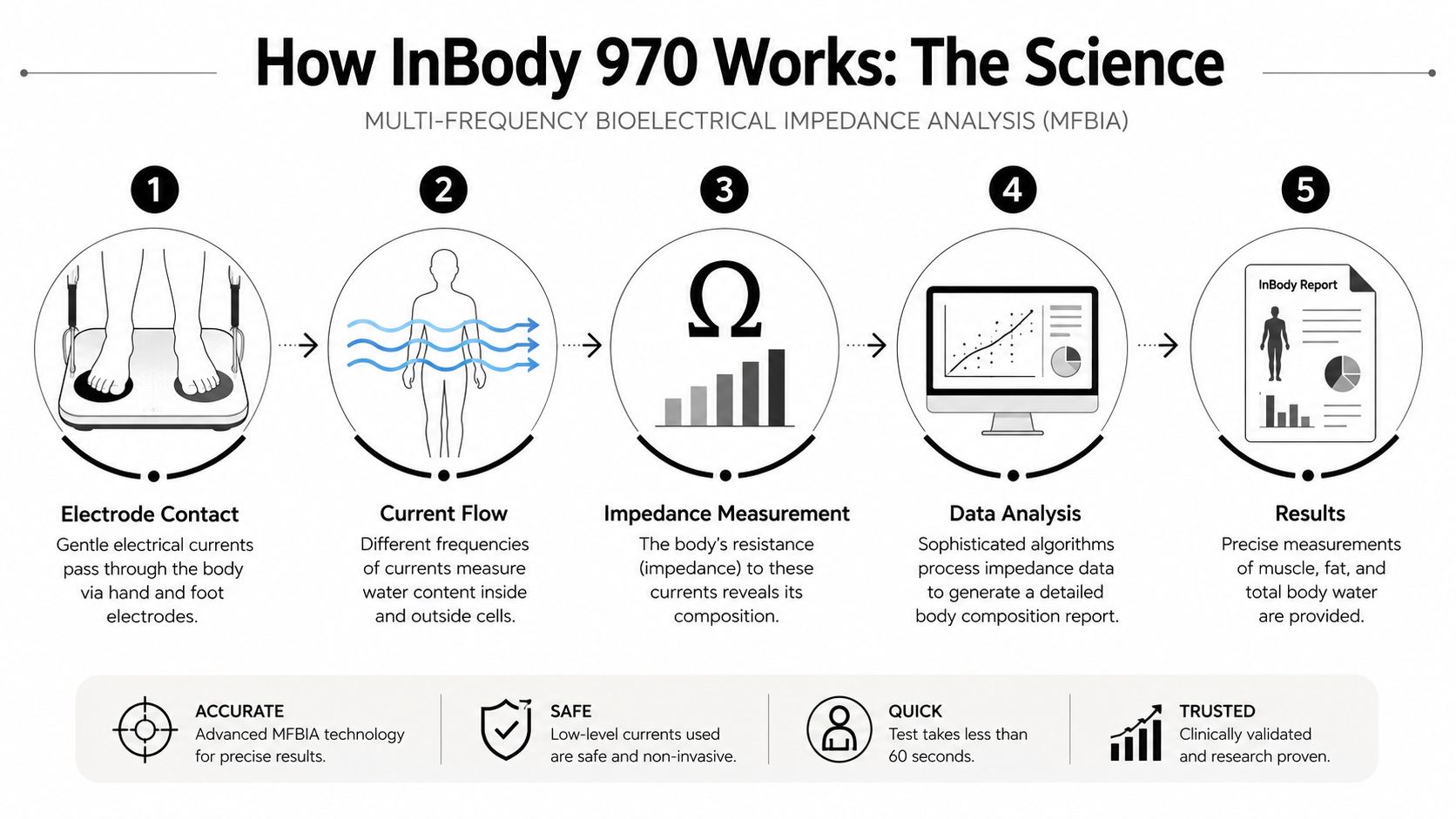
A simple way to picture the technology
The measurement works like sending a signal through different types of terrain. A path with more water allows the signal to move differently than a path with less water. By mapping those resistance patterns, the device estimates how much of the body is lean tissue, fat tissue, and body water.
That matters for more than physique tracking. Because hydration and tissue quality influence these readings, the test offers a practical window into cellular health. In longevity care, that helps clinicians look beyond total body weight and study whether the body is holding onto metabolically active tissue or drifting toward patterns linked with frailty, inflammation, or central fat gain.
The system measures across six distinct frequencies and five body segments, specifically the right arm, left arm, trunk, right leg, and left leg, and delivers results in 60 seconds.
Why segmental and multi-frequency testing matters
Consumer bathroom devices often treat the body as one simple circuit. The InBody 970 measures the body in sections, which is closer to how a clinician evaluates a patient. One leg can lose lean tissue after injury. The trunk can carry more fat than the limbs suggest. Fluid can shift in ways that change the interpretation of progress.
Multiple frequencies add another layer. Lower and higher frequencies move through body water differently, which helps refine the estimate of intracellular and extracellular fluid. That is one reason this tool fits so well into longevity medicine. It gives a more detailed view of whether a patient's body composition changes reflect stronger tissue quality or a less favorable pattern hidden beneath a stable weight.
What the patient experience is like
The test is brief and comfortable. You stand on the device, hold the hand electrodes, remain still, and let the system complete the reading. There is no radiation, which makes repeat testing practical when the goal is to follow trends over time rather than rely on a single snapshot.
The InBody 970 is also designed for a wide range of patients, including children, older adults, and people with very different body sizes, as noted earlier.
Practical rule: The best body composition test is one you can repeat under consistent conditions, because changes over time often matter more than one isolated result.
That repeatability makes the scan useful in a broader clinical framework. A physician can compare body composition trends with biomarkers from an in-house clinical laboratory and build a more complete picture of metabolic health, recovery, and long-term healthspan risk.
Key Metrics for Healthspan and Longevity
A patient can keep the same weight for years and still move in two very different biological directions. One path preserves muscle, keeps visceral fat in check, and supports healthy cellular hydration. The other slowly trades muscle for fat, shifts fluid balance, and reduces tissue quality. The scale misses that distinction. The InBody 970 helps make it visible.

For patients focused on healthspan, the value of these measurements is not cosmetic. They help clinicians examine how well the body is built, where risk is stored, and whether cells appear well supported or under strain. That is a very different question from "What do I weigh?"
Visceral fat and why location matters
Fat location often matters more than fat total. Visceral fat sits around the organs, where it is more closely tied to metabolic risk than the fat just under the skin. A person may look lean in clothing and still carry an unfavorable amount centrally. Another may weigh more overall but have a less concerning distribution.
This is why waist shape, visceral fat area, and related patterning deserve attention. They add context that a body mass index checker cannot provide on its own. BMI can flag size. It cannot show where fat is stored.
Skeletal muscle mass and segmental lean analysis
Muscle is your metabolic engine and your physical reserve. It supports glucose handling, balance, strength, recovery from illness, and independence with age.
Segmental lean analysis adds another layer. Instead of treating the body as one lump sum, it measures the arms, legs, and trunk separately, much like reviewing a house room by room instead of only checking the total square footage. That matters in clinical care because asymmetry can point to disuse, injury, neurologic change, or early frailty before the problem becomes obvious in daily life.
Patterns like these can guide decisions in several settings:
Healthy aging: Lower muscle reserves can raise concern for sarcopenia risk.
Rehabilitation: One limb may lag after pain, surgery, or reduced use.
Performance care: Side to side imbalances can be addressed before they affect movement quality.
ECW/TBW ratio and fluid balance
The ECW/TBW ratio compares extracellular water with total body water. In simpler terms, it shows how body water is distributed, not just how much water is present.
Patients often find this confusing because hydration is usually discussed as a single number. Clinically, distribution is often more informative. Water inside cells and water outside cells do not mean the same thing. A shift in that ratio can add useful context when a patient has swelling, poor recovery, systemic stress, or a pattern that suggests tissue strain.
This is one reason the InBody 970 reaches beyond the idea of a body fat scale. It begins to sketch a map of tissue condition.
Phase angle and cellular health
Phase angle is one of the most interesting outputs for longevity medicine because it points attention toward cellular health. In practical terms, clinicians use it as part of the picture of cell membrane integrity and hydration status.
A helpful comparison is fruit. A fresh grape has tension, structure, and intact boundaries. A raisin has lost that internal balance. Human tissue is far more complex, of course, but the principle is similar. Phase angle gives a window into whether cells appear more resilient and well maintained or less so.
No single value should be read in isolation. But when phase angle is reviewed alongside muscle mass, visceral fat, and fluid distribution, it can help shape a more forward-looking plan aimed at preserving function over time.
The goal is not simply to weigh less. The goal is to maintain stronger tissue, healthier fat distribution, and better cellular resilience as the years pass.
Other outputs patients often ask about
Several additional metrics help complete the picture:
| Metric | What it helps show |
|---|---|
| Body fat percentage | How much of total body weight comes from fat mass |
| Fat mass index | Fat mass interpreted relative to height, which adds context beyond total weight |
| Skeletal muscle mass index | Muscle relative to body size |
| Basal metabolic rate | An estimate used in broader nutrition and energy planning |
| Segmental fat analysis | Whether fat is distributed evenly or concentrated in specific regions |
Clinical value comes from reading these markers together. A patient with acceptable body fat percentage but high visceral fat raises a different concern than someone with low visceral fat but declining muscle and a less favorable phase angle. For a wider framework on how clinicians follow aging risk over time, it helps to review longevity biomarkers used in personalized preventive care alongside body composition.
InBody 970 vs DEXA BMI and Other Methods
Patients often ask a practical question. If the InBody 970 is so detailed, how does it compare with other familiar methods?
The short answer is that each method has strengths, and each has limitations. The right tool depends on what you're trying to learn, how often you need to repeat testing, and whether you need only body fat estimates or a broader picture that includes hydration and cellular health markers.
BMI is fast but shallow
Body mass index, or BMI, is widely used because it's simple. It considers height and weight, but it doesn't distinguish muscle from fat. A muscular person and a sedentary person can fall into the same BMI category.
DEXA offers useful reference value
DEXA is often treated as a reference method for body composition. It can provide detailed regional data, and many patients know it from bone density testing. But it doesn't provide everything an InBody 970 does. The InBody 970 includes outputs such as phase angle and detailed body water analysis, which DEXA does not provide in the same way.
There is also an important nuance clinicians should discuss openly. A study indexed on PubMed noted that the InBody 970 tends to underestimate body fat percentage by approximately 3.1% compared to DXA standards, and that these deviations are largest among normal-weight individuals.
That doesn't make the device unusable. It means the results should be interpreted with clinical judgment, especially when tracking subtle changes in patients who don't obviously appear overweight.
A balanced comparison
| Method | Main advantage | Main limitation |
|---|---|---|
| BMI | Easy and accessible | Doesn't separate fat from muscle |
| Weight scale | Quick trend check | No insight into composition |
| DEXA | Useful reference for body composition | Doesn't provide phase angle and involves imaging |
| Bod Pod | Alternative body composition method | Less convenient in many clinical workflows |
| Skinfold calipers | Low-tech and portable | More operator dependent |
| Basic BIA scales | Easy home use | Less detailed than clinical-grade segmental analysis |
| InBody 970 | Fast, repeatable, broad clinical picture | Results still require context and interpretation |
For patients trying to decide whether advanced testing adds value, the answer is often yes when the goal is precision. That becomes especially clear when body composition is interpreted alongside imaging, such as an AI full-body MRI, rather than treated as a standalone number.
Clinical Applications in Modern Medicine
A patient can look stable on the scale and still be changing in ways that matter for long-term health. An older adult may be losing leg muscle. A patient on GLP-1 therapy may be dropping fat and lean mass at the same time. Someone recovering from surgery may be holding fluid that hides real progress. The value of the InBody 970 in clinical care is that it makes those hidden shifts visible.
Used well, the device functions less like a bathroom scale and more like a metabolic map. It helps clinicians see where tissue is changing, how fluid is distributed, and whether a treatment plan is improving resilience or gradually eroding it. That perspective matters in longevity medicine because healthspan depends on preserving function at the cellular and tissue level, not merely lowering body weight.
Sarcopenia risk and healthy aging
In healthy aging, muscle is not cosmetic. It is reserve capacity.
A patient may arrive with a reasonable body weight and still show patterns that raise concern, such as lower lean mass in the legs, side-to-side asymmetry, or a gradual decline over repeated visits. Those findings can support earlier action on resistance training, protein intake, balance work, and fall prevention before frailty becomes obvious.
This is one reason body composition testing has a place in preventive medicine. It can reveal a problem while it is still modifiable.
Weight loss and GLP-1 care
Structured weight-loss care needs more than a lower number on the scale. Clinicians want to know what the patient is losing.
If fat mass is falling while muscle is largely preserved, that usually supports the plan. If lean mass is dropping too quickly, the program may need changes in protein intake, exercise, recovery, or medication pacing. Water shifts can complicate the picture as well, especially early in treatment.
That distinction is central to longevity-focused care. Losing weight is one goal. Preserving metabolic strength and physical function is the larger one.
Orthopedic and athletic recovery
Rehabilitation often depends on symmetry. A patient recovering from a knee injury, hip procedure, or shoulder problem may report feeling better, yet one limb can still lag behind in lean mass.
Segmental analysis helps the care team check whether the recovering side is catching up. It works like comparing the tread on all four tires of a car. Overall movement may look fine, but uneven wear points to a problem that still needs correction. In practice, that can guide decisions about exercise progression, loading, and return to sport or full activity.
A closer look at the technology in action can be helpful here:
Regenerative medicine and longitudinal tracking
Repeated testing is where the clinical value grows. One report offers a baseline. A series of reports shows direction.
That matters in regenerative and recovery-focused medicine, where the question is rarely, "What is the number today?" The more useful question is, "Is the patient rebuilding capacity over time?" Clinicians may follow trends in muscle distribution, trunk fat, and fluid balance to judge whether recovery is progressing or stalling.
For patients, those trend lines are easier to understand when body composition results sit alongside labs, imaging, and treatment notes in a single longitudinal view of your health data.
The broader point is simple. In modern medicine, the InBody 970 helps translate body composition into a practical clinical signal. It shows whether an intervention is supporting strength, recovery, and cellular resilience, which are the traits that shape healthspan over the years ahead.
Interpreting Your Results for Personalized Care
A body composition report becomes meaningful when it is interpreted as a pattern rather than a collection of isolated numbers. A physician doesn't look at visceral fat, skeletal muscle mass, phase angle, or ECW/TBW ratio one by one and stop there. The question is how those variables fit together.
A practical example helps. Suppose a patient shows high visceral fat, borderline-low muscle mass, and a body water pattern that suggests poor fluid balance. That combination raises a different concern than high fat alone. It may point toward a plan that emphasizes resistance training, protein adequacy, recovery support, and closer attention to inflammatory drivers.
Why trends matter more than one report
One report can establish a baseline. Repeated testing shows direction.
If muscle is improving while body fat is falling, that generally supports the idea that a plan is working well. If body weight is falling but muscle is also dropping, the plan may need adjustment. If asymmetry between limbs persists, rehab may need to be more targeted.
The report doesn't stand alone
In advanced care, body composition is more useful when integrated with other diagnostics. A clinician may compare the report with blood chemistry, advanced imaging, cardiovascular findings, symptom history, and treatment goals.
That kind of integration is also easier for patients to follow when they can view their health data in one place, such as a longitudinal patient health platform.
Good interpretation is never about chasing a single perfect number. It's about identifying the pattern that deserves attention.
Patients are often relieved to learn that an InBody 970 report isn't a pass-fail judgment. It's a map. For some people, the most important finding is low muscle. For others, it's central fat storage. For others, it's imbalance after injury. The clinical value comes from knowing what to prioritize first.
Frequently Asked Questions About the InBody 970 Test
Is the InBody 970 just a better scale
The InBody 970 is a body composition analyzer designed to show what your weight is made of. It looks at muscle, fat, water balance, and markers linked to cellular integrity, such as phase angle. That matters because two people can weigh the same and have very different metabolic risk, recovery capacity, and long-term health trajectories.
A standard scale gives you the total. The InBody 970 helps your clinician examine the parts that drive healthspan.
How long does the test take
The test is brief. For most patients, the measurement itself is completed in about a minute, which makes it practical for repeat visits and trend tracking over time.
Is the test safe to repeat
Yes. The test uses bioelectrical impedance analysis rather than radiation, so it is commonly used for serial monitoring.
That repeatability is one of its main clinical strengths. A single reading is helpful, but a series of readings can show whether you are preserving muscle, drifting toward dehydration, or accumulating central fat during a treatment plan.
How should I prepare for the test
Consistency matters more than perfection. The goal is to test under similar conditions each time so changes on the report are more likely to reflect biology rather than timing.
Your care team may ask you to avoid a large meal, strenuous exercise, or unusual fluid intake shortly before the scan. Removing shoes, socks, and heavy accessories is also standard. If you are tracking progress across months, using the same time of day often helps reduce noise in the comparison.
Is it reliable enough for clinical decision-making
It can be very useful in clinical care when interpreted in context. Clinicians often use it to follow trends in muscle mass, fat mass, hydration patterns, and segmental balance during weight loss, performance training, rehabilitation, and longevity programs.
The key is to treat the report like a dashboard, not a verdict. Decisions are stronger when InBody findings are reviewed alongside symptoms, exam findings, labs, imaging, and treatment goals.
Does it replace DEXA
DEXA and InBody testing answer related but different questions. DEXA is often used when a clinician wants imaging-based detail, including bone mineral assessment. The InBody 970 is often chosen when speed, repeat testing, hydration context, and cellular health markers are especially useful.
In practice, many clinics use each tool for what it does best. The right test depends on the question being asked.
If you'd like a more precise view of your muscle, fat distribution, hydration status, and longevity risk profile, Longevity Medical Institute offers physician-led assessments that can place advanced body composition testing in a broader clinical context and help you decide what to do next.
Author
Dr. Kirk Sanford, DC, Founder & CEO, Longevity Medical Institute. Dr. Sanford focuses on patient education in regenerative and longevity medicine, translating complex therapies into clear, practical guidance for patients.
Medical Review
Dr. Félix Porras, MD, Medical Director, Longevity Medical Institute. Dr. Porras provides clinical oversight and medical review to help ensure accuracy, safety context, and alignment with current standards of care.
Published: July 18, 2026
Last Reviewed: July 18, 2026
This article is published under Treatments & Resources at Longevity Medical Institute.
Longevity Medical Institute uses allogeneic stem cells, not autologous stem cells. Our biotechnology lab produces five different types of stem cells, including placental, Wharton's jelly, adipose, endometrial, and dental pulp.
Short Disclaimer
This information is for educational purposes only and is not medical advice. It does not replace an evaluation by a qualified healthcare professional. For personalized guidance, please schedule a consultation.