

Mesenchymal Stem Cell Research: What Evidence Reveals
Over 1,000 MSC clinical trials are registered worldwide, yet only 12 MSC therapies have received regulatory approval for commercial use, revealing a substantial gap between research momentum and clinical reality. Mesenchymal stem cell research is therefore promising, but it isn't a guarantee that every product, clinic, or indication will produce the same result.
Why does a field with such a large clinical pipeline still leave patients unsure about what works? A person searching for treatment may encounter claims about cartilage repair, immune balance, neurological recovery, and longevity in the same afternoon. Some claims reflect credible research. Others stretch laboratory findings far beyond what clinical trials support.
This article offers a practical way to read that field. It explains what MSCs do, where they come from, why outcomes vary, which applications have the clearest evidence, and what questions to ask before considering treatment. The objective isn't to sell certainty. It's to help you distinguish biological plausibility, clinical evidence, regulatory approval, and responsible patient care.
What Mesenchymal Stem Cell Research Actually Means for You
A patient with persistent knee pain may begin with a familiar question: “Could stem cells help me avoid surgery?” Within minutes, that question can lead to websites promising regeneration, social media posts describing miraculous recovery, and scientific papers filled with terms such as paracrine signaling and immunomodulation. Feeling confused in that situation is reasonable. The word “stem cell” describes a biological category, not a single standardized treatment.
Mesenchymal stem cell research matters because MSCs interact with the processes involved in inflammation, tissue injury, and repair. Researchers study them in musculoskeletal disease, autoimmune conditions, inflammatory bowel disease, lung injury, cardiovascular recovery, and other areas. But an encouraging mechanism doesn't automatically become an approved therapy, and an outcome in one disease cannot be transferred to another.
The most useful distinction is between repairing tissue directly and signaling the body to organize repair. MSCs can differentiate into certain tissue-related cell types under specific conditions, but much of the therapeutic interest now centers on the signals they release. Those signals may influence immune cells, local tissue cells, blood-vessel formation, and the broader healing environment.
Patient rule: A plausible mechanism is a reason to investigate a treatment. It isn't proof that the treatment will work for you.
The field has deep roots. The modern MSC concept was coined by Arnold Caplan in 1991, while the biological foundation reaches back to bone marrow transplantation research in the 1960s and to 1968 work by Tavassoli and Crosby, who showed that marrow cells could generate ectopic bone and marrow in heterotopic sites. By the late 2000s, one review had identified more than 55,000 MSC publications, illustrating how quickly the field expanded from foundational biology into translational and clinical research (historical review of MSC biology).
For a plain-language foundation, patients can also read A Patient's Introduction to Stem Cells, Regenerative Medicine, and the Science of Aging Well.
The central message is straightforward: MSC therapy should be evaluated as a specific biological product for a specific medical indication, not as a universal cure.
How MSCs Work Inside Your Body
An MSC is best understood as a multipotent adult stromal cell. In the right biological environment, MSCs can develop along pathways associated with bone, cartilage, fat, and connective tissue. Their flexibility explains why researchers have studied them in orthopedics and regenerative medicine.
That description, however, can create the wrong expectation. MSCs don't function like microscopic replacement parts that travel to a damaged knee and rebuild it piece by piece. A more accurate analogy is a construction-site project manager. The project manager may not personally lay every brick, but can coordinate workers, supplies, safety, and timing. MSCs can similarly communicate with surrounding cells and influence the conditions that shape healing.
Four functions help explain the biology
Homing: MSCs may respond to signals associated with injury or inflammation and move toward affected tissue.
Immunomodulation: MSCs interact with immune cells and can help regulate an excessive inflammatory response.
Paracrine signaling: MSCs release growth factors, cytokines, exosomes, prostaglandin E2, and other bioactive signals that influence nearby cells.
Differentiation: Under specific conditions, MSCs can develop into cell types associated with bone, cartilage, or fat.
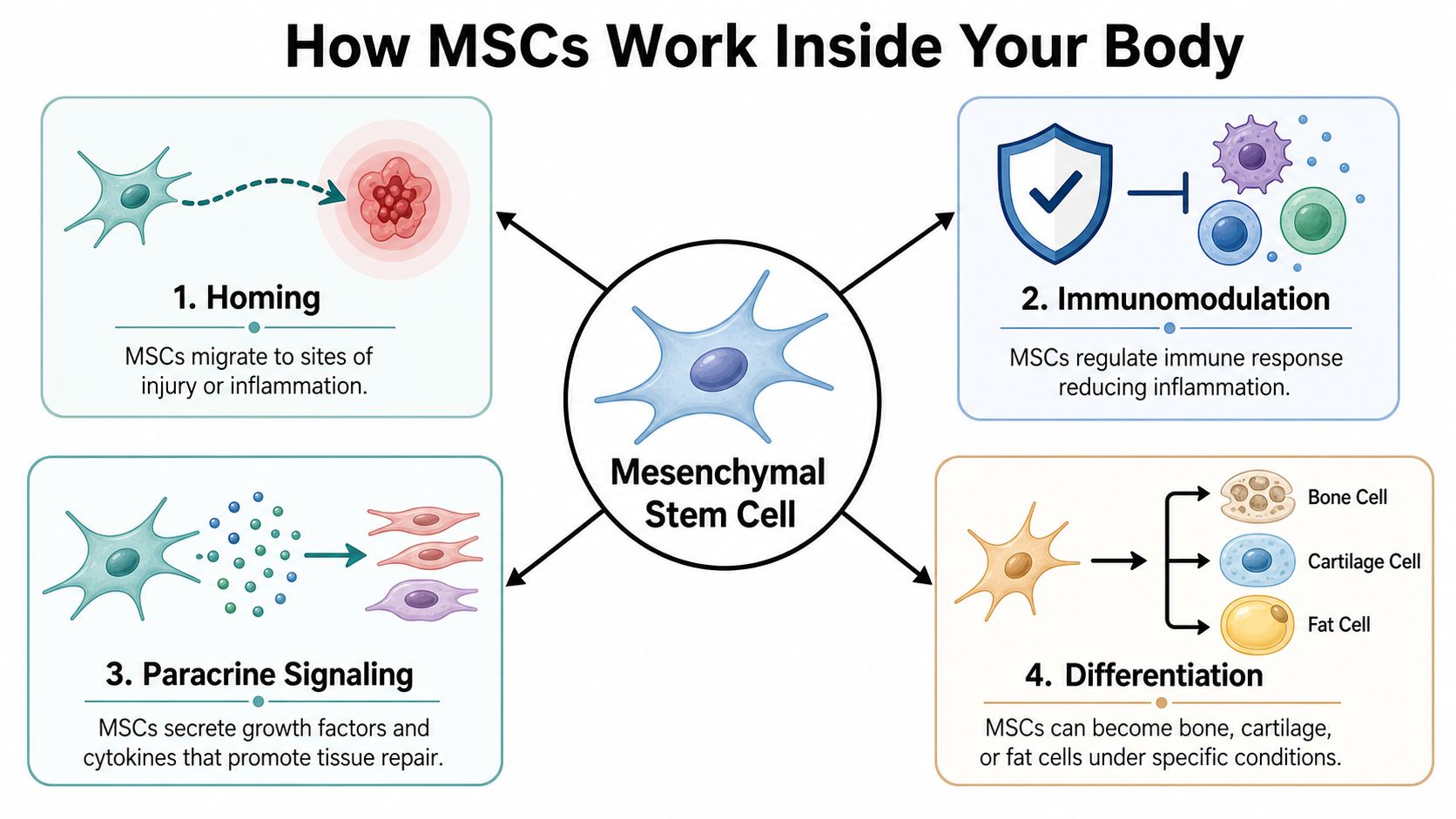
The clinical implication is important. MSC therapy may work less like a permanent implant and more like a temporary biological instruction system. Researchers are particularly interested in how MSCs influence the inflammatory environment, recruit or activate local repair cells, and reduce signals that contribute to ongoing tissue damage.
A 2023 meta-analysis of MSC therapy in acute respiratory distress syndrome described mechanisms involving prostaglandin E2, indoleamine 2,3-dioxygenase, and TLR signaling. Those pathways help explain why inflammatory priming, administration route, and product characterization can affect results (acute respiratory distress syndrome meta-analysis).
The phrase “homing” also needs careful interpretation. It doesn't mean that every cell reaches the precise location a patient has in mind, or that migration alone guarantees regeneration. Cell survival, dose, route, inflammatory state, and tissue environment all influence what happens after administration. Patients seeking a clearer explanation can read how stem cell therapy works.
Where MSCs Come From and How They Are Prepared
MSC source matters because cells from different tissues can differ in growth behavior, signaling profile, manufacturing requirements, and practical availability. Peer-reviewed reviews identify sources that include bone marrow, peripheral blood, umbilical cord, adipose tissue, dental pulp, placenta, amniotic fluid, and amniotic membrane (review of MSC sources; review of tissue-derived MSC materials).
Patients will often hear two terms, autologous and allogeneic. Autologous MSCs come from the patient. Allogeneic MSCs come from a donor. Longevity Medical Institute uses allogeneic MSCs only, rather than patient-derived cells, and produces five types in its biotechnology laboratory:
Placental MSCs, derived from placental tissue.
Wharton's jelly MSCs, derived from the supportive tissue within the umbilical cord.
Adipose MSCs, associated with fat tissue.
Endometrial MSCs, associated with the uterine lining.
Dental pulp MSCs, derived from the inner tissue of teeth.
Birth-associated tissues such as placenta and umbilical cord are often treated as medical waste, yet they can provide rich MSC sources. The choice between sources shouldn't be presented as a simple ranking. It should be connected to the intended indication, manufacturing process, dose, potency testing, and release criteria.
Preparation is part of the therapy
The label “MSC” doesn't tell you enough about a finished product. A responsible program should be able to explain how donors are screened, how tissue is collected, how cells are isolated and expanded, how contamination is controlled, how identity is confirmed, and what criteria must be met before administration.
Allogeneic manufacturing can support repeatable production and standardized testing, while also avoiding the need to collect cells from a patient whose age, illness, or medications may affect cell quality. Those advantages don't eliminate risk or guarantee efficacy. They make quality systems especially important.
Before treatment, ask for the cell source, donor-screening process, laboratory certifications, identity and viability testing, sterility controls, traceability records, and physician oversight. A clinic should answer directly rather than relying on vague phrases such as “premium cells” or “maximum potency.” Patients can review how stem cell quality is assessed and how cells are made before a consultation.
Clinical Applications with the Strongest Evidence
Which MSC applications have the clearest human evidence today? The answer depends on the diagnosis, product, protocol, and outcome being measured. Current research supports indication-specific signals, not one universal MSC treatment.
A 2025 MSC systematic review and meta-analysis of randomized controlled trials found osteoarthritis pain improvements across several MSC sources. The standardized mean difference was -0.95 for bone marrow MSCs, -1.25 for umbilical cord MSCs, and -1.26 for adipose MSCs. The analysis also reported improvement in systemic lupus erythematosus activity, with a SLEDAI standardized mean difference of -2.32, and inflammatory bowel disease clinical efficacy, with a relative risk of 2.02.
These results justify further study and careful clinical use. They do not show that every product, source, or clinic will produce the same outcome, and they do not replace established care.
| Application | Evidence level | Key outcome data |
|---|---|---|
| Osteoarthritis | Relatively developed clinical evidence | Pain improvement across bone marrow, umbilical cord, and adipose MSC sources, with source-specific effect sizes reported in the 2025 meta-analysis |
| Systemic lupus erythematosus | Promising randomized-trial evidence | SLEDAI standardized mean difference of -2.32 |
| Inflammatory bowel disease | Promising randomized-trial evidence | Clinical efficacy relative risk of 2.02 |
| Acute respiratory distress syndrome | Meta-analytic evidence with important limitations | 13 randomized trials and 655 patients, lower mortality, and no significant increase in adverse events (ARDS analysis) |
| Post-myocardial infarction heart failure events | Emerging phase 3 evidence | A 2025 phase 3 randomized trial reported fewer heart failure events with Wharton's jelly-derived MSCs (recent evidence map) |
| Neurological and cognitive conditions | Still uncertain | Evidence remains affected by small, heterogeneous studies and uncertain dosing and administration schedules |
The osteoarthritis evidence is developing through longer follow-up. A 2026 meta-analysis reported improvements in pain, function, and activity up to 24 months. Longer-lasting benefit still does not prove a cure or show that structural disease has been reversed. Patients considering orthopedic treatment can review MSC therapy for osteoarthritis.
For psoriasis, peripheral neuropathy, Lyme disease, long COVID, chronic fatigue syndrome, fibromyalgia, cognitive decline, and general chronic inflammation, the appropriate description is investigational or condition-dependent. Patients should examine the exact diagnosis, protocol, outcome measure, and evidence supporting that protocol rather than relying on the MSC label alone.
Why MSC Results Vary Across Clinics and Indications
The question “Do MSCs work?” sounds direct, but it hides the variables that determine the answer. A 2026 review identifies inter- and intra-donor variability, uncertain mechanisms of action, recipient variability, and inconsistent characterization and reporting standards as major barriers to translating research into standardized care (review of MSC translation challenges).
Two products may both be labeled MSCs while differing in tissue source, donor characteristics, expansion method, cell age, concentration, viability, potency, storage, and administration route. Even when two clinics start with a similar source, their laboratory procedures and release standards may not be comparable.
The recipient is part of the treatment environment
A person's immune status, inflammatory burden, age, medications, underlying disease, tissue damage, and overall physiology can influence the response. The same cells may encounter a very different biological environment in two patients. That doesn't mean clinicians can predict every result. It means individualized assessment is more rational than a one-size-fits-all promise.
Route and timing also matter. Intravenous delivery, local injection, and other administration approaches expose cells to different biological conditions. The inflammatory environment may influence how MSCs signal, survive, or interact with immune cells. Researchers therefore study potency, inflammatory priming, dosing, route, and release specifications together rather than treating the cell label as the whole intervention.
Practical rule: Compare protocols, not slogans. “Umbilical cord MSCs” is a source description, not a complete treatment specification.
A credible clinic should discuss uncertainty openly, define what outcome it is monitoring, and explain how it will respond if the patient doesn't improve. Longevity Medical Institute describes a model that combines physician oversight with a COFEPRIS-licensed, ISO-certified biotechnology laboratory, in-house diagnostics, and individualized protocols. Those systems can reduce avoidable variation, but no laboratory certification can guarantee a clinical outcome.
The Regulatory Framework and Safety Standards in Mexico
Is a clinic operating within the applicable rules? Is the cell product manufactured under controlled conditions? Does the proposed use have appropriate evidence? Patients traveling to Mexico should ask all three questions, because a positive answer to one does not settle the others.
In Mexico, COFEPRIS, the Federal Commission for the Protection against Sanitary Risks, oversees health-related regulatory matters. Ask the clinic to explain its registrations, operating permissions, laboratory oversight, product traceability, and adverse-event reporting process. A logo on a website or verbal assurance during a sales call is not enough.
A pre-travel safety check
Regulatory status: Request documentation for the clinic, laboratory, and proposed treatment.
Laboratory quality: Ask whether the laboratory follows recognized ISO-certified processes and whether quality-control records can be reviewed.
Traceability: Confirm how donor material is tracked through processing, storage, release, and administration.
Medical oversight: Verify the treating physician's credentials and experience with the specific protocol.
Follow-up care: Establish who will monitor you afterward and how adverse events will be handled.
Regulation works like a safety framework, not a stamp of clinical success. The United States has its own system, with the FDA regulating applicable MSC products as biologics under strict requirements, while Mexico uses its national regulatory system. Different jurisdictions may offer different legal pathways. “Available” does not mean “proven,” and limited routine availability does not by itself show that a treatment has no value. The clinic should explain both the treatment's regulatory status and the strength of evidence for your indication.
Written answers matter. A clinic that cannot clearly document manufacturing, informed consent, risks, and follow-up warrants caution. Before traveling, review whether stem cell therapy in Mexico is safe and discuss the proposed plan with a qualified physician familiar with your complete medical history.
How to Evaluate a Stem Cell Clinic and Treatment Protocol
A good consultation should feel like a medical assessment, not a product demonstration. Bring your diagnosis, imaging, medication list, prior treatments, and goals. Then ask questions that force the clinic to connect its claims to the actual protocol being offered.
Five questions deserve clear answers
What cells are being used? Ask whether they are allogeneic or autologous, which tissue they come from, and why that source fits your indication.
How are the cells prepared? Request information about donor screening, laboratory controls, identity testing, sterility, viability, potency, storage, and traceability.
Who is responsible for care? The treating physician should understand your diagnosis, contraindications, administration route, and follow-up plan.
What evidence supports this use? Ask for clinical trials or systematic reviews that match your condition, cell source, route, and intended outcome. Evidence for osteoarthritis shouldn't be presented as proof for cognitive decline or chronic fatigue syndrome.
How will success and harm be measured? A responsible plan defines baseline assessments, follow-up timing, meaningful outcomes, and adverse-event reporting.
Red flags and reassuring signs
Guarantees, pressure to pay quickly, vague cell descriptions, undisclosed laboratory work, and claims that one infusion treats every disease are warning signs. A more credible operation welcomes questions, explains uncertainty, documents consent, and offers a plan that includes conventional medical care when appropriate.
Longevity Medical Institute combines allogeneic MSC programs with in-house clinical testing, physician-led evaluation, and advanced diagnostic services such as biomarker assessment and imaging. Those tools can help clinicians establish a baseline and personalize care, but patients should still judge the proposed protocol on evidence, transparency, and safety rather than atmosphere or branding.
Frequently Asked Questions About MSC Therapy
Is MSC therapy FDA-approved or COFEPRIS-approved?
Approval depends on the specific product, indication, manufacturing process, and jurisdiction. The global pipeline is large, but a 2023 review identified only 12 MSC therapies approved by regulatory agencies for commercialization, despite 1,120 registered MSC clinical trials worldwide by April 2023 (review of MSC clinical translation). Ask exactly what is approved, what is investigational, and what oversight applies in Mexico.
Can MSCs cure degenerative disease?
Current evidence doesn't justify promising a cure. MSCs may improve symptoms or function in selected conditions, but outcomes vary and tissue regeneration claims require indication-specific evidence.
How long does recovery take?
Recovery depends on the administration route, diagnosis, overall health, and procedure. Some patients may notice changes relatively soon, while others require longer observation. A clinic should provide a monitoring plan rather than a guaranteed timetable.
How many treatments are needed?
There is no universal schedule. The appropriate number depends on the condition, protocol, response, safety findings, and clinical judgment.
Are serious risks possible?
Yes, but extremely rare. No cell therapy is risk-free. Discuss infection, immune reactions, procedure-specific complications, worsening symptoms, and other risks relevant to your health. In ARDS trials, the meta-analysis found no significant increase in adverse events versus control, but that result doesn't eliminate risks in other diseases or protocols.
Are allogeneic MSCs safer or more effective?
Allogeneic cells can support standardized manufacturing and avoid harvesting from the patient, but those features don't prove superior effectiveness or guarantee safety. Source, quality controls, potency, route, dose, and patient selection all matter.
Longevity Medical Institute offers physician-led evaluation, allogeneic MSC programs, laboratory-guided assessment, and individualized regenerative medicine planning for patients considering evidence-based options in San José del Cabo. Visit Longevity Medical Institute to request a consultation and discuss whether your diagnosis, goals, and medical history fit a responsible MSC evaluation.
Author
Dr. Kirk Sanford, DC, Founder & CEO, Longevity Medical Institute. Dr. Sanford focuses on patient education in regenerative and longevity medicine, translating complex therapies into clear, practical guidance for patients.
Medical Review
Dr. Félix Porras, MD, Medical Director, Longevity Medical Institute. Dr. Porras provides clinical oversight and medical review to help ensure accuracy, safety context, and alignment with current standards of care.
Last Reviewed: August 18, 2026
Short Disclaimer
This information is for educational purposes only and is not medical advice. It does not replace an evaluation by a qualified healthcare professional. For personalized guidance, please schedule a consultation.