

Unlock Longevity: Photobiomodulation Therapy 2026
Your calendar is full. Your sleep is shorter than it should be. You train hard, travel often, sit too long, recover inconsistently, and still expect your body and brain to perform on demand. That's the modern reality for many professionals, athletes, and health-focused adults.
Individuals often respond with single tools. A red light panel at home. A meditation app. A vibration plate. A breathing exercise between meetings. Each can help. But human recovery doesn't happen in isolated compartments. Cells need energy. Tissues need circulation. The nervous system needs safety signals. Oxidative stress needs control. Repair works best when those systems move in the same direction.
That's where a combined approach becomes more interesting than any one device on its own.
An Introduction to the Longevity Recharge Station
A common pattern in clinic is the high-functioning person who says some version of the same thing: “I'm not sick, but I don't feel fully recovered.” It may be the executive who wakes up tired after travel, the recreational athlete whose soreness lingers, or the healthy older adult who wants better resilience rather than waiting for decline.
The Longevity Recharge Station is designed around that exact problem. It's not a single wellness gadget. It's a 20-minute, multi-modality recovery session that combines five inputs into one experience: photobiomodulation therapy, molecular hydrogen inhalation, vagus nerve stimulation, micro-impact plate therapy, and guided meditation with breathwork. If you want the treatment overview itself, you can review the Longevity Recharge Station page.
What makes this approach clinically interesting is not novelty. It's alignment. Each modality influences a different part of the recovery equation. Light aims at mitochondrial signaling and tissue support. Hydrogen is used to support redox balance. Vagus nerve stimulation and mindfulness nudge the body toward a more parasympathetic state. Mechanical input adds a circulatory and musculoskeletal component.
Why patients often misunderstand recovery
Many people think recovery means rest alone. Rest matters, but biological recovery is active. Cells have to produce energy. Inflammatory signals have to resolve. Blood and lymph have to move. The brain has to stop acting like it's in a threat state.
Recovery works best when the body receives consistent signals for energy production, circulation, and nervous system calm at the same time.
That's the promise of an integrated station. Not that it replaces medical care. Not that it “hacks” aging. It gives the body several supportive signals in a concentrated window, which may be more practical for real life than trying to stack separate devices and habits across the day.
What the session is meant to support
Patients usually look for this kind of experience when they want support around:
Physical recovery after training, travel, or long workdays
Stress regulation when they feel wired but tired
Cognitive reset after prolonged screen time or poor sleep
Healthy aging support aimed at resilience rather than symptom chasing
That framing matters. The station isn't about forcing the body to do something unnatural. It's about supporting the systems the body already uses to repair, regulate, and adapt.
Why Modern Recovery Requires a Multi-Modality Approach
The body doesn't separate stress into clean categories. Poor sleep changes autonomic balance. Autonomic imbalance affects inflammation. Inflammation and oxidative stress can influence how tissues recover. Low recovery capacity then changes exercise tolerance, mood, and cognitive sharpness.
That's why single-modality recovery often feels incomplete.
A red light panel may offer one kind of stimulus. Breathwork may help another. Mechanical stimulation may improve movement or circulation. But if a person is dealing with layered stressors, they often need support at more than one level. That's also why many multi-faceted recovery plans combine device-based therapies with tools such as hyperbaric oxygen therapy, nutrition, movement, and sleep optimization rather than relying on one intervention.
Recovery is a systems problem
From a clinical education perspective, it helps to think of recovery as five linked domains:
Cellular energy: Cells need usable energy to repair and maintain tissue.
Oxidative balance: Energy production and stress both influence reactive oxygen species.
Autonomic state: A body stuck in fight-or-flight doesn't heal efficiently.
Circulation and mechanical signaling: Tissues need delivery of oxygen, nutrients, and movement-related input.
Behavioral regulation: Breathing patterns, attention, and mental state influence physiology.
If only one domain is addressed, the others can remain limiting factors.
Why single tools often disappoint
Patients sometimes ask why a home red light device, breathing app, or vibration platform didn't create the shift they expected. The answer usually isn't that the tool was useless. It's that the tool was incomplete for their current physiology.
A person can receive a mitochondrial stimulus from light, for example, but still remain highly sympathetically activated. Another person may feel calmer with breathwork but still struggle with physical recovery after exertion. Someone else may improve circulation mechanically without influencing oxidative stress or mental overactivation.
Clinical perspective: The more interconnected the stress pattern, the more logical it becomes to use a coordinated, multi-input strategy.
A better analogy than “more is better”
This isn't about piling on treatments. It's more like conducting an orchestra. A single instrument can be beautiful. But if you want a fuller piece, timing and coordination matter. In recovery medicine, the same principle applies. The value is not random stacking. The value is combining inputs that act on complementary pathways.
A thoughtful multi-modality session can support:
| Recovery challenge | Why one tool may fall short | Why a combined session makes sense |
|---|---|---|
| Mental fatigue | Calming the mind alone may not support tissue or cellular function | Neural calming plus cellular support may feel more complete |
| Post-exercise soreness | Mechanical work alone may not address autonomic stress | Tissue support, circulation, and nervous system regulation can complement each other |
| Travel-related depletion | Hydration and rest may not fully reset stress physiology | Multiple signals may help the body shift back toward balance |
| Healthy aging support | Single interventions often target one pathway | Aging biology is multi-system, so support often works best the same way |
The modern environment pushes on many systems at once. A recovery strategy that respects that complexity is often more realistic than pretending one modality can do everything.
The Five Pillars of Cellular Optimization
A patient steps into the Longevity Recharge Station after a week of poor sleep, hard training, long flights, and too much time in a high-alert state. The question is not whether one tool can help. The better question is which systems need support at the same time.
That is the logic of this five-part design. Each modality sends a different signal into the body. Light interacts with cellular energy pathways. Hydrogen supports redox balance. Electrical stimulation influences autonomic tone. Mechanical input affects circulation and musculoskeletal signaling. Breath and attention shift the brain and nervous system from effort toward regulation.
Used together in one session, these inputs are meant to work like a well-coordinated clinical team. One modality does not need to do everything. Each one covers a different layer of physiology, and the combined effect can be broader than any single therapy used alone.
The five modalities in plain language
Photobiomodulation therapy uses red and near-infrared light to influence cellular signaling. The biological response depends on details such as wavelength, dose, power, timing, distance, and pulse pattern. In practical terms, this modality is used to support mitochondrial function, tissue repair signaling, and recovery capacity.
Molecular hydrogen inhalation is used for its role in oxidative balance. A simple way to understand it is as support for the cell's chemical environment during periods of stress, exertion, or recovery. Patients often describe it less in technical terms and more as part of a session that feels restorative rather than depleting.
Vagus nerve stimulation targets the autonomic nervous system. Its purpose is to encourage a shift toward parasympathetic activity, the branch associated with rest, digestion, and repair. That matters because recovery is not only about muscles and mitochondria. It also depends on whether the brain and body receive the signal that it is safe to stand down.
Micro-impact plate therapy provides rhythmic mechanical stimulation. This input travels through bone, muscle, fascia, and the circulatory system, creating a whole-body mechanical signal rather than a localized treatment. It is often included to support movement-related physiology, circulation, and physical readiness.
Guided meditation and breathwork give the patient an active role in the session. Technology can change the environment around the nervous system. Breathing and attention help change the internal response from the inside out.
The Five Modalities of the Longevity Recharge Station
| Modality | Primary Mechanism | Key Biological Targets | Main Benefits |
|---|---|---|---|
| Photobiomodulation therapy | Light-mediated cellular signaling | Mitochondria, inflammatory pathways, tissue repair signaling | Supports cellular energy, repair processes, and recovery |
| Molecular hydrogen inhalation | Redox support through selective antioxidant behavior | Oxidative stress pathways, inflammatory signaling | Supports oxidative balance and recovery resilience |
| Vagus nerve stimulation | Non-invasive autonomic modulation | Vagus nerve, parasympathetic nervous system | Supports stress regulation and recovery state |
| Micro-impact plate therapy | Gentle mechanical stimulation | Bone, muscle, circulation, lymphatic movement | Supports activation, circulation, and physical recovery |
| Guided meditation and breathwork | Conscious regulation of breath and attention | Autonomic nervous system, stress response networks | Supports calm, focus, and physiologic downshifting |
Why this matters in daily life
The value of this station is coordination. A person dealing with fatigue, post-exercise soreness, travel strain, or healthy aging concerns is rarely dealing with a single pathway problem. Energy production, oxidative stress, autonomic tone, circulation, and mental state all influence one another.
That is why a combined session can feel different from using one device in isolation. Light may support cellular energy. Hydrogen may help maintain oxidative balance. Vagus stimulation and breathwork may make the nervous system more receptive to repair. Mechanical stimulation adds a physical signal that reaches tissues light and breathing do not directly address. The goal is not more inputs for their own sake. The goal is better-matched inputs for the complexity of the human body.
For some patients, this broader recovery strategy also includes clinician-guided nutrition and targeted formulations, such as clinician-selected recovery supplements from Revive.
Clinical takeaway: A single therapy can support one layer of recovery. Five well-matched therapies used together can support how those layers interact.
The Science of Photobiomodulation and Molecular Hydrogen
A patient finishes a demanding week, steps into the station, and asks a fair question. Why combine light with hydrogen in the same session? The short answer is biology. Cells need energy to repair, and they need a controlled chemical environment to do that repair well.
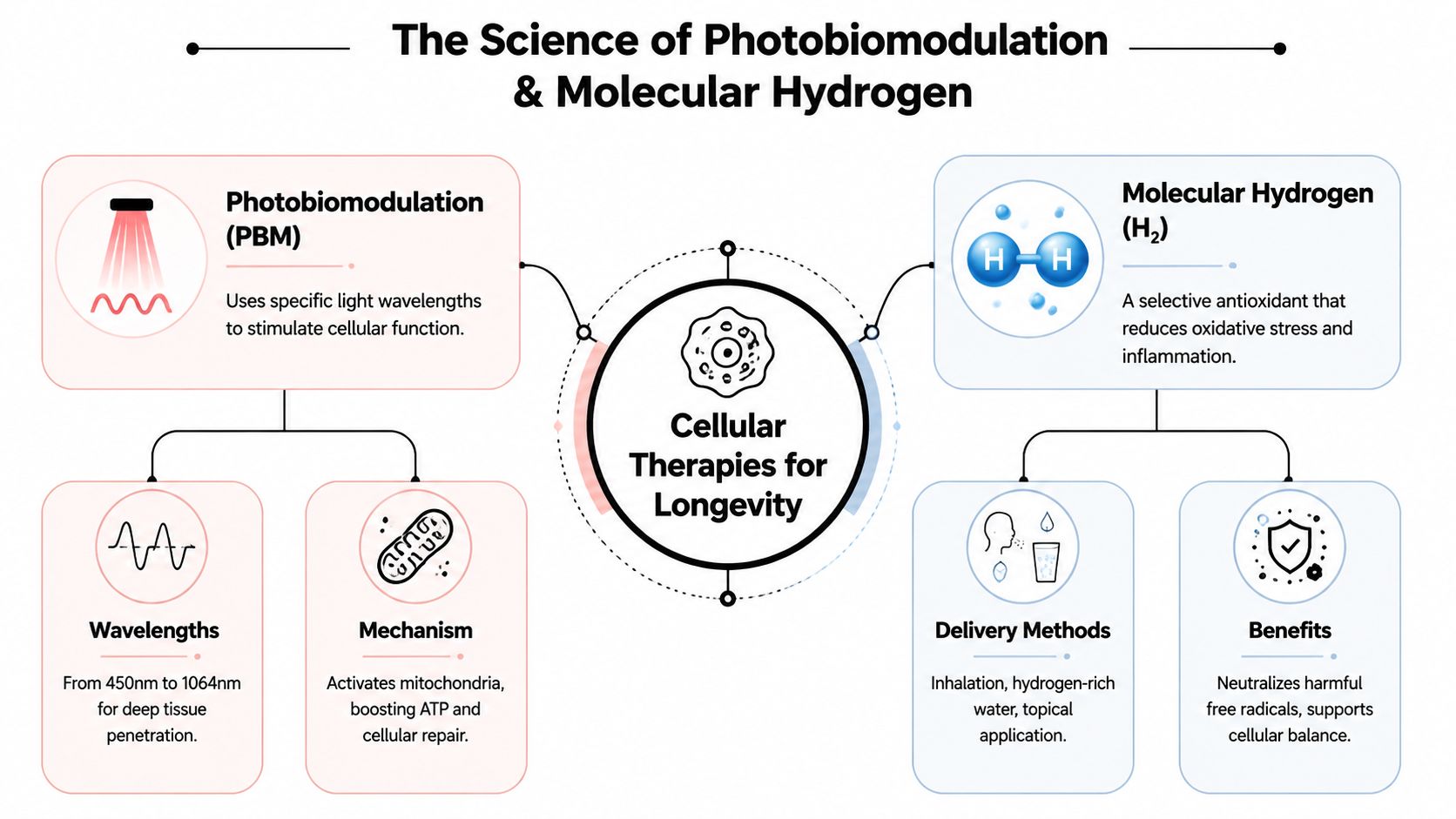
Among the five modalities, photobiomodulation therapy and molecular hydrogen form the core cellular pairing. Photobiomodulation influences how cells produce and use energy. Molecular hydrogen is used to support redox balance, which refers to how the body manages reactive oxygen species and antioxidant defenses. Those two processes are tightly linked. If you increase cellular work, you also increase the need for orderly signaling and oxidative control.
How photobiomodulation therapy works
Photobiomodulation works by delivering specific wavelengths of non-ionizing light to tissue at a carefully chosen dose. The target is not “the skin” in a general sense. The target is cellular photoreceptors, with cytochrome c oxidase in mitochondria remaining the best-supported mechanism in the literature.
A practical comparison helps. Mitochondria work like the cell's power plants, but power plants only increase output when the control systems receive the right signal. In PBM, light provides that signal. If the wavelength, dose, and timing are appropriate, photon absorption can shift mitochondrial activity, increase ATP production, and influence signaling pathways tied to inflammation and tissue repair, as described earlier in the article.
ATP matters because it is the cell's usable energy. Repairing a stressed tendon, restoring a hard-trained muscle, or supporting irritated skin all require energy. PBM does not “force healing.” It gives cells a better chance to carry out the repair work they are already designed to do.
Why dose and wavelength matter
Many simplified wellness explanations err on this point. Light is not one uniform therapy. Different wavelengths interact with tissue differently, and the biological response depends on the amount of energy delivered over time.
That is why clinics that use PBM carefully pay attention to wavelength, fluence, power, distance, and treatment duration. Change those variables, and you change the physiologic effect. A low dose may do very little. A poorly matched higher dose may reduce the response rather than improve it.
In photobiomodulation, the dose is the therapy.
This dose sensitivity is one reason PBM has a real clinical framework rather than a vague “more is better” model. Research on PBM dose response describes a biphasic pattern, where the same stimulus can help, do little, or become less effective depending on how it is delivered. That same body of literature also discusses PBM in relation to collagen signaling, pain reduction, and modulation of inflammatory processes in selected clinical settings through repeated, properly dosed treatment, as reviewed in this PBM dose-response paper.
What this means in clinical use
For patients, the reassuring point is simple. PBM has technical boundaries. It is not just red light placed near the body. It is a parameter-driven therapy with established medical use, device standards, and decades of scientific study.
That distinction matters even more in a multi-therapy session. A well-designed PBM application can support mitochondrial signaling first, creating a stronger metabolic foundation for the other therapies that follow. If you want an example of how Longevity Medical Institute applies light-based therapies in another protocol, you can review TriFusion ozone therapy.
Later in the session, some patients like to review the visual explanation below.
Where molecular hydrogen fits
If PBM helps cells manage energy, molecular hydrogen is used to help manage the chemical byproducts that come with metabolic activity. Reactive oxygen species are not bad in themselves. They are part of normal physiology and cell signaling. Problems arise when the balance shifts too far toward oxidative stress.
Hydrogen draws interest because it is often described as a selective antioxidant. In practical terms, the goal is not to suppress all oxidation. The goal is to reduce excess reactivity while preserving the signaling functions the body still needs.
A clear comparison is this. PBM is like increasing the efficiency of a power plant. Hydrogen helps keep the surrounding environment cleaner while that plant is working harder. One supports output. The other supports conditions.
Why the pairing matters more than either therapy alone
The station's design incorporates an interesting pairing. These therapies are not placed side by side by accident. They are paired because one may support energy production and signaling, while the other may help contain the oxidative strain that can accompany higher metabolic activity.
Used together in a coordinated session, they can create a more favorable biologic sequence:
Stimulate mitochondrial signaling
Support ATP production and cellular work
Help maintain redox balance while that work is occurring
Create better conditions for tissue repair and recovery
That sequence is the beginning of synergy. It is not just “light plus hydrogen.” It is a timed combination that may help the body respond with more stability and less friction at the cellular level. In the broader five-part session, that improved cellular environment can make the later nervous system and mechanical inputs more productive as well.
Regulating the Nervous System with VNS and Mindfulness
Some patients respond strongly to light and mechanical stimulation, but they still don't recover well because their nervous system never stands down. They may feel tired, yet internally activated. Their body behaves as if it still needs to scan for threat.
That state matters. Repair is harder when the nervous system remains biased toward vigilance.
The vagus nerve as a recovery pathway
The vagus nerve is central to parasympathetic activity, the branch of the autonomic nervous system associated with rest, digestion, and recovery. When clinicians talk about “downshifting” physiology, this is often what they mean.
Non-invasive vagus nerve stimulation, or VNS, aims to gently encourage that shift. The goal isn't sedation. The goal is better regulation. In practical terms, that may mean a body that's more able to settle, recover, and allocate resources toward maintenance rather than defense.
A patient-friendly way to think about this is braking versus accelerating. Many people live with the accelerator partially pressed all day. VNS is one way of helping the braking system engage.
Why autonomic state affects every other modality
Multi-modality design proves compelling. A nervous system that feels safe is often a nervous system that distributes blood flow differently, breathes differently, and reacts differently to sensation and stress. That affects how a person experiences every other input in the session.
If someone receives PBM while mentally overactivated and physically tense, the session may still be useful. But if that same person shifts toward parasympathetic balance at the same time, the body may be in a more favorable state for recovery signaling.
Practical insight: Recovery isn't only about what you add to the body. It's also about what state the body is in when it receives that input.
Guided meditation and breathwork are not “soft” add-ons
Patients sometimes assume guided breathwork is the least important part because it doesn't look technical. That's a mistake. Breath is one of the fastest ways to influence physiology voluntarily.
Slow, deliberate breathing can change how the chest moves, how carbon dioxide is tolerated, how attention is directed, and how the nervous system interprets internal signals. Guided meditation then adds another layer by reducing mental noise and interrupting habitual stress loops.
These practices matter because they create internal compliance. A body that is resisting, bracing, and ruminating is harder to calm than one that is actively participating in the session.
Why VNS and mindfulness work well together
These two modalities can be thought of as bottom-up and top-down support.
Bottom-up support: VNS delivers a physical signal meant to influence autonomic tone.
Top-down support: Breathwork and meditation use conscious attention to shape physiology.
Shared outcome: Both encourage a shift toward a calmer, more restorative state.
Session advantage: Used together, they may help the person feel both physiologically and mentally settled.
Some people feel this as warmth, heaviness, easier breathing, or a quieting of internal urgency. Others notice it later, as improved clarity or a different quality of recovery after the session.
Who benefits most from this layer
This part of the station is especially relevant for people who are:
| Pattern | Why nervous system regulation matters |
|---|---|
| High stress | Constant alertness can interfere with recovery |
| Poor sleep habits | Dysregulated autonomic tone often carries into nighttime |
| Frequent travel | Travel can keep the body in a low-grade stress state |
| Cognitive overload | Mental overactivation often has a physical autonomic component |
For many adults, the most limiting factor isn't motivation. It's physiology. They're trying to recover with a nervous system that never quite believes it can let go.
Mechanical Stimulation for Systemic Health
You settle into a recovery session expecting light, breath, and calm. Then the platform beneath you begins a gentle rhythmic pulse. That mechanical input is not there for novelty. It gives the body a physical signal that chemistry alone cannot provide.
Mechanical stimulation adds the language of load, pressure, and movement. Cells do not respond only to molecules and nerves. They also respond to force. Muscle, bone, blood vessels, connective tissue, and the lymphatic system all adjust their behavior based on repeated mechanical cues. In daily life, walking supplies many of those signals. A micro-impact platform delivers a controlled, low-intensity version of them during the session.
What micro-impact adds
Its value is practical and systemic at the same time.
Muscle engagement through repeated rhythmic input
Circulatory support by helping move blood through the lower body
Lymphatic movement through gentle oscillation and pressure changes
Bone and connective tissue signaling because these tissues are designed to sense load
A useful comparison is walking on a very small scale. With each step, your body receives information about gravity, impact, balance, and muscle tension. That information helps maintain tone and flow. Micro-impact therapy delivers a simplified version of those cues in a controlled setting, which is why it fits well inside a multi-therapy session instead of competing with the other modalities.
Why mechanical input matters in a combined session
Each therapy in the station speaks to the body through a different channel. Light influences cellular signaling. Hydrogen supports redox balance. Vagal stimulation and mindfulness shape autonomic tone. Mechanical stimulation adds fluid movement and load-based signaling.
That distinction matters because recovery has bottlenecks. A cell can receive a favorable biochemical message, but tissues still depend on circulation, interstitial fluid movement, and regular mechanical input to distribute resources and maintain function. Mechanical stimulation helps address that part of the equation. It is one reason the combined session can produce an effect that feels broader than any single modality used alone.
Patients sometimes ask whether this is the same as a body-sculpting device. It is not. A technology like Emsculpt Neo for muscle and body-composition support has a different purpose and a different intensity profile. Here, the goal is to support recovery physiology across multiple systems, not to target aesthetic change.
The simplest way to understand its role
Mechanical stimulation works like circulation coaching for the body. It reminds tissues to keep fluids moving, muscles responding, and load-sensing pathways active. In the context of the full station, that matters because better recovery is rarely about one perfect signal. It is about sending several compatible signals at the same time.
That is the larger logic of the station. One modality improves the cellular environment. Another helps the nervous system shift out of guard mode. Mechanical input makes the body less static while those processes are underway. The result is a session designed around biological cooperation, where each therapy strengthens the conditions that help the others do their job.
Synergy in Action and Comparing Recovery Technologies
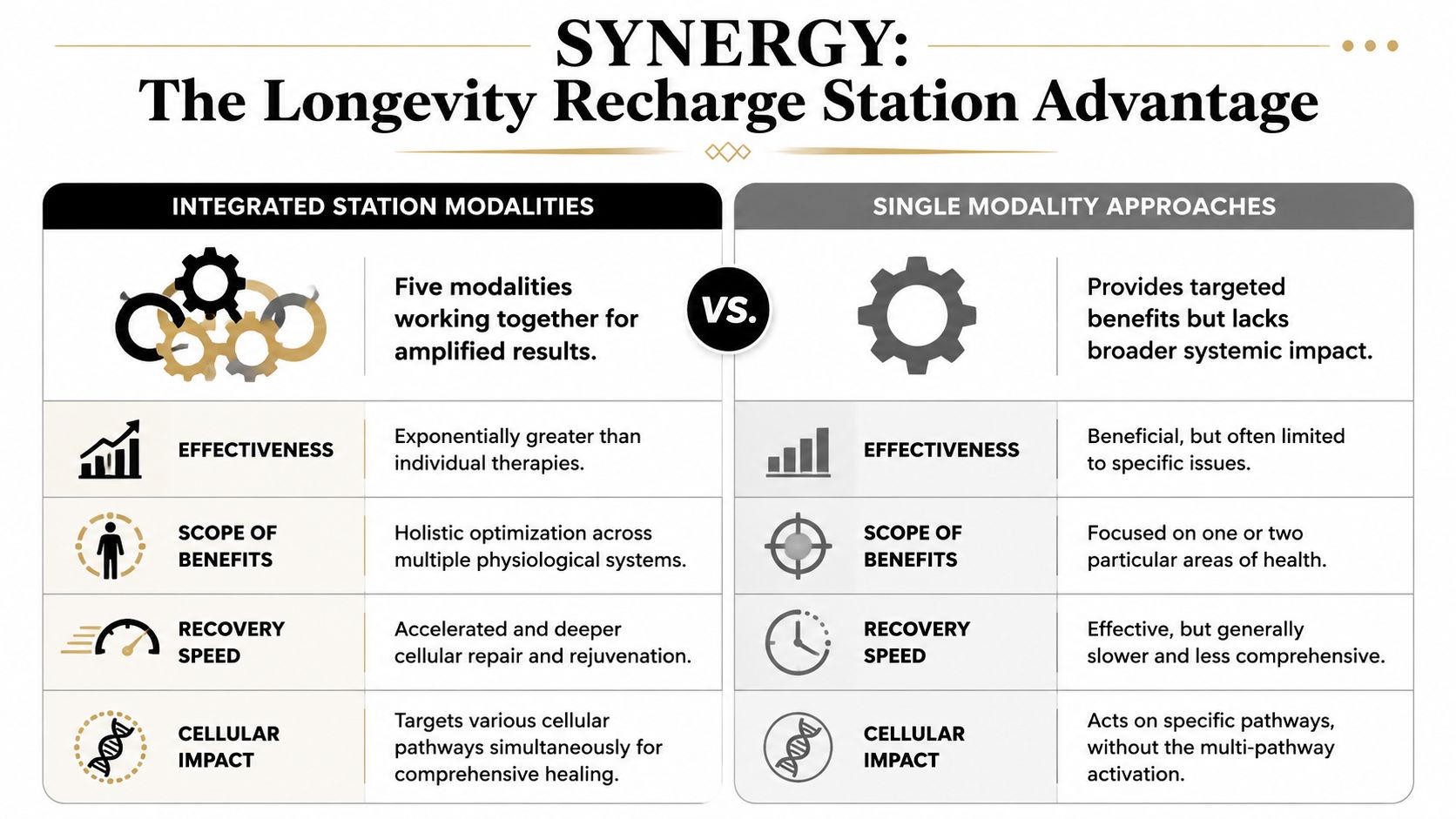
The most important idea in the entire station is synergy. Not in the vague marketing sense. In the biological sense. One input changes the context for the next.
A calmer autonomic state may make restorative processes more accessible. Better cellular signaling may support repair activity. Better oxidative balance may support that work. Improved mechanical circulation may help tissues receive and distribute what they need.
Why integrated recovery can feel different
Single devices often have one clear job. That can be useful. But they also have one clear limitation. They leave other bottlenecks untouched.
An integrated station can support several domains in one sitting:
Mitochondrial function and cellular energy
Oxidative balance
Autonomic regulation
Circulation and mechanical signaling
Mental downshifting
The interesting part is how these domains reinforce one another. A person who feels calmer may breathe more efficiently. A person who is less physiologically tense may perceive discomfort differently. A body with better circulation may support tissue maintenance more effectively.
Important nuance about photobiomodulation
PBM should still be discussed objectively. A nuanced review from McGill notes that PBM is highly parameter-dependent, that the strongest clinical evidence is for areas such as wound healing and oral mucositis, and that light reaching deep structures like the hip or spine is limited by intervening tissue. That same critique points out how this limitation is often missing from broad claims about systemic rejuvenation, as described in the McGill review of what PBM does and does not do.
That honesty is useful. It doesn't weaken the case for PBM. It sharpens it. PBM is not magic. It is a real, dose-dependent therapy with specific strengths and real limits. In a multi-modality station, that means the light component should be viewed as one contributor to a broader physiological effect, not as a cure-all.
Comparing the station with standalone recovery tools
| Approach | What it primarily offers | Main limitation |
|---|---|---|
| Traditional red light therapy device | Light-based cellular stimulus | Usually lacks autonomic, oxidative, and mechanical components |
| Standalone hydrogen inhalation system | Oxidative stress support focus | Doesn't provide light, movement, or nervous system guidance |
| Standalone vibration or impact platform | Mechanical and circulatory stimulus | Limited cellular and autonomic depth on its own |
| Meditation or breathwork alone | Nervous system regulation | No direct light-based or mechanical stimulus |
| Integrated multi-modality station | Coordinated support across several systems in one session | Requires careful design and clinical context |
One example of this integrated approach in a clinical setting is the single-session technology stack used by Longevity Medical Institute, which combines multiple recovery inputs into one coordinated experience rather than asking patients to assemble separate tools on their own.
Who may find this especially appealing
Different people are drawn to this model for different reasons.
Athletes and active adults often care about recovery quality, soreness management, and readiness for the next effort.
Executives and high-output professionals usually care about mental clarity, stress load, and how quickly they can reset after long days or travel.
Frequent travelers often notice how circadian disruption, dehydration, stiffness, and nervous system activation overlap.
Healthy aging individuals tend to value consistency. They want supportive routines that help maintain resilience over time rather than waiting until recovery becomes harder.
The unifying idea is simple. Human performance depends on more than muscles, more than mindset, and more than mitochondria. The body works as a network. Recovery technology should respect that.
Frequently Asked Questions
What does a session feel like
It is described as calming, immersive, and physically gentle. You may notice warmth from the light, rhythmic movement from the plate, and a settling effect from the breathing and guided mindfulness. The goal isn't intensity. It's coordinated regulation.
How long does a session take
The Longevity Recharge Station is designed as a 20-minute experience. That short format is part of its appeal for people who want a concentrated recovery intervention without building a long ritual around multiple devices.
How often should someone use it
That depends on goals, training load, stress burden, and clinical context. Some people use integrated recovery support periodically. Others prefer it as part of a structured routine. A clinician should guide frequency based on the person, not a generic online schedule.
Is photobiomodulation therapy safe
PBM has a substantial research history and established clinical use. The field includes more than 700 randomized controlled trials and thousands of peer-reviewed studies, and the ASLMS notes that negative side effects have not been reported in PBMT use, while historical critics also note that much of the earlier literature was preclinical and many human trials were small, as summarized in this overview of the PBM evidence base.
That balanced view matters. The therapy is well-studied and widely discussed, but proper use still depends on parameters, indication, and clinical judgment.
Who is a good candidate
Adults interested in recovery, performance support, stress regulation, or healthy aging often ask about this type of session. It may be especially relevant for people dealing with travel fatigue, training load, cognitive overwork, or a sense that they don't recover as efficiently as they used to.
Are there contraindications
Any device-based therapy should be reviewed in the context of your medical history, current symptoms, medications, and goals. That includes light-based therapies, electrical stimulation, and mechanical modalities. A proper screening conversation matters more than broad assumptions.
Will it replace medical treatment
No. It's best understood as a supportive recovery and wellness technology, not a substitute for diagnosis or medical care. If you have a specific condition, pain issue, inflammatory complaint, or unexplained fatigue, get a qualified evaluation.
If you'd like help deciding whether an integrated recovery approach fits your goals, Longevity Medical Institute can guide you through a personalized evaluation and discuss whether the Longevity Recharge Station belongs in a broader plan for recovery, performance, and healthy aging.
Author
Dr. Kirk Sanford, DC, Founder & CEO, Longevity Medical Institute. Dr. Sanford focuses on patient education in regenerative and longevity medicine, translating complex therapies into clear, practical guidance for patients.
Medical Review
Dr. Félix Porras, MD, Medical Director, Longevity Medical Institute. Dr. Porras provides clinical oversight and medical review to help ensure accuracy, safety context, and alignment with current standards of care.
Last Reviewed: June 13, 2026
This information is for educational purposes only and is not medical advice. It does not replace an evaluation by a qualified healthcare professional. For personalized guidance, please schedule a consultation.