

Root Cause Analysis Testing: Find Your Health's 'Why'
You've probably lived some version of this already. A symptom appears, you get a treatment, you feel a little better, and then the same problem returns in a new form. Fatigue becomes poor sleep. Joint pain turns into reduced activity, then weight gain, then lower energy. Brain fog lifts for a while, then comes back when stress rises or inflammation flares.
That cycle is exhausting because it keeps your attention on what hurts right now, not on why your system keeps falling out of balance. For many patients, that's the missing piece.
Beyond Symptom Management
A person comes in with low energy, stubborn inflammation, and a sense that their body doesn't recover the way it used to. They've tried supplements, medication changes, exercise plans, and rest. Each one helped a little. None of them explained the whole picture.
That's where root cause analysis testing becomes useful.
In other fields, root cause analysis was formalized to prevent serious failures by looking at system breakdowns rather than isolated errors. In healthcare, that same systems-based thinking helps clinicians ask a more meaningful question: not just “What symptom is present?” but “What process has failed?” The AHRQ PSNet primer on root cause analysis explains that this approach grew from industrial accident review and is now widely used in medicine, with a focus on underlying system issues rather than blame.
When symptoms are only the smoke
Think about a recurring headache. The headache may be real, disruptive, and worth treating. But it may not be the actual problem. Poor sleep, inflammation, blood sugar swings, hormonal stress, vascular issues, or even recovery deficits can all feed the same symptom.
If you only chase the headache, you may never understand the pattern behind it.
Practical rule: A symptom is often the body's alarm, not the body's diagnosis.
A clinical philosophy, not a single lab order
Root cause analysis testing isn't one test. It's a way of investigating health that combines history, imaging, lab data, physiologic signals, and structured reasoning.
That matters if you've ever been told your results were “normal” while you still felt unwell. Standard screening can miss layered problems that only make sense when your data is examined as a connected system.
For patients interested in longevity, regenerative care, and better function over time, this shift changes the conversation. Instead of asking how to suppress the next flare, you begin asking how to build a body that's more stable, more resilient, and more capable of repair.
The Philosophy of Root Cause Medicine
A high-performance home can look beautiful on the surface and still have a failing foundation. You can paint over cracks, replace a warped door, and patch water stains. The house may look improved for a while. But if the structure underneath is unstable, the same problems keep returning.
The body works in a similar way.
Surface relief versus structural repair
Symptom-based care often acts like patching the visible crack. It has value. Pain relief matters. Sleep support matters. Controlling inflammation matters. But if the deeper drivers remain active, the body keeps spending energy on compensation instead of repair.
Root cause medicine looks below the surface at patterns such as:
Inflammatory signaling that keeps tissue irritated
Metabolic strain that reduces energy production
Recovery deficits that prevent repair after stress or exercise
Cardiovascular inefficiency that limits oxygen delivery
Sleep disruption that destabilizes hormones, mood, and resilience
A patient might describe this as “I just don't bounce back anymore.” Clinically, that can mean several systems are underperforming at once.
Why this model fits longevity care
Longevity medicine isn't only about living longer. It's about protecting the quality of those years. That requires more than naming disease. It requires understanding how biology is trending before dysfunction becomes obvious.
Root cause analysis testing supports that mindset because it pushes the investigation upward and downward at the same time. Upward, toward whole-system patterns. Downward, toward the mechanisms underneath those patterns.
Here's where people often get confused. They assume the “root cause” must be one single explanation. Sometimes it is. Often it isn't. Human biology is layered. A person with fatigue may also have sleep fragmentation, chronic inflammation, and a reduced recovery reserve. The symptom is one. The causes can be several.
The goal isn't to force every problem into a single story. The goal is to identify the deepest correctable drivers.
A better question to ask
Instead of asking, “What can I take for this symptom?” root cause medicine asks questions like these:
| Question | What it reveals |
|---|---|
| Why did this symptom start now? | Triggers, timing, stressors, exposures |
| Why does it keep recurring? | Unresolved processes, not isolated events |
| Why does recovery feel incomplete? | Repair capacity, resilience, and physiologic reserve |
| Why do standard answers feel insufficient? | Multi-factor patterns that need integrated analysis |
That shift is subtle, but it's powerful. It turns healthcare into an investigation of your personal biology, not a generic response to a label.
Our Advanced Diagnostic Toolkit
When clinicians perform root cause analysis testing well, they don't start with guesses. They start with evidence. Guidance on practical RCA emphasizes turning a vague concern into a measurable problem statement, then rebuilding the timeline with records, logs, images, test data, and environmental details so teams can separate symptoms from actual causes, as explained by 6Sigma's overview of how to do root cause analysis.
In medicine, that evidence comes from several sources at once.
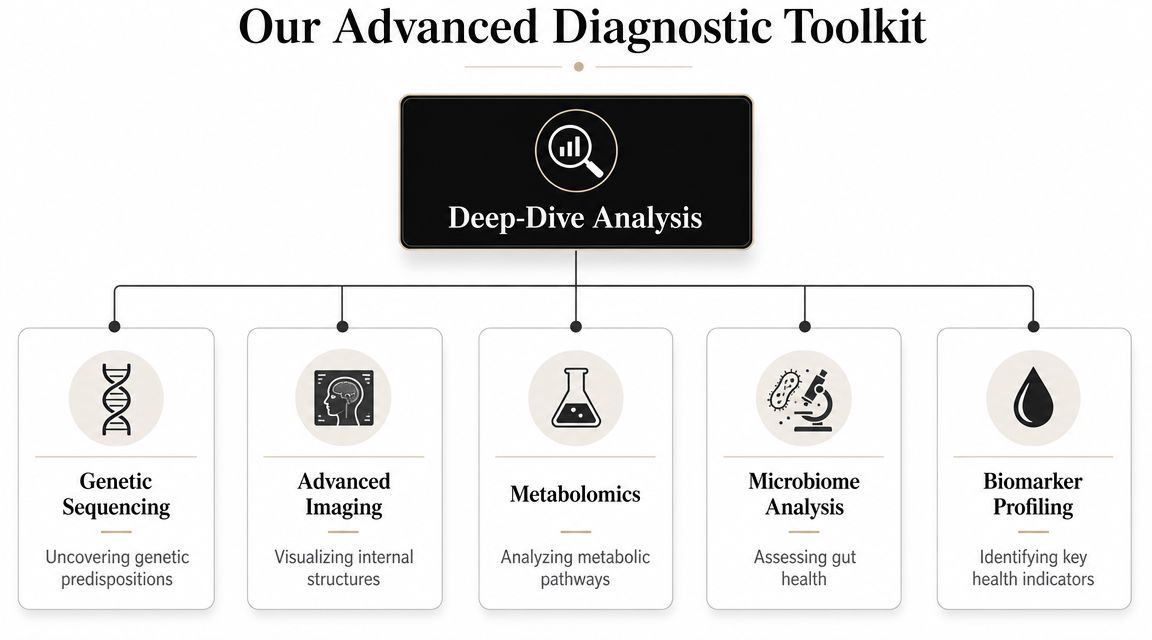
Imaging that shows structure and hidden patterns
Advanced imaging answers questions that symptom checklists can't. If pain, inflammation, reduced performance, or unexplained decline is part of the picture, structure matters. Anatomy, tissue quality, silent abnormalities, and patterns across organ systems all add context.
An AI-enhanced full-body MRI can support that deeper review by helping clinicians examine broad structural information in a more integrated way. It doesn't replace medical judgment. It expands what the team can inspect.
Biomarkers that show function in real time
Imaging tells you what tissues look like. Biomarkers help show how the body is functioning right now.
An in-house clinical lab can evaluate patterns involving inflammation, metabolic balance, nutrient status, recovery, and broader physiologic stress. That kind of data matters because many patients don't have one obvious problem. They have a web of subtle shifts that, together, create fatigue, pain, poor recovery, brain fog, or accelerated aging.
Cardiac evaluation and physiologic reserve
Some symptoms that feel vague are rooted in capacity. A person says they're tired, but the deeper issue may involve circulation, recovery strain, or the heart's ability to keep pace with demand.
That's why advanced heart evaluation belongs in a root cause framework. It helps clarify whether the body's delivery system is supporting healing, exercise tolerance, cognitive performance, and long-term resilience.
AI can help, but it can also mislead
Modern medicine produces a flood of information. Labs, scans, wearable data, symptom histories, and longitudinal trends create a high-data environment. That's where AI-assisted analysis can be useful. The broader discussion around RCA notes that in data-heavy settings, AI can help teams detect patterns across complex datasets, but it can also increase false attribution if correlated events are mistaken for true causes, as summarized in the Wikipedia overview of root cause analysis.
That warning matters.
A scan finding isn't always the reason you feel unwell. A marker that's out of range isn't always the driver of disease. A wearable alert isn't always clinically meaningful. Good root cause analysis testing uses technology to widen the lens, then uses clinical reasoning to decide what matters.
More data doesn't automatically create more clarity. It only helps when someone can tell signal from noise.
Your Diagnostic Journey Step by Step
Patients often imagine this process as one long battery of tests. It's better understood as a guided investigation. Each step has a different purpose, and each one helps prevent the most common mistake in health analysis, which is jumping to conclusions too early.

Step one begins with your story
The first phase is clinical listening. Your history matters because symptoms don't happen in a vacuum. Timing, triggers, medications, injuries, stress, sleep, digestive patterns, athletic load, and family context all shape what the data means.
This is also where a vague complaint gets translated into something more precise. “I'm exhausted all the time” becomes a clearer working problem that can be examined.
Step two gathers the hard evidence
The next stage is data collection. That may include lab work, imaging, cardiac testing, sleep-related evaluation, and other targeted assessments depending on your history.
If you want a closer look at one of the core data streams in this process, you can review our in-house clinical lab resources.
A short visual overview can help make the process easier to picture.
Step three connects the dots
Root cause analysis testing distinguishes itself from a routine workup. Teams don't just read isolated results. They compare findings across systems and ask structured questions about causality.
A common benchmark in RCA is the 5 Whys method, but authoritative guidance stresses that it's only a rule of thumb. Tableau notes that reaching a root cause may take as few as 2 or as many as 50 rounds of questioning, and not every problem is solved by a simple single chain of “why” questions, as described in Tableau's explanation of root cause analysis.
That's why skilled teams don't rely on one method alone.
Linear issues may respond to repeated why-questioning.
Multi-factor conditions often need a broader map of contributing causes.
Unclear patterns require validation with evidence, not instinct.
Step four produces a causal map
Once the data is assembled, clinicians and scientists can build a working model of what's driving the problem. That map may include structural findings, biochemical stress, inflammatory contributors, recovery bottlenecks, and lifestyle factors that keep the condition active.
It's less like getting a grade on a test and more like receiving an architectural report on your body.
Patients usually feel relief at this stage. Not because every answer is perfect, but because the pattern finally makes sense.
Step five turns findings into a plan
The final review is a strategy conversation. You walk through the findings, ask questions, and discuss which causes are most important to address first.
That sequence matters because treatment works better when it follows a coherent map. Otherwise, care becomes trial and error.
From Diagnosis to Personalized Treatment
A useful diagnosis should change what you do next. If root cause analysis testing only produces interesting information, it hasn't gone far enough. Value appears when findings shape a treatment plan with clear logic.

Not every finding deserves equal weight
One of the hardest parts of RCA is deciding whether something is a true root cause or only a contributing factor. CMS guidance explains that multiple root causes are common and that teams often need to prioritize the top 2–3 causes for action rather than trying to fix everything at once, as outlined in CMS guidance for root cause analysis.
That principle translates well into medicine.
If a patient has poor sleep, increased inflammatory burden, deconditioning, and nutrient deficits, all of those matter. But they don't all have the same impact. A smart plan identifies which corrections are most likely to prevent the pattern from recurring.
What personalization actually looks like
Here's the practical logic:
| If the analysis suggests | The care plan may emphasize |
|---|---|
| Recovery is impaired after stress or exercise | Recovery support, sleep optimization, targeted rehabilitation |
| Inflammatory burden appears central | Anti-inflammatory nutrition, restorative therapies, careful immune modulation |
| Structural degeneration is part of the picture | Regenerative strategies, guided procedures, movement correction |
| Energy production appears strained | Nutrient repletion, metabolic support, peptide-based strategies |
| Multiple systems are involved | Sequenced treatment, not all-at-once treatment |
This is also where regenerative medicine becomes more precise. Instead of applying a generic protocol, the findings can guide which tools are appropriate and in what order. That may include peptides, hyperbaric oxygen therapy, nutrition changes, physical medicine, or regenerative options explained in this overview of how regenerative medicine works.
In a clinic setting such as Longevity Medical Institute, clinicians may also consider allogeneic cell-based therapies based on the patient's full diagnostic picture. The institute's biotechnology lab produces five types of stem cells, including placental, Wharton's jelly, adipose, endometrial, and dental pulp. The key point isn't the menu of therapies. It's the matching process.
Why this feels different to patients
People often say personalized medicine sounds vague until they see how directly the findings affect decisions. If the body shows a tissue problem, the plan looks different than if the body shows an energy problem. If the main issue is inflammatory signaling, the sequence changes again.
That's the difference between a protocol and a blueprint. A protocol treats categories. A blueprint treats the person in front of you.
The Benefits of Knowing Your Biological Blueprint
Individuals often seek answers because they want relief. That's reasonable. But the deeper value of root cause analysis testing is that it gives you a more useful relationship with your own health.
You stop reacting blindly. You start making decisions with context.
From reactive care to proactive care
When you understand the pattern behind your symptoms, you can act earlier. You don't have to wait until function drops further before paying attention. You can track what's changing, what's improving, and what still needs support.
That can change how patients approach training, travel, sleep, work stress, and recovery. It can also change compliance. People tend to follow a plan more consistently when the plan makes biological sense to them.
Better personalization, less guesswork
Generic health advice often fails because it treats everyone as if they share the same bottlenecks. They don't.
A person whose main issue is inflammation needs a different strategy than someone whose major limitation is sleep disruption or structural degeneration. A data-informed blueprint reduces wasted effort and makes treatment sequencing more rational.
A stronger long-term view
This approach also supports healthspan. You're not only looking for today's explanation. You're building a framework for better resilience over time.
For many patients, that becomes easier to maintain when information is organized and visible in one place. Tools like the Longevity Patient App with a 360-degree view of your health can help patients follow trends, review findings, and stay engaged with the bigger picture.
Knowing your biology doesn't guarantee perfect health. It does give you a better chance of making the right decision at the right time.
Frequently Asked Questions about RCA Testing
How long does the process take?
It depends on which diagnostics are needed and how complex the case is. Some patients move through the process quickly. Others need a broader workup so the team can compare multiple data sources before making recommendations. The goal isn't speed alone. It's clarity.
How is this different from a standard executive physical?
A standard physical is often designed to screen for obvious issues and establish baseline health information. Root cause analysis testing goes further by integrating findings across systems and asking why symptoms, decline, or poor recovery are happening.
| Feature | Standard Executive Physical | LMI Root Cause Analysis Testing |
|---|---|---|
| Primary goal | General screening and baseline review | Identify deeper drivers behind symptoms and performance decline |
| Data interpretation | Often reviewed in separate categories | Interpreted as a connected biological system |
| Focus | Current health snapshot | Causal patterns, recurrence prevention, and treatment design |
| Treatment planning | May remain general | Built around prioritized findings |
| Usefulness for unexplained symptoms | Can be limited | Better suited to multi-factor problems |
Is this only for people with a diagnosis?
No. Many people seek root cause analysis testing because they feel off, not because they carry a formal diagnosis. Low energy, poor recovery, inflammation, brain fog, pain, or a sense of accelerated aging can all justify a more serious investigation.
Where can I learn more about logistics and patient questions?
You can review the institute's frequently asked questions for practical information about consultations, planning, and the patient experience.
If you're tired of chasing symptoms without understanding the pattern underneath them, Longevity Medical Institute offers physician-led evaluation and personalized regenerative care designed to investigate your health at a deeper level. Articles like this are published through the Institute's Treatments and Resources library.
Author
Dr. Kirk Sanford, DC, Founder & CEO, Longevity Medical Institute. Dr. Sanford focuses on patient education in regenerative and longevity medicine, translating complex therapies into clear, practical guidance for patients.
Medical Review
Dr. Félix Porras, MD, Medical Director, Longevity Medical Institute. Dr. Porras provides clinical oversight and medical review to help ensure accuracy, safety context, and alignment with current standards of care.
Last Reviewed: May 28, 2026
Short Disclaimer
This information is for educational purposes only and is not medical advice. It does not replace an evaluation by a qualified healthcare professional. For personalized guidance, please schedule a consultation.