

Spinal Cord Injury Stem Cell Therapy: A New Horizon for Recovery
For years, a spinal cord injury diagnosis often signified a final word on recovery, leaving individuals with few options beyond managing symptoms. Regenerative medicine, however, is opening an entirely new chapter, and spinal cord injury stem cell therapy is at the very heart of this progress. This sophisticated approach marks a fundamental shift away from simply managing damage to actively creating a healing environment within the spinal cord itself.
A New Chapter in Spinal Cord Injury Recovery
The environment within the spinal cord after an injury is incredibly hostile. The initial trauma sets off a destructive chain reaction of inflammation, which can cause even more secondary damage. This process ultimately creates a dense scar that blocks nerve signals and halts any natural repair in its tracks.
This is precisely where stem cell therapy offers a new way forward.
Think of stem cells not as a magic bullet, but as a team of sophisticated cellular architects and first responders deployed directly to the site of injury. Their primary role isn't always to become new nerve cells—though that is one possibility. Instead, they perform a number of critical support functions essential for fostering recovery.
The Core Goals of Stem Cell Therapy
The strategy behind using stem cell therapy for spinal cord injuries is multi-pronged. It’s about fundamentally changing the environment at the injury site to make it more receptive to healing. The primary objectives are to:
Control Inflammation: Stem cells release powerful anti-inflammatory signals that calm the destructive inflammatory storm, much like a specialized firefighting crew containing a blaze. This helps protect surviving, uninjured nerve cells from further harm.
Protect Existing Neurons: They produce neurotrophic factors—think of these as high-potency fertilizer for neurons. These factors nourish and support the health of existing nerve cells, helping them resist damage.
Modulate the Scar: By changing the cellular environment, stem cells can help remodel the dense glial scar tissue, potentially making it more permeable for new nerve connections to grow through.
Foster New Connections: Stem cells can encourage neuroplasticity, which is the brain and spinal cord's incredible ability to form new connections. They create a supportive scaffold that may enable new communication pathways to develop around the damaged area.
A common misconception is that stem cells work by simply replacing all damaged tissue. In reality, their most powerful contribution is often their ability to orchestrate the body's own repair mechanisms, creating an environment where healing is possible.
Instead of being presented as a guaranteed cure, spinal cord injury stem cell therapy is a scientifically grounded advancement designed to improve function and quality of life. For a deeper dive into the foundational science, you can learn more about stem cell education made simple in our guide. This therapy represents a significant step forward, offering hope built on a foundation of clinical research and a growing understanding of cellular biology.
How Stem Cell Therapy Works for Spinal Cord Injuries
To understand how stem cell therapy can help with a spinal cord injury (SCI), we must first appreciate what happens inside the body following the injury. The initial trauma sets off a devastating chain reaction: intense inflammation floods the area, healthy cells begin to die off, and the body forms a dense wall of scar tissue. This scar acts as a physical roadblock, preventing nerve signals from getting through and halting any chance of natural regeneration.
Modern stem cell therapy does not attempt to simply replace what was lost. Instead, the goal is to intervene in this destructive process. It’s about transforming the hostile environment at the injury site into one that can actively support healing and protect the nerve cells that survived. The cells act like an on-site 'support crew,' coordinating a series of restorative actions.
The Mechanisms of Cellular Restoration
Stem cells are not a one-trick pony; they work through several powerful mechanisms simultaneously. This multi-faceted approach is what gives them such potential in addressing the incredible complexity of a spinal cord injury.
Immunomodulation: Stem cells are masters at calming an aggressive inflammatory response. Think of it as turning down the volume on the body's blaring alarm system, which in turn saves surviving nerve cells from being collateral damage.
Neuroprotection: They release powerful neurotrophic factors—essentially potent fertilizers for neurons. These proteins nourish and shield existing nerve cells, helping them survive the toxic environment created by the injury.
Scar Remodeling: By releasing specific signals, stem cells can help soften and break down that dense glial scar. This can potentially create new pathways for nerve fibers to regrow and reconnect.
Stimulating Angiogenesis: They encourage the formation of new blood vessels, a critical step for bringing fresh oxygen and nutrients to the injured tissue while clearing out waste.
This concept map breaks down how stem cell therapy intervenes at these key points following a spinal cord injury.
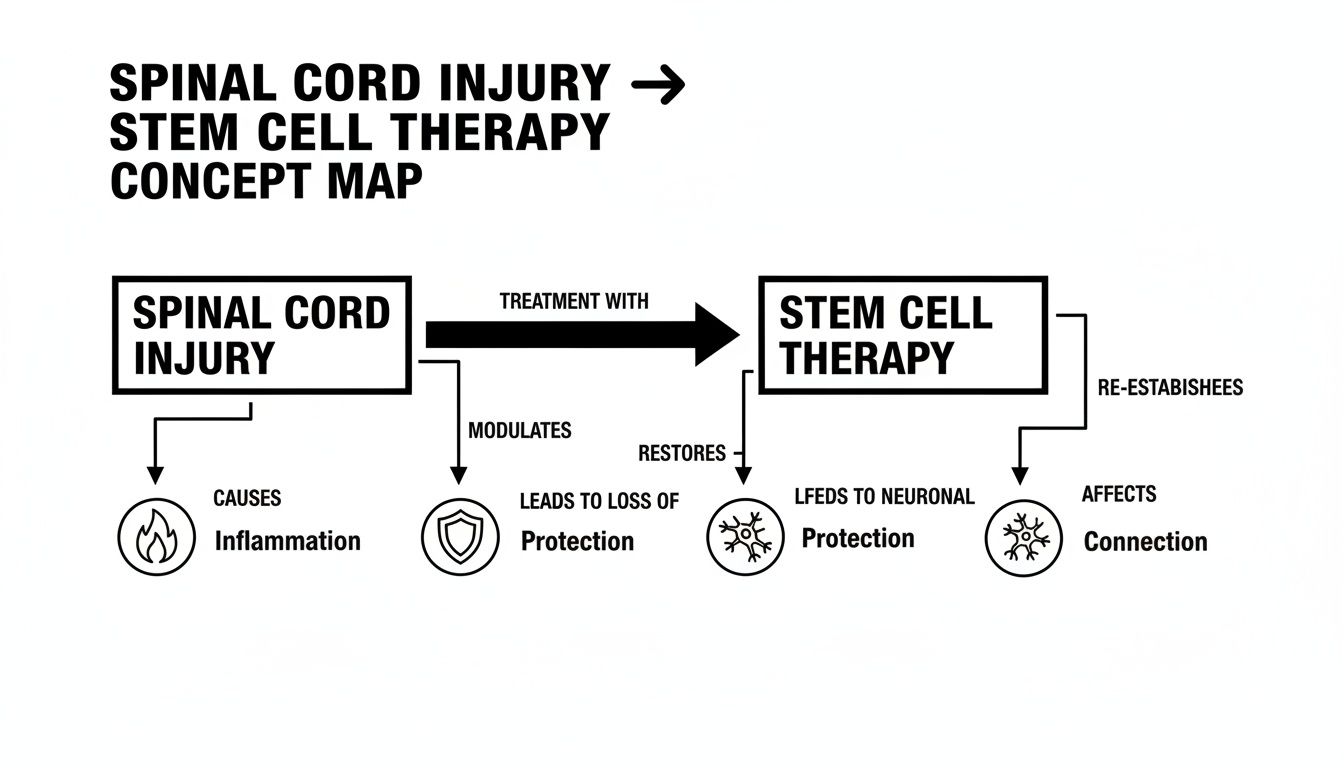
As you can see, the process starts by targeting inflammation to protect existing neurons. This then creates an environment where new neural connections can begin to form, which is the key to promoting functional recovery.
The Role of MSCs, Exosomes, and Other Approaches
The field of regenerative medicine utilizes several types of cellular therapies, each playing a distinct role. When it comes to spinal cord injuries, our focus narrows to a few key players.
To clarify these different approaches, here's a comparison of the cellular therapies most commonly used for SCI.
Comparing Cellular Therapies for SCI
| Therapy Type | Source | Primary Mechanism | Analogy |
|---|---|---|---|
| Mesenchymal Stem Cells (MSCs) | Umbilical Cord, Adipose Tissue, or Bone Marrow | Orchestrate repair, control inflammation, and release growth factors. | The construction managers of the repair site, directing the entire healing process. |
| Neural Stem Cells (NSCs) | Specialized donor cells | Can potentially differentiate into new neurons or support cells within the spinal cord. | The specialized technicians brought in to replace specific, highly technical components. |
| Exosomes | Secreted by stem cells (cell-free) | Deliver targeted instructions (proteins, miRNA) to existing cells. | The blueprints and instructions sent from the managers to the workers on site. |
While each of these therapies holds promise, they work in different ways. Our clinical focus is often on Mesenchymal Stem Cells (MSCs) and their exosomes due to their powerful signaling capabilities and excellent safety profile.
Mesenchymal stem cells (MSCs) are the workhorses of regenerative therapy. These adult stem cells are especially skilled at controlling inflammation and releasing a cocktail of growth factors. They are prized for their ability to orchestrate a healing environment without triggering an immune reaction. You can explore our deep dive into Mesenchymal Stem Cell Therapy in Los Cabos to learn more.
Exosomes, on the other hand, are not cells at all. They are microscopic 'messenger bubbles' released by stem cells. These tiny vesicles are packed with the proteins and genetic signals that instruct surrounding cells to calm down, protect themselves, and start repairing.
Think of MSCs as the skilled doctors directing the recovery, and exosomes as the prescriptions and instructions they send out to get the job done. Using exosomes allows for a cell-free therapy that delivers the powerful signaling benefits of stem cells in a highly concentrated form.
Autologous vs. Allogeneic Sources
Another key distinction is where the cells originate. This choice has major implications for the potency of the treatment, its accessibility, and the overall therapeutic strategy.
Autologous Therapy: This approach uses stem cells harvested from your own body, usually from bone marrow or adipose (fat) tissue. The primary benefit is that there is zero risk of immune rejection since the cells are your own. However, harvesting them requires an invasive procedure, and the quality and quantity of these cells decline significantly with age.
Allogeneic Therapy: This method uses young, vibrant stem cells sourced from the umbilical cord tissue of a healthy, carefully screened donor. These cells are pristine and can be cultured into large quantities, ensuring a consistent and highly potent dose for every treatment. Because they are "immunoprivileged," they do not trigger an immune response, making them a safe and more powerful option for most patients.
What the Latest Clinical Research Is Telling Us
While the science behind spinal cord injury stem cell therapy is fascinating, what truly matters is its performance in the real world with patients. As we move from the laboratory to the clinic, research paints a picture of careful optimism. It highlights both the incredible promise and the current limitations of these therapies. The goal has shifted from simply trying to prevent more damage to actively helping the body repair and recover function.
When we look at clinical trials, we are really asking two straightforward questions: Is it safe? And does it make a meaningful difference in a person's life? We are not looking for a miracle cure overnight. We are looking for consistent, measurable improvements that give patients back their independence and quality of life.
Turning Clinical Data into Real-World Outcomes
The best clinical trials rely on standardized measurements to track progress. One of the most important is the ASIA Impairment Scale (AIS), which grades the severity of a spinal cord injury based on motor and sensory function. Seeing a patient’s grade improve—for instance, moving from an AIS A (a complete injury with no function) to an AIS B (some sensation returns below the injury)—is a profound achievement. It is tangible proof of neurological change.
These are the kinds of changes that matter. An improvement in sensation could mean feeling a loved one’s hand for the first time in years. A gain in motor function might translate into better bladder control or the ability to wiggle a toe that was once completely still.
And recent studies are showing us that these functional gains aren't just a possibility; they are happening with increasing regularity in well-controlled clinical trials.
The entire point of modern clinical research is to generate results that can be repeated. It's about proving that certain therapies can lead to concrete improvements in movement, feeling, and automatic body functions, giving patients a clear, evidence-based roadmap for recovery.
This focus on evidence is vital. It grounds hope in reality, helping patients and families understand what is truly achievable with spinal cord injury stem cell therapy today.
Landmark Trials and What We Have Learned
A growing body of research is cementing both the safety and potential of stem cell therapy for SCI. A landmark Phase 1 trial from Mayo Clinic, known as CELLTOP, has delivered some particularly powerful results. In this study, 10 patients with traumatic SCI received stem cells taken from their own fat tissue. The findings, published in Nature Communications, were outstanding from a safety perspective—all 10 participants tolerated the cells without any serious adverse effects.
Even more remarkably, seven out of the 10 participants improved by at least one full grade on the AIS scale, a powerful indicator of genuine neurological recovery. One patient, dubbed a "super-responder," showed massive improvements in function in both their arms and legs. This builds on earlier work, like studies where patients with subacute SCI treated with bone marrow stem cells also saw significant AIS upgrades and functional gains. To get a better sense of the research landscape, you can review our published research.
These findings are crucial for a few key reasons:
Safety Is Confirmed: They show that administering high doses of mesenchymal stem cells is a safe procedure with manageable side effects, like temporary headaches. Learn more about stem cell safety in our published research.
Efficacy Is Demonstrated: The high percentage of patients showing real functional improvement provides strong evidence that the therapy is having a biological effect.
It Builds a Foundation: Every successful trial gives scientists more data to refine treatment protocols, determine the best cell dosages, and identify which patients are most likely to respond well.
As more data like this comes to light, we get a much clearer picture of how to best utilize these therapies. You can learn more about the science that informs our own protocols by exploring our research initiatives at Longevity Medical Institute. All evidence points in one direction: we are entering a new era where stem cell therapy is becoming a cornerstone of a complete recovery strategy for spinal cord injuries.
Your Treatment Journey at Our Institute
Choosing to move forward with regenerative therapy is a significant decision, and we believe the entire experience should feel as restorative as the therapy itself. That is why we have created a clear, physician-led process designed around your unique biology and clinical needs.
Your journey with us is a partnership built on trust, transparency, and an unwavering commitment to excellence. We want you to feel confident and informed every step of the way.
Here is a look at what you can expect as we combine advanced medical science with compassionate, comprehensive care tailored just for you.
Phase 1: The Initial Consultation and Diagnostic Evaluation
Everything starts with a deep, precise understanding of your injury. Your journey begins with a comprehensive consultation where our physician team will carefully review your medical history and conduct a detailed physical exam. But we do not stop there.
We use advanced diagnostics, including AI-enhanced MRI scans, to create a high-definition map of your spinal cord. This sophisticated imaging provides a remarkably accurate picture of the exact location and extent of the damage.
This detailed map serves as your personal baseline. It is the critical data we need to design a spinal cord injury stem cell therapy protocol that is meticulously tailored to your specific anatomy and neurological profile.
Phase 2: The Treatment Protocol and Cellular Administration
Once your personalized protocol is designed, we proceed to the treatment itself. At Longevity Medical Institute, the safety and quality of our cellular therapies are our highest priorities.
The mesenchymal stem cells (MSCs) we use are sourced from carefully screened, healthy donors. They are then processed in our on-site, COFEPRIS-licensed and ISO-certified laboratory. This rigorous quality control is non-negotiable; it ensures every single dose is pure, potent, and consistent.
Your treatment will be administered by our expert physicians, who use techniques like ultrasound-guided injections to deliver the cells with absolute precision. But the procedure is just one piece of a much larger, integrated plan.
Phase 3: Integrated Rehabilitation and Supportive Therapies
Receiving spinal cord injury stem cell therapy is the catalyst that creates the opportunity for healing. But dedicated rehabilitation is what translates that potential into real-world functional gains.
We cannot emphasize this enough: the procedure is not a standalone fix. It marks the beginning of a new recovery phase that requires your active participation to be successful.
To maximize your results, your protocol will be integrated with a suite of supportive therapies designed to enhance the effects of the stem cells. These often include:
Physical Medicine: Our specialists will create a targeted rehabilitation program to help you build strength, improve coordination, and retrain crucial neural pathways.
Hyperbaric Oxygen Therapy (HBOT): Breathing pure oxygen in a pressurized chamber floods your body's tissues with oxygen, which can reduce inflammation and give cells the fuel they need for repair.
Nutraceutical and IV Infusions: We use customized nutrient infusions to provide your body with the essential vitamins and minerals it needs for optimal healing at a cellular level.
This comprehensive approach creates a powerful synergistic effect, where each therapy amplifies the benefits of the others. You can learn more about our approach to regenerative rehabilitation therapy to see how these elements work together.
We view treatment as a partnership. The stem cells create the opportunity for repair, but the dedicated work you do in rehabilitation, supported by our advanced therapies, is what unlocks your full potential for recovery.
Phase 4: Ongoing Monitoring and Follow-Up Care
Your journey with us does not end when you leave the clinic. We are committed to your long-term progress, which is why your care includes a structured follow-up process.
We will schedule regular check-ins to monitor your functional improvements, track your progress against your initial baseline data, and answer any questions that arise. This ongoing relationship allows us to fine-tune your supportive care plan as you continue to heal.
Our goal is to provide complete transparency and unwavering support from your very first call through every step of your ongoing health journey.
How to Choose a Safe and Reputable Clinic
Navigating your options for spinal cord injury stem cell therapy is a significant decision. In a field with so much hope, choosing the right clinical partner is everything. A confident, informed choice comes down to prioritizing safety, deep expertise, and complete transparency. The quality and credibility of the clinic you select are the foundation for your entire journey.
It is also natural to have questions about safety. While stem cell therapy is broadly considered safe, some patients might experience minor, temporary side effects like a low-grade fever, headaches, or some discomfort where the cells are administered. In a top-tier clinical setting, these are things your medical team anticipates and manages with ease, ensuring your comfort is always the priority.
Key Credentials of a Leading Clinic
When you evaluate a clinic, certain credentials are simply non-negotiable. These certifications are your assurance that a facility operates at the highest level of medical oversight, quality, and safety.
Physician Expertise: Your treatment should be led by specialist physicians with years of experience in regenerative medicine and, specifically, in treating neurological conditions. Their expertise is what ensures your protocol is not only designed for the best possible outcome but also administered with absolute precision.
Laboratory Certification: The quality of the cells is directly linked to the quality of the laboratory. Look for clinics that have their own on-site, government-licensed lab. In Mexico, this means approval from COFEPRIS, the nation's equivalent of the FDA.
International Quality Standards: An ISO certification is another critical sign of a high-caliber laboratory. It proves the facility follows strict international standards for quality management, which guarantees the purity, viability, and consistency of the cells used in your therapy.
These credentials are not just pieces of paper; they are your guarantee that the cells being used are pure, potent, and safe. An uncertified lab simply cannot provide this level of assurance, introducing unacceptable risks into your treatment.
Understanding Regulatory and Travel Logistics
For patients traveling from the United States or Canada, receiving care in Mexico provides access to advanced therapies inside a strong and well-established regulatory framework. At Longevity Medical Institute in San José del Cabo, our facilities are fully licensed by COFEPRIS, which provides a level of governmental oversight that ensures patient safety and clinical integrity.
The financial and logistical aspects of treatment are also becoming more straightforward as the field grows. Market analyses reflect this momentum, with one report estimating the global spinal cord injury regenerative sector will expand from USD 54 million in 2026 to USD 655 million by 2035. This growth is a direct result of increasing clinical validation and patient demand, making established medical destinations like ours a hub for international care. You can read more about study findings on Mayo Clinic's professional portal to better understand the research.
A leading clinic should also offer dedicated concierge services to manage every aspect of your travel, from private transportation to luxury accommodations. This allows you to focus completely on your health and recovery. For more general information on this topic, you can also check out our guide on whether stem cell therapy is safe.
Ultimately, choosing the right clinic means finding a team that brings together proven scientific protocols, rigorous safety standards, and compassionate, patient-first care.
Looking Ahead at Spinal Cord Injury Treatment
The progress we are seeing today in treating spinal cord injuries is extraordinary, but it is important to understand that this is just the beginning. The future is not about small, incremental improvements; it's about a fundamental shift in what we believe is possible for recovery.
We are on the cusp of a new era, with next-generation therapies already in development that promise to be even more precise and effective. Scientists are looking beyond current methods, exploring ways to engineer cells for specific repair tasks and create advanced delivery systems that can target the injury site with pinpoint accuracy. This is not science fiction—it is the active, evolving frontier of clinical care.
A Future Driven by Innovation and Investment
The momentum behind this field is undeniable, evident in both clinical research and the financial investment pouring in. Dozens of promising therapies are currently moving through clinical trials across the globe, including next-generation allogeneic stem cells, specialized oligodendrocyte progenitor cells (AST-OPC1), and platforms using a patient's own olfactory cells.
This groundswell of research is attracting serious attention. The global market for regenerative medicine in spinal cord injury was valued at just USD 16 million in 2025. Projections show it soaring to USD 655 million by 2035—a powerful signal of growing confidence and validation from the medical community. You can read the research detailing the global therapy pipeline to see the sheer scope of what is being developed.
This is not just a trend. The growth is fueled by real demand and encouraging results from early trials in major markets. What was once considered experimental is steadily becoming a recognized, accessible path toward meaningful recovery.
The ultimate goal is not just to manage an injury but to restore function and empower patients. Every new discovery and successful trial brings us closer to a future where significant recovery from a spinal cord injury is the expectation, not the exception.
The Path Forward Is Integrated and Empowered
While spinal cord injury stem cell therapy represents a monumental leap forward, it is crucial to see it for what it is: a powerful catalyst. The cells create the biological opportunity for repair, but it is the dedicated, focused rehabilitation that turns that cellular potential into real-world gains in movement, sensation, and independence.
Think of it this way: the therapy rebuilds the bridge, but rehabilitation teaches you how to walk across it again. The future of care is fully integrated, combining the most advanced cellular biology with personalized, hands-on physical medicine.
This journey is one of empowered hope, grounded in scientific progress and clinical expertise. If you are ready to explore what this new chapter in medicine could mean for you or your loved one, we invite you to take the next step. Discover your personal options for recovery by scheduling a consultation with our physician team today.
Frequently Asked Questions
When exploring a path as significant as spinal cord injury stem cell therapy, it is natural to have many questions. This is not just about the science; it is about your life, your function, and your future.
Here, we have gathered straightforward answers to the most common questions we hear from patients and their families. Our goal is to provide clear, honest information so you can move forward with confidence and a solid understanding of what is possible.
Am I a Good Candidate for This Therapy?
This is the first and most important question for anyone considering this journey. Candidacy is not based on a simple checklist; it is determined through a comprehensive medical evaluation. Our physicians look at several key factors, including the type of your injury (complete vs. incomplete), its severity, and importantly, the time that has passed since the injury occurred. Your overall health is also a critical piece of the puzzle.
Generally, individuals with subacute or chronic injuries who are in stable health are the most promising candidates. However, the only way to know for sure is through a deep-dive evaluation. We use advanced diagnostics to map out your specific neurological condition and determine if a regenerative protocol is a genuinely promising option for you.
What Are Realistic Expectations for Improvement?
It is absolutely vital to approach this therapy with grounded, realistic expectations. This is not a "cure" for spinal cord injury. Instead, think of it as a powerful biological tool designed to support and amplify your body's own capacity for repair. The goal is functional improvement, not a complete reversal of the injury.
So, what could that look like? The potential gains are highly individual, but they often fall into these categories:
Improved Sensation: Some patients begin to regain feeling, even if subtle, below their level of injury.
Increased Motor Function: This can range from the return of small muscle twitches to more significant gains in voluntary limb movement.
Better Autonomic Function: For many, improvements in bladder, bowel, and sexual function have a profound impact on daily independence and quality of life.
It is important to remember that progress is almost always gradual. It also depends heavily on your commitment to a dedicated and intensive rehabilitation program after the procedure.
The aim of spinal cord injury stem cell therapy is to create the biological potential for recovery. Your commitment to physical medicine and supportive therapies is what helps translate that potential into tangible, real-world function.
How Long Does It Take to See Results?
Recovery from a spinal cord injury is a marathon, not a sprint. The healing process at the cellular level is a slow and steady one, and the timeline can vary dramatically from one person to another.
Some patients might notice subtle changes within the first few months. For others, the most meaningful improvements may unfold over the course of a year or more. Your timeline will be influenced by the specifics of your injury, your age, your overall health, and how diligently you work in your rehabilitation program. Patience and persistence are your greatest allies here; progress often arrives in small but incredibly meaningful steps.
Is the Treatment Painful?
We make your comfort a top priority throughout the entire process. The administration of stem cells is a minimally invasive procedure, most often performed through a simple intravenous (IV) infusion or a targeted injection, such as a lumbar puncture.
An IV infusion is painless. If your protocol involves a targeted injection, you might feel some temporary, localized discomfort, much like getting a standard shot. Our medical team is highly skilled in making this process as comfortable as possible. Most patients report only mild, short-lived side effects like a temporary headache or soreness, which are easily managed.
At Longevity Medical Institute, we believe that an empowered patient is a successful one. If you have more questions or wish to explore your personal options for recovery, we invite you to take the next step. Schedule a physician consultation today to learn how our science-backed regenerative programs can support your journey toward a better quality of life. Begin your journey with us.
Author
Dr. Kirk Sanford, DC — Founder & CEO, Longevity Medical Institute. Dr. Sanford focuses on patient education in regenerative and longevity medicine, translating complex therapies into clear, practical guidance for patients.
Medical Review
Dr. Félix Porras, MD — Medical Director, Longevity Medical Institute. Dr. Porras provides clinical oversight and medical review to help ensure accuracy, safety context, and alignment with current standards of care.
Last Reviewed: March 20, 2026
Short Disclaimer
This information is for educational purposes only and is not medical advice. It does not replace an evaluation by a qualified healthcare professional. For personalized guidance, please schedule a consultation.