

Stem Cell Injections for Hip Arthritis: A Patient's Guide
Living with chronic hip pain from osteoarthritis can feel like an unwelcome restriction on your life. Simple pleasures once taken for granted—a morning walk, playing with grandchildren, or even rising from a chair without a second thought—can become significant obstacles. For years, the path forward seemed limited: temporary relief from steroid injections or the finality of a total hip replacement.
But what if a third path existed? One that collaborates with your body's innate healing potential.
This is the promise of regenerative medicine, offering a fundamentally different approach to hip pain. Stem cell injections for hip arthritis are a sophisticated, non-surgical therapy designed to do more than simply mask symptoms. The objective is to foster a healing environment within the joint itself to reduce pain, improve mobility, and help you return to the life you wish to lead.
This guide will illuminate what this advanced therapy is, how it functions, and who it is designed to help.
Your Guide to a Life Beyond Hip Pain
Consider stem cells your body’s master repair crew. These remarkable cells possess the unique ability to coordinate a powerful healing response wherever they are needed. The core principle of this therapy is to deliver a concentrated dose of these specialized cells directly into your arthritic hip, sending in the reinforcements your body requires to counter the ongoing damage.
The primary objective is to provide lasting relief and, in many cases, help you delay—or even avoid—the need for a highly invasive hip replacement surgery.
Shifting from Management to Regeneration
Standard treatments for osteoarthritis are largely focused on managing symptoms. They do not address the underlying issue: the progressive breakdown of cartilage, the smooth, protective cushion within your hip joint. As this cushion erodes, it leads to the friction, inflammation, and pain that steadily worsen over time.
Regenerative medicine offers a paradigm shift.
At its core, stem cell therapy for hip arthritis is about creating a pro-healing environment within the joint. Instead of just managing pain, the objective is to calm inflammation, protect the cartilage you still have, and signal your own body to begin the repair process.
We utilize your body’s own powerful mesenchymal stem cells (MSCs) to orchestrate this healing. When a physician injects these cells with precision into the hip joint, they immediately begin their work. They don't simply become new cartilage; they act as intelligent project managers for the entire repair site.
Here is what they do:
Calm Chronic Inflammation: MSCs are experts at quieting the inflammatory signals that drive your pain and cause further joint damage. This is often the first benefit patients notice.
Stimulate Tissue Repair: They release a cascade of growth factors—think of them as biological "blueprints"—that instruct your local cells to begin rebuilding and protect the tissue that remains.
Improve Mobility and Function: As pain and inflammation decrease, your range of motion increases. Patients often find they can move more freely and return to the activities they love.
At Longevity Medical Institute, this physician-led therapy is a cornerstone of our mission. We are focused not just on helping you live a life free from pain, but on extending your healthspan—the years you spend in excellent health. Our entire approach is built on providing advanced, safe, and effective solutions that empower you to reclaim your vitality.
How Stem Cells Address Hip Osteoarthritis
To truly appreciate how stem cell therapy works for hip arthritis, it helps to visualize what is occurring inside the joint. Imagine the smooth, slick tread on a new tire. This is much like the healthy cartilage in your hip—a resilient cushion that allows the ball and socket to glide past each other without friction.
With hip osteoarthritis, however, that tire tread has worn dangerously thin. The cartilage becomes frayed and rough, eventually leading to painful bone-on-bone grinding. This constant friction triggers a chronic inflammatory response, which is the direct cause of the pain, stiffness, and frustrating loss of mobility you experience.
The Role of Your Body's Natural Repair Crew
This is where mesenchymal stem cells (MSCs) intervene. When a concentrated dose is precisely injected into the hip joint, they do not simply attempt to become new cartilage. Instead, they act as the body’s own intelligent signaling agents, becoming the conductors of a sophisticated healing orchestra.
Their primary function is to transform the joint's environment, shifting it from a state of chronic breakdown to one of active repair and protection. This regenerative process occurs through several key biological actions.
Calming the Inflammatory Storm
The first and most immediate effect of a stem cell injection for hip arthritis is a powerful anti-inflammatory response. MSCs release specialized molecules that act like circuit breakers, interrupting the inflammatory signals that send pain messages to your brain.
This is fundamentally different from a steroid injection, which temporarily muffles inflammation. Instead, it is a biological process that encourages the joint to reset itself to a calmer, healthier state. By quieting this inflammatory fire, the therapy delivers significant pain relief and helps break the vicious cycle of ongoing cartilage damage.
Orchestrating Cellular Repair and Protection
Once the inflammation is under control, the stem cells can begin their primary work: coordinating the repair process. They accomplish this by releasing a rich blend of growth factors and other signaling proteins.
Think of these growth factors as a set of biological blueprints and instructions delivered directly to the construction site. They signal the local cells in your hip to protect the remaining cartilage from further breakdown and stimulate a natural repair response.
This complex cellular communication achieves several critical goals:
Chondroprotection: The signaling molecules help protect your existing cartilage cells (chondrocytes) from premature cell death.
Modulating the Immune Response: MSCs guide the immune system to support healing rather than continuing to attack the joint.
Signaling for Reinforcements: They encourage nearby cells to contribute to tissue maintenance and repair.
The clinical evidence supporting this approach continues to grow. For instance, a 2023 study observing patients who received adipose-derived stem cell injections for hip osteoarthritis demonstrated significant benefits. Out of 55 patients, 51% required no further treatments at all. For those who did eventually progress to a hip replacement, the surgery was delayed by an average of nearly 16 months. Patients with early-to-moderate arthritis saw their pain scores drop dramatically.
This ability to manage pain and potentially delay major surgery is precisely what makes stem cell injections for hip arthritis such a compelling option. For a more detailed exploration of the science, you may be interested in our guide on how stem cell treatment works. Ultimately, the therapy aims to restore function not by introducing foreign materials into your body, but by activating its own profound capacity to heal itself.
The Patient Journey at Longevity Medical Institute
Choosing to pursue regenerative medicine is a significant decision. We believe the entire experience should feel as restorative as the therapy itself. Your journey with us is a seamless, physician-led process designed around your unique biology and clinical needs, all while prioritizing your personal comfort. It’s a partnership built on trust, transparency, and an unwavering commitment to excellence.
From your first conversation, our focus is squarely on you. We move beyond one-size-fits-all protocols to create a therapeutic strategy that is meticulously aligned with your specific health goals. This is the foundation of everything we do.
Phase 1: The Initial Consultation and Diagnostics
Your journey begins not with a procedure, but with a conversation. This one-on-one session with one of our specialist physicians is where we get to know you, your health history, and your goals. It's a deep dive into how hip pain affects your life and what you hope to achieve.
This initial meeting is followed by advanced diagnostics. It’s impossible to treat what you can’t see, so we use a suite of world-class tools to create a precise, detailed picture of your joint health.
High-Resolution Imaging: Detailed MRI or ultrasound scans allow us to see the exact extent of cartilage damage, inflammation, and any other structural issues inside your hip.
Comprehensive Lab Work: Our in-house clinical laboratory runs thorough blood panels to assess your overall health, check for underlying conditions, and confirm you are a strong candidate for regenerative therapy.
This data-rich approach is non-negotiable for us. It allows our medical team to move beyond guesswork and design a protocol that is truly built for you.
Phase 2: Your Personalized Treatment Plan
With a precise diagnosis in hand, our medical team collaborates to design your treatment protocol. This plan is crafted based on the severity of your osteoarthritis, your biological markers, and your desired outcomes.
Your plan will outline the specific type of regenerative therapy we recommend—whether it involves your own mesenchymal stem cells (MSCs), other powerful orthobiologics, or a combination approach. We will walk you through the science, the expected benefits, and answer every question you have.
We believe a well-informed patient is an empowered one. Our physicians take the time to translate complex medical science into clear, practical information, making you an active partner in your own health journey.
This collaborative process ensures your treatment is perfectly aligned with your unique biological needs.
Phase 3: The Stem Cell Procedure Day
When you arrive for your procedure, our team’s highest priorities are your comfort and safety. The entire process is minimally invasive and performed in a licensed, sterile medical facility.
Cell Sourcing: Rather than harvesting cells from your own fat tissue or bone marrow, we use carefully screened allogeneic donor stem cells obtained from approved tissue sources. This allows us to avoid an additional harvesting procedure and focus directly on delivering high-quality regenerative cells under strict safety and screening standards.
Cell Processing: Your sample is immediately taken to our on-site, COFEPRIS-licensed and ISO-certified laboratory. Here, our scientists use advanced methods to isolate and concentrate the powerful stem cells, creating a pure, high-potency injectate.
The Precision Injection: Your physician then uses sophisticated ultrasound guidance to perform the injection. This real-time imaging acts like a GPS for the needle, allowing us to see inside the joint and deliver the concentrated stem cells with pinpoint accuracy directly to the area of damage.
This infographic shows the core biological actions your stem cells initiate once they arrive at the site of your hip arthritis.
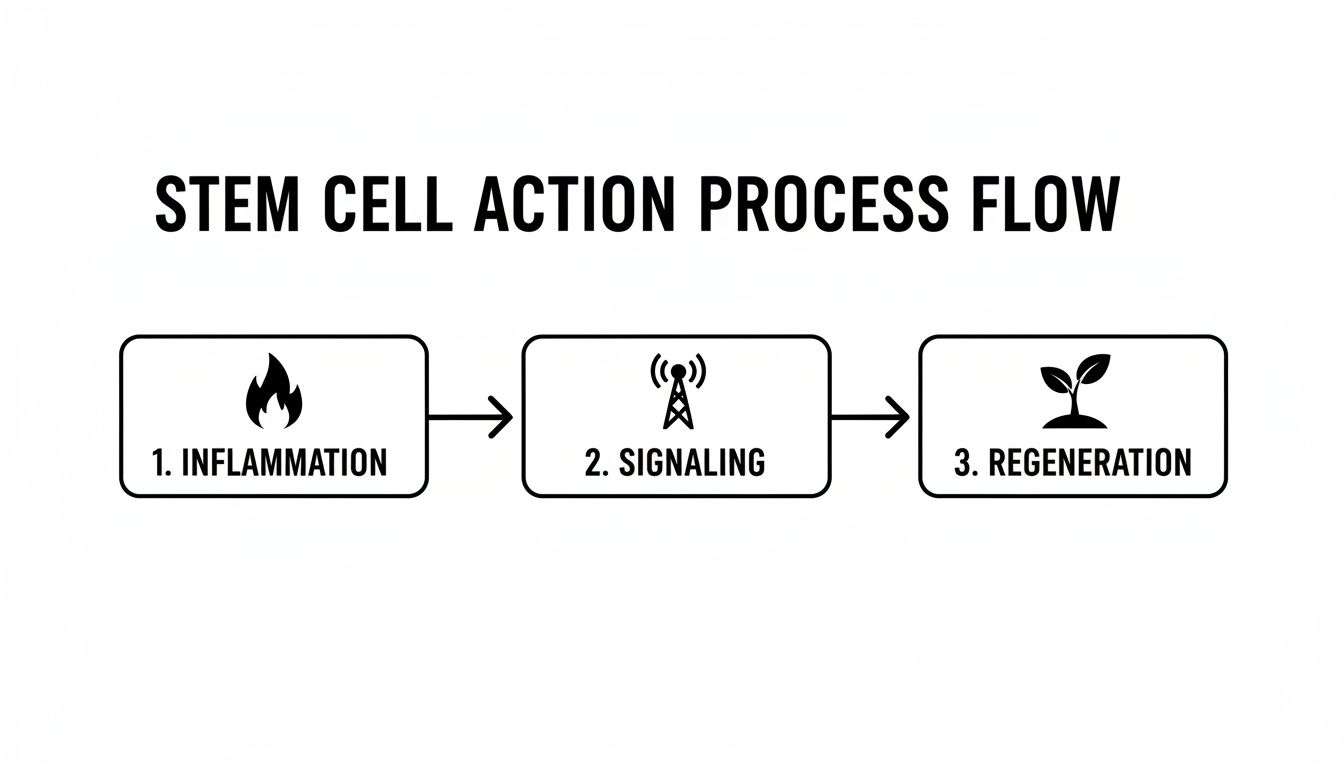
As you can see, the cells first work to quiet inflammation, then send out powerful signals to coordinate a healing response that leads to tissue regeneration.
Phase 4: Post-Procedure Recovery and Support
Our care for you doesn't end when the procedure is over. What follows is just as important. We provide a detailed recovery plan to support your body’s healing process and help you get the best possible results.
This includes specific guidance on rest, activity modification, and how to safely return to your normal routine. We may also integrate complementary therapies available at our institute, like physical medicine or hyperbaric oxygen therapy, to amplify the regenerative effects.
Regular follow-up appointments allow us to monitor your progress, answer your questions, and make any adjustments to your care plan. For a deeper dive into what to expect, read our guide on the recovery time after a stem cell injection. Our goal is to support you every step of the way as you get back to a life with less pain and more mobility.
Are You a Candidate for Stem Cell Hip Injections?
Determining if stem cell therapy is the right choice for your hip arthritis is a clinical decision that must align with your body, your goals, and your life. It is not a universal solution. An honest, thorough evaluation is the bedrock of responsible regenerative medicine, and our physician-led consultations are designed to provide exactly that.
Our goal is to give you total clarity, so you can make a decision with complete confidence. The best candidate for stem cell injections for hip arthritis is always someone who is well-informed and motivated to find a solution that addresses the root cause of their pain, not just mask it.
The Profile of an Ideal Candidate
While every patient is unique, individuals who experience the greatest benefit from this therapy often share several key characteristics. Our clinical team is adept at identifying the factors that point toward a high probability of success.
The strongest candidates are typically:
Individuals with Mild to Moderate Osteoarthritis: This therapy is most effective when there is still some cartilage left in the joint to protect and preserve. Early intervention is key to achieving more durable, long-lasting results.
Patients Wishing to Postpone or Avoid Surgery: Many people seek a powerful, less invasive alternative to total hip replacement. Stem cell therapy can be an excellent way to delay major surgery for years or, in some cases, avoid it altogether.
Those Who Haven't Found Relief Elsewhere: If you’ve already tried physical therapy, NSAIDs, or corticosteroid injections without achieving the lasting success you need, regenerative medicine opens a new and promising therapeutic path.
The primary goal is to intervene before the joint has reached a state of severe, "bone-on-bone" degeneration. By acting at an earlier stage, we can leverage the body's own healing capacity to calm inflammation, protect remaining cartilage, and restore function.
Who Is Not a Good Candidate?
Patient safety and clinical transparency are our highest priorities. To ensure we only proceed when the potential for success is high, we are clear about situations where stem cell therapy is not the appropriate choice. These are known as contraindications.
Certain factors can interfere with the therapy’s effectiveness or pose a risk. These generally include:
Active Infections: Any systemic or localized infection must be fully resolved before a regenerative procedure can be considered.
Certain Cancers or Blood Disorders: A comprehensive medical history is essential to rule out any conditions that could be complicated by this type of therapy.
Severe "Bone-on-Bone" Arthritis: In cases where the cartilage is completely gone and significant bone deformity is present, a hip replacement may be the more appropriate and effective solution.
The clinical evidence is clear: patient selection is paramount. Real-world data from leading regenerative clinics shows that precise, image-guided injections yield the best results in patients with mild-to-moderate hip OA. This is especially true for those under 55, with benefits sometimes lasting for years. One major case series found that in patients who responded well, positive outcomes were maintained for 2-7 years.
Our physicians use this data, combined with your advanced diagnostic results, to have a frank conversation about whether this treatment is right for you. For a deeper look into our specific methods, you can learn more about our mesenchymal stem cell therapy in Los Cabos.
The Longevity Medical Institute Standard of Care
Navigating the world of regenerative medicine can feel daunting, particularly when standards of care vary so dramatically between clinics. At Longevity Medical Institute, we believe your peace of mind is as critical as your physical outcome.
This is why we have established an uncompromising standard built on transparency, strict regulatory compliance, and a physician-led approach that places your safety above all else. When you choose us for stem cell injections for hip arthritis, you are partnering with a team dedicated to delivering treatment that is not only effective but also meticulously controlled for quality.
We understand the trust you place in us, and we honor it by adhering to the highest international benchmarks at every single stage of your care.
Our Unwavering Commitment to Quality and Safety
Our commitment to excellence is not just a philosophy; it is built directly into our infrastructure and clinical processes. Unlike many clinics that outsource the complex task of cell processing, we maintain complete control over the entire therapeutic chain.
This integrated model ensures the purity, potency, and safety of the cells used in your treatment. Nothing is left to chance.
Our key differentiators include:
An On-Site Certified Laboratory: We operate our own COFEPRIS-licensed and ISO-certified biotechnology lab on our premises. This allows us to process your cells under the strictest sterile conditions, supervised directly by our scientific team.
Physician-Led Care: From your initial consultation to your final follow-up, your care is managed entirely by specialist physicians. Our doctors oversee every step, including the harvesting, processing, and the precise, ultrasound-guided injection of your stem cells.
Allogeniec Therapy: We exclusively use screened donor stem cells. These cells are carefully selected and tested, providing a safe and effective approach to regenerative therapy..
Every aspect of your care is meticulously managed under one roof by a unified team of experts who know your case intimately.
The Science of Safety in Regenerative Medicine
This intense focus on safety is reflected in the findings of the broader scientific community. A global surge in clinical trials for stem cell therapies has demonstrated a remarkably strong safety profile, especially for conditions like osteoarthritis.
A landmark analysis identified 224 eligible trials worldwide, with data showing consistently low rates of adverse events. Specifically for hip arthritis, across six key studies, none reported major complications, and five showed statistically significant improvements in both function and pain relief.
At Longevity Medical Institute, our rigorous standards ensure that the stem cells injected into your hip are your own, pure, and handled with the highest level of scientific integrity. This is the cornerstone of safe and effective regenerative medicine.
By controlling the entire process—from cell harvesting in a sterile environment to processing in our state-of-the-art laboratory—we can guarantee the quality of the final product. You can learn more about our commitment to quality by exploring our on-site biotechnology stem cell lab in Mexico.
This transparent, regulated, and scientific approach stands in stark contrast to the risks associated with unregulated clinics. Our standard of care is designed to provide you with a powerful therapeutic outcome while giving you the complete confidence and peace of mind you deserve.
Your Questions, Answered
Exploring an advanced medical therapy like stem cell injections for your hip will naturally bring up questions. We believe that feeling confident and informed is the first step toward healing, so we have gathered clear, straightforward answers to the inquiries our patients most frequently have.
Our goal is to provide the practical knowledge you need to understand the path back to a more active life.
How Long Do the Results of Stem Cell Hip Injections Last?
This is one of the most important questions patients ask, and the answer depends on several factors. The longevity of your results is heavily influenced by the condition of your hip joint at the time of treatment, as well as your overall health and post-procedure lifestyle choices.
For many patients, the pain relief and improved function can last for several years. We observe the most profound and lasting results in individuals with mild to moderate osteoarthritis, where the stem cells' regenerative signals can have a greater impact on the joint environment.
Your outcome is influenced by a few key factors:
Severity of Your Arthritis: Joints with less severe cartilage damage generally respond better and maintain their results for a longer period.
Your Body’s Healing Capacity: Each person’s biology is unique, and your individual ability to heal plays a significant role in the regenerative process.
Post-Procedure Care: Adhering to your physician’s recovery plan is crucial for protecting the joint and maximizing the therapeutic benefit.
Is the Procedure Painful?
Your comfort is a top priority at every stage. The procedure itself is minimally invasive and designed to be as comfortable as possible. It involves two main parts: cell harvesting and the injection into your hip.
For the harvesting, we use a local anesthetic to completely numb the area, so you should only feel mild pressure, not pain. The injection into the hip joint is also performed with local anesthesia to numb the site.
It is normal to experience some mild soreness or stiffness in the hip for a few days afterward, similar to how a muscle feels after a workout. This is a positive sign that your body’s healing response has been successfully activated. For a more detailed look, you can read our article on the general side effects of stem cell therapy, which are typically mild and resolve quickly.
What Is the Recovery Time After a Hip Stem Cell Injection?
Recovery is a gradual process that unfolds over weeks, not days. Most of our patients return to light daily activities and desk work within a few days of the procedure. We strongly advise avoiding strenuous activities and high-impact exercise for the first four to six weeks. This provides the optimal environment for the cells to perform their work.
Your physician will provide a personalized recovery timeline, but a typical progression is as follows:
First Few Days: Rest is your primary focus. Minimize stress on the hip.
Weeks 1-4: You can gradually return to normal daily activities and begin low-impact exercises like swimming or stationary cycling.
Weeks 4-6 and Beyond: With your doctor's guidance, you can begin a progressive return to more demanding activities and sports.
The most significant improvements in pain and function often become apparent between three and six months post-procedure, as the biological repair process fully takes hold.
Why Choose a Clinic in Mexico Like Longevity Medical Institute?
Choosing Longevity Medical Institute provides access to a unique combination of advanced, regulated care and a premium, patient-first experience that is often difficult to find elsewhere. We are not just a clinic but a comprehensive wellness destination.
Our key advantages are clear:
Advanced, Regulated Care: We operate with a COFEPRIS-licensed, ISO-certified biotechnology lab on-site. This ensures every treatment meets the highest international standards for safety, purity, and quality control.
Physician-Led Expertise: Your entire treatment is overseen by specialist physicians. We use advanced tools like ultrasound imaging to guide every injection with pinpoint accuracy, ensuring the cells are placed exactly where they are needed most.
Integrated Wellness Environment: We are a complete wellness institute offering a suite of services designed to support your entire healthspan—all within a calm, restorative, and luxurious setting.
This combination allows us to deliver world-class regenerative medicine with the transparency and peace of mind you deserve.
Ready to take the next step toward a life with less hip pain? At Longevity Medical Institute, we combine the best of medical science with a premium patient experience. Schedule your personalized consultation today.
Author
Dr. Kirk Sanford, DC — Founder & CEO, Longevity Medical Institute. Dr. Sanford focuses on patient education in regenerative and longevity medicine, translating complex therapies into clear, practical guidance for patients.
Medical Review
Dr. Félix Porras, MD — Medical Director, Longevity Medical Institute. Dr. Porras provides clinical oversight and medical review to help ensure accuracy, safety context, and alignment with current standards of care.
Last Reviewed: March 14, 2026
Short Disclaimer
This information is for educational purposes only and is not medical advice. It does not replace an evaluation by a qualified healthcare professional. For personalized guidance, please schedule a consultation.