

Stem Cell Therapy for Alzheimer's Disease: A 2026 Guide
Why do so many Alzheimer's treatments slow decline without repairing the brain's damaged networks? That question sits at the center of Stem Cell Therapy for Alzheimer's Disease, because the disease is driven by biology that current medicines can soften, but not reverse.
Alzheimer's disease gradually disrupts memory, judgment, language, and day-to-day function. At the tissue level, the disorder is linked to amyloid-beta, tau, synaptic loss, and persistent neuroinflammation, which is why families often see a slow but relentless change in personality and independence rather than a single dramatic event.
Current FDA-approved medicines are real treatments, but they are not regenerative therapies. Cholinesterase inhibitors can help symptoms for some people, and memantine can support function in certain stages, yet neither medicine rebuilds lost neurons or stops the disease process. That gap is why regenerative neurology has become such an active research area, not as a replacement for conventional care, but as an effort to answer a harder question, whether the injured brain can be biologically nudged toward repair.
Understanding Alzheimer's Disease and Current Treatment Limitations
Alzheimer's disease is best understood as a progressive failure of brain networks, not just a memory problem. As neurons lose synaptic connections, the brain becomes less efficient at storing new information, organizing language, and coordinating complex tasks. Over time, plaques, tangles, and inflammation interfere with communication between cells, so the person's abilities narrow in ways that can be visibly apparent to family members long before a formal diagnosis is made.
What the pathology means in real life
The pathology matters because it explains why symptom control and repair are not the same thing. A medication may improve attention or ease day-to-day confusion, but if the underlying circuitry keeps deteriorating, the benefit is partial and time-limited. That's the central limitation of conventional therapy in Alzheimer's disease, it can support function, but it can't yet restore the tissue that the disease has already damaged.
Practical rule: When a therapy can help a patient cope better with symptoms, that's valuable. When it can also change the brain's repair environment, that's a different biological goal.
For patients and caregivers, this distinction can be confusing because improvement in alertness is easy to see, while structural brain repair is much harder to prove. That is why clinicians still rely on a combination of history, cognitive testing, and imaging rather than one single marker. It also explains why families often want a clearer roadmap earlier in the disease, before the window for preservation narrows.
What approved therapies can and can't do
The main approved drugs for Alzheimer's are used to manage symptoms and preserve day-to-day function for as long as possible. They are part of evidence-based care, and they should not be dismissed. Still, they don't directly target the broader injury pattern that includes inflammation, synaptic breakdown, and neuronal loss.
That limitation is one reason the field is moving toward earlier diagnosis and more precise intervention. People who are newly noticing memory lapses often want to know whether those changes are age-related or a sign of neurodegeneration, and they need clear language, not alarmism. In that context, stem cell research is interesting because it aims at the disease environment itself, not only the symptoms.
The Biological Rationale for Stem Cell Therapy in Alzheimer's
Why do stem cells remain such a serious research topic in Alzheimer's disease? The main reason is not that they turn into new neurons on command. Their stronger biological role appears to be signalers that alter the local brain environment, helping the brain's own repair systems function under more favorable conditions. In preclinical Alzheimer's models, transplanted cells have been associated with reduced tau phosphorylation, lower Aβ production through the Trk-dependent Akt/GSK3β pathway, and suppression of inflammatory mediators by deactivating microglia. That pattern supports a paracrine model, where the cells influence surrounding tissue through the factors they release, rather than through simple cell replacement (Frontiers in Neuroscience).
Why paracrine signaling matters
Mesenchymal stem cells can function like project managers at a construction site. They may not lay every brick themselves, but they can direct traffic, reduce chaos, and release instructions that help the repair crew do better work. In Alzheimer's disease, that kind of influence matters because chronic inflammation and protein dysregulation are part of the injury process itself, not just a background feature of aging.
Independent reviews describe related effects, including shifting microglia toward less inflammatory states, inhibiting astrogliosis, and promoting Aβ degradation. Those findings are meaningful because they connect directly to disease biology, even if they still come mostly from preclinical work. They also explain why the field has moved beyond the idea of simple replacement and toward therapies designed to secrete neurotrophic and immunomodulatory factors.
What the preclinical work shows
Animal studies point to several linked outcomes rather than a single mechanism. Reviews report hippocampal neurogenesis, improved synaptic plasticity, and better cognitive performance in Alzheimer's mouse and rat models, with some studies showing that hUCB-MSCs injected into the hippocampus stimulate neurogenesis and synaptic plasticity through GDF-15-mediated paracrine effects (PMC8879630). That is encouraging biology, but it is still not human proof.
Cell source also matters. Different MSC populations can have different secretome profiles, which is one reason clinicians and researchers keep emphasizing that route, source, and delivery method may matter as much as dose. The practical lesson is straightforward. Any stem cell product has to match the biology of an inflamed brain that is losing connectivity, rather than assuming that all cell preparations will behave the same way. For a plain-language overview of that treatment logic, see how stem cell therapy works at Longevity Medical Institute.
Delivery Routes to the Brain and the Blood-Brain Barrier Challenge
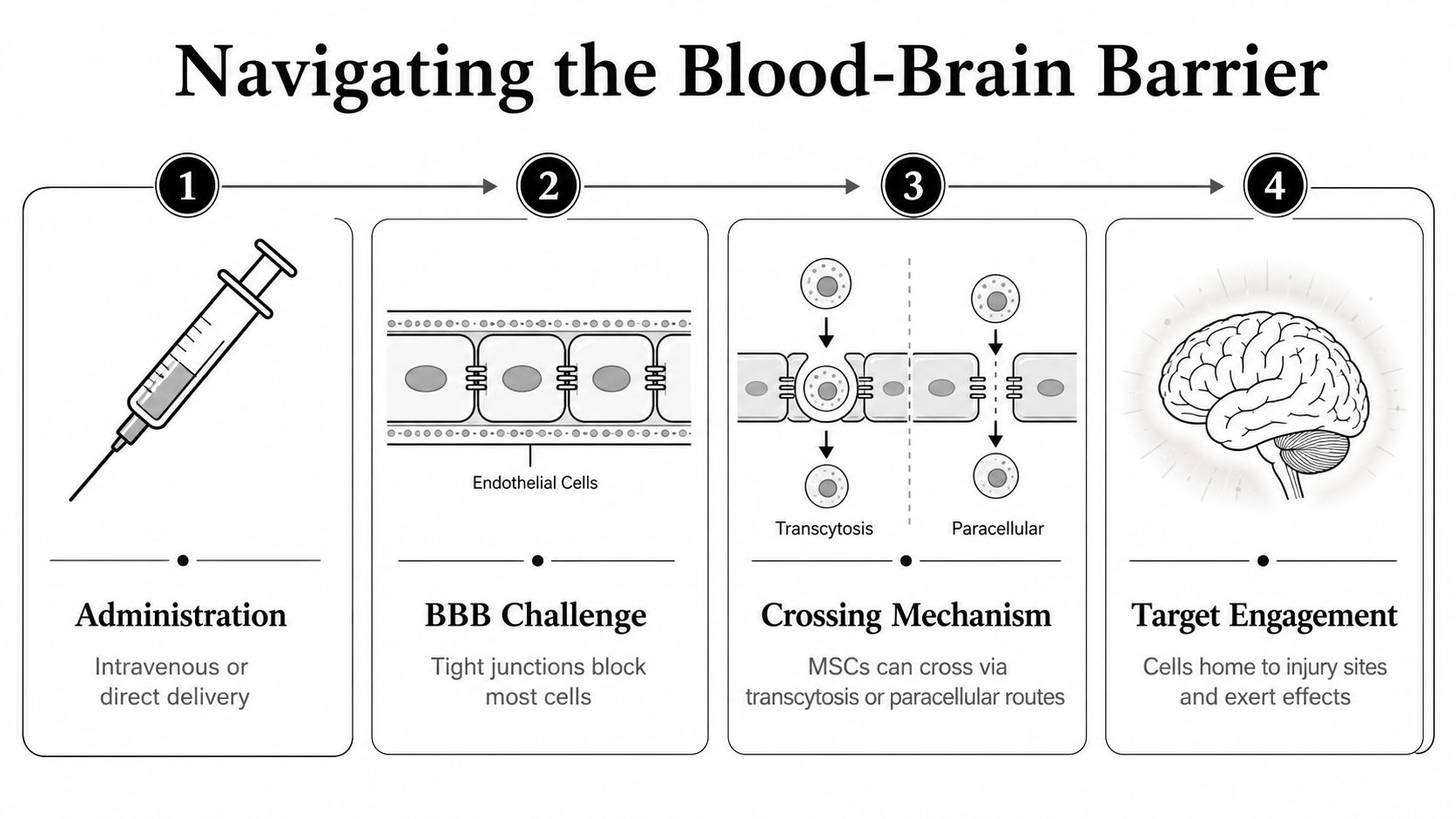
What happens when a therapy has the right cells, but cannot reach the right tissue? The brain is protected by the blood-brain barrier, which is protective and restrictive at the same time. It blocks toxins and pathogens, yet it also limits many therapeutic cells and molecules. In Alzheimer's disease, that barrier is one of the main reasons delivery strategy matters so much in regenerative neurology.
How the main routes differ
Intravenous delivery is familiar and practical, but it does not guarantee that cells reach the brain in high numbers. Some cells are filtered out, some are distributed to other tissues, and only a fraction may interact with the central nervous system. Intrathecal delivery places cells into cerebrospinal fluid, which can help bypass the barrier more directly, while intranasal delivery uses the nose-to-brain pathway through the olfactory and trigeminal routes. For a plain-language overview of the intravenous approach, see Longevity Medical Institute's IV stem cell therapy resource.
Specialized intranasal systems are not the same as an over-the-counter nasal spray. The biological goal is to move therapeutic material along pathways that can reach deeper neural structures, not just coat the nasal cavity. Device design, particle behavior, and dosing strategy all matter because the delivery route shapes how much material can plausibly reach the target.
The route is part of the treatment. If the delivery method does not fit the biology, the right cell product can still underperform.
That is also why the migration capacity described in stem cell literature gets so much attention. Cells may respond to injury signals and move toward regions where support is needed, which is one reason researchers continue studying them as carriers of neurotrophic signaling. For a plain-language primer on that logic, the internal resource on how stem cell therapy works is a helpful starting point.
For a visual summary of the barrier problem and how researchers think about crossing it, the following graphic captures the sequence well.
Human Clinical Evidence for Stem Cell Therapy in Alzheimer's Disease
The human evidence is still early, but it is no longer purely theoretical. A 2024 review found 76 stem-cell-based trials over the past 15 years, including 27 trials for Alzheimer's disease, and reported that none had advanced to phase 3 (PMC12701875). The same review noted that more than half of these trials occurred in the last 5 years, which shows rising clinical interest while still underscoring how far the field remains from routine care.
What the trial data shows
Most Alzheimer's studies in that review were still in phase 1 or 2, with only four ongoing trials at publication and several still in recruitment or pre-recruitment stages. That pattern matters because it separates scientific momentum from medical certainty. The field is active, but the evidence base is still being assembled.
| Trial Feature | Details |
|---|---|
| Disease focus | Alzheimer's disease, especially early-stage and prodromal populations |
| Development stage | Mostly phase 1 and 2, with no phase 3 advancement reported |
| Recent trend | More than half of the stem-cell-based trials occurred in the last 5 years |
| Current status snapshot | Only four ongoing trials were noted at publication, with others in recruitment or pre-recruitment |
| Clinical implication | Active investigation, but not established standard care |
One registered study uses 0.5 × 10^6 cells/kg of human umbilical cord-derived mesenchymal stem cells given intravenously, with a planned 10-week period and outcomes including ADAS-Cog, MMSE, CIBIC, ADL, and biomarkers such as amyloid beta (PMC7477654). That design is important because it shows how researchers are trying to connect cognition with biomarker change, not just symptom reporting.
A University of Miami investigator-initiated trial is also testing whether a single infusion of mesenchymal stem cells, given with standard anti-amyloid therapy, can stabilize cognitive decline in people with mild cognitive impairment or early Alzheimer's disease (University of Miami). That combined approach reflects a practical idea, existing drugs and regenerative strategies may not compete so much as complement each other.
The most clinically nuanced trend is the move toward earlier disease. A trial registered at ClinicalTrials.gov is following adults with late pre-symptomatic disease or MCI due to AD and uses TSPO PET to track neuroinflammation rather than relying only on memory scores (ClinicalTrials.gov NCT06775964). That shift matters because it treats inflammation as a measurable target, not just an abstract theory.
For a related overview of how stem-cell approaches are being discussed in cognitive decline more broadly, see the internal resource on stem cells for cognitive decline.
Safety Profile of Mesenchymal Stem Cell Therapy
Why does safety matter so much here? Because patients are not weighing a lab theory, they are weighing a treatment that enters the body and is meant to act in a fragile brain disease. The encouraging part is that the early human data have been more reassuring than alarming, while still falling well short of proving clinical benefit.
A 2025 randomized phase 2a trial of allogeneic mesenchymal stem cells in mild Alzheimer's disease reported no excess serious safety signal within 4 weeks of infusion across four groups, with treatment-emergent serious adverse events of 0%, 7.7%, 7.7%, and 9.1% depending on group. The same trial also reported that, at 39 weeks, laromestrocel slowed decline in whole brain volume by 48.4% versus placebo and slowed decline in hippocampal volume by 61.9% versus placebo. Those findings are biologically intriguing, and they suggest the therapy may be influencing more than symptoms alone, but imaging preservation is still not the same as a clear patient-centered benefit, and a later 2025 systematic review of 5 phase I studies including 70 individuals, 59 treated and 11 placebo controls, likewise found no major safety concerns while concluding that efficacy remains unproven because the studies were small and varied in dosing, cell source, and delivery route (Nature Medicine).
What safety does and doesn't mean
That distinction matters because a treatment can be tolerated without being effective. In other words, the absence of a major safety signal lowers one barrier, but it does not answer the harder question of whether the therapy changes the course of Alzheimer's disease in a meaningful way.
Clinical judgment matters: An allogeneic cell product is not the same as a casual infusion. Preparation quality, dosing, and oversight determine whether a therapy remains within the bounds of responsible medicine.
The broader human safety literature across more than fifteen years and multiple indications is part of why MSCs continue to attract attention. Even so, immune compatibility, theoretical tumorigenicity, and product consistency remain valid concerns, especially when a treatment is marketed outside rigorous trial settings. For a factual overview of how Longevity Medical Institute frames this class of therapy, the internal page on mesenchymal stem cell therapy provides additional context.
Why Patients Seek Regenerative Neurological Therapy
Patients rarely pursue regenerative options because they've rejected standard care. More often, they've watched a spouse, parent, or themselves continue to decline despite appropriate treatment, and they're trying to understand what else biology might still allow. That emotional pressure is real, and it doesn't mean a person is being irrational.
The unmet need is genuine
Conventional Alzheimer's care can be compassionate and evidence-based while still leaving a major gap. Many approved therapies are designed to manage symptoms or modestly slow decline, not repair injured tissue. Families often feel that gap most acutely when they can see function slipping but can't point to a treatment that changes the trajectory.
There's also an information gap. Mainstream resources often say, correctly, that stem cell therapy for Alzheimer's is not yet proven, but they don't always explain what researchers are trying to measure, why early-stage trials are being done, or why disease stage may matter so much. The result is that patients can hear “not proven” without hearing “still scientifically active.”
For many people, exploring regenerative neurological therapy is a rational response to incomplete options. It's not a rejection of neurology, and it's not a shortcut around evidence. It's a search for a treatment model that aims at preservation and repair when preservation alone may no longer be enough.
What We Are Not Claiming
Stem cell therapy, exosomes, and peptides are not proven cures for Alzheimer's disease. The human evidence is encouraging in some early studies, but larger randomized controlled trials are still needed before anyone should call this a standard disease-modifying treatment.
Patient responses can vary, sometimes widely. Disease stage, overall health, prior treatments, and the specific cell product all matter, which is why careful selection is essential. A therapy that may be biologically plausible for very early disease is not automatically appropriate for advanced dementia.
We're also not claiming that every clinic offering treatment delivers the same quality of care. The evidence supports consultation with experienced physicians who can review the diagnosis, assess risks, and decide whether a regenerative approach belongs in the plan at all. If a program promises guaranteed reversal, that promise goes beyond the current science.
Your Path Forward at Longevity Medical Institute
The most responsible way to approach Stem Cell Therapy for Alzheimer's Disease is through careful evaluation, not impulse. At Longevity Medical Institute, the practical work begins with careful diagnostics, including an in-house clinical laboratory measuring 140 biomarkers, full-body MRI integrated with AI, and advanced heart evaluation to build a complete baseline before any regenerative plan is considered.
The clinic's approach also includes physician-led review of whether a patient is a fit for individualized regenerative care, especially for people traveling from the United States or Canada. That process can include remote consultation, travel coordination, informed consent, and structured follow-up, so the plan is clear before anyone arrives. For readers who want a broader overview of the model, the internal resource on physician-led stem cell therapy in Mexico provides useful context.
LMI also describes a COFEPRIS-licensed biotechnology lab producing five types of allogeneic stem cells, including placental, Wharton's jelly, adipose, endometrial, and dental pulp sources, which is relevant because the field still believes source and secretome profile matter. Its published research also discusses a non-invasive intranasal delivery platform for neurological conditions, a route that aligns with the broader brain-delivery rationale discussed earlier. For a related clinic resource, see stem cell therapy for cognitive decline.
The strongest arguments for regenerative neurological therapy remain consistent, even with uncertainty. The biological rationale is compelling, the early human evidence is increasingly real, the published safety record is broad enough to support continued study, and non-invasive intranasal delivery may offer practical advantages for selected patients. That said, the evidence is still incomplete, and the most trustworthy answer remains the same, this is promising investigational medicine, not a proven cure.
If you're considering a physician-led evaluation for Alzheimer's disease or another neurologic condition, visit Longevity Medical Institute to review the current options, understand the science, and schedule a consultation that's grounded in your specific clinical picture.
Author
Dr. Kirk Sanford, DC, Founder & CEO, Longevity Medical Institute. Dr. Sanford focuses on patient education in regenerative and longevity medicine, translating complex therapies into clear, practical guidance for patients.
Medical Review
Dr. Félix Porras, MD, Medical Director, Longevity Medical Institute. Dr. Porras provides clinical oversight and medical review to help ensure accuracy, safety context, and alignment with current standards of care.
Last Reviewed: August 4, 2026
Short Disclaimer
This information is for educational purposes only and is not medical advice. It does not replace an evaluation by a qualified healthcare professional. For personalized guidance, please schedule a consultation.