

Stem Cell Therapy for Nerve Repair: A Patient's Guide
A nerve injury can make ordinary life feel strangely distant. A foot that burns at night. Fingers that stay numb after surgery. A leg that looks strong but doesn't quite listen. Patients often describe the same frustration in different words: the pain is real, the weakness is unsettling, and many standard treatments seem built to quiet symptoms rather than help the nerve recover.
That's why interest in stem cell therapy for nerve repair has grown so quickly. The appeal is simple. Instead of asking only how to suppress pain, regenerative medicine asks whether the injured nerve environment can be changed in a way that supports repair. For the right patient, under medical guidance, that's a very different question.
The science is promising, but it's also nuanced. Nerves heal slowly. Different injuries behave differently. A compressed peripheral nerve is not the same problem as a severed nerve, and neither is the same as a spinal cord injury. Good medicine starts there, with precision.
A New Horizon in Healing Damaged Nerves
When a nerve is injured, the problem isn't limited to one spot. The nerve fiber may be disrupted, the myelin coating may thin, nearby tissues may become inflamed, and the muscles the nerve once controlled may begin to weaken from disuse. That's one reason nerve symptoms can feel so complicated. Pain, numbness, tingling, weakness, and altered coordination often arrive together.
Traditional care still matters. Depending on the diagnosis, patients may need decompression, physical therapy, medications, bracing, microsurgical repair, or rehabilitation. But those approaches don't always restore the biological conditions that support nerve regeneration. That's where regenerative medicine enters the conversation.
Repair rather than simple suppression
A useful analogy is to think of a damaged nerve like a frayed insulated cable running through inflamed ground. You can dull the signal of pain. You can protect the area from further stress. But if you want better function, you also have to improve the cable and the environment around it.
Stem cell based regenerative therapy aims to influence that environment. The interest is not only in replacing tissue, but in signaling repair. Certain cell therapies may help calm inflammatory signals, support Schwann cells, encourage axonal regrowth, and improve the conditions needed for more coordinated healing.
Nerve repair is rarely one event. It's a sequence of biological decisions made over time.
That distinction matters for patients. Regenerative care isn't magic, and it isn't a shortcut. It's an attempt to guide healing more intelligently.
Why patients often get confused
Many readers arrive here after seeing broad claims online. One clinic says stem cells rebuild nerves. Another says exosomes regenerate anything. Current research is more disciplined. Some evidence is strong in preclinical models. Early human studies are encouraging in selected settings. But not every nerve condition is equally studied, and not every patient is an ideal candidate.
A medically guided protocol should answer four questions clearly:
What kind of nerve problem is this. Peripheral injury, neuropathy, entrapment, postsurgical dysfunction, or spinal cord involvement all require different thinking.
What biological tool fits the problem. Cells, exosomes, rehabilitation, image-guided injections, or a combination.
How will progress be measured. Symptoms matter, but so do functional exams, imaging, and electrophysiology.
What timeline is realistic. Nerves don't usually recover on the schedule patients wish they would.
That's the mindset worth bringing to stem cell therapy for nerve repair. Hope is appropriate. Precision is essential.
Understanding Stem Cells and Exosomes for Nerve Repair
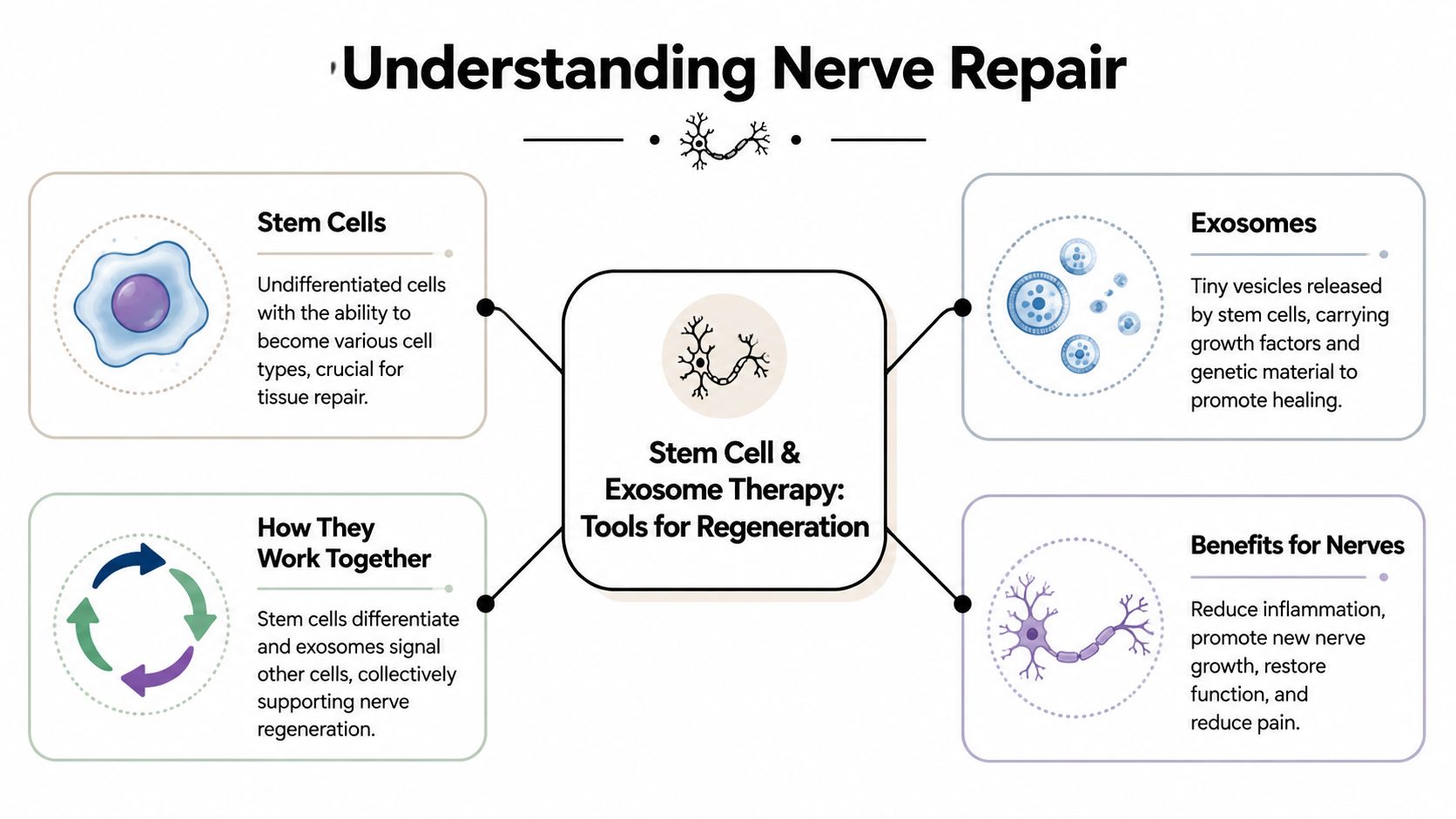
The vocabulary of regenerative medicine can make a sensible therapy sound mysterious. It doesn't need to. At its core, nerve repair involves two broad kinds of biological tools: cells and cell-derived signals.
What stem cells are doing
For nerve-focused regenerative protocols, the most discussed cells are mesenchymal stem cells, often abbreviated MSCs. In practical terms, MSCs matter because they behave less like simple replacement parts and more like biological coordinators. They interact with the injury site, release signaling molecules, and can influence inflammation, tissue remodeling, and support cells involved in nerve healing.
A helpful analogy is an orchestra. The healing process has many players: immune cells, Schwann cells, blood vessels, structural proteins, and the injured nerve itself. MSCs act more like conductors than soloists. They don't do every job directly, but they can help the system perform in a more organized way.
At clinics that focus on advanced regenerative medicine, physicians may choose among different allogeneic cell sources depending on the clinical picture. Some programs use multiple allogeneic lines, including placental, Wharton's jelly, adipose, endometrial, and dental pulp derived cells. The reason this matters is straightforward. Nerve injuries vary, and a single generic protocol doesn't respect that complexity.
What exosomes are doing
Exosomes are much smaller. They are tiny vesicles released by cells and packed with biologically active cargo, including proteins, lipids, and regulatory signals. If stem cells are the conductors, exosomes are the message packets carrying instructions through the tissue.
This is one of the clearest ways to understand why exosomes have become so important in nerve repair. They don't occupy space alone. They communicate.
For readers comparing these therapies, this guide to exosomes vs stem cells is useful because it frames the distinction in patient-friendly language.
Clinical lens: In regenerative medicine, the question often isn't cells or signals. It's whether the protocol uses each tool in the right context.
Why exosomes matter in nerve healing
Preclinical evidence suggests these extracellular vesicles can meaningfully change the local nerve environment. In rat sciatic nerve models, hydrogels loaded with MSC-derived extracellular vesicles increased myelin sheath thickness by 25 to 30% and improved nerve signal transmission by 20 to 30%, supporting a more regenerative state at the injury site, as described in this review of MSC-EVs and peripheral nerve repair.
That finding is easy to underestimate. Nerves depend on both structure and signaling. Better myelin and better signal transmission point to changes that are not merely cosmetic.
Why allogeneic cell choice matters
The word allogeneic means the cells come from a donor source rather than from your own body. For many advanced regenerative programs, that isn't a compromise. It's a design choice. It allows controlled sourcing, rigorous screening, and more consistent product characterization.
Patients often ask whether one cell source is always best. That's not how this field works. One patient may need a protocol designed around inflammatory modulation. Another may need local support around a surgical repair site. Another may have a diffuse neuropathic pattern that calls for a broader strategy.
Here's the more useful framework:
Cell source matters because tissue origin can influence the biological profile of the therapy.
Delivery matters because a local nerve injury and a generalized neuropathy may not be approached the same way.
The surrounding program matters because nerves respond to mechanics, oxygenation, rehabilitation, and systemic inflammation, not just one injection.
How they work together
The best way to think about stem cells and exosomes is not as competing ideas, but as complementary tools. Cells may help organize the repair environment over time. Exosomes may deliver concentrated signals that help direct nearby tissues toward repair rather than degeneration.
That combination is one reason regenerative nerve care has become so compelling. It treats the nerve not as an isolated wire, but as living tissue inside a living system.
Conditions We Address with Regenerative Nerve Repair
A patient with a numb fingertip after hand surgery, another with burning feet that worsen at night, and another with weakness after a spinal cord injury may all ask about stem cell therapy. They are not asking the same biological question. Nerves fail in different ways, and a medically guided regenerative protocol has to match the pattern of injury, the surrounding tissue environment, and the outcome that can be measured.
That distinction matters early. A crushed peripheral nerve, a diffuse neuropathy, and a central nervous system injury each involve different anatomy, different obstacles to repair, and different standards for what counts as progress.
Peripheral nerve injuries
Peripheral nerve injuries include traumatic cuts or crush injuries, postsurgical irritation, traction injuries, and some long-standing compression syndromes. In these cases, the problem is often local. The axon may be disrupted, the myelin may be thinned, the blood supply around the nerve may be impaired, or scar tissue may be crowding a structure that needs space to glide and signal.
A useful analogy is a damaged cable inside a tight conduit. Repair depends on more than the wire itself. The insulation, the surrounding channel, and the local electrical conditions all influence whether signals can travel again.
For these patients, regenerative treatment is usually aimed at four practical goals. Calm pain. Support conduction. Improve the tissue environment around the nerve. Protect function while the biology has time to recover.
Chronic peripheral neuropathy
Chronic peripheral neuropathy is a different clinical problem. The nerve is often not sharply torn or compressed at one spot. Instead, many small fibers or longer nerve pathways are under chronic metabolic, inflammatory, toxic, or vascular stress. The pattern is broader, and the symptoms often reflect that. Burning, tingling, altered balance, numbness, and reduced tolerance for standing or walking are common examples.
Here, the regenerative objective is less about rebuilding one short segment and more about supporting an injured network. Physicians may focus on neuroprotection, inflammatory control, microenvironment support, and functional stability. Patients who want a condition-specific overview can review our page on stem cell treatment for peripheral neuropathy.
In neuropathy, success may look modest from the outside but meaningful in daily life. Better sensation in the toes. Fewer nighttime flares. More confident walking. Longer activity before symptoms rise.
Spinal cord injury
Spinal cord injury requires the highest level of caution in this group because the biology is more complex and the risks are more significant. Peripheral nerves have one repair logic. The spinal cord has another. The injury affects central pathways, supporting glial cells, inflammatory signaling, and circuit-level function all at once.
Early human research has shown enough signal to justify continued scientific attention, but the language has to stay disciplined. In a Mayo Clinic Phase 1 study of intrathecal autologous adipose-derived mesenchymal stem cells in adults with chronic or subacute traumatic spinal cord injury, 7 of 10 participants improved by at least one AIS grade and no serious adverse events were reported, according to Mayo Clinic's summary of the CELLTOP trial. That is encouraging early evidence, not proof that stem cell therapy is standard care for spinal cord injury.
For a patient, that distinction is important. A responsible program does not promise reversal. It defines the injury carefully, sets measurable goals, and weighs any intervention against function, safety, and rehabilitation potential.
Regenerative goals by condition
| Condition Type | Primary Challenge | Main Regenerative Goal |
|---|---|---|
| Peripheral nerve injury | Local damage to axons, myelin, or surrounding tissue | Support structural repair and functional reconnection |
| Chronic peripheral neuropathy | Diffuse signaling dysfunction and inflammatory stress | Improve the nerve environment and reduce symptom burden |
| Spinal cord injury | Complex central nervous system damage | Modulate the post-injury environment and support functional recovery |
Why condition matching matters
A patient with a digital nerve laceration, a runner with chronic tibial nerve irritation, and a person with long-standing neuropathy should not receive the same protocol. Good regenerative medicine starts with classification. Where is the lesion? Is the pattern focal or diffuse? Is the main problem pain, weakness, sensory loss, or failed recovery after surgery? Which outcomes can be followed over time?
That is the difference between a generic stem cell discussion and a precise regenerative care plan. The treatment only makes sense after the diagnosis does.
Your Personalized Nerve Repair Protocol
A serious regenerative protocol begins long before treatment day. It starts with a disciplined effort to define the injury, the surrounding biology, and the outcomes worth pursuing.
Step one begins with the map
Patients often arrive focused on the symptom they can feel most clearly. Burning in the foot. Weak grip. Numbness after a procedure. But treatment planning requires a broader map.
That often includes a detailed neurological and musculoskeletal exam, review of prior imaging, and objective baseline testing. In advanced programs, physicians may also use an in-house clinical lab measuring 120 biomarkers, along with AI-integrated full-body MRI and targeted ultrasound to understand both the local injury and the systemic terrain influencing recovery.
A physician-led process matters in these cases. A careful workup can distinguish between a focal entrapment, a postsurgical nerve irritation, a referred spinal issue, and a more generalized neuropathic state. Those pathways don't point to the same intervention.
Step two is choosing the biological tool
Once the problem is defined, the formulation has to match it. Some patients may be candidates for a cell-based approach designed to support local repair. Others may benefit from adding exosome-based signaling support. Some require a broader plan that addresses systemic inflammation and tissue recovery alongside the nerve itself.
At this stage, cell source matters. Some centers work with multiple allogeneic lines, including placental, Wharton's jelly, adipose, endometrial, and dental pulp derived cells, so that protocol design reflects the injury pattern rather than forcing every patient into one template.
For patients considering care abroad, this overview of physician-led stem cell therapy in Mexico explains why medical supervision, diagnostics, and procedural standards matter as much as the therapy itself.
Step three is precise delivery
Nerve tissue is unforgiving of guesswork. A guided procedure is not a cosmetic detail. It is a safety and accuracy issue.
High-resolution ultrasound helps the treating physician visualize the target region in real time, identify adjacent structures, and place the therapy where it is intended to act. In nerve repair, a few millimeters can change the meaning of an injection.
Practical rule: The more specific the target, the more important image guidance becomes.
A clinic such as Longevity Medical Institute combines physician-led evaluation, advanced imaging, and regenerative protocols under one roof. For patients comparing options, that model is relevant because diagnostics, formulation, delivery, and follow-up are coordinated rather than fragmented.
A closer look at the patient journey can help make that process concrete.
Step four supports the biology after treatment
The procedure is only one part of the protocol. Nerve repair depends on what happens afterward. That may include structured rehabilitation, activity modification, nutrition support, and therapies designed to create a more favorable healing environment.
In some programs, physicians integrate hyperbaric oxygen therapy, targeted peptides, physical medicine, and electrophysiologic follow-up. The logic is straightforward. If a nerve needs a calmer inflammatory environment, better tissue support, and consistent functional retraining, then recovery should be managed as a system, not as a single event.
A thoughtful protocol usually includes:
Objective baseline tracking so progress isn't judged by memory alone.
Guided follow-up visits to correlate symptoms with function.
Rehabilitation support because nerves need useful movement, not just passive hope.
Clear milestones so patients know what improvement may look like over time.
Patients tend to feel more at ease when they understand that good regenerative medicine is not mysterious. It is methodical.
Clinical Evidence and Realistic Timelines
A patient can leave a procedure room with the right cells placed in the right tissue and still feel very little the next week. That does not mean the treatment failed. Nerve repair usually follows the biology of rewiring, insulation, and repeated signaling, which is slower than pain relief from a drug or the immediate mechanical change after surgery.
That distinction matters. A medically guided regenerative protocol is judged by more than the injection day. It is judged by whether the diagnosis was precise, whether the cell strategy fit the injury pattern, and whether progress is measured in ways that go beyond hope or memory.
What the evidence supports today
Preclinical research supports the idea that mesenchymal signaling can calm inflammation, support Schwann cell activity, and encourage axonal repair after peripheral nerve injury, as noted earlier in this article. That gives clinicians a scientific rationale for treatment planning, but it does not erase the limits of current human evidence.
Human studies remain early. Many reports describe encouraging short-term changes in pain, sensation, or function, yet longer follow-up is still needed to show which patients improve, how durable those gains are, and which protocols work best for specific nerve conditions. For a discerning patient, that is not a reason to dismiss regenerative care. It is a reason to ask sharper questions.
Why timelines are often misunderstood
Nerves recover in stages. First, the local environment has to become less hostile. Then damaged fibers need time to recover or regenerate. After that, the brain and body have to relearn how to use the new signal.
A practical analogy helps here. Repairing a nerve is closer to restoring a damaged communication cable than treating a bruise. The line may be physically reconnected before the message comes through clearly, and even then the signal can be faint, inconsistent, or distorted before it becomes reliable.
This is why a structured protocol matters. Advanced diagnostics establish the starting point. Follow-up exams, electrodiagnostic testing when appropriate, symptom mapping, and functional measures help determine whether the biology is changing.
The timeline patients should expect
Most patients do better with a phased expectation model than with a single promised date.
Early phase: soreness after the procedure, fluctuating symptoms, or no clear change yet.
Middle phase: more noticeable shifts in pain pattern, sensation, endurance, coordination, or tolerance for activity.
Later phase: confirmation that early gains are translating into durable function in daily life.
The exact pace depends on the nerve involved, the chronicity of injury, the surrounding tissue environment, and whether compression, metabolic stress, or inflammation are still interfering with repair. A useful overview of recovery time after stem cell injection can help patients place those phases in context.
How to think about safety and progress
Safety is not one question. It is a chain of decisions that starts with patient selection and continues through cell sourcing, manufacturing controls, delivery accuracy, and follow-up. In nerve repair, outcomes should be tracked with the same discipline.
Early improvement has value. Lasting improvement is the primary goal.
Patients should ask how success will be measured at baseline, what milestones will be reviewed over the following months, and what the clinical team will do if recovery slows or symptoms only improve partially. That is the standard of care a high-level regenerative protocol should meet.
The LMI Difference in Regenerative Medicine
Many clinics can say they offer regenerative care. The more important question is how they reduce uncertainty in a field where patient selection, manufacturing standards, and procedural accuracy can change the entire experience.
Precision starts before the procedure
A major challenge in stem cell therapy is choosing the right cell type and the right delivery method for a specific patient. A review discussing peripheral nerve injury notes the need for better comparative frameworks in cell selection and delivery strategy, which is exactly the gap many patients encounter when researching treatment options in the wild, as described in this review on regenerative medicine in peripheral nerve injury.
That challenge is easier to address when diagnostics and biotechnology are closely integrated. An in-house lab producing five distinct allogeneic cell lines, paired with advanced imaging, creates the possibility of patient-specific protocols rather than generic menus.
What a discerning patient should look for
When evaluating a regenerative center, these features matter:
Controlled cell sourcing with transparent quality standards.
Imaging-guided delivery so treatment is anatomically precise.
Objective diagnostics that establish a meaningful baseline.
Integrated follow-up instead of a one-day procedure with little long-term oversight.
For patients who care about safety culture and process transparency, this resource on how trust begins with safety and transparency is worth reviewing.
The wider treatment ecosystem matters too
Nerve recovery rarely sits in isolation. Patients may also need physical medicine, peptide support, hyperbaric oxygen therapy, advanced imaging, or cardiovascular and metabolic evaluation to understand why healing has stalled. A center that can coordinate those pieces is often better positioned to build a coherent plan.
The premium aspect of care, in this context, isn't aesthetics. It's coordination, discretion, and the absence of improvisation.
Your Questions About Nerve Repair Therapy Answered
How is the ideal stem cell type chosen for my condition
Physicians should begin with diagnosis, not product preference. The location of the nerve problem, how long it has been present, whether the pattern is focal or diffuse, and whether surrounding tissues are inflamed all shape the decision. A patient with a localized postsurgical nerve issue may need a different strategy than someone with broader neuropathic symptoms. That's why access to multiple allogeneic cell lines can matter. It allows the protocol to be individualized rather than standardized by convenience.
Is the treatment painful and what is the downtime
Most regenerative nerve procedures are designed to be minimally invasive, especially when image guidance is used. Patients may feel pressure, temporary discomfort, or soreness afterward, but the experience depends on the target area, delivery method, and the underlying condition. Downtime is usually less about bed rest and more about respecting the biology of healing. You may need activity modification, structured rehabilitation, and follow-up rather than dramatic interruption of daily life.
How many treatments will I need and how are results measured
There isn't a universal answer. Some patients are evaluated after one carefully designed intervention, while others may need a staged protocol depending on the diagnosis and response. The key is not to chase procedures. It's to measure effect.
Useful tracking often includes a combination of:
Symptom change such as pain quality, numbness, sleep disruption, or endurance.
Functional gains like grip strength, walking tolerance, coordination, or return to sport.
Objective testing which may include imaging, neurological examination, or nerve conduction studies when appropriate.
The right question isn't only how many treatments. It's what measurable change would justify another one.
Article Information
Author
Dr. Kirk Sanford, DC, Founder & CEO, Longevity Medical Institute. Dr. Sanford focuses on patient education in regenerative and longevity medicine, translating complex therapies into clear, practical guidance for patients.
Medical Review
Dr. Félix Porras, MD, Medical Director, Longevity Medical Institute. Dr. Porras provides clinical oversight and medical review to help ensure accuracy, safety context, and alignment with current standards of care.
Last Reviewed: May 10, 2026
Short Disclaimer
This information is for educational purposes only and is not medical advice. It does not replace an evaluation by a qualified healthcare professional. For personalized guidance, please schedule a consultation.
If you're exploring stem cell therapy for nerve repair and want a medically guided evaluation, Longevity Medical Institute provides educational resources and consultation pathways designed to help patients understand their options, clarify candidacy, and make informed decisions with appropriate clinical oversight.