

Advanced Stem Cell Therapy for Spinal Disc Degeneration
Chronic back pain changes how you live long before it changes what your MRI shows. It alters how you sit through dinner, how you sleep, how you train, how you travel, and how much confidence you have in your own body. Many patients dealing with spinal disc degeneration have already tried the standard sequence of care. Physical therapy helped somewhat, medications dulled symptoms for a while, injections offered temporary relief, and surgery felt too aggressive or too final.
That’s the point where regenerative medicine becomes a serious conversation. Not because it promises magic, and not because every disc can be restored, but because it shifts the goal from symptom suppression alone to biologic repair support. For the right patient, stem cell therapy for spinal disc degeneration can be a minimally invasive option that aims to calm inflammation, improve function, and support a healthier disc environment.
Patients exploring care in Mexico often ask a broader set of questions as well. They want to know whether treatment is physician-led, whether the cells are produced under strict quality standards, whether diagnostics are advanced enough to guide decisions properly, and whether the clinic is equipped to manage more than a single injection. Those are the right questions. They matter more than marketing language.
Rebuilding Your Spine from Within
Back pain from disc degeneration rarely begins with a dramatic event. More often, it starts as stiffness after sitting, soreness after golf or tennis, or a dull ache that becomes a daily companion. Over time, the disc loses hydration and resilience. The spine starts handling load less efficiently, and the tissues around it react. What begins as annoyance can become a major quality-of-life problem.
That’s why many patients looking into regenerative medicine for back pain are no longer interested in short-term symptom management alone. They want to know whether there’s a credible way to support healing at the source of the problem. Stem cell therapy for spinal disc degeneration sits in that category. It’s a biologic strategy designed to influence the disc environment itself.
Why conventional care often plateaus
Conservative treatment still matters. Many patients should start there. Good rehabilitation, core stabilization, movement correction, weight management, and careful pain control can reduce strain on an injured spine. But conservative care has limits, especially when discogenic pain persists.
A familiar pattern looks like this:
Physical therapy helps movement but doesn’t always change the biology inside a degenerating disc.
Anti-inflammatory medication can reduce pain but may not offer durable improvement once the medication stops.
Epidural or facet injections may calm pain generators yet often work best as temporary tools, not full solutions.
Fusion surgery can be appropriate in select cases but comes with a very different recovery profile and a different risk-benefit equation.
A degenerating disc isn't just a painful structure. It's a stressed biologic environment that has become less capable of maintaining itself.
A different treatment goal
The modern regenerative approach is more selective than many patients expect. It isn’t about offering stem cells to everyone with low back pain. It’s about identifying whether the disc is a meaningful pain generator, whether the degeneration is at a stage that may still respond biologically, and whether the patient’s broader health supports a regenerative response.
When those pieces line up, treatment can offer something valuable. Not a guaranteed reversal of years of wear, but a meaningful chance to reduce pain, improve function, and potentially slow the degenerative cycle.
The Science of Spinal Disc Regeneration
A spinal disc works a bit like a shock-absorbing cushion between vertebrae. In a healthy state, it holds water, distributes force, and helps the spine move smoothly. In degeneration, that cushion begins to lose hydration and structural integrity. The disc becomes less resilient. Load distribution changes. Inflammatory signaling increases. Pain can follow.
The disc is also a difficult place to heal. It has poor blood supply, limited nutrient delivery, and a harsh microenvironment. That matters because a treatment can sound impressive in theory and still fail if it can’t function inside that setting.
What stem cells are doing inside the disc
The most useful way to understand mesenchymal stem cells, or MSCs, is not as replacement parts but as biologic coordinators. They release signaling molecules that influence the local environment. In practical terms, they help shift the disc away from a breakdown-dominant state and toward a repair-supportive one.
That signaling effect is often called the paracrine effect. A simple way to think about it is that the cells act like project managers. They send instructions. Those instructions can reduce inflammatory signaling, support resident disc cells, and encourage production of matrix components such as proteoglycans and Type II collagen.
Preclinical animal models of intervertebral disc degeneration show strong regenerative effects from MSCs, including disc height restoration of up to 30 to 50 percent and improved extracellular matrix production, with mechanisms linked to anabolic growth factors such as TGF-β3 and IGF-1, as described in this preclinical review of MSC disc regeneration.
Why allogeneic cells matter
In our setting, the conversation is centered on allogeneic stem cells, not autologous harvesting. That distinction is important for patients comparing stem cell treatment Mexico options.
Allogeneic cells are donor-derived and prepared under controlled laboratory conditions. The practical reason many advanced clinics favor this model is consistency. Instead of relying on the cell quality available from a patient who may be older, inflamed, metabolically stressed, or already dealing with chronic degeneration, the treatment can use cells selected and processed for therapeutic use.
That doesn’t eliminate the need for patient selection. A strong product still requires the right indication. But it does improve one of the most overlooked variables in regenerative medicine, which is cell quality at baseline.
For patients who want a deeper explanation of cell signaling and therapeutic applications, mesenchymal stem cell therapy is the core biologic platform behind many orthopedic regenerative protocols.
Why the disc environment is the real challenge
The disc isn’t just worn down. It’s hostile. Degenerated discs often contain inflammatory cytokines and catabolic enzymes that make survival difficult for therapeutic cells. That’s one reason outcomes in humans are usually more modest than preclinical images suggest.
This short overview helps visualize the concept in a patient-friendly way:
A sophisticated treatment plan has to account for more than the injection itself. It has to account for disc biology, mechanical loading, imaging findings, and the patient’s systemic health.
Practical rule: If a clinic explains stem cells as if the cells simply "become a new disc," that's an oversimplification. The more accurate model is signaling, immune modulation, and support for a better repair environment.
Clinical Evidence and Realistic Outcomes
Patients deserve a clear answer on what the literature supports. The good news is that clinical evidence for intradiscal stem cell therapy is no longer limited to theory. The more cautious truth is that the strongest and most consistent benefits are in pain and function, while structural regeneration on imaging tends to be more modest.
A 2025 systematic review of clinical trials concluded that patients receiving MSC therapy for degenerative disc disease had meaningful reductions in pain and disability scores that were maintained over short- to mid-term follow-up, according to this systematic review on intradiscal MSC therapy. That aligns with what matters most to patients in day-to-day life. Less pain getting out of bed. Better tolerance for sitting, walking, training, and travel. More confidence moving without fear.
What improvement usually means in practice
The same body of evidence doesn’t support claiming that every disc rebuilds in a dramatic way. Some studies show imaging improvement, but the most dependable outcome is symptomatic and functional change. That’s why a careful physician won’t frame treatment as guaranteed disc regrowth.
Realistic expectations usually include:
Pain reduction that makes daily movement easier
Functional gains reflected in disability scores and activity tolerance
A minimally invasive option for patients trying to avoid or delay surgery
Variable imaging change, often less dramatic than symptom improvement
Another useful point from the published literature is safety. A broader review of clinical trials reported statistically significant improvements in discogenic low back pain after intradiscal stem cell therapy and described a serious adverse event rate below 2 percent across trials, while also noting that long-term durability remains uncertain and protocols still vary, as summarized in this clinical review of stem cell therapy for discogenic back pain.
What the evidence does not prove
Evidence does not currently justify telling patients that stem cell therapy will reliably restore a severely collapsed disc, eliminate every pain generator in the lumbar spine, or permanently replace surgical care in all cases. That’s not what responsible medicine looks like.
It’s also why safety review and proper patient education matter. Anyone considering treatment should understand both the strengths and the limitations of the field. Our broader discussion on what published research concluded about stem cell safety is useful for patients who want to separate careful evidence from exaggerated claims.
Good regenerative care starts with the right question. Not "Can stem cells fix everything?" but "Is my pain pattern and disc biology a reasonable fit for this treatment?"
Your Personalized Treatment Protocol
The quality of a regenerative outcome depends on decisions made before the injection. That starts with diagnosis. Not every patient with lumbar MRI findings has discogenic pain, and not every degenerated disc should be treated biologically. A physician-led workup should determine whether the disc is likely central to the pain pattern, whether instability or other structural issues dominate the case, and whether the patient’s systemic health supports a meaningful response.
Candidacy begins with better diagnostics
An advanced workup goes beyond reading a routine MRI report. Disc height loss, hydration status, endplate changes, adjacent level stress, nerve involvement, and other pain generators all need context. In clinical practice, that often means pairing imaging with physical examination, functional history, and laboratory assessment.
At a higher level, diagnostics may include:
Advanced MRI review to assess the level and character of degeneration
Clinical correlation so imaging findings match the actual pain pattern
Metabolic and inflammatory assessment to identify factors that may affect response
Performance and lifestyle review for active patients who place unusual mechanical demand on the spine
Patients interested in the imaging side of this process can review how MRI diagnostics support regenerative medicine in Los Cabos.
Why whole-patient biology matters
There is growing evidence that systemic biological age and metabolic factors can influence stem cell response, and current literature highlights the importance of lifestyle, hormonal status, and systemic inflammation when personalizing regenerative protocols, as discussed in this review on biological age and stem cell efficacy.
That point is clinically important. A disc doesn’t live in isolation from the rest of the body. If a patient is dealing with chronic inflammation, poor sleep, metabolic dysfunction, low recovery capacity, or excessive repetitive loading, those issues can work against the treatment.
What the procedure usually involves
For patients who qualify, the procedure is typically performed as a minimally invasive image-guided injection. Precision matters. The target has to be correct, the approach has to be controlled, and the physician has to understand spinal anatomy in a procedural setting.
A quality protocol often includes these steps:
Pre-procedure planning
Imaging is reviewed in detail, the target level is confirmed, and the patient receives clear guidance on medications, activity, and logistics.Physician-guided intradiscal treatment
The injection is performed under procedural imaging guidance to place the biologic product accurately.Immediate observation and discharge planning
Most patients don’t require a hospital stay, but they do need structured aftercare instructions.Recovery support
Activity is modified strategically. Rehabilitation is usually phased, not rushed.
Recovery is active, not passive
Many patients expect either instant relief or a prolonged shutdown. Most regenerative recoveries are neither. The first phase is about protecting the treated area. The next phase is about reintroducing movement without overloading a healing environment. Aggressive return-to-sport behavior too early can undermine good biology.
One clinic example is Longevity Medical Institute, which combines physician-guided regenerative care with advanced diagnostics and adjunctive recovery tools in a single setting. For spine patients, that integrated model matters because treatment quality depends on more than a syringe.
Comparing Regenerative Therapy to Conventional Options
The most useful comparison isn’t whether stem cell therapy is modern and surgery is old. Instead, the question is whether a treatment matches the stage of disease, the pain generator, and the patient’s goals.
Conservative care remains appropriate for many early cases. Surgery remains necessary for some advanced cases. Regenerative treatment sits between those paths for a specific group of patients. Typically, these are people who have persistent symptoms, imaging that supports disc degeneration as a pain contributor, and a strong preference to avoid a more invasive operation if reasonable alternatives exist.
Treatment Comparison Spinal Disc Degeneration
| Approach | Mechanism | Recovery Time | Long-Term Outlook |
|---|---|---|---|
| Physical therapy and medication | Improves mechanics, strength, and symptom control | Usually compatible with daily life | Helpful for many patients, but may plateau if the disc remains a major pain source |
| Steroid or pain-focused injections | Suppresses inflammation or interrupts pain signaling | Often short procedural recovery | Can provide relief, but doesn’t aim to regenerate disc tissue |
| Stem cell therapy for spinal disc degeneration | Supports a more favorable biologic environment within the disc | Typically less disruptive than surgery, with guided activity modification | Best evidence supports pain and functional improvement. Structural restoration is more variable |
| Spinal fusion or other surgery | Stabilizes or removes the painful segment depending on procedure | Greater recovery demands and procedural burden | Can be appropriate in selected cases, especially when instability or severe structural failure dominates |
Mexico versus the United States
When patients compare stem cell therapy Mexico options to care in the United States, the decision usually comes down to access, regulatory environment, cell sourcing model, physician oversight, and treatment integration. Some patients also prefer Mexico because clinics there may offer integrated regenerative programs in one location rather than fragmented referrals across multiple facilities.
That said, geography alone doesn’t tell you whether a clinic is credible. A polished website in Cabo doesn’t equal a sound medical process. The more important distinction is between a clinic that performs a transaction and one that performs a real evaluation.
For patients comparing providers, these questions matter more than branding:
Who evaluates the MRI and performs the procedure
Whether the protocol uses allogeneic cells with documented lab standards
Whether diagnostics and aftercare are built into the program
Whether surgery is discussed candidly when regeneration isn't the right fit
The Longevity Medical Institute Difference
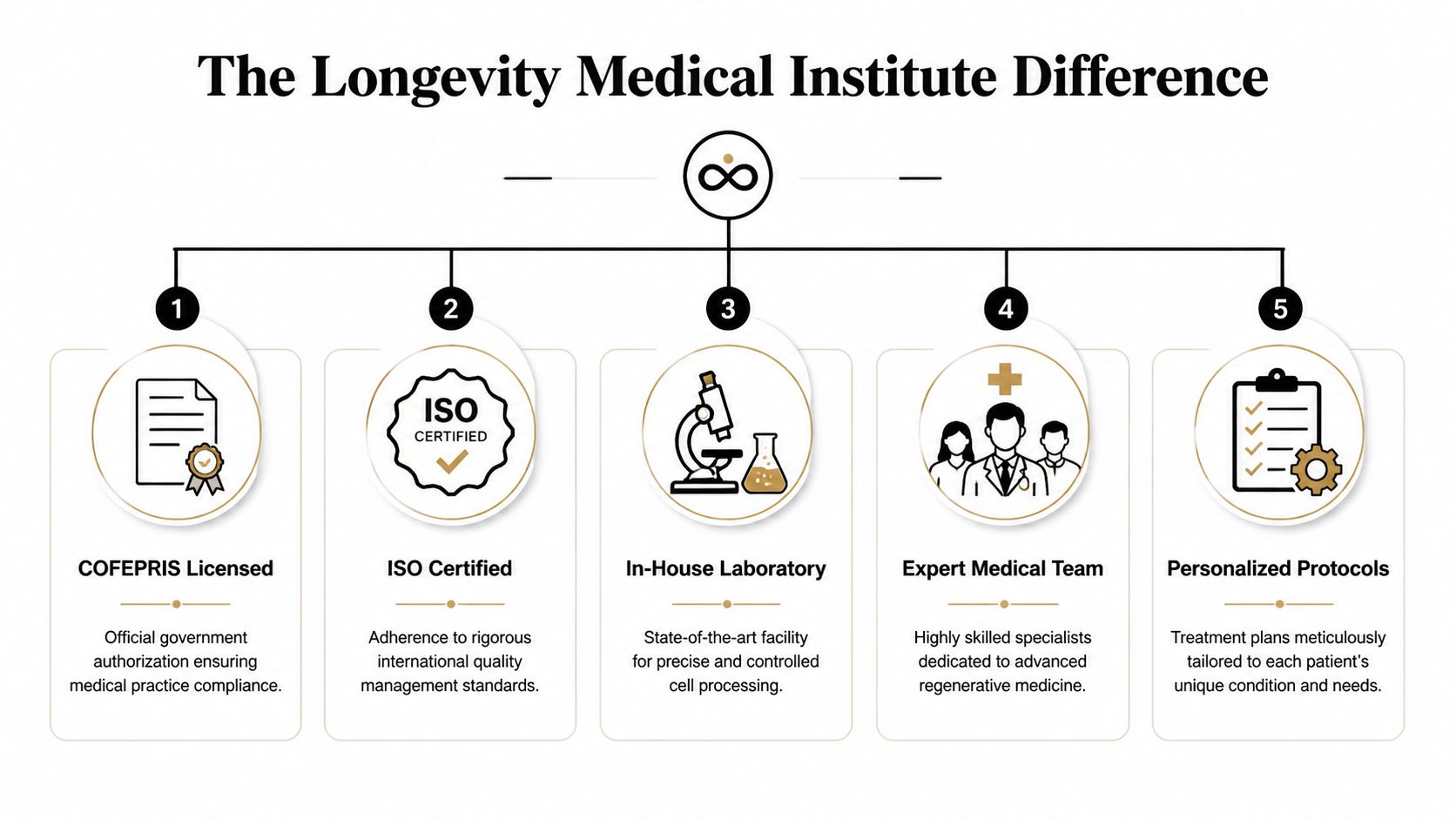
A credible regenerative spine program depends on the chain of quality behind the treatment. Cell source, laboratory controls, diagnostics, physician oversight, and aftercare all affect whether a protocol is thoughtful or generic.
What patients should verify in any clinic
Patients researching stem cell therapy cabo, stem cell treatment Mexico, or regenerative medicine Mexico should verify the operational side of care with the same scrutiny they apply to the medical side.
A strong clinic should be able to explain:
How cells are produced and controlled
Laboratory process matters. Sterility, handling, identity, and release standards should not be vague.What kind of cells are used
In this setting, allogeneic cell platforms may include placental, Wharton’s jelly, adipose, endometrial, and dental pulp derived products.Who is making treatment decisions
The protocol should be physician-led, not delegated as a sales process.Whether the clinic can support full evaluation
Spine care often requires more than a simple procedure room.
Patients who want to understand the laboratory side of treatment can review how a biotechnology stem cell lab in Mexico fits into clinical quality control.
Why integrated care matters for affluent medical travelers
Patients traveling from the United States or Canada usually want more than access to a procedure. They want a controlled experience. That includes pre-arrival review, coordinated scheduling, physician communication, imaging support, post-treatment planning, and a setting that respects privacy and time.
For that audience, the difference between the best stem cell clinics in Mexico, the best stem cell clinics in Cabo, and the best longevity clinics in Mexico often comes down to whether regenerative treatment is part of a complete medical system. The same applies when people compare the best longevity clinics in the world or the best longevity clinics in Cabo. Sophistication is not only about amenities. It’s about whether diagnostics, biologics, procedural skill, and follow-up operate as one coherent program.
Frequently Asked Questions
Is stem cell therapy for spinal disc degeneration actually a treatment for the disc, or just another pain injection
It’s intended to be a biologic treatment for the disc environment itself. That’s different from a conventional pain-management injection whose main role is to suppress inflammation temporarily. A realistic expectation, however, is improved pain and function rather than guaranteed full structural restoration.
Who is a good candidate
The best candidates usually have persistent disc-related low back pain, imaging that supports degenerative disc disease, and symptoms that haven’t resolved with well-executed conservative care. Patients also need an evaluation to determine whether the disc is the main pain generator or whether other structures are driving symptoms.
Who is not a good candidate
Some patients need a different path. Severe instability, advanced neurologic compromise, major deformity, or pain driven primarily by another diagnosis may make regenerative treatment a poor fit. A careful clinic should say that directly.
Do allogeneic stem cells make more sense than harvesting my own cells
In many modern protocols, yes. The practical advantage is consistency and controlled preparation. Clinics using allogeneic platforms can select from established cell sources rather than depending on the regenerative quality available from a patient whose age, inflammation burden, or metabolic status may reduce biologic potency.
Is the procedure painful
Most patients tolerate it well when it’s performed in a proper procedural setting with physician oversight. You should still expect some soreness or post-procedure discomfort. That doesn’t necessarily mean anything is wrong. It often reflects tissue response and the fact that the disc is a sensitive structure.
How long does recovery take
Recovery isn’t a single moment. It’s a sequence. Patients often return to basic daily activities relatively quickly, but exercise progression and loading of the spine should be controlled. Your physician should give a staged plan, not a casual “listen to your body” summary.
How long do results last
Honesty holds significant importance. Short-term and mid-term data are encouraging, but long-term structural durability remains an active research question. Randomized data show significant improvements at 12 to 24 months, while few trials provide imaging-based proof of sustained disc height restoration at 5 to 10 years, according to this review on long-term evidence gaps in disc stem cell therapy. In practice, long-term outcome quality likely depends on patient selection, loading patterns, metabolic health, and follow-through after treatment.
The injection is one event. The long-term result is a combination of procedure quality, spine mechanics, recovery behavior, and whole-body health.
Can this replace spinal fusion
Sometimes it may help a patient avoid or delay surgery, but it doesn’t replace surgery in every case. Fusion and other operations still have a role, especially when anatomy, instability, or neurologic issues make surgery the more appropriate option.
Why do patients travel to Mexico for this treatment
Patients often travel for access to integrated regenerative care, advanced diagnostics, allogeneic cell platforms, and physician-led protocols in one setting. For many affluent patients, convenience also matters. They want evaluation, treatment, and recovery planning coordinated without fragmentation.
How do I choose among stem cell clinics in Mexico
Start with fundamentals, not branding. Ask who reviews your MRI, who performs the procedure, what type of cells are used, how they are produced, whether diagnostics are reliable, and how aftercare is managed. If the clinic can’t answer those questions clearly, keep looking.
Is this information enough to decide whether I should proceed
No. Education helps you ask better questions, but it doesn’t replace individual evaluation. The decision should come from your imaging, your symptoms, your physical findings, your goals, and an honest risk-benefit discussion.
If you're considering Longevity Medical Institute for stem cell therapy in Mexico, the next step is a physician-led review of your imaging, symptom history, and candidacy. Patients seeking a premium, diagnostics-first approach to spinal disc degeneration can request a consultation to determine whether a personalized regenerative protocol is appropriate.
Author
Dr. Kirk Sanford, DC, Founder & CEO, Longevity Medical Institute. Dr. Sanford focuses on patient education in regenerative and longevity medicine, translating complex therapies into clear, practical guidance for patients.
Medical Review
Dr. Félix Porras, MD, Medical Director, Longevity Medical Institute. Dr. Porras provides clinical oversight and medical review to help ensure accuracy, safety context, and alignment with current standards of care.
Last Reviewed: May 1, 2026
Short Disclaimer
This information is for educational purposes only and is not medical advice. It does not replace an evaluation by a qualified healthcare professional. For personalized guidance, please schedule a consultation.
Published at Longevity Medical Institute Treatments & Resources