

Urologic Health and Why I Believe It Belongs in Longevity Medicine
What Changes in Your 50s, 60s and Beyond
For this mid-month newsletter, I wanted to focus on an area of health that becomes increasingly important as we get older but often receives little attention until something changes: urologic health.
Many of the patients I speak with are in their late 50s, 60s, and beyond. These are the years when maintaining independence, sexual health, sleep, and quality of life becomes increasingly important. They are also the years when prostate, bladder, kidney, urinary, and pelvic health concerns become more common.
Most people immediately associate urology with men and the prostate, but the specialty is much broader. Kidney stones, urinary urgency, incontinence, recurrent urinary symptoms, bladder dysfunction, kidney conditions, and pelvic floor problems can affect both women and men.
These changes can develop gradually. Waking once during the night to use the bathroom becomes twice, then three times. Urgency becomes something you plan around. A weaker urinary stream gets dismissed as aging. A woman may quietly adapt to leakage. Meanwhile, changes in prostate biomarkers or kidney function can occur while someone still feels perfectly healthy.
I don't believe we should simply accept these changes as an inevitable part of aging without understanding why they are happening.
Why I Wanted to Bring Urology to the Forefront
Urology is actually something we have offered at Longevity Medical Institute for the past several months, but many of our patients don't know about it.
Until now, patients have often learned about this part of our medical program because something appeared during their diagnostics. An abnormal PSA trend led to a prostate MRI. An ultrasound revealed a bladder or kidney issue. Persistent urinary symptoms led our doctors to look deeper. At that point, patients discovered that we also had the specialist and surgical capabilities to continue their care here.
I wanted to bring urology to the forefront this month so you know it is an option before you need it.
Dr. Iván Ibarra, MD, our Chief of Preventive Urology & Urologic Surgery, provides care across prostate health, urinary dysfunction, kidney and bladder conditions, pelvic floor disorders, male reproductive health, and minimally invasive urologic surgery for both women and men.
Having Dr. Ibarra here also connects pieces of Longevity Medical Institute that were already in place. Our clinical laboratory can identify functional changes and developing biomarker patterns, MRI and ultrasound can reveal structural changes, and our surgical theater allows appropriate procedures to be performed when needed.
For me, that continuity matters. If we identify something, the last thing I want is for our patients to enter another silo of care, adding more specialists, more appointments, more waiting, and more delays just to get to the next step. When we have the expertise and capabilities here, I want the path from finding a problem to understanding it and addressing it to be as coordinated, efficient, and convenient as possible.
Two patients demonstrate exactly why this matters.
Dr. Iván Ibarra, MD
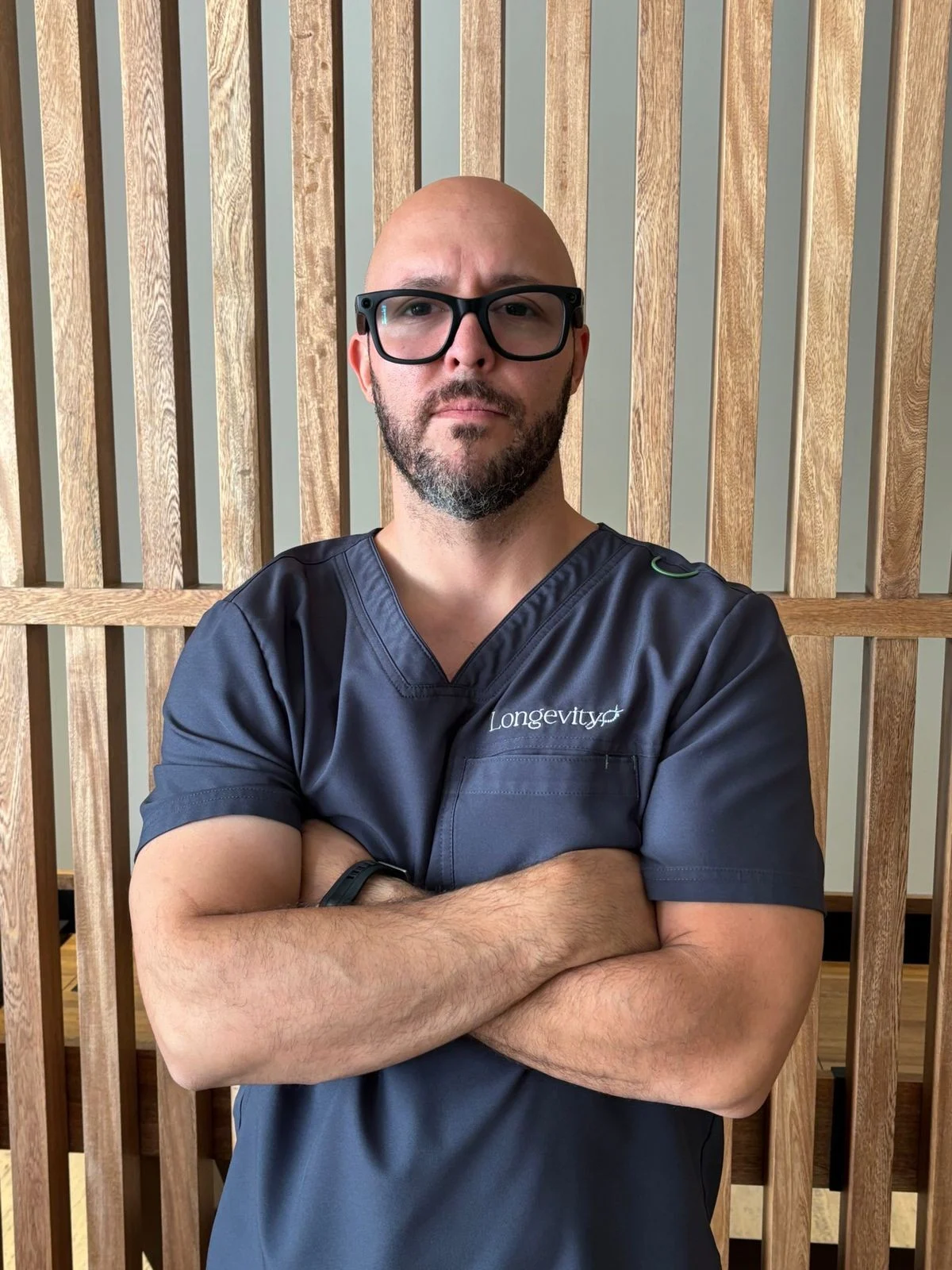
Chief of Preventive Urology & Urologic Surgery at Longevity Medical Institute
Patient One: Approximately One Week to an Answer
Since opening our clinic, we had been monitoring one patient's prostate biomarkers. By following his PSA and free PSA over time rather than looking at a single result, our doctors recognized a developing pattern that warranted a closer look.
Our doctors recommended a contrast-enhanced prostate MRI. It was performed and interpreted by our radiologist the same day, identifying a PI-RADS 4 lesion, a highly suspicious finding for cancer.
Our doctors recommended a transperineal prostate biopsy. This is the modern approach we use rather than the traditional biopsy performed through the rectum. Studies have reported approximately a 90% lower rate of sepsis with the transperineal approach. If one of our patients needs a biopsy, I believe we should use an approach that provides the answers we need while reducing unnecessary risk.
Within 48 hours, the patient was in our operating room for the biopsy. Four days later, the pathology results were available.
Thankfully, the biopsy was negative.
From identifying the concerning lab findings to contrast MRI, biopsy, pathology, and an answer took approximately one week.
Think about that from the patient's perspective. Learning that an MRI has identified a highly suspicious prostate lesion and then waiting weeks for another appointment, a biopsy, and pathology can create enormous anxiety.
Moving quickly didn't mean rushing medical decisions. It meant removing unnecessary delays and giving our patient the reassurance of knowing rather than continuing to wonder.
Patient Two: When the Obvious Answer Wasn't the Right Answer
Another patient came to us with urinary incontinence. He had previously been told the problem was likely his prostate and was prescribed medication, but it wasn't working.
Our evaluation didn't find prostate changes that adequately explained his symptoms, so our doctors looked deeper.
Ultrasound identified two abnormal growths in his bladder. Further investigation and biopsy determined they were malignant.
Fortunately, we identified the issue early. The patient underwent appropriate treatment and today is cancer-free.
His experience reinforces something important: a symptom tells us something is happening, but it doesn't necessarily tell us why. When the clinical picture doesn't make sense, we need to keep looking.
Why I Believe Early Detection Matters
There is something I hear from patients from time to time: “I'm not sure I want to know.” Or, “What could you do about it anyway?”
My response is simple: early detection matters, and it can prevent a lot of unnecessary suffering.
Not knowing does not prevent a problem from progressing. Finding it earlier can mean more options, less extensive treatment, and an opportunity to act before serious complications develop.
The numbers make that difficult to ignore. Five-year relative survival for localized bladder cancer is approximately 73%, compared with about 9% once it has spread to distant parts of the body. For prostate cancer, it is greater than 99% when localized, compared with approximately 38% for distant disease.
But survival is only part of the story.
Earlier detection may preserve options for surveillance, localized treatment, or less extensive intervention. Many men with low-risk prostate cancer, for example, can be monitored through active surveillance rather than immediately undergoing surgery or radiation.
When disease becomes more advanced, those choices can narrow. In some circumstances, treatment can involve removing a functioning organ such as the bladder or prostate, with potentially significant consequences for urinary function, continence, sexual health, independence, and overall quality of life.
This is why I believe so strongly in knowing your baseline and paying attention when something changes. Early detection isn't about living in fear of what we might find. It's about giving ourselves the opportunity to act while a problem is still more manageable, preserve function whenever possible, and prevent suffering that might otherwise have been avoidable.
When someone asks me, “What could you do about it anyway?” my answer is: potentially, quite a lot.
Urologic Health for Women
For women, it isn't always obvious whether a urinary problem belongs with a gynecologist or a urologist. Gynecology primarily focuses on female reproductive and pelvic health, while urology focuses on the urinary system, including the kidneys, bladder, ureters, and urethra. There is overlap, particularly with pelvic floor conditions and incontinence, and sometimes the right answer involves both.
Women may see a urologist for urinary leakage, bladder problems, pelvic floor dysfunction, pelvic organ prolapse, kidney stones, recurrent urinary symptoms, and other structural or functional problems involving the urinary tract.
For men, these shared kidney and urinary concerns are joined by prostate health, enlarged prostate, urinary obstruction, male fertility, and sexual health.
The important thing isn't deciding which specialist you need on your own. It is making sure persistent changes are properly evaluated rather than simply accepted as menopause, aging, or “just something I have to live with.”
Ultimately, this is about quality of life: sleeping through the night, exercising without worrying about leakage, traveling without planning around a restroom, and maintaining urinary and sexual function as we age.
What Can We Address?
Urology covers much more than most people realize, and many of these conditions become increasingly common in our 50s, 60s, and beyond.
For men, some of the most common concerns include enlarged prostate and difficulty urinating, changes in PSA or prostate MRI, kidney stones, bladder problems, male fertility concerns, and erectile dysfunction. When a procedure is necessary, options include HoLEP laser treatment for enlarged prostate, transperineal prostate biopsy, no-scalpel vasectomy, varicocele and hydrocele repair, laser circumcision, and procedures for certain forms of erectile dysfunction.
For women, Dr. Ibarra evaluates urinary leakage and incontinence, bladder conditions, pelvic floor dysfunction, pelvic organ prolapse, kidney stones, and other urinary tract concerns. Treatment options include urinary incontinence sling procedures such as TVT/TOT, pelvic organ prolapse repair, and bladder instillation therapy for certain chronic bladder conditions.
Kidney, ureter, and bladder conditions affect both women and men. Our capabilities include ureteroscopy and laser lithotripsy for kidney and urinary stones, PCNL for large or complex kidney stones, laparoscopic treatment of appropriate kidney cysts, and 3D laparoscopic surgery for certain structural urinary conditions.
Kidney cysts are a good example of why having diagnostics and urology together can be valuable. We often see them on full-body MRI scans, and most simple kidney cysts are common incidental findings that require no treatment. But imaging tells us what the kidney looks like structurally, while laboratory testing and urinalysis help tell us how it is functioning. Looking at both helps our doctors determine whether a finding is simply incidental or deserves further attention.
These are some of the more common conditions and procedures, but they are not the full extent of the program. The important point is that if you have a prostate, bladder, kidney, urinary, pelvic floor, or male reproductive concern, there may be considerably more we can evaluate and treat at Longevity Medical Institute than you realized.
And that is exactly why I wanted to bring urology to the forefront this month.
Don't Assume It's Just Aging
If there is one message I would like you to take from this month's newsletter, it is this: don't automatically assume a change in urinary or urologic health is simply part of getting older.
If you are waking repeatedly at night, experiencing urgency or leakage, noticing changes in urinary flow, dealing with recurring kidney stones or urinary symptoms, or seeing changes in prostate or kidney health, it is worth understanding why.
The two patients I shared demonstrate both sides of this philosophy. For one, looking closer provided reassurance. For another, looking beyond the presumed explanation uncovered something important while there was still an opportunity to act.
Different outcomes, but the same principle: recognize change, understand what is causing it, and act when necessary.
Early detection matters. It can preserve options, preserve function, and prevent a tremendous amount of unnecessary suffering.
That is the kind of proactive medicine I want us to continue building at Longevity Medical Institute.
Schedule a Urology Consultation
Our urology program is available to women and men for prostate health, urinary symptoms, urgency and incontinence, kidney and bladder concerns, kidney stones, kidney cysts, pelvic floor conditions, male fertility and sexual health, and other urologic concerns.
We invite you to book a free online consultation with Ivanna, or reach out to any of our patient coordinators to schedule an appointment: Nico, Roman, and Erick.
Your Feedback Makes a Difference
We're proud to share that we've already received multiple five-star reviews — thank you to everyone who's taken the time to support us!
As a new clinic, your positive feedback not only means the world to us, but it also helps boost our visibility online so more people can discover us.
If you’ve had a positive experience at Longevity Medical Institute, we’d be truly grateful for your review. Select the button below to Leave a Google Review
See more of our articles
Be up to date and check our newest educational materials.

Brenee’s Story and Her Fight Against Familial Pulmonary Fibrosis
This is a terminal, currently incurable disease, but Brenee refuses to let that diagnosis take away her hope.
Can Stem Cells Help With Aging?
What The Research Shows, Why The Fundamentals Come First, And My 80/20 Rule

Announcing Regenerative Neurological Therapy
A New Non-Invasive Intranasal Approach to Delivering Stem Cells, Exosomes, and Peptides to the Brain
Bridging the expertise of traditional medicine with the innovations of tomorrow.
With decades of experience spanning tens of thousands of patient cases, our doctors provide an unparalleled depth of care.