

7 Best Stem Cell Therapy Clinics to Consider in 2026
You may be comparing clinics from your laptop late at night, with a mix of hope and skepticism. One website promises cutting-edge science. Another highlights comfort, travel support, and personalized care. A third sounds academic and cautious. For most patients, the hard part isn't finding a clinic that offers stem cell therapy. It's figuring out which clinic is credible, which model fits your condition, and which claims deserve a second look.
That confusion isn't surprising. A 2017 NIH/PMC analysis identified 432 distinct U.S. businesses selling stem-cell-based treatments across 716 clinics, with 67% of those clinics concentrated in California, Florida, Texas, Arizona, and Colorado, underscoring how crowded and uneven the field had already become in the U.S. according to the NIH-hosted review. Since then, patient interest has only broadened, especially among people seeking options for orthopedic pain, recovery, inflammation, and healthy aging.
Choosing among the best stem cell therapy clinics comes down to a few practical questions. Who is supervising your care. What kind of cells are being used. How transparent is the clinic about what's established, what's elective, and what remains investigational. And how much diagnostic work happens before anyone recommends treatment.
1. Longevity Medical Institute

A patient with a worn knee and a clear MRI finding may need one focused procedure. A patient dealing with pain, poor recovery, fatigue, and inflammatory issues often needs a wider clinical workup first. Longevity Medical Institute is built for that second category.
That difference helps explain where Longevity Medical Institute fits in this guide. Many top U.S. academic centers concentrate on autologous, orthopedic care inside a cautious hospital framework. Longevity Medical Institute uses a different model. It is a physician-led clinic in San José del Cabo that offers allogeneic, multi-modal regenerative care under Mexico's regulatory system, with diagnostics, procedures, and travel coordination handled in one setting.
Why Longevity Medical Institute stands apart
Longevity Medical Institute does not frame stem cell therapy as a stand-alone injection. It treats it as one tool inside a larger treatment plan. For patients, that matters because regenerative medicine works best when the team first asks what is driving the problem. Is it a local injury. Systemic inflammation. Poor metabolic health. Reduced recovery capacity. More than one of those at once.
The clinic states that it uses only allogeneic stem cells and produces five cell types in its biotechnology lab: placental, Wharton's jelly, adipose, endometrial, and dental pulp. That is a clear contrast with many U.S. academic programs in this article, which usually focus on orthopedic use and patient-derived procedures.
Diagnostics are a major part of the model. LMI describes an in-house lab panel covering 120 biomarkers, AI-enhanced full-body MRI, and advanced cardiac evaluation. In plain terms, the clinic is trying to map the whole operating system before adjusting one part. If you want a plain-language primer on the basics, this overview of how stem cell therapy works can help.
Practical rule: If a clinic recommends a detailed regenerative plan before doing detailed assessment, slow down.
Longevity Medical Institute also offers supportive therapies that go beyond cell treatment alone. Depending on the program, that may include peptides, hyperbaric oxygen therapy, nutraceutical support, physical medicine, the Longevity Recharge Station, and TriFusion EBOO with UV and PBM. For some patients, that range is a benefit. For others, especially someone seeking a single orthopedic intervention, it may feel broader than necessary.
Best fit for patients seeking a broader regenerative model
A useful comparison is this. A typical U.S. orthobiologics clinic can function like a specialty service line built around joints, tendons, and sports injuries. LMI functions more like a high-end diagnostic and regenerative center that combines multiple therapies around one patient plan.
That makes its strengths fairly easy to see:
- Integrated clinical workflow: Diagnostics, physician oversight, regenerative procedures, and supportive therapies are coordinated in one place.
- Allogeneic treatment model: The clinic is not centered on autologous, same-day cell procedures.
- Medical travel support: Concierge coordination, accommodations, and travel assistance reduce logistical friction for out-of-town patients.
The tradeoff is just as important to understand. LMI operates outside the FDA framework used by U.S. hospitals and academic centers. Pricing is program-based, and the care model is broader than a standard injection visit.
Viewed in that context, LMI represents the premium international side of the stem cell clinic market. It is not the closest match to Mayo, HSS, Stanford, or Duke. It is the clearest contrast to them. For patients comparing global options, that distinction is useful. You are not only comparing clinic quality. You are also comparing two different models of care. For a wider international comparison, see this guide to top stem cell clinics in the world.
2. Mayo Clinic Regenerative Sports Medicine
Mayo Clinic approaches regenerative medicine the way many patients wish every clinic would. Carefully. Narrowly. With clear boundaries. Its regenerative sports medicine services are built for musculoskeletal care, not for broad anti-aging or whole-body claims.
That makes Mayo one of the best stem cell therapy clinics to consider if your goal is orthopedic care inside a major U.S. academic system. Instead of promising everything, the program focuses on orthobiologics such as PRP and same-day autologous cell procedures used within accepted U.S. care pathways.
Where Mayo is strongest
Mayo's advantage is context. Regenerative care doesn't sit in isolation. It sits next to sports medicine, orthopedic surgery, imaging, rehabilitation, and specialty consultation. For a patient with a stubborn tendon injury or cartilage-related concern, that matters because the biologic procedure becomes one option within a full decision tree, not the only recommendation on offer.
This kind of model usually leads to more conservative guidance. That can feel less exciting, but it's often more trustworthy.
Academic centers are often less impressive in their marketing and more impressive in their restraint.
Mayo also gives patients access to consult services that help determine whether they're a candidate for regenerative treatment at all. That screening step is important. The University of Utah's orthopedic guidance notes that stem cell and PRP treatments for musculoskeletal pain have mixed evidence, are not FDA-approved for most musculoskeletal uses, and have unknown long-term effects for many applications in its patient education on PRP and stem cell therapy.
Best for orthopedic patients who want academic oversight
Mayo is a strong fit if you value:
- Evidence-centered care: The clinical tone tends to be measured rather than promotional.
- Integrated orthopedic backup: If rehab, imaging, or surgery becomes the better route, those resources are already in-house.
- Trial access: Some patients may qualify for research pathways that aren't available in commercial clinics.
The limitations are just as important. The model is primarily orthopedic. It relies on autologous procedures within the U.S. framework. And many orthobiologic services in the U.S. are self-pay.
Patients who are new to regenerative medicine may find it useful to review how stem cell therapy works before a consult. Mayo Clinic's program is available through Mayo Clinic Regenerative Sports Medicine.
3. Hospital for Special Surgery Center for Regenerative Medicine
If your world revolves around knees, hips, shoulders, spine, or getting back to sport, HSS deserves attention. Its reputation comes from orthopedic specialization first, regenerative medicine second. That order is important. It tells you the clinic wasn't built around a trend. It added regenerative tools inside a serious musculoskeletal institution.
HSS is especially appealing for patients who want top-tier orthopedic subspecialists involved in treatment planning. In many regenerative settings, that's the missing layer. You get the injection, but not always the depth of diagnosis around biomechanics, surgical alternatives, rehabilitation strategy, or realistic outcome ranges.
Why HSS earns trust
The center is known for research-driven musculoskeletal care and straightforward patient education. It doesn't blur the line between established orthopedic management and investigational hope. For patients, that transparency can be calming.
Many ranking lists flatten all regenerative clinics into one category, overlooking that patients aren't really shopping for one thing. A person with knee osteoarthritis, a rotator cuff problem, and systemic inflammatory symptoms does not need the same clinic.
HSS benefits from being part of a broader academic ecosystem where sports medicine physicians, physiatrists, and orthopedic surgeons can all weigh in. That multidisciplinary structure often leads to more precise recommendations and fewer “one-size-fits-all” plans.
Best for serious musculoskeletal decision-making
HSS is a smart choice if you want:
- Orthopedic depth: The regenerative consult is connected to one of the best-known musculoskeletal care environments in the U.S.
- Clear messaging: Patients are less likely to encounter inflated promises.
- Research orientation: Clinical trials and ongoing orthopedic investigation support a more disciplined approach.
The downsides follow the same pattern as other U.S. academic centers. Therapies are generally limited to autologous options for orthopedic issues, many treatments are self-pay, and scheduling can be competitive.
Patients weighing procedural risk versus potential benefit should also review is stem cell therapy safe. HSS details its program at Hospital for Special Surgery Center for Regenerative Medicine.
4. Stanford Health Care Orthobiologics Clinic

Stanford's Orthobiologics Clinic has a distinctly translational feel. You can sense the proximity to research. The clinical tone is conservative, but the intellectual environment is ambitious. For some patients, that's the sweet spot.
This is one of the better options if you want care anchored to a major academic center with connections to advanced cell and gene therapy research. It still functions as an orthopedic and sports medicine service, but it carries a strong laboratory-to-clinic identity.
Best for patients who value a research-connected environment
Stanford's strength isn't broad consumer accessibility. It's disciplined clinical selection and access to a research-rich ecosystem. Patients may receive PRP and other orthobiologic services, while some advanced cell-based approaches are more closely tied to research participation.
That can be frustrating if you're hoping for an expansive commercial menu. It can also be reassuring if you're trying to avoid hype.
The best clinic for you might not be the one offering the most procedures. It might be the one most willing to say no.
Stanford also benefits from strong imaging and ultrasound-guided procedural capabilities. For orthopedic interventions, precision matters. The closer the treatment is to the right tissue plane and pathology, the more coherent the plan becomes.
A good fit for selective, academically minded patients
Patients often choose Stanford when they want:
- Academic oversight: Recommendations tend to follow a data-driven, less promotional style.
- Trial awareness: Research pathways may exist for carefully selected patients.
- High-level imaging support: Useful for accurate procedural targeting.
The limitations are familiar. Orthobiologics are generally focused on orthopedics, many offerings remain autologous in nature, and U.S. cash-pay realities still apply.
Before traveling or budgeting, some patients find it helpful to review stem cell therapy cost. Stanford's clinic information is available at Stanford Health Care Orthobiologics Clinic.
5. Duke Health Orthobiologics Program
A patient comparing stem cell clinics often runs into the same problem quickly. One site gives polished promises. Another gives a long procedure menu. Very few make it easy to answer the basic questions first: What do you treat, how do you deliver it, and what will it cost?
Duke earns attention because it answers some of those questions more plainly than many clinics do. Its Orthobiologics Program sits inside a major academic orthopedic system, and that context matters. In this guide, that places Duke firmly in the U.S. academic category: orthopedic-focused, generally conservative in scope, and centered more on autologous orthobiologics than the broader allogeneic, multi-modal models some patients see internationally.
Why clarity matters at Duke
Clear pricing and clear indications act like labels on medication bottles. They do not guarantee the treatment is right for you, but they reduce guesswork and help you compare options on something more solid than marketing language.
Duke publicly lists pricing for some PRP services, which is unusual in this field. That single choice tells you something about how the program communicates. It is willing to be specific where many regenerative clinics stay general.
That matters because stem cell and orthobiologic shopping can become confusing fast. Some clinics blend orthopedic injections with exosomes, peptides, wellness packages, or anti-aging services, which makes fair comparison difficult. Duke reads more like a musculoskeletal care program that includes regenerative tools, not a broad longevity clinic built around expansive biologic offerings.
Who tends to fit Duke well
Duke is often a strong match for patients who want:
- Transparent starting points: Public pricing for some services makes budgeting less opaque.
- Orthopedic integration: Sports medicine, imaging, physical therapy, injections, and surgical evaluation exist within one health system.
- Academic guardrails: Recommendations are more likely to stay tied to diagnosis, function, and conventional orthopedic decision-making.
That profile will appeal to some patients and disappoint others.
If you are looking for a highly selective orthopedic program with fewer moving parts, Duke may feel reassuring. If you are comparing it with a premium international clinic such as LMI, the contrast is straightforward. Duke reflects the U.S. academic model, narrower indications, orthopedic use, and a more restrained treatment menu. LMI represents a different model, broader regenerative planning, allogeneic options, and multi-modal protocols under a different regulatory structure.
Athletes and active adults weighing those differences may also find it helpful to review how stem cell therapy is used for athletes. Duke's current clinic information is available at Duke Health Orthobiologics Program.
6. UCSF Health Orthobiologics Program
UCSF is a strong option for patients who want regenerative orthopedic care inside a large academic medical center without a heavy luxury or sales overlay. Its orthobiologics offering sits within a sports medicine and orthopedic surgery environment, which helps keep recommendations grounded in function, diagnosis, and alternatives.
That's often what patients need most. Not just a treatment, but a fair comparison between treatment paths.
Where UCSF is particularly useful
UCSF emphasizes image-guided procedures and access to clinical trials for newer orthobiologic strategies. It also integrates biologics with other musculoskeletal interventions when appropriate. In plain terms, the program behaves less like a stand-alone regenerative boutique and more like a musculoskeletal service line that includes regenerative tools.
That can be especially useful for tendon problems and sports injuries, where good outcomes depend on more than the injectate itself. Rehab, biomechanics, imaging, and procedural accuracy all matter.
A patient deciding between PRP, a minimally invasive tendon procedure, or a more conventional orthopedic plan may benefit from this kind of setting because the clinic can compare options within one system rather than steering every patient toward the same revenue-producing service.
Best for orthopedic patients who want balanced options
UCSF may be the right fit if you want:
- Image-guided precision: Helpful for tendon and joint procedures.
- Sports medicine depth: Good for active adults with overuse or performance-related injuries.
- Academic balance: The tone tends to be explanatory rather than promotional.
The limitations remain consistent with the U.S. orthobiologics model. The focus is orthopedic, most services are self-pay, and insurance coverage for standalone biologic injections is often limited.
For patients who want a major academic center with strong sports medicine collaboration and a practical approach to orthobiologics, UCSF is easy to justify. Learn more at UCSF Health Orthobiologics Program.
7. Cleveland Clinic Joint Preservation Center
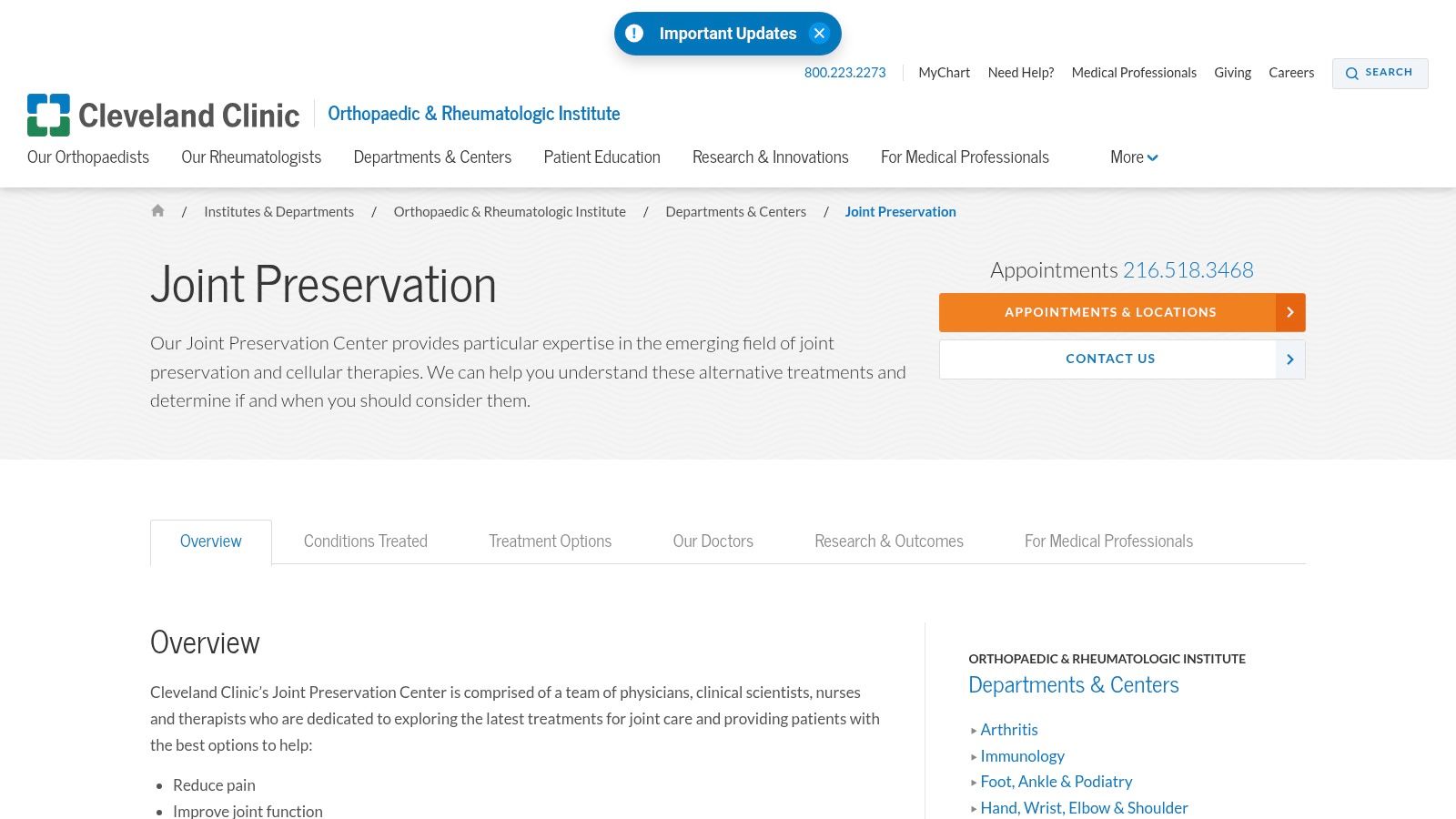
Cleveland Clinic's Joint Preservation Center is a good example of regenerative medicine placed inside a broader function-first strategy. The name says a lot. Joint preservation, not miracle restoration. That framing helps set expectations from the beginning.
Its orthobiologic offerings, including PRP and bone marrow concentrate, are part of a larger effort to help patients maintain mobility, reduce symptoms, and delay or avoid more invasive intervention when appropriate. That's a practical, patient-friendly lens.
Why Cleveland Clinic appeals to cautious patients
Many people searching for the best stem cell therapy clinics are not primarily seeking the most aggressive treatment. They're seeking the most credible one. Cleveland Clinic's patient education style and large orthopedic infrastructure make it attractive for that group.
The clinic also sits in a healthcare system with a strong outcomes-oriented culture. Patients benefit when regenerative procedures are treated as one piece of a longitudinal orthopedic strategy rather than an isolated event.
Outside the U.S., some patients prioritize scale and international accessibility when comparing clinics. Bookimed's 2026 ranking states that its top stem cell clinic database spans 218 partner clinics and 12,921+ treatment cases, while some featured international providers highlight high treatment volumes, international patient flow, and certified manufacturing infrastructure as markers of operational maturity in Bookimed's clinic ranking. Cleveland Clinic represents the opposite end of that comparison. Less destination-style regenerative branding, more mainstream academic joint care.
Best for conservative, function-focused care
Cleveland Clinic is worth considering if you want:
- Balanced messaging: Benefits and limits are both part of the conversation.
- Orthopedic scale: Surgical and non-surgical pathways coexist in one high-capacity system.
- Educational support: The program offers useful patient-facing materials.
The same caveats apply. Therapies are autologous and joint-focused, exact offerings can vary by provider, and public price transparency may be limited.
For the patient who wants regenerative medicine inside a highly established orthopedic framework, Cleveland Clinic remains a credible choice. Visit Cleveland Clinic Joint Preservation Center.
Top 7 Stem Cell Therapy Clinics Comparison
A clinic comparison works best when you read it like a map, not a scoreboard. One group of clinics is built around orthopedic care inside major U.S. academic systems. The other model, represented here by Longevity Medical Institute, is organized for broader regenerative care, including allogeneic cell therapy, layered diagnostics, and coordinated travel support under a different regulatory structure.
That distinction matters because these clinics are not offering the same type of medicine to the same type of patient.
A simple way to read the table is to separate scope from setting. The U.S. academic centers listed here mostly focus on autologous orthobiologics for musculoskeletal problems. Longevity Medical Institute represents a different category. It is designed for patients comparing broader regenerative programs, including allogeneic therapies and multi-part treatment plans, often with international travel built into the process.
If your goal is a knee, shoulder, tendon, or cartilage problem, the academic centers usually fit more naturally. If your question is larger, such as recovery, inflammation, systemic aging concerns, or a multi-site treatment plan, the international clinic model deserves a different kind of evaluation.
Making Your Decision with Confidence
The phrase best stem cell therapy clinics sounds simple, but the category isn't. Some clinics are primarily orthopedic injection practices. Some are academic centers that offer regenerative medicine with tight clinical boundaries. Others are international programs that combine stem cells with diagnostics, travel support, and broader longevity care. Comparing them as if they all deliver the same thing can lead to the wrong choice.
One way to simplify the decision is to start with your actual goal. If you have a clear orthopedic problem and want conservative care inside the U.S. system, academic centers such as Mayo, HSS, Stanford, Duke, UCSF, and Cleveland Clinic make sense. They tend to be cautious, evidence-aware, and structurally integrated with imaging, rehabilitation, and surgery. That can be exactly what you want when the priority is disciplined musculoskeletal care.
If your goal is broader than an isolated joint issue, your criteria change. A patient exploring regeneration in the context of recovery, inflammation, performance, or age-related decline may prefer an integrated international clinic model. Longevity Medical Institute fits that profile because it combines physician-led care, allogeneic stem cell programs, advanced diagnostics, and adjunctive therapies in one setting.
That international interest isn't happening in a niche market. The global stem cell therapy market is projected to grow from USD 0.48 billion in 2026 to USD 3.65 billion by 2035, implying a 25.3% CAGR according to the market projection from MarketsandMarkets. Medical tourism is a major part of that conversation, and Mexico has become a particularly visible destination. Bookimed reports 146 clinics in Mexico in its database, treatment packages starting at USD 1,600, and more than 890,000 stem cell therapy requests across its platform in its country comparison for stem cell treatment. Those figures don't tell you which clinic is best. They do explain why careful selection matters.
Use a simple filter. Look for physician oversight, transparency about what's elective or investigational, clear diagnostic logic, and a treatment model that matches your condition rather than your hopes alone.
Key questions to ask any clinic
- Cell source: What type of stem cells do you use, and from what source?
- Lab standards: Is your laboratory on-site, and what certifications does it hold?
- Quality controls: How do you verify cell identity, purity, and viability before treatment?
- Personalization: What diagnostic tools shape my treatment plan?
- Clinical leadership: Which physicians design and administer the therapy?
The right clinic is the one that can explain its process clearly, set honest expectations, and match its capabilities to your health goals without overselling certainty.
Last Reviewed: June 12, 2026
Short Disclaimer
This information is for educational purposes only and is not medical advice. It does not replace an evaluation by a qualified healthcare professional. For personalized guidance, please schedule a consultation.