

Cellular Regeneration Therapy: A Patient's Guide
Persistent joint pain changes how you move. Slow recovery changes how you train. Brain fog, inflammation, and age-related decline can change how you live.
That's why so many people start looking beyond symptom control. They want to know whether medicine can do more than reduce discomfort for a few hours or a few weeks. They want to know whether the body can be supported at a deeper level, where repair begins.
Cellular regeneration therapy sits in that space. It focuses on restoring healthier function by working with the body's own repair signaling, rather than covering up pain or waiting for degeneration to progress. For patients exploring a more complete recovery strategy, this field can feel both exciting and confusing. The language is technical. The clinic models vary widely. And many people don't know how to tell a thoughtful medical program from a generic sales pitch.
This guide is meant to make the subject clear.
The Future of Healing Is Here
Modern medicine has long been excellent at stabilization. It can suppress inflammation, reduce pain, and help people function through difficult periods. But many chronic problems don't begin with a shortage of symptom management. They begin with impaired repair.
That distinction matters.
When cartilage is stressed, when tissue stays inflamed, or when recovery slows with age, the central question becomes whether the body can be guided back toward a more regenerative state. Cellular regeneration therapy is built around that question. It represents a shift from only managing decline to supporting biological repair.
This isn't a fringe concept. Clinical interest and patient demand have expanded rapidly. The global cell therapy market was valued at USD 4.74 billion in 2023 and is projected to reach USD 20.07 billion by 2030. Growth on that scale doesn't prove that every treatment is right for every patient, but it does show that this area of medicine has moved well beyond theory.
Why patients are paying attention
People usually arrive here after a familiar cycle:
Conventional care helped, but not enough. Pain decreased, but function didn't fully return.
They want to avoid a larger intervention. Surgery, long medication courses, or repeated flare management may not feel like the right next step.
They're thinking about healthspan. They're not only asking, “How do I feel this month?” They're asking, “How do I maintain mobility, clarity, and resilience over time?”
Cellular regeneration is most useful when it's treated as a strategy, not a miracle. The best outcomes come from matching the right biology to the right patient.
A different lens on healing
A simple way to think about this field is to compare it to restoring a property after damage. Pain medicine can quiet the alarm. Anti-inflammatory treatment can reduce the smoke. Regenerative care asks whether the repair crew can rebuild the damaged area more effectively.
That's why patients with orthopedic injuries, chronic inflammation, autoimmune burden, and recovery concerns often find this area compelling. They aren't just looking for relief. They're looking for restoration.
Understanding Cellular Regeneration Your Body's Repair System
The easiest way to understand cellular regeneration therapy is to stop thinking of it as one product. It's better understood as a biological repair system.
Your body already has repair tools. It sends signals to calm inflammation, recruit support cells, build blood supply, and remodel damaged tissue. The problem is that injury, aging, overuse, and chronic inflammation can disrupt those signals. Cellular regeneration therapy is designed to support and organize that repair process.
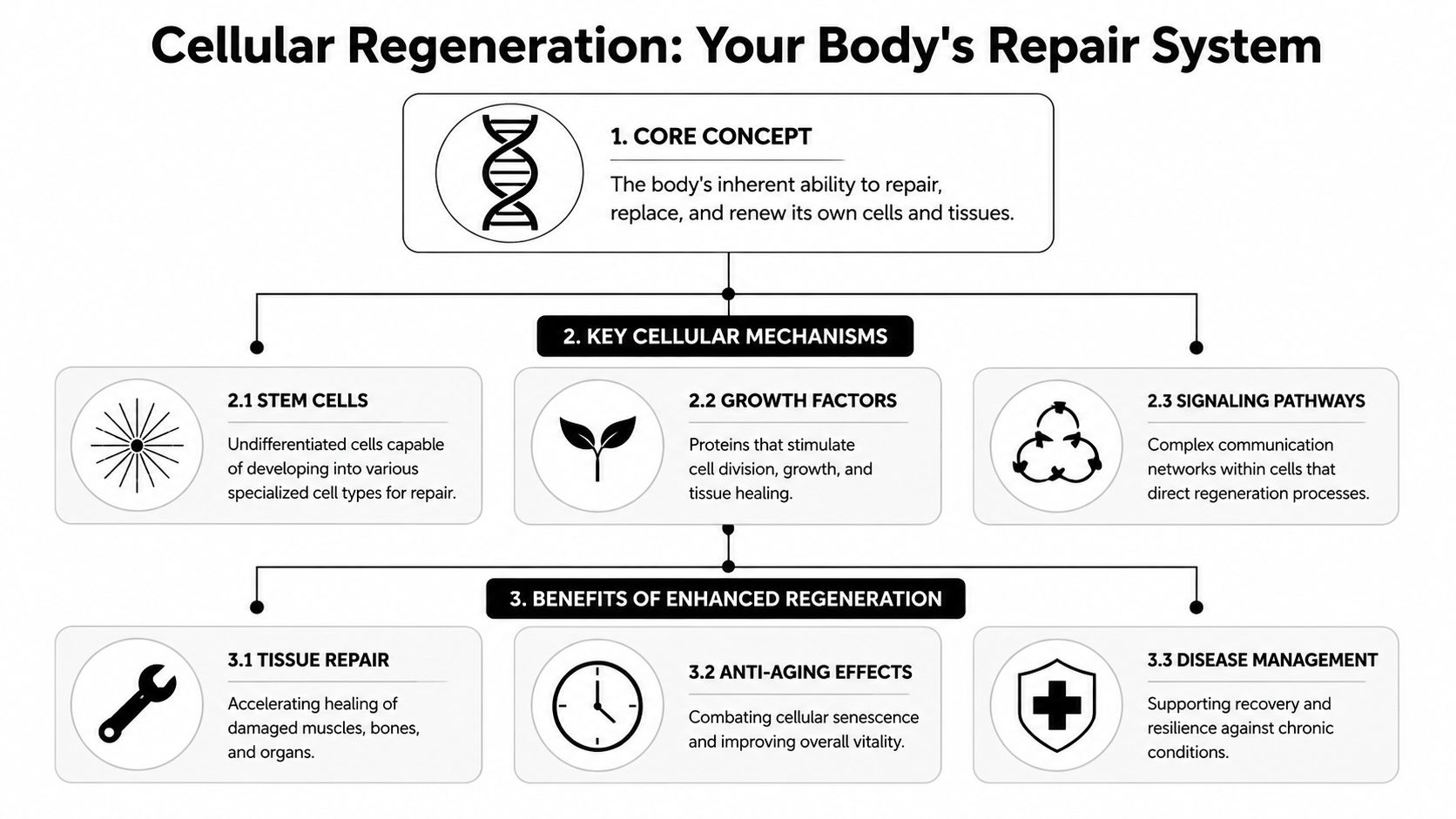
Think of it as a repair crew
A helpful analogy is a high-level restoration team working on a damaged structure.
Allogeneic stem cells are the coordinators. They help direct the repair environment.
Exosomes are the messengers. They carry instructions between cells.
Peptides are specialized tools. They support targeted biological processes.
NK cells act like quality control. They help the immune system identify unhealthy cells.
This analogy isn't perfect, but it clears up one common misunderstanding. Many patients think stem cells work mainly by turning into new tissue on command. In practice, much of their therapeutic value comes from signaling.
How stem cells really help
Mesenchymal stem cells, or MSCs, primarily work through paracrine signaling, which means they release bioactive factors that influence nearby cells. Those signals can help reduce inflammation, promote blood vessel formation, and support tissue repair. In published research, this signaling activity has been shown to suppress pro-inflammatory cytokines by up to 40%, creating a more regenerative environment, as described in this review of MSC mechanisms and regenerative microenvironments.
That's a key idea. The cell doesn't need to “become” your new cartilage cell to be useful. It may act more like an expert conductor, helping your own tissues perform a more organized healing response.
Practical rule: If a clinic explains stem cells as if they simply replace damaged tissue directly in every case, the explanation is too simplistic.
For a broader patient-friendly overview of the science, these podcasts on how regenerative medicine works can help connect the terminology to real treatment decisions.
Why cell source matters
Not all cellular therapies are the same. Source, processing, quality control, and clinical matching all matter.
This article's clinical framework centers on allogeneic cells, meaning donor-derived cells prepared for therapeutic use. In an advanced treatment environment, clinicians may work with multiple cell sources depending on the treatment goal and protocol design. That can include placental, Wharton's jelly, adipose, endometrial, and dental pulp derived cell lines produced in a biotechnology lab.
For patients, the important question isn't which source sounds most impressive. The important question is whether the source is appropriate for the indication, processed under strict standards, and used as part of a medically guided plan.
Where readers often get confused
A few terms are often blended together when they shouldn't be.
| Term | Plain-language meaning | Why it matters |
|---|---|---|
| Stem cells | Living cells used to influence repair biology | They can help regulate the healing environment |
| Exosomes | Tiny signaling particles released by cells | They help carry instructions from one cell to another |
| Peptides | Short chains of amino acids | They're often used to support specific tissue or recovery goals |
| NK cells | Natural killer immune cells | They're part of immune surveillance and cellular housekeeping |
The bigger idea
Cellular regeneration therapy isn't just about one injection. It's about improving the biological conditions under which healing can occur.
That's why the strongest programs don't treat the body like a collection of isolated parts. They look at inflammation, tissue quality, circulation, immune balance, metabolic stress, and recovery capacity together.
Clinical Applications Who Can Benefit From This Therapy
Most patients don't come in asking for “paracrine signaling.” They come in because something in daily life no longer feels normal.
A runner feels a sharp pull in the heel every morning and worries that a chronic foot problem will turn into a long-term limitation. A former tennis player can still work, but shoulder pain now shapes sleep, travel, and exercise. A high-performing executive notices that inflammation, fatigue, and slow recovery have become the new baseline.
Those are very different stories. They can all lead to the same conversation about cellular regeneration therapy.
The athlete trying to avoid a bigger setback
Athletes and active adults often look at regenerative care when they feel caught between two unsatisfying options. One option is to keep pushing through pain. The other is to accept escalating intervention before they feel ready.
In this setting, cellular regeneration therapy is often discussed for joint stress, tendon overload, soft tissue injuries, and recovery after repetitive strain. The goal isn't only to feel better at rest. It's to restore confidence in movement.
For people traveling for care, practical planning also matters. This overview of stem cell therapy in Mexico addresses questions that often come up around treatment access, logistics, and evaluation.
The patient living with chronic inflammation
Some people aren't dealing with a single injured area. They're dealing with a system that seems stuck in overdrive.
These patients often describe a body that feels reactive. Joints flare more easily. Recovery takes longer. Energy feels less dependable. Their concern may center on inflammatory conditions, autoimmune burden, persistent pain, or a broader sense that their physiology is no longer adapting well.
Cellular regeneration therapy may be considered in these cases because of its immunomodulatory role. In plain language, that means the treatment approach may help calm an overactive inflammatory environment and support healthier repair signaling.
A useful question isn't only “Where does it hurt?” It's also “What kind of internal environment is preventing recovery?”
The proactive adult focused on healthspan
Another group arrives before a crisis. They still function well, but they've started to notice slower healing, reduced resilience, or subtle age-related decline.
They may be thinking about:
Mobility preservation for knees, hips, shoulders, or spine
Recovery support after exercise, travel, or demanding work cycles
Cognitive and systemic vitality as part of a broader longevity plan
Inflammation control to protect long-term function
In these cases, cellular regeneration therapy is rarely used in isolation. It's usually part of a larger conversation about diagnostics, sleep, metabolic health, cardiovascular status, physical medicine, and recovery support.
A brief clinical overview can also help make the experience more concrete:
Other areas patients often ask about
Interest also continues to expand in conditions that are more complex and often frustrating to manage. Patients commonly ask about regenerative support for:
Peripheral neuropathy
Cognitive decline
Long Covid
Chronic fatigue syndrome
Fibromyalgia
Psoriasis
Ulcerative colitis
Chronic inflammation and inflamaging
Persistent symptoms after Lyme disease
Not every patient is a candidate, and not every condition has the same depth of evidence. But these questions reflect a real shift in patient thinking. People are looking for care models that see recovery as an integrated biological process, not a collection of disconnected symptoms.
Evidence and Outcomes What Results Can You Expect
The most honest answer is that outcomes vary. That isn't a vague disclaimer. It's the actuality of regenerative medicine.
Cellular regeneration therapy is highly dependent on context. Tissue quality matters. Timing matters. The degree of degeneration matters. Inflammatory burden matters. So do sleep, metabolic health, physical loading, and whether the treatment plan fits the actual problem.
Still, there is meaningful evidence to discuss.
What the published numbers show
Across regenerative applications, cellular regeneration therapies have demonstrated success rates ranging from 50% to 90%, with joint repair and autoimmune conditions reporting approximately 80% positive outcomes. The same research notes that 67% of patients report good to excellent quality of life post-treatment. These findings are summarized in 2025 reporting on stem cell therapy outcomes across regenerative medicine applications.
Those are encouraging figures, but they should be interpreted carefully.
What those results do and don't mean
A success rate doesn't mean the same thing in every study or for every patient. One patient may define success as walking without pain. Another may define it as returning to sport. A third may value improved energy, fewer flares, and better daily function.
That's why broad percentages are helpful, but incomplete.
A more useful way to think about outcomes is to separate them into categories:
| Outcome type | What patients often notice |
|---|---|
| Symptoms | Less pain, stiffness, or irritation |
| Function | Better walking, training, lifting, or sleep |
| Recovery | Faster bounce-back after exertion |
| Quality of life | More confidence, more activity, less limitation |
Good regenerative care doesn't promise identical results for every person. It aims for meaningful improvement that matches the patient's actual goals.
Why personalization changes expectations
Two people with the same diagnosis may not have the same biology. One knee may have mostly inflammatory irritation. Another may have more advanced structural degeneration. One patient may recover quickly because the surrounding systems are strong. Another may need a broader plan because inflammation, circulation, or recovery capacity is impaired.
That's one reason safety review and clinical selection matter so much. Patients should understand not only whether a therapy can work in general, but whether it makes sense in their specific case.
Questions about risk are part of that process, too. This review of stem cell safety and published research conclusions is a useful place to start when you want to understand how clinicians think about evidence, oversight, and informed consent.
A realistic standard for progress
A thoughtful outcome conversation should sound measured, not theatrical.
Patients should expect a process. They should expect follow-up. They should expect that some goals improve faster than others. And they should expect that the best results usually come when cellular therapy is placed inside a larger program that supports the body's ability to heal well.
Your Journey with Longevity Medical Institute
The most advanced version of cellular regeneration therapy doesn't begin with a syringe. It begins with a map.
If a patient has pain, inflammation, slower recovery, and age-related changes, a clinician needs to know which of those factors is primary and which are downstream. Treating biology without first defining the terrain is like renovating a home without inspecting the foundation, electrical system, and water damage.
That's why an integrated healthspan program matters. The treatment isn't just the cell product. The treatment is the sequence of diagnosis, interpretation, protocol design, delivery, and recovery support.
Step one begins with deep diagnostics
A proper regenerative workup should answer more than “Where does it hurt?”
It should clarify:
Inflammatory status
Tissue condition
Cardiovascular readiness
Metabolic resilience
Recovery capacity
Hidden contributors to symptoms
In a modern clinical setting, this may include an in-house lab measuring 120 biomarkers, AI-integrated full-body MRI, advanced heart evaluation, ultrasound-guided assessment, and physician review that connects the findings into one coherent picture.
Many patients feel relief for the first time at this stage. Their symptoms are no longer treated as isolated complaints. They're interpreted as parts of a biological pattern.
Step two is protocol design, not one-size-fits-all care
Once the data is clear, the protocol can become precise.
That may involve allogeneic stem cell therapy, exosome support, targeted joint or tissue injections, peptide strategies, NK cell protocols, IV support, physical medicine, and recovery therapies selected according to the patient's priorities. Someone focused on orthopedic repair may need a very different plan from someone focused on systemic inflammation, healthspan, or cognitive resilience.
One reason combination planning matters is that supportive therapies can influence the biological environment in which cellular therapy works. Combining hyperbaric oxygen therapy with stem cells can enhance MSC survival and engraftment by 40% through HIF-1α upregulation.
That doesn't mean every patient needs the same stack. It means the surrounding plan can materially affect how well a core regenerative therapy performs.
The strongest protocol is rarely the most aggressive one. It's the one that fits the patient's biology, timeline, and goals.
How supportive therapies fit into the bigger picture
Patients often ask whether therapies like HBOT, peptides, or recovery technologies are “extras.” In a well-designed program, they're better understood as amplifiers or stabilizers.
A few examples make that easier to visualize:
HBOT may support oxygen delivery and the healing environment around regenerative treatment.
Peptides may be used when clinicians want targeted support for tissue recovery, signaling, or repair dynamics.
The Longevity Recharge Station may be included when a patient needs broader recovery support as part of an intensive program.
Advanced cardiac evaluation may influence treatment pacing in patients whose recovery plans need to account for cardiovascular status.
AI-enhanced MRI may identify issues that pain location alone would miss.
The experience matters, too
A premium clinical experience isn't only about comfort. It affects clarity and adherence.
When patients travel for care or commit to an intensive plan, they need a setting where testing, physician review, treatment delivery, and follow-up are coordinated. They need a team that can explain why a protocol was chosen, what each part is meant to do, and how progress will be monitored.
For readers who want a closer look at how an integrated program is organized in practice, this article on inside Mexico's premier longevity clinic and its future-focused care model provides a useful overview. Longevity Medical Institute is one example of a physician-led setting that combines regenerative medicine, diagnostics, and recovery support under one roof.
What patients should expect from the process
The patient journey should feel structured, not improvised.
Evaluation first. Symptoms, history, imaging, biomarkers, and goals are reviewed together.
Protocol matching. The treatment plan is built around indication, biology, and tolerance.
Therapy delivery. Injections, infusions, or combination therapies are performed with clinical oversight.
Recovery support. Adjunctive therapies help strengthen the repair environment.
Follow-up. Progress is measured by function, symptoms, and objective findings where appropriate.
That structure is one of the clearest markers of quality. Regenerative medicine works best when it's practiced as medicine.
Safety Regulation and Making an Informed Decision
The most important safety question isn't whether cellular regeneration therapy sounds advanced. It's whether the clinic offering it behaves like a real medical institution.
Patients should be cautious with any provider that skips diagnostic depth, gives the same recommendation to everyone, or treats informed consent like a formality. Regenerative medicine requires rigorous sourcing, handling, clinical oversight, and patient selection. Without those elements, the conversation moves from innovation to risk.
What to ask before choosing any clinic
A serious clinic should be able to answer practical questions clearly:
What cells are being used. Patients should understand that the program uses allogeneic cells and know the source categories being offered.
How are they produced and screened. The clinic should explain lab standards, sterility controls, and quality systems in plain language.
Who decides if you are a candidate. A physician should evaluate your case, not just a coordinator.
How is treatment guided. For orthopedic care, image guidance and anatomical precision matter.
What follow-up is included. Good care continues after treatment day.
Regulation and the patient's role
In Mexico, many patients specifically ask about licensing and oversight. Those are the right questions.
A clinic should be transparent about regulatory status, physician involvement, and laboratory standards. If a provider references COFEPRIS licensing or an ISO-certified laboratory environment, they should be able to explain what that means operationally. Patients don't need to become regulatory experts, but they should expect specific answers.
This guide on whether stem cell therapy in Mexico is safe is helpful if you're comparing clinics and want a more grounded framework for evaluating credibility.
A trustworthy clinic won't rush you past your questions. It will welcome them.
Signs of a stronger decision process
A better decision usually comes from looking for evidence of discipline, not drama.
Look for:
Physician-led evaluation
Clear explanation of risks and expected benefits
Defined treatment rationale
Documented lab and safety standards
A plan for aftercare and monitoring
Be careful with:
Universal promises
Pressure to commit immediately
Vague language about sourcing
No real workup before treatment
Claims that sound certain when your case is still being evaluated
The right clinic won't tell you that cellular regeneration therapy is for everyone. It will tell you whether it fits you.
Frequently Asked Questions for Our Patients
How long does it take to notice results
Some patients notice early changes in comfort, inflammation, or recovery. Others improve more gradually. Tissue repair and immune modulation don't always move on the same timeline, so patience matters.
A useful way to think about it is that symptom relief may happen before deeper functional change. Your clinician should explain what short-term, medium-term, and longer-term progress would reasonably look like in your case.
Why would one patient receive a different cell type or combination than another
Because the treatment target isn't always the same.
A joint-focused protocol may emphasize local tissue support. A systemic longevity program may place more weight on inflammation, immune signaling, or recovery environment. Clinics working with multiple allogeneic cell sources, including placental, Wharton's jelly, adipose, endometrial, and dental pulp lines, can tailor protocols according to the clinical objective and physician judgment.
Are exosomes, peptides, or HBOT separate treatments or part of the same plan
They can be either, but in a thoughtful program they're usually part of the same logic.
Cellular regeneration therapy works best when the surrounding environment supports repair. HBOT may be used to strengthen that environment. Peptides may be selected to support specific healing goals. Exosomes may be included when signaling support is clinically appropriate. The decision should come from your workup, not from a preset package.
Do I need to travel for treatment if I'm coming from the United States or Canada
Many patients do travel for regenerative care, especially when they want a setting that combines diagnostics, physician oversight, treatment delivery, and recovery services in one place.
The most important part of planning isn't the flight. It's making sure your records, imaging, goals, and medical history are reviewed in advance so the trip is medically purposeful.
What if I'm interested in longevity, not just pain relief
That's a common reason people explore this field.
Cellular regeneration therapy can be part of a broader healthspan strategy when the aim is to support resilience, recovery, inflammation control, and function over time. In that context, it's often paired with biomarker analysis, advanced imaging, cardiac assessment, sleep optimization, and recovery therapies rather than being used as a standalone intervention.
How do therapies like the Longevity Recharge Station or Trifusion EBOO with UV and PBM fit in
These therapies are generally considered part of a wider systems-based program.
They may be used to support recovery, circulation, oxidative balance, or overall physiological readiness depending on the clinical plan. Whether they belong in your protocol depends on your diagnostic findings, goals, and physician assessment. They should complement the treatment strategy, not distract from it.
If you're considering Longevity Medical Institute, the next step is a physician-led review of your goals, history, imaging, and biomarkers so your care plan can be built around your biology, not a generic package.
Author
Dr. Kirk Sanford, DC, Founder & CEO, Longevity Medical Institute. Dr. Sanford focuses on patient education in regenerative and longevity medicine, translating complex therapies into clear, practical guidance for patients.
Medical Review
Dr. Félix Porras, MD, Medical Director, Longevity Medical Institute. Dr. Porras provides clinical oversight and medical review to help ensure accuracy, safety context, and alignment with current standards of care.
Last Reviewed: May 13, 2026
Short Disclaimer
This information is for educational purposes only and is not medical advice. It does not replace an evaluation by a qualified healthcare professional. For personalized guidance, please schedule a consultation.