

Stem Cell Therapy Mexico: A Guide to Advanced Regenerative Care
An increasing number of patients from the U.S. and Canada are now looking to Mexico for stem cell therapy, and for good reason. They're drawn by the unique opportunity to access advanced regenerative care that is often unavailable back home, all while receiving premium, physician-led treatment at a fraction of the cost.
The Rise of Mexico as a Hub for Regenerative Medicine
For many, the phrase "stem cell therapy in Mexico" evokes a sense of sophisticated treatments that feel just out of reach in their own countries. This is not just a perception; it is rooted in a fundamental difference in regulatory philosophy. While the U.S. and Canada focus on long, arduous drug approval pathways, Mexico’s framework supports the direct, physician-led application of advanced biologics within a licensed clinical setting.
This environment has established Mexico as a premier destination for medical travel—not just for the savings, but for access to a different class of care. The country has become a genuine hotspot for patients seeking meaningful solutions for orthopedic injuries, chronic pain, and the biological realities of aging.
A Tale of Two Systems
The main driver behind this medical migration boils down to two things: access and cost. In the United States, comparable treatments are often confined to restrictive clinical trials or come with price tags that are simply out of reach for most people. Mexico, on the other hand, operates on a different model.
Medical travel is a major pillar of the country's healthcare landscape, with Mexico ranking as the second-largest destination for it in the world. The country's top facilities handle over 233,000 verified patient requests across more than 140 specialized clinics. This influx, primarily from the U.S. and Canada, is fueled by cost savings of 39-60%.
Here, comprehensive regenerative protocols can range from $4,900 for a targeted joint injection to $9,500 for a more systemic protocol. This is a stark contrast to the typical U.S. prices of $15,000–$25,000 for a far more limited procedure. You can dive deeper into these trends and learn what separates the leading facilities in our guide to finding the best stem cell clinic in Mexico.
Stem Cell Therapy Landscape: Mexico vs US and Canada
Understanding these key differences is vital for any patient considering their options. Mexico offers a distinct advantage in the availability of certain regenerative therapies, all guided by its own dedicated regulatory body, COFEPRIS. This table breaks down the core distinctions for patients.
| Factor | Stem Cell Therapy in Mexico | Stem Cell Therapy in the US/Canada |
|---|---|---|
| Regulatory Focus | COFEPRIS-licensed clinical application and safety | FDA/Health Canada focus on lengthy drug approval pathways |
| Treatment Access | Broader access to allogeneic stem cell therapies | Highly restricted, often limited to investigational use for many conditions |
| Average Cost | Significantly lower, offering high value for comprehensive care | Often prohibitively expensive for most patients |
This unique combination of progressive regulation, high value, and a focus on direct clinical application is exactly why so many are looking south for healing, hope, and a new standard of care.
The Science of Allogeneic Stem Cells and Exosomes
To truly appreciate how regenerative medicine works, we must look at its two core components: allogeneic stem cells and their tiny but powerful messengers, exosomes. Our entire clinical approach is built on using the most potent and ethically sourced versions of these biological tools.
At Longevity Medical Institute, we exclusively use allogeneic mesenchymal stem cells (MSCs). These are meticulously selected from the umbilical cords of healthy, pre-screened newborns, which are donated with full consent after a healthy birth.
The term "allogeneic" simply means the cells come from a qualified donor. This is a crucial distinction. Unlike your own cells, which carry the wear and tear of your age and inflammatory history, these umbilical cord-derived MSCs are incredibly youthful, vibrant, and pure.
Critically, they are also "immunologically privileged." This means they can go to work in your body without triggering an immune reaction or being rejected, allowing them to perform their job effectively.
The Master Repair Crew for Your Body
Think of allogeneic MSCs as a highly skilled, elite repair crew dispatched to a site of injury or chronic inflammation. When introduced into your body, these cells are naturally drawn to the chemical distress signals that damaged tissues send out.
Once they arrive, they don’t just become new tissue. Instead, they initiate a sophisticated cascade of healing actions.
These cells are not just building blocks; they are intelligent biological directors. Their main job is to orchestrate your body’s own healing mechanisms, instructing local cells to reduce inflammation, clear out damaged tissue, and start the process of regeneration.
This ability to manage the local environment is what makes MSCs so effective for a wide range of issues, from an arthritic knee to systemic inflammation. They create the ideal conditions for your body to repair itself far more efficiently than it could on its own.
Exosomes: The Communication Network
If stem cells are the repair crew, then exosomes are their communication system. They are microscopic vesicles—think of them as tiny bubbles—that are released by stem cells.
Exosomes are not cells themselves. They are messengers, carrying vital cargo like proteins, lipids, and genetic material (mRNA and microRNA) from the stem cell to your body's own cells.
These powerful messengers deliver specific instructions that amplify the regenerative signal. For instance, they might tell your cells to:
Reduce inflammation by signaling a halt to the production of inflammatory chemicals.
Promote new blood vessel growth to improve circulation and get nutrients to damaged areas.
Prevent cell death (apoptosis) in the healthy cells surrounding an injury.
Stimulate cell replication and differentiation to replace old, damaged tissue with new, functional tissue.
By delivering these instructions directly where they are needed, exosomes essentially teach your body’s cells how to heal more effectively. Their small size allows them to travel throughout the body and even cross barriers that stem cells can’t, making them a crucial part of both systemic wellness and targeted repair.
Here at Longevity Medical Institute, we know that providing the highest quality of care means using the most advanced and potent biologics. That’s why our protocols for stem cell therapy Mexico are built around the combined power of high-purity allogeneic MSCs and their highly active exosomes. This combination gives us a powerful, multi-faceted way to restore function, reduce pain, and enhance your body's innate capacity for healing.
To explore this topic in greater detail, you can read our comprehensive overview of stem cells and exosomes.
Proven Clinical Applications of Stem Cell Therapy
While the science behind regenerative medicine is extraordinary, its true value is measured in patient outcomes. The application of stem cell therapies has moved beyond theory and is now used to solve specific health challenges—restoring function, reducing pain, and elevating overall quality of life.
These are not broad, speculative treatments. They are highly targeted therapies with clear objectives, grounded in the unique signaling and repair capabilities of stem cells and exosomes. The focus is on activating your body's own repair mechanisms to create lasting biological change, rather than simply masking symptoms with conventional drugs.
Orthopedics and Pain Management
One of the most well-established applications for stem cell therapy is in orthopedics, offering a powerful alternative for joint pain and tissue injuries. Millions of people live with chronic pain from conditions like osteoarthritis or from old injuries that never quite healed. This is where these therapies can be truly transformative.
When injected directly into a damaged joint, like a knee or shoulder, these regenerative biologics get right to work. They release potent anti-inflammatory signals to calm the painful environment and then orchestrate the repair of damaged cartilage and surrounding tissues.
For someone with an arthritic knee, this can mean regaining the ability to walk without a limp or climb stairs without pain. For a person with chronic back pain from a degenerated disc, it offers a real chance at relief that may have felt out of reach for years. We consistently see significant improvements in:
Knee Pain: Addressing cartilage loss and inflammation from osteoarthritis or meniscus tears.
Shoulder Pain: Repairing rotator cuff injuries and reducing pain from impingement.
Hip and Spine Issues: Targeting degenerative disc disease and joint deterioration.
The market for these therapies continues to grow, largely because of their effectiveness in treating orthopedic issues. A comprehensive treatment in Mexico might combine 50 million cells with supportive therapies for around $3,600–$4,000, offering a powerful path toward tissue regeneration.
Sports Injuries and Accelerated Recovery
Athletes and active people place immense demands on their bodies, and an injury like a muscle tear or ligament sprain can be career-altering. Regenerative therapy offers a way to not just heal, but to heal stronger and faster.
Instead of just waiting weeks or months for the body’s slow, natural repair processes, stem cells and exosomes can dramatically shorten recovery timelines. Flooding a partially torn ligament with these regenerative signals, for example, can accelerate the formation of new, healthy tissue. This helps athletes get back in the game with greater confidence and a reduced risk of re-injury.
Autoimmune and Systemic Inflammation
Many chronic diseases are driven by a state of systemic inflammation, where the body's immune system is stuck in a constant state of over-activation. Allogeneic mesenchymal stem cells (MSCs) are powerful immunomodulators, meaning they can help regulate and rebalance this overactive immune response without suppressing the entire system.
This makes them a promising approach for managing autoimmune conditions. By calming the immune environment, these therapies can help reduce the chronic inflammation that drives symptoms, offering a way to target the root cause of the disease. If this area is relevant to you, you can explore our detailed guide on stem cell therapy for autoimmune and inflammatory diseases.
Longevity and Wellness
Beyond treating specific conditions, regenerative medicine is a cornerstone of any serious longevity and wellness strategy. As we get older, our bodies accumulate a low-grade, chronic inflammation often called "inflammaging."
Systemic IV infusions of stem cells and exosomes are used to combat this process directly. This approach helps enhance overall vitality, improve recovery from physical exertion, support cognitive function, and promote a longer, more vibrant healthspan. It is about proactively supporting your body’s ability to repair and maintain itself, helping you feel your best for years to come.
How to Verify Safety and Clinic Credentials in Mexico
When you’re considering stem cell therapy in Mexico, your safety should be the single most important factor. The reality is that the landscape includes both world-class medical institutions and opportunistic, unregulated clinics. Knowing how to tell them apart is the key to making a confident and informed decision.
The primary regulatory body you need to know is COFEPRIS (the Federal Commission for the Protection against Sanitary Risk). Think of it as Mexico’s equivalent of the FDA in the United States. Any reputable clinic will operate under a COFEPRIS license, which covers both their facility and the biologics they use. This license isn't just a piece of paper; it's a non-negotiable sign of a clinic's commitment to established safety and quality standards.
The Anatomy of a Trustworthy Clinic
Beyond a license, a top-tier clinic proves its dedication to patient outcomes through radical transparency and verifiable infrastructure. These aren’t just nice-to-haves; they are the critical markers of quality that separate legitimate medical providers from unregulated operators.
Here is exactly what to look for when vetting a clinic for stem cell therapy in Mexico:
Physician-Led and Administered Procedures: Your entire treatment should be overseen and performed by qualified medical doctors, not technicians. This ensures every decision is guided by deep clinical expertise and a true understanding of your unique medical needs.
Transparent Cell Sourcing and Screening: The clinic must be able to clearly explain where its allogeneic stem cells come from—specifically, ethically donated umbilical cords from healthy, pre-screened mothers. They should also detail the rigorous testing protocols used to screen for diseases and guarantee cell purity.
An On-Site, Certified Laboratory: A premier clinic will have its own on-site lab. This is a crucial element, as it gives them complete quality control over the processing, expansion, and storage of the biologics. For a deeper dive into what this entails, you can learn more about the biotechnology and stem cell lab standards in Mexico.
Red Flags to Watch For
Just as important as knowing what to look for is knowing what to avoid. Certain claims and practices are immediate red flags that should make you seriously question a clinic's legitimacy.
A common tactic among less reputable clinics is to promise guaranteed "cures" for complex conditions. Legitimate regenerative medicine is a sophisticated medical process, not a miracle fix. Any provider making such guarantees is prioritizing marketing over medical ethics.
Be extremely wary of any clinic that:
Lacks verifiable COFEPRIS licenses or clear physician credentials.
Is vague about their cell sourcing, quality control, or laboratory standards.
Uses high-pressure sales tactics or discourages you from asking detailed questions.
Cannot provide clear, documented protocols for their procedures.
The safety record of established clinics speaks volumes. For instance, some of the largest providers in Mexico have performed thousands of procedures with an exceptional safety profile, underscoring the reliability of professionally administered therapies for conditions like chronic pain and orthopedic injuries. As of 2024, one major provider reported performing over 23,000 procedures with zero major adverse events. You can read more about the Mexican regenerative medicine market growth to understand the scale of these established operations.
By focusing on clinics with transparent credentials, physician-led care, and robust laboratory standards, you can confidently navigate your options and choose a partner dedicated to your safety and long-term health.
Your Patient Journey From Consultation to Recovery
Choosing to pursue stem cell therapy in Mexico is a significant decision. We believe the entire experience should feel as restorative as the therapy itself. That’s why your journey with us is a seamless, physician-led process designed around your unique biology and clinical needs, prioritizing your comfort and confidence above all else.
It’s a partnership built on trust and transparency. From your very first conversation to your long-term follow-up, you are not just a patient—you are a partner in your own health.
Personalized Planning and Seamless Travel
Your path begins with a detailed initial consultation with one of our physicians. Whether you connect with us virtually or in person, this conversation is the foundation of your entire treatment plan. We take the time to truly understand your medical history, your current health challenges, and your personal goals. This is often guided by advanced diagnostics to create an incredibly detailed picture of your current biological state.
Based on this deep understanding, we design a personalized treatment protocol that is yours and yours alone. This is not a one-size-fits-all approach. Your protocol details the precise type and dosage of biologics, the exact delivery methods (like ultrasound-guided injections or systemic IVs), and any supportive therapies that will amplify your results.
Once your plan is set, our dedicated patient care team steps in to manage all your travel and logistical details. For our international patients from the U.S. and Canada, this concierge service is designed to make the journey feel effortless. We handle everything, so you can focus on what truly matters: your health and healing.
This infographic shows the core safety and quality pillars that guide every step of your care at a premier facility.
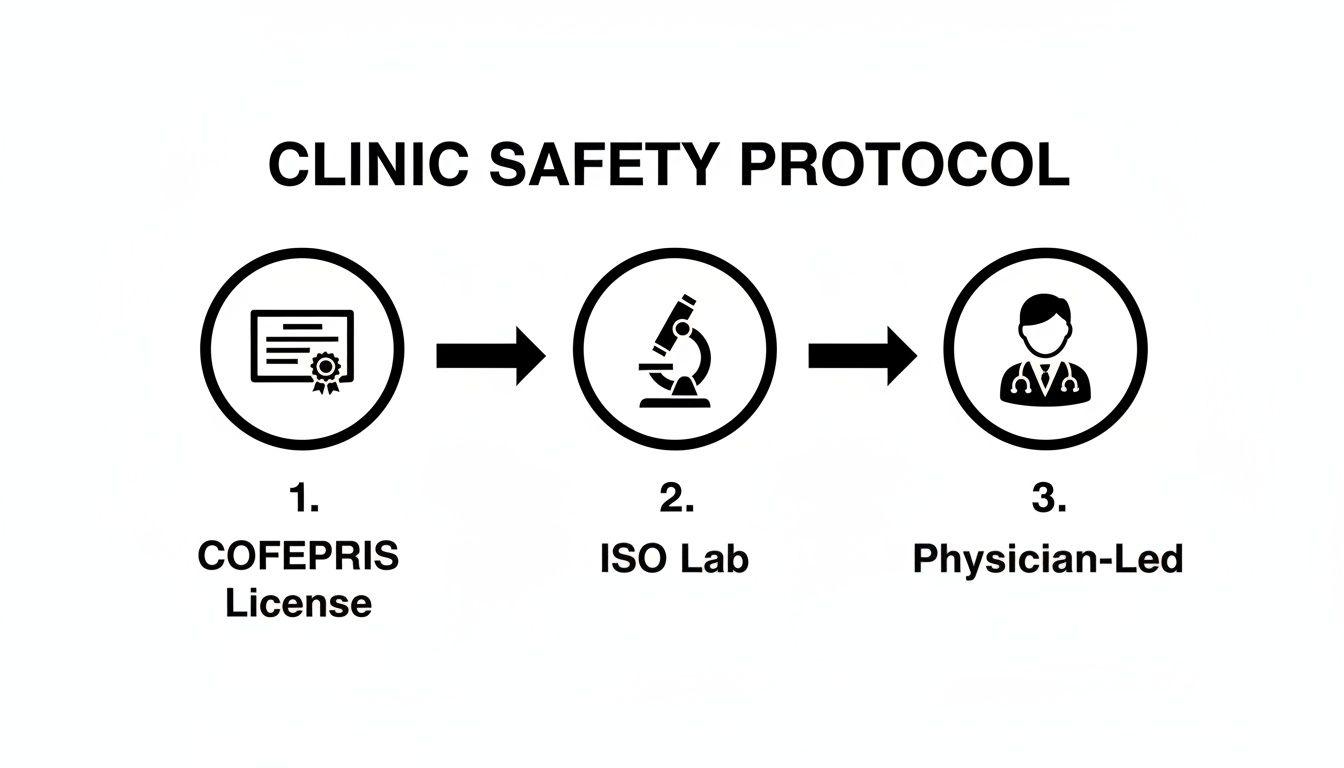
This process highlights that every procedure is underpinned by official COFEPRIS licensing, ISO-certified lab standards, and direct physician oversight.
Treatment Day and Post-Procedure Care
On the day of your treatment, our entire focus is on precision, safety, and your comfort. Whether you are receiving an ultrasound-guided injection into a specific joint or a systemic IV infusion to address whole-body inflammation, every step is performed by our expert medical team in a sterile, controlled clinical environment.
It is crucial to understand that regenerative medicine is a process, not a single event. The procedure itself is just the beginning of your body's healing cascade, which unfolds over the following weeks and months.
Your care absolutely does not end when you leave the clinic. We provide a detailed post-treatment plan outlining what to expect and how to best support your body’s regenerative response. Open communication is key, and our clinical team remains available to you for ongoing support and follow-up consultations.
This ensures we can monitor your progress and answer any questions as you move through your recovery. For a more detailed look at what to expect after your procedure, you can read our guide on the recovery time after a stem cell injection.
This transparent, supportive, and medically rigorous journey is designed to make your experience with stem cell therapy Mexico feel manageable, empowering, and centered on achieving your long-term health goals with confidence.
Your Questions About Stem Cell Therapy Answered
Exploring regenerative medicine is an important step, and it’s natural to have questions. This section is designed to provide clear, straightforward answers to the inquiries our patients most frequently have about stem cell therapy, so you can feel confident and informed about the path ahead.
We believe a well-informed patient is an empowered one. Our commitment is to complete transparency, ensuring you feel secure and knowledgeable at every point in your health journey.
How Much Does Stem Cell Therapy Cost in Mexico?
The investment for high-quality regenerative care in Mexico is significantly lower than in the U.S. or Canada. However, it's still a major medical decision where clinical excellence—not the price tag—should always be your primary focus. For a comprehensive, physician-led protocol at a reputable clinic, patients can typically expect to invest between $4,900 and $9,500 and up.
That price isn't just a number; it’s a direct reflection of the personalized, data-driven protocol designed for you. The final cost is shaped by several key factors:
Cell Count and Potency: Systemic conditions or more complex issues require higher cell counts, which will influence the investment.
Treatment Areas: The number of joints or body systems being addressed will naturally affect the total cost.
Supportive Therapies: Your protocol may include complementary treatments like exosomes, IV nutritional infusions, or hyperbaric oxygen therapy to amplify your results.
While this is considerably less than the $15,000–$25,000 often quoted for more limited procedures in the U.S., it's crucial to think in terms of value, not just cost. Your decision should be driven by a clinic’s safety record, lab quality, and physician expertise—never by price alone.
Is Stem Cell Therapy in Mexico Safe?
Yes, when performed in a medically sound, licensed, and regulated environment, stem cell therapy has an excellent safety profile. But that safety is entirely dependent on the clinic you choose. The single most important factor is confirming the facility operates with a COFEPRIS license for both its clinical practice and the biologics it administers.
Your safety is non-negotiable. A reputable clinic will be completely transparent about its credentials and will welcome detailed questions about its safety protocols. Never compromise on this.
To ensure you are choosing a safe and legitimate provider, you must verify the following:
Physician-Led Care: Are all procedures performed by qualified medical doctors within a clinical setting?
Lab Certification: Is their laboratory ISO-certified, and do they maintain full quality control over their biologics?
Cell Screening: Can they provide clear documentation of their rigorous screening process for all allogeneic cell sources?
By asking these critical questions, you can confidently distinguish between a true medical institution and a high-risk, unregulated operator.
What Is the Recovery Time After Treatment?
The immediate physical recovery from the procedure itself is minimal. Most patients can return to normal, light activities almost right away, whether they received a targeted injection or a systemic IV infusion. We generally advise you to avoid strenuous exercise for a short period to allow the cells to settle and begin their work.
It's vital to understand that the real "recovery" is a biological healing process that unfolds over weeks and months. The stem cells and exosomes are just the starting signal for a cascade of regeneration. You might start to notice initial improvements, like reduced pain and inflammation, within the first few weeks.
However, the most significant and lasting results typically emerge between three to six months as your body's tissues progressively repair and rebuild. This timeline requires patience. The goal of stem cell therapy Mexico is not a quick fix but a profound and lasting biological change, and our team will be there to guide you through every stage of your healing journey.
Author
Dr. Kirk Sanford, DC — Founder & CEO, Longevity Medical Institute. Dr. Sanford focuses on patient education in regenerative and longevity medicine, translating complex therapies into clear, practical guidance for patients.
Medical Review
Dr. Félix Porras, MD — Medical Director, Longevity Medical Institute. Dr. Porras provides clinical oversight and medical review to help ensure accuracy, safety context, and alignment with current standards of care.
Last Reviewed: March 29, 2026
Short Disclaimer
This information is for educational purposes only and is not medical advice. It does not replace an evaluation by a qualified healthcare professional. For personalized guidance, please schedule a consultation.