

Cutera Xeo Navigator: Advanced Laser Rejuvenation Explained
Why can one patient leave a laser visit with only mild warmth, while another needs a resurfacing plan, vascular treatment, and tightening all at once? The answer is simple, and it changes how you should think about aesthetic lasers, no single wavelength treats every skin concern. Pigment, redness, vessels, collagen, and texture each respond to different forms of energy, so a serious skin program uses the right tool for the right target, not one device for everything.
That is where the Cutera Xeo Navigator fits in. It is less a single treatment than a multi-wavelength treatment philosophy, built around matching light and heat to the structure you want to improve. For patients, that means the conversation should start with skin goals and skin biology, then move to the device, instead of starting with the device and hoping it fits.
Why Skin Concerns Require Multiple Laser Technologies
Skin aging rarely shows up as just one problem. A person can have sun spots on the cheeks, redness around the nose, fine lines across the eyes, a little laxity along the jawline, and rough texture from years of sun exposure. Treating all of that with one energy source usually means compromising somewhere, because different chromophores absorb different wavelengths.
Why wavelength matters
Pigment responds differently than blood. Collagen responds differently than either of them. That is why a clinic with several technologies can be more precise than a clinic that only offers one platform. A thoughtful physician chooses energy based on whether the goal is superficial pigment, deeper vascular work, collagen stimulation, or resurfacing.
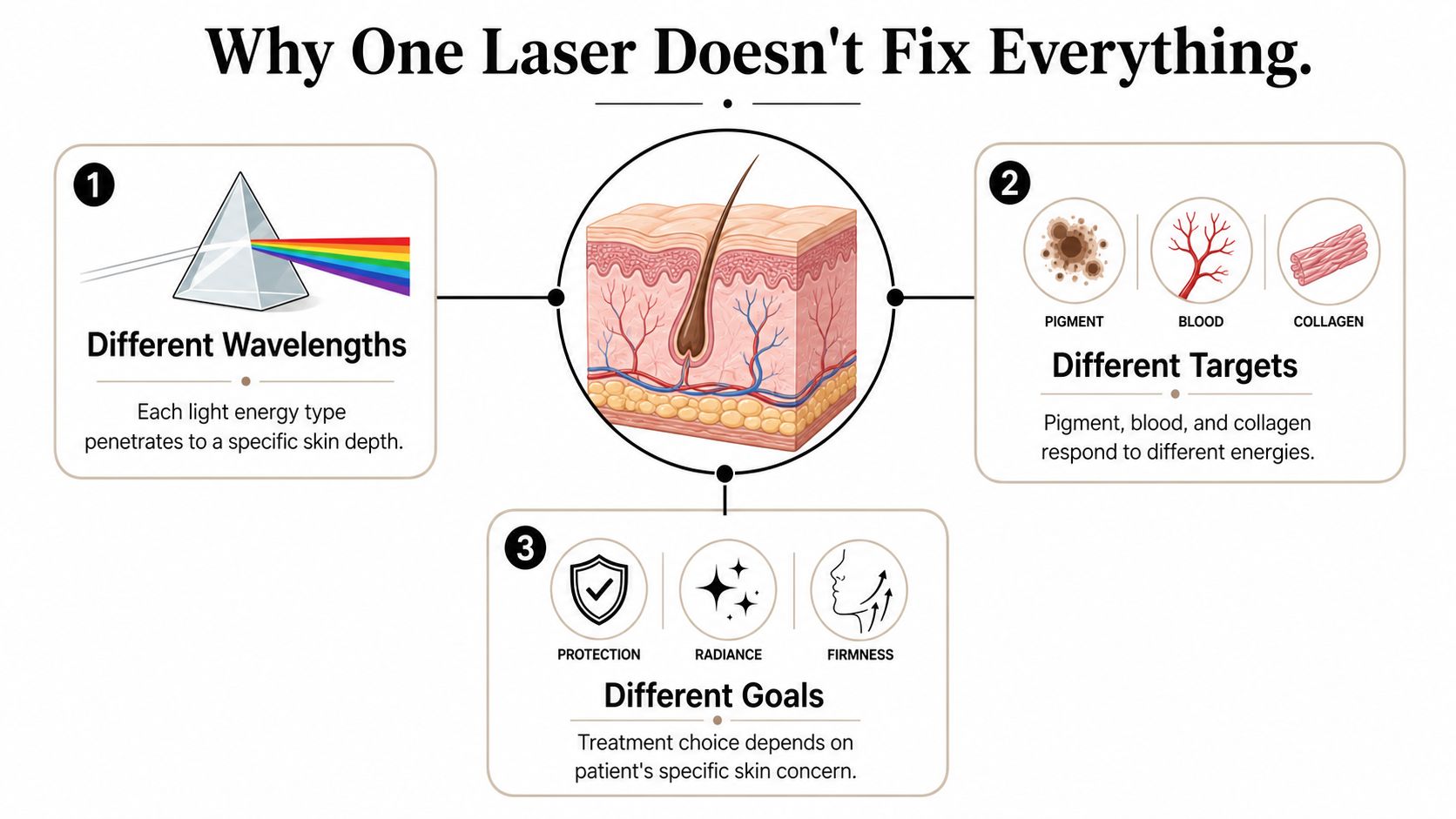
That is also why people get confused by the words ablative and non-ablative. Ablative resurfacing removes a controlled layer of skin, which usually means more visible downtime but stronger texture correction. Non-ablative treatments heat the skin without removing the surface, so recovery is typically lighter and improvements tend to build gradually.
Practical rule: the best treatment is rarely the one with the biggest name. It is the one whose wavelength matches the patient's concern, skin type, and downtime tolerance.
Choosing a device is not the same as choosing a result
The key question is not, “Which laser is strongest?” It is, “What problem is the skin showing?” A patient with brown sun spots may need a different energy profile than someone with diffuse redness, and both may need something different again if the main complaint is laxity or acne scarring.
That is why experienced physicians often combine treatments rather than chase a single catch-all solution. The right setup lets them treat multiple layers of the skin in a staged, rational way, so the plan follows the biology instead of forcing the biology to fit the machine.
What the Cutera Xeo Navigator Is and How It Works
The Cutera Xeo is a clinic-based, multi-handpiece energy platform, not a small handheld device. Its size reflects that role, with operator documentation listing a system mass around 135 to 140 lb and dimensions near 12 x 19 x 35 in to 13 x 18 x 38 in. It also requires dedicated electrical power and internal cooling to keep pulsed-energy delivery stable during treatment sessions (operator manual). That engineering matters because output consistency, thermal control, and comfort all depend on how well the platform manages heat and power.
What the Navigator feature adds
Cutera describes Xeo Navigation as a dynamic mapping tool that guides practitioners toward treatment guideline parameter ranges for different patient conditions (XEO brochure and clinical reference material). In practical terms, the Navigator screen works like a built-in clinical reference layer. It helps the operator stay inside recommended ranges instead of building a plan by trial and error.
That matters because skin care with energy devices is not one-size-fits-all. A patient with redness, pigment, or vascular concerns may need a very different wavelength and pulse structure than someone whose main goal is texture refinement. For patients also comparing broader dermatology skin health care, the Xeo Navigator fits into a larger medical approach that matches the energy source to the skin finding, rather than forcing one setting to cover everything.
The Xeo family also includes handpieces with clearly defined operating ranges. The Nd:YAG handpiece in the 2024 brochure operates at 1064 nm, with fluence from 3 to 300 J/cm², pulse duration from 0.1 to 300 ms, repetition rate of less than 10 Hz, and spot sizes from 3 to 16 mm (2024 product brochure). Those are concrete parameters, not vague marketing language.
A system like this is built for controlled delivery, not improvisation. The point of Navigator is to keep treatment choices organized, repeatable, and tied to guideline ranges.
Why the technical range matters
The broader Xeo family includes light and laser outputs spanning 500 to 1300 nm for pulsed light, plus 532 nm and 1064 nm Nd:YAG outputs (FDA documentation). That spread is what lets the platform address different skin concerns with different handpieces. A shorter wavelength or IPL range is better suited to more superficial targets, while 1064 nm reaches deeper and is often favored when deeper vessels or darker skin types are part of the equation because melanin absorption is lower and deeper penetration is more favorable at that wavelength.
For readers comparing options, the point is simple. The Xeo Navigator is not one beam trying to do everything. It is a structured platform that helps an experienced clinician choose among multiple energy profiles with more precision.
The Xeo Handpieces and What Each One Treats
The easiest way to understand the Xeo family is to think of each handpiece as having its own job description. Some are gentle and collagen-focused, some are better for pigment and redness, and some reach deeper vessels or create tightening through controlled heat. The experience changes as the target gets deeper.
Laser Genesis for redness, pores, and texture
Laser Genesis is the gentlest of the group. It is a non-ablative treatment that heats the upper dermis to stimulate natural collagen remodeling while reducing diffuse redness, enlarged pores, fine lines, acne scars, and uneven texture. Because it does not remove surface skin, downtime is usually minimal, and many patients do best with a series of sessions rather than expecting a dramatic one-day change.
That progressive pattern matters. Collagen remodeling is slow biology, not a switch. Patients often notice a softer look, less visible redness, and a smoother surface over time rather than a sudden transformation.
LimeLight IPL for color correction
LimeLight IPL uses broad-spectrum light rather than a single wavelength, which makes it useful for pigmentation, freckles, sun damage, age spots, redness, rosacea, and uneven skin tone. Because it addresses several superficial concerns at once, it often appeals to patients who feel their face looks “weathered” rather than having one isolated lesion.
Multiple sessions are often discussed because surface pigment and vascular changes usually need staged treatment. A physician will also consider whether the patient's skin tone and recent sun exposure make IPL a good choice, since surface light energy needs careful selection.
Nd:YAG for deeper vascular concerns
The Nd:YAG laser sits deeper on the spectrum. Its 1064 nm wavelength is useful for facial veins, leg veins, cherry angiomas, and some vascular birthmarks, and it can also be used for other applications depending on the patient's needs. The longer wavelength penetrates deeper into tissue while minimizing injury to surrounding skin, which is why it is often favored when deeper vessels are the main issue or when a clinician is treating patients with darker skin tones.
Titan for mild laxity
Titan infrared skin tightening uses controlled infrared energy to heat collagen fibers in the dermis and encourage new collagen production over time. It is intended for mild to moderate laxity along the face, neck, jawline, and selected body areas, without surgery or significant downtime. Improvements build gradually over months, because new collagen takes time to form and organize.
The broader patient guide skin, hair, and aesthetic guides can also be useful when someone is comparing redness, pigment, resurfacing, and tightening goals side by side.
Combining DEKA SmartXide Tetra CO2 for Resurfacing
The DEKA SmartXide Tetra CO₂ adds a resurfacing layer that the Xeo light-based handpieces do not provide on their own. Fractional CO₂ means the laser creates microscopic treatment zones while leaving surrounding tissue intact, which helps the skin heal faster than traditional fully ablative resurfacing. That design is what makes fractional CO₂ a useful option for wrinkles, texture, scars, enlarged pores, sun damage, and overall skin quality.
What CoolPeel changes
CoolPeel™ is the superficial, low-heat mode that aims to deliver the benefits of CO₂ resurfacing while reducing thermal exposure compared with conventional CO₂ treatment. Patients often ask whether that means “lighter” is the right word. A better description is more controlled at the surface, with less heat spread into surrounding tissue.
That can matter for downtime. The recovery burden may be lower than traditional deeper ablative resurfacing, while still addressing fine lines, pigmentation, texture, and signs of photoaging. Recovery still varies, though, because intensity and skin characteristics both influence how the skin responds.
Why settings matter so much
The SmartXide Tetra platform includes multiple emission modes and adjustable pulse settings, which lets a physician shape the treatment depth, energy delivery, and recovery window to the patient's goals. A conservative setting may suit someone who wants a refreshed look with less interruption to daily life. A more intensive plan may be chosen when scars or deeper wrinkles are the main concern.
The smartest resurfacing plan is not the deepest one. It is the one that matches the skin's condition and the patient's tolerance for healing time.
One helpful way to think about it is that the Xeo family manages color, vessels, and collagen stimulation, while the Tetra addresses the surface architecture of the skin. Put together, those technologies let a physician treat the same face from more than one angle.
The clinical dermatology resource at dermatology and dermatological surgery is a useful reference for patients who want to understand why resurfacing and light-based treatments are often planned separately.
Building a Personalized Treatment Plan
A good aesthetic plan starts with the face in front of the physician, not the catalog of devices. A patient with sun damage and diffuse redness may do well with IPL plus Laser Genesis, because one treatment helps with color irregularity and the other addresses redness and collagen support. A different patient focused on mild laxity and rough texture might be better served by Titan plus a light fractional CO₂ session, especially if their concern is less about pigment and more about structure.
How a physician decides what fits
Several factors shape the plan. Skin type matters because some energies are more forgiving than others across different pigment backgrounds. Recent sun exposure matters because tanned skin can absorb more light than intended. Active skin conditions matter because inflammation, infection, or irritation can change the risk profile. Medications and downtime tolerance matter too, since some people can accommodate a series of lighter visits while others prefer fewer, more intensive sessions.
The consultation itself is usually the most important step. That is where a physician decides whether the patient needs pigment correction first, vascular work first, tightening first, or a staged combination.
Why combination therapy often makes more sense
Many patients do better with staged combinations than with a single modality. Photoaging is cumulative, and it rarely shows up as one isolated problem. Combining technologies lets the clinician work on multiple dimensions of aging without asking one device to do everything at once.
The internal guide at your personalized aesthetic journey led by a physician's expertise aligns with that same philosophy, because customization matters more than a one-size-fits-all protocol.
For patients, that often means the plan is paced rather than rushed. A physician may space out pigment work, collagen stimulation, tightening, and resurfacing so the skin can respond safely and predictably.
What Treatment and Recovery Actually Feel Like
A treatment day usually starts with a skin check, not the laser. The clinician reviews the areas of concern, looks at skin tone and texture, and confirms that the planned energy level still fits the patient's current condition. Before certain treatments, patients may be asked to avoid excess sun and pause irritating skincare products so the skin is calmer going in.
The room itself is usually straightforward. Patients feel warmth, brief snapping sensations, or a prickling heat depending on the device and setting. Comfort measures can include cooling, air flow, or topical numbing when resurfacing is involved. After the session, the skin may look pink or feel warm, and that reaction is expected.
Downtime varies by technology
Laser Genesis and Titan usually involve none to minimal downtime. IPL commonly brings a few days of redness or darkening of pigment before it clears. Fractional CO₂ and CoolPeel can involve several days to about a week of healing, with redness, dryness, and flaking depending on intensity and individual skin response.
That means the aftercare is not identical for every device. Some patients return to normal activities quickly, while others need a short social pause. Good sun protection matters across the board, because healing skin is more vulnerable to irritation and unwanted pigment change.
For at-home support, a calm skincare routine can help.
Simple recovery rule: if the skin is pink, hot, dry, or flaky, treat it gently. That usually means less friction, more sun protection, and fewer active ingredients until the clinician says otherwise.
What patients should expect later
Collagen-driven improvement takes time. Redness and pigment can change faster than texture or tightening, while resurfacing can show early smoothing before the final result fully settles. Follow-up visits are used to check healing, review progress, and decide whether another session should be staged.
Evidence, Safety, and Honest Expectations
Laser resurfacing, IPL, fractional CO₂, infrared tightening, and collagen-stimulating technologies are all well established in dermatology and aesthetic medicine. The important distinction is that well-established does not mean identical results for everyone. Skin type, age, sun exposure, healing behavior, and treatment intensity all shape the outcome.
The safety conversation should be direct. Patients need to avoid excess sun before and after treatment, and clinicians need to adjust parameters carefully for the skin in front of them. Certain active infections, inflammatory flares, medications, and pregnancy can change whether a procedure is appropriate at that moment. For that reason, candidacy is a clinical decision, not a marketing one.
Results also age with the patient. No cosmetic treatment stops the natural aging process, and maintenance sessions or good skincare may be needed over time to preserve the look a patient wants. The most credible aesthetic programs are honest about that from the start.
The resource on safety and transparency in care reinforces an important principle, patients deserve a plan that balances effectiveness with clear risk discussion.
Why Physician-Led Personalization Matters at Longevity Medical Institute
The value of a system like the Cutera Xeo Navigator is not that it replaces judgment. It is that it gives a physician more ways to match treatment to the problem. When a clinic also has DEKA SmartXide Tetra CO₂, the plan can include pigment treatment, redness control, collagen support, tightening, and resurfacing in a coordinated way.
At Longevity Medical Institute, that kind of layered planning fits a physician-led approach to skin care. The clinic's treatment model is built around selecting the right technology for the right indication, then spacing treatments so efficacy, safety, and recovery time stay in balance. For many patients, that is the difference between chasing a trend and following a real plan.
Visit Longevity Medical Institute to learn more and schedule a consultation. A personalized evaluation can clarify whether your goals point toward IPL, Laser Genesis, Titan, fractional CO₂, or a staged combination built around your skin and your schedule.
Author
Dr. Kirk Sanford, DC, Founder & CEO, Longevity Medical Institute
Medical Review
Dr. Félix Porras, MD, Medical Director, Longevity Medical Institute
Last Reviewed: July 30, 2026
Short Disclaimer
This information is for educational purposes only and is not medical advice. It does not replace an evaluation by a qualified healthcare professional. For personalized guidance, please schedule a consultation.