

Men's Health Procedures: A Guide to Longevity
A lot of men arrive at midlife with a strange kind of contradiction. Their basic labs may look “fine.” They're functioning, working, exercising when they can, and pushing through fatigue, stiffness, poor sleep, or slower recovery as if those changes are just the price of getting older.
But that quiet question keeps returning. Is this really as good as it gets?
For many patients, the answer isn't found in another rushed annual exam. It's found in a deeper look at how the body is aging, where inflammation is accumulating, how repair systems are performing, and which interventions can preserve function before decline becomes obvious.
Beyond the Annual Checkup A New Era in Men's Health
A common scenario looks like this. A man in his forties, fifties, or sixties hasn't had a major diagnosis, yet he notices subtle shifts everywhere. Training soreness lingers. Focus feels less crisp. Libido changes. Sleep becomes lighter. He's still “healthy” in the conventional sense, but he no longer feels fully in command of his physiology.
That's where modern men's health procedures have changed. The old model waited for symptoms to become loud enough to treat. The newer model looks for quiet signals much earlier, then builds a plan around preserving strength, cognition, metabolism, hormone balance, vascular health, and resilience.
The need for that shift is real. Men are less likely to engage in preventive care behaviors; a 2023 Cleveland Clinic survey revealed that 44% of men do not get a yearly physical, and 44% neglect their mental health, creating a barrier to timely care, as summarized by the Global Action on Men's Health overview. In practice, that means many men seek help only after a problem has already disrupted performance, relationships, or quality of life.
From disease management to healthspan strategy
The annual checkup still matters. It just isn't enough on its own.
A basic visit can detect some issues, but it rarely maps the systems that shape long-term vitality. It may not fully explore metabolic strain, silent cardiovascular risk, early prostate changes, inflammatory burden, sleep architecture, or the recovery capacity that determines how well you age.
Practical rule: If you're waiting until something feels clearly broken, you're already behind the ideal timeline for preventive care.
A proactive model treats the body less like a machine that gets repaired when parts fail, and more like a high-performance estate that needs ongoing calibration. Roofing, plumbing, electrical, climate control. You don't wait for every system to collapse at once. You inspect, tune, and reinforce.
That philosophy is central to premium longevity care. Instead of asking only, “What disease do we need to rule out?” the better question is, “What patterns are shaping your next decade of health?”
Some men start with prostate concerns. Others come in because of fatigue, weight resistance, low motivation, stubborn pain, or diminished sexual confidence. Others are performing well and want to stay that way. All of them benefit from a framework that treats prevention as active medicine, not passive hope.
For readers exploring a broader performance toolkit, resources on safe peptide protocols for men can help clarify how signaling therapies may fit into a physician-guided longevity plan. For a closer look at in-depth men's health care pathways, it helps to think beyond the checklist and toward a long-range strategy.
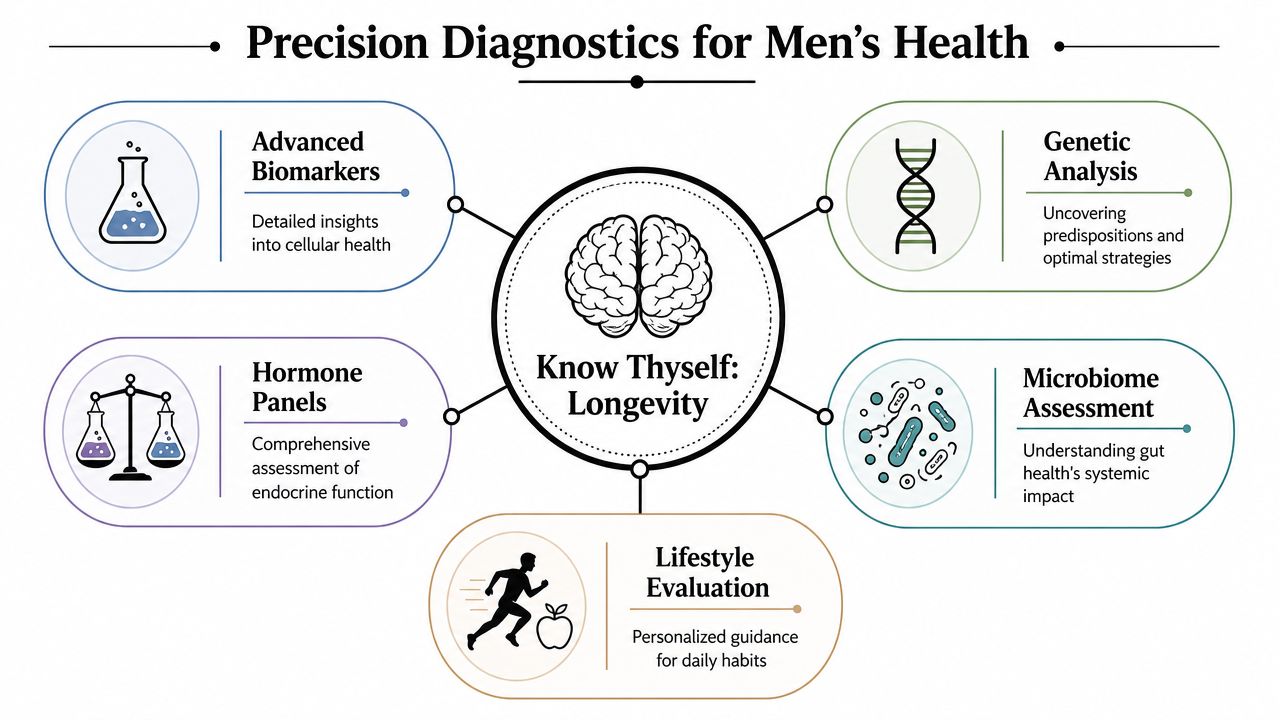
Understanding Your Body with Precision Diagnostics
The smartest men's health procedures begin with measurement. Not guesswork. Not trend-driven supplements. Measurement.
A standard panel can tell you whether a value falls inside a broad reference range. Precision diagnostics ask a more useful question. Is your body operating in a way that supports long-term function, or merely avoiding a red flag today?
Biomarkers that reveal hidden patterns
An advanced longevity workup often starts with a broad biomarker review. At a high level, that means looking beyond a few routine markers and studying patterns related to inflammation, metabolic function, endocrine signaling, nutrient status, and organ stress.
The value isn't just in isolated numbers. It's in how the markers relate to one another. A single violin note doesn't tell you much about a symphony. But once you hear the brass, strings, percussion, and tempo together, the whole composition becomes clear. Human physiology works the same way.
This is especially important in men who feel “off” despite being told everything is normal. A more detailed laboratory lens can uncover why recovery is slower, why body composition is shifting, or why energy feels less stable throughout the day.
MRI that changes the diagnostic sequence
Prostate care is a good example of how diagnostics have become more precise. PSA screening for men aged 55 to 69 can reduce prostate cancer mortality, and modern diagnostic protocols increasingly prioritize MRI-guided prostate biopsy over older methods for patients with high PSA, because MRI improves lesion detection and reduces unnecessary procedures, according to the VA Whole Health overview of men's health.
That matters because a more refined image changes the conversation. Instead of moving quickly from concern to invasive sampling, clinicians can often use MRI to better characterize what deserves attention and what may not.
A similar principle applies beyond the prostate. Full-body MRI, particularly when paired with thoughtful interpretation, offers a non-invasive way to look for structural changes that don't always announce themselves with symptoms.
For patients who want to better interpret body-composition imaging alongside broader longevity testing, this guide to decode your body composition with an InBody 970 scan can be a helpful companion resource.
Here's a closer look at how imaging fits into the modern workup:
Cardiovascular clarity, not assumptions
Cardiovascular risk is another area where broad screening often leaves gaps. A man can exercise, look fit, and still carry hidden vascular issues that alter his long-term outlook.
A more advanced heart evaluation may include layered assessment of structure, rhythm, perfusion, and functional response. The purpose isn't to medicalize a healthy person. It's to distinguish appearance from reality.
Good diagnostics don't create problems. They reveal the ones that were already present.
The practical result is simple. Data makes treatment more personal. It helps determine whether a man needs closer prostate evaluation, metabolic support, sleep intervention, cardiovascular follow-up, or a regenerative strategy aimed at inflammation and recovery.
For a deeper look at how advanced imaging contributes to that process, explore how an AI full body MRI works.
Harnessing Regenerative Medicine for Men's Vitality
Once the body's weak points are mapped clearly, regenerative medicine becomes much easier to understand. It isn't magic, and it isn't random. It's a way of improving the internal conditions that allow repair, signaling, and recovery to happen more effectively.
That distinction matters because many people imagine stem cells as tiny replacement parts. In reality, their most meaningful role is often more like direction than construction.

How allogeneic cell therapy works
At our institute, the focus is on allogeneic stem cells, not autologous cells. We produce five different types in our biotechnology lab, including placental, Wharton's jelly, adipose, endometrial, and dental pulp cell lines.
Patients often ask why this matters. The simplest answer is consistency and design. In a controlled biotechnology setting, cell selection, characterization, and preparation can be aligned with the intended clinical use. That's very different from treating the body as though every harvested cell sample will behave the same way in every context.
Think of these cells less as bricklayers and more as conductors of a cellular orchestra. They don't arrive and “become” a new tendon, nerve, or gland. Instead, they influence the surrounding environment. They help calm inflammatory noise, coordinate repair signals, and encourage local tissue behavior to shift toward recovery rather than chronic irritation.
Peptides as signaling partners
Peptides fit naturally into this framework. They are signaling molecules. If stem cells are conductors, peptides are the score markings and cues that help sections of the orchestra come in at the right moment.
In men's health, that can matter for recovery capacity, tissue support, inflammation management, training adaptation, and general resilience. The key is that peptides aren't one-size-fits-all. Their role depends on the diagnostic picture and the treatment objective.
A regenerative plan may also be layered with exosomes, targeted injections, rehabilitation, sleep optimization, and systemic therapies that improve the body's readiness to respond. That's why isolated treatment shopping usually underperforms compared with a coordinated medical strategy.
Why root-cause medicine feels different
Many conventional therapies are designed to suppress a symptom. That can be valuable, especially when symptoms are severe. Regenerative medicine aims at a different target. It tries to improve the terrain in which symptoms developed.
For men, that terrain often includes chronic low-grade inflammation, slower tissue turnover, endocrine shifts, vascular strain, and the cumulative wear of training, stress, travel, poor sleep, or old injuries. Addressing those patterns can support not just pain relief, but also function.
Clinical perspective: The goal isn't to chase youth theatrically. It's to preserve capability, reduce biological drag, and extend the years in which a man feels strong in his own body.
Readers interested in this broader therapeutic model can learn more about stem cell therapy for anti-aging and longevity.
Targeted Applications for Performance and Recovery
The science becomes easier to appreciate when you see how it applies in real life. Men usually don't seek treatment because they love medical theory. They seek treatment because they want to walk without heel pain, think more clearly, recover faster, sleep better, or feel more like themselves again.
Orthopedic recovery when pain keeps returning
Consider the athletic executive who keeps dismissing plantar fascia pain as a minor nuisance. At first, it only hurts during the first steps in the morning. Then it starts shaping his training choices. Then it changes his gait. Then the calf tightens, the hip compensates, and movement quality drops across the whole chain.
In this kind of tendinopathy, mesenchymal stem cells primarily reduce inflammation and pain through immunomodulation rather than by directly regenerating tissue, decreasing mononuclear cell infiltration and promoting M2 macrophage polarization, as described in this review of stem cell therapy for chronic plantar fasciitis.
That mechanism is important because it corrects a common misunderstanding. Patients often expect a dramatic “rebuild.” What they often need first is a calmer tissue environment. When local inflammatory signaling settles, movement quality and loading tolerance can improve enough for meaningful rehabilitation to happen.
Systemic conditions that blur the whole picture
Now think of a different patient. He isn't limited by one joint or one tendon. He feels diffusely inflamed. Brain fog comes and goes. Stamina is unreliable. Some days are decent, others collapse unexpectedly.
That pattern shows up in men dealing with chronic inflammatory states, including syndromes that follow infection or prolonged immune disruption. In those cases, treatment often has to work on two levels at once:
Systemic regulation: reducing the background inflammatory noise that keeps the nervous system and immune system on edge
Targeted support: addressing the body region or function most affected, such as neuropathic discomfort, musculoskeletal pain, or cognitive slowdown
Recovery scaffolding: adding sleep support, nutrient therapy, oxygen-based therapies, and rehabilitation so gains can hold
Regenerative medicine often feels different from a symptom-by-symptom approach. Instead of asking which single complaint to silence first, a clinician can ask which physiological bottlenecks are preventing recovery altogether.
Sexual wellness and function preservation
Men also seek regenerative procedures when sexual health changes begin to affect confidence. Sometimes the issue is vascular. Sometimes it's hormonal. Sometimes pain, sleep disruption, chronic stress, or inflammation are diminishing performance.
The right response depends on identifying the driver. A man with poor sleep and cardiometabolic strain won't benefit from the same strategy as a man whose primary issue is pelvic tissue health or age-related change in vascular responsiveness.
That's why modern men's health procedures work best when sexual wellness isn't isolated from the rest of the body. Erection quality, libido, stamina, and urinary function sit at the intersection of circulation, endocrine signaling, nervous system tone, and tissue integrity.
A useful treatment plan should make sense as a whole person strategy, not as a disconnected menu of procedures.
For active adults comparing recovery options for sports injuries, overuse conditions, and movement-related pain, stem cell therapy for athletes offers a more focused look at how these protocols are applied.
Integrating an Ecosystem of Supportive Therapies
Regenerative treatment rarely works as a solo act. It performs better when the surrounding physiology supports healing. That's why the most effective men's health procedures are usually built as an ecosystem, not a single intervention.

Creating the right internal environment
Hyperbaric oxygen therapy is one example. By improving oxygen delivery under pressure, it can support tissues that are metabolically stressed and may complement repair-focused protocols.
The Longevity Recharge Station serves a different purpose. It can provide targeted IV nutritional support when the goal is to improve hydration, micronutrient delivery, mitochondrial support, or recovery after travel, stress, illness, or intensive treatment days.
Trifusion EBOO with UV and PBM belongs to another category. Patients often ask how to think about it. A useful analogy is a high-precision filtration and conditioning loop. Blood moves through a therapeutic circuit designed to support cleaner internal conditions while pairing that process with adjunctive light-based elements.
Why sleep medicine belongs in the center
Sleep medicine is often underestimated because it doesn't sound futuristic. In reality, poor sleep can sabotage almost every advanced intervention.
If a man has fragmented sleep, sleep-disordered breathing, or chronically poor recovery cycles, the body receives mixed repair signals night after night. In that context, regenerative therapies may still help, but they're working against a headwind.
A coordinated plan often combines several supportive layers:
Oxygen support: used when tissue oxygenation and recovery need reinforcement
IV and nutrient strategies: helpful when repletion, hydration, or metabolic recovery is part of the picture
Detoxification-oriented adjuncts: considered when inflammatory or toxic burden may be interfering with healing
Clinical sleep assessment: essential when fatigue, poor recovery, mood changes, or cognitive dulling may reflect disordered sleep
Synergy matters more than novelty
The point isn't to collect high-end procedures. The point is to create alignment.
A thoughtful program may include diagnostics, regenerative injections, peptide support, sleep treatment, cardiac assessment, and structured follow-up. Another patient may need only a small subset of those. That's why personalization matters more than trendiness.
One physician-led option that combines advanced diagnostics, regenerative medicine, supportive therapies, and international patient coordination under one roof is Longevity Medical Institute, which integrates AI-enhanced MRI, cardiac evaluations, an in-house clinical lab, ultrasound-guided procedures, and a biotechnology lab into individualized care plans.
Planning Your Treatment Journey to Los Cabos
Medical travel feels far less intimidating when the process is clear. Men usually want to know three things right away. Am I a candidate, what happens before I arrive, and how much support will I have on the ground?
The pathway typically starts remotely. Medical history, current concerns, prior imaging or lab work, and treatment goals are reviewed first. That early screening helps determine whether a patient needs advanced diagnostics, a regenerative procedure, a broader men's health workup, or referral into a different specialty pathway.
Why earlier evaluation matters
For many men, prostate health is part of the concern that finally pushes them to seek more thorough care. That urgency isn't misplaced. Prostate cancer accounted for more than 1.4 million new cases worldwide in 2020, making it the second most common cancer in men globally, according to this summary of global men's health statistics.
That doesn't mean every urinary symptom is cancer, and it doesn't mean every high PSA leads to invasive treatment. It does mean postponing evaluation isn't a wise strategy when symptoms, family history, or screening results raise questions.
What the travel experience usually includes
Once a patient is accepted for care, the next step is coordination. A premium medical travel experience usually includes help with scheduling, records collection, lodging guidance, and planning around treatment and recovery days.
Patients should expect discussion around:
Candidacy and timing
Whether their current condition is appropriate for travel and whether any testing should be completed at home first.On-site sequencing
Which diagnostics happen first, which procedures are same-day, and which therapies are spaced out for safety and response assessment.Recovery expectations
Some treatments allow a quick return to routine. Others require several days of reduced load, hydration focus, and follow-up monitoring.Quality controls
Patients should ask direct questions about laboratory standards, procedural oversight, cell sourcing, sterility, and physician supervision.
Travel medicine works best when logistics are treated with the same seriousness as the clinical plan.
For international patients considering this route, a practical next step is reviewing medical tourism for stem cell treatments in Cabo, which outlines how treatment planning and travel coordination can fit together.
Common Questions About Men's Regenerative Procedures
Are allogeneic stem cells ethically sourced and safe?
That should always be asked. Ethical sourcing, laboratory controls, sterility protocols, physician oversight, and case selection all matter. The category “stem cells” is broad, so patients shouldn't assume every clinic follows the same standards or produces the same product quality. Ask where the cells come from, how they're processed, and who supervises their clinical use.
Is regenerative medicine just symptom relief in a more expensive package?
Not when it's done thoughtfully. Symptom relief aims to make you feel better now. Root-cause care asks why the tissue, immune environment, vascular system, or recovery network became dysfunctional in the first place. Sometimes both approaches are needed, but they are not the same thing.
Can healthy men benefit, or is this only for people who are already sick?
Many men pursue care before a major diagnosis. They may want sharper diagnostics, stronger recovery, better sleep, improved cardiometabolic clarity, or support for performance and healthy aging. Prevention isn't passive. It often involves active testing, behavior change, and targeted therapy before a decline becomes difficult to reverse.
How personalized should a treatment plan be?
Very personalized. Men with similar complaints may have very different drivers. One man's fatigue may trace back to sleep disruption. Another's may relate to inflammation. Another may need deeper endocrine or cardiovascular workup. A sound plan should reflect the diagnostic picture, not a generic package.
The right question isn't “What's the most advanced procedure?” It's “What does my physiology actually need?”
Do newer prostate therapies always offer a better answer?
Not automatically. Clinical discussions around focal prostate therapies such as HIFU and partial prostatectomy show that many patients remain underinformed about their limitations, insurance gaps, and the need for careful risk stratification, as highlighted in this discussion of emerging focal prostate therapies. Newer can mean promising, but it can also mean narrower indications and more nuance.
If you're exploring men's health procedures with a long-view mindset, the most useful next step is a structured evaluation that looks at diagnostics, recovery capacity, inflammation, cardiovascular health, prostate considerations, and regenerative options together. Learn more or schedule a consultation with Longevity Medical Institute.
Published: July 10, 2026
Author
Dr. Kirk Sanford, DC, Founder & CEO, Longevity Medical Institute. Dr. Sanford focuses on patient education in regenerative and longevity medicine, translating complex therapies into clear, practical guidance for patients.
Medical Review
Dr. Félix Porras, MD, Medical Director, Longevity Medical Institute. Dr. Porras provides clinical oversight and medical review to help ensure accuracy, safety context, and alignment with current standards of care.
Last Reviewed: July 10, 2026
Short Disclaimer
This information is for educational purposes only and is not medical advice. It does not replace an evaluation by a qualified healthcare professional. For personalized guidance, please schedule a consultation.
Published under: Longevity Medical Institute Treatments & Resources