

Men's Health: Your 2026 Guide to Optimal Wellness
Men's health starts with a sobering reality. Men die younger than women in every country, and the gap hasn't closed despite major advances in medicine. That fact should change how we think about prevention, performance, and aging.
A modern approach to men's health isn't about waiting for symptoms, collecting diagnoses, and reacting late. It's about building healthspan, the years in which your body, mind, metabolism, mobility, and independence still work the way you need them to. For a discerning patient, that shift matters. We're no longer talking only about avoiding disease. We're talking about preserving strength, clarity, sexual health, resilience, and function over time.
The Imperative for Proactive Men's Health
Men face a critical global health disparity, dying on average five years earlier than women. This gap, with a global male life expectancy of 71 years versus 76 for women, is driven largely by non-communicable diseases like heart disease, for which men are 60% more likely to die from before age 70 according to this global men's health analysis.
That isn't just a statistic. It's a pattern with familiar roots. Men often push through fatigue, normalize weight gain, dismiss stress, minimize sleep problems, and postpone care until something becomes disruptive or dangerous. Many don't think of themselves as “sick,” so they assume they're fine. In practice, that mindset can allow silent processes to advance for years.
Healthspan changes the question
The old question was, “How long will I live?”
The better question is, “How well will I live along the way?”
A man can have a respectable lifespan and still lose decades of quality through metabolic decline, vascular disease, chronic pain, low energy, mood changes, sexual dysfunction, poor sleep, or cognitive slowing. Healthspan asks whether you can still think clearly, train hard, recover well, work with focus, and remain independent.
Clinical perspective: In men's health, the most expensive mistake is late attention.
A premium view of prevention
Preventive medicine should feel less like crisis management and more like asset protection. You maintain a high-value property before the roof leaks. You service a performance vehicle before the engine light flashes. Your physiology deserves at least that level of respect.
That means learning your baseline before symptoms force the issue. It means understanding your blood pressure, glucose regulation, body composition, sleep quality, hormone patterns, cardiovascular risk, and recovery capacity. It also means recognizing that physical health and mental health aren't separate silos. They're one operating system.
For many men, the breakthrough isn't a treatment. It's a decision. The decision to stop treating health as background noise and start treating it as a strategic priority.
Your Health Roadmap Through the Decades
Men's health isn't static. What matters at 28 isn't identical to what matters at 48 or 68. The priorities shift, but the underlying principle stays the same. Intervene early, measure wisely, and don't confuse a lack of symptoms with a lack of risk.
In your 20s and 30s
This is the decade when many men feel durable enough to ignore maintenance. That confidence is understandable, but it can be misleading. Metabolic dysfunction often begins subtly, long before a formal diagnosis appears.
Metabolic dysfunction is a key concern that often emerges in early adulthood and progresses. The CDC estimates that 15.4% of U.S. men have diabetes. Key biomarkers to monitor include high fasting glucose, hypertension (≥130/80 mmHg), and abnormal triglycerides (≥150 mg/dL) as outlined in this men's metabolic health overview.
What does that mean in plain language? It means the body often gives biochemical warnings before it gives dramatic symptoms.
Focus here on the basics that compound:
Build muscle early: Strength supports insulin sensitivity, joint stability, and long-term mobility.
Protect sleep: Poor recovery in youth often becomes poor hormonal and metabolic resilience later.
Learn your baseline: A thoughtful workup can reveal trends before they become diagnoses.
Respect overuse injuries: Shoulder pain, low back pain, tendon strain, and foot pain don't always “work themselves out.”
For men who want a more detailed internal look, an AI full body MRI can be part of a broader strategy to understand structural health before symptoms become the sole guide.
In your 40s and 50s
At this point, many men first notice that effort and outcome stop matching. Recovery takes longer. Abdominal weight becomes harder to lose. Blood pressure climbs. Energy dips in the afternoon. Libido changes. Training that once felt restorative may now feel punishing.
That doesn't mean decline is inevitable. It means the margin for neglect narrows.
A practical focus in midlife includes:
Metabolic control
If fasting glucose, triglycerides, and blood pressure are drifting, don't wait for a more serious diagnosis to act.Cardiovascular vigilance
Vascular disease often progresses without symptoms. Endurance in the gym doesn't always equal arterial health.Hormonal context
Symptoms such as fatigue, reduced drive, lower exercise output, and erectile changes deserve proper evaluation.Digestive and inflammatory burden
Men often overlook gut symptoms, chronic pain, and systemic inflammation because they seem unrelated. They rarely are.
Midlife is when “I'm just getting older” becomes a dangerous substitute for assessment.
In your 60s and beyond
Later decades should be about preservation of function, not surrender of function. The most important outcomes now are often practical. Can you travel well, stay steady on your feet, think clearly, sleep soundly, and remain physically capable without relying on luck?
The priorities tend to include:
Mobility and balance: Independence depends on lower-body strength, joint integrity, and confidence in movement.
Cognitive preservation: Brain health is shaped by sleep, vascular health, inflammation, stress load, and metabolic status.
Muscle retention: Frailty doesn't arrive in one day. It develops when strength training and protein intake disappear.
Purpose and connection: Isolation, grief, retirement shifts, and loss of identity can affect both mental and physical outcomes.
The thread through every decade is simple. Your body keeps score. The earlier you read the signals, the more options you have.
The Four Pillars of Lifelong Male Vitality
The most advanced medical plan in the world can't outrun a weak foundation. Men who want durability need a framework that supports hormone balance, metabolic control, vascular integrity, cognition, and recovery. In practice, four pillars carry most of that load.
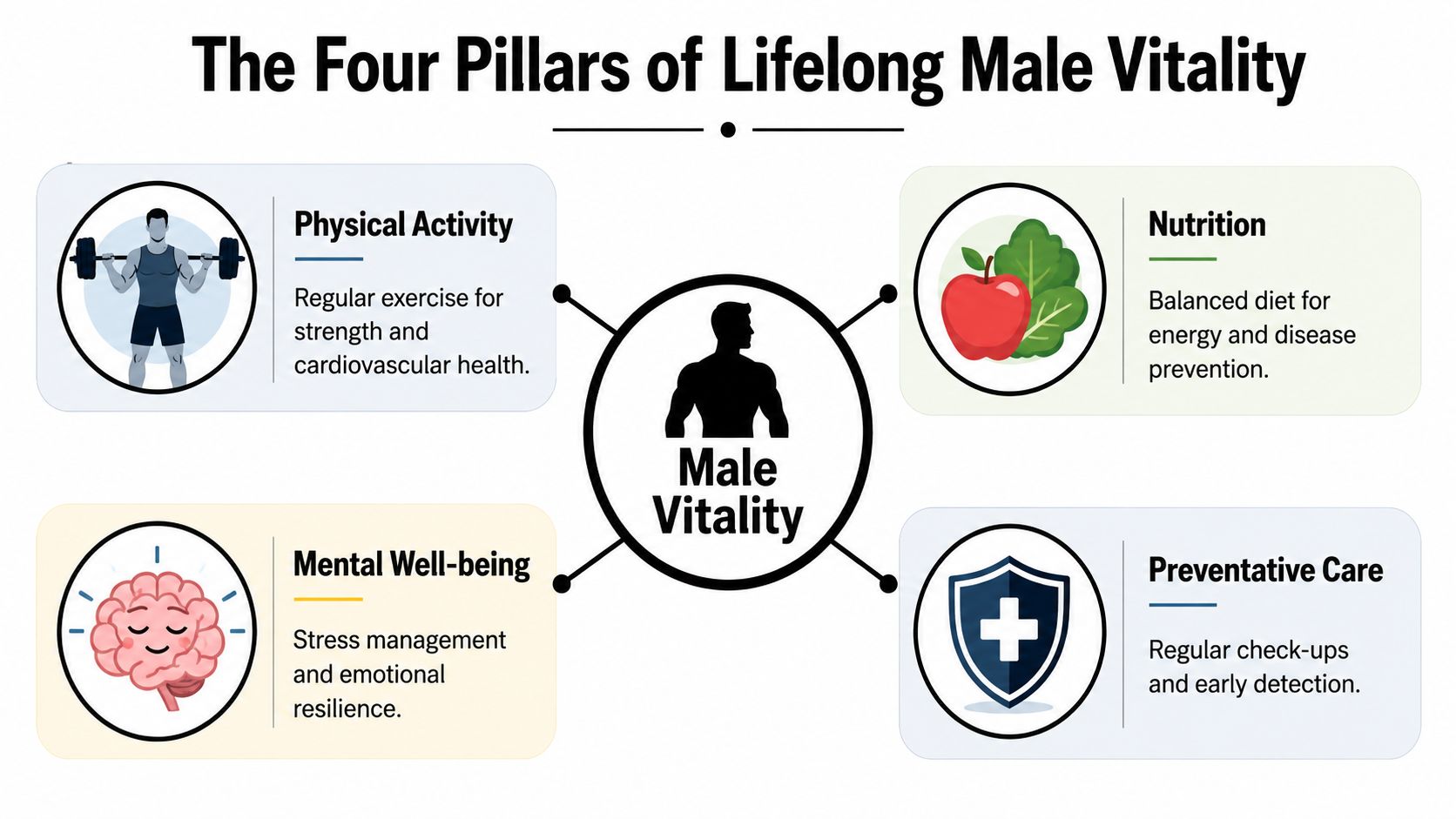
Fueling for performance
Food isn't just calories. It's instruction. It tells the body whether to build, repair, inflame, or store.
A useful standard is to eat in a way that stabilizes energy and supports lean mass instead of chasing short-term restriction. Men often get confused here because nutrition advice swings between extremes. The body usually responds better to consistency than drama.
Building a resilient body
Exercise is one of the most powerful tools in all of men's health because it improves several systems at once. Done well, it supports insulin sensitivity, cardiovascular function, mood, sleep, joint integrity, and body composition.
Testosterone declines with age, obesity, and type 2 diabetes. Clinical guidelines recommend regular exercise, healthy nutrition, and smoking cessation as the most effective natural interventions to maintain optimal levels and support functions like erectile quality.
The goal isn't random intensity. It's a balanced training life:
Strength work: Preserves muscle, bone loading, and insulin sensitivity.
Cardiovascular conditioning: Supports circulation, work capacity, and recovery.
Mobility practice: Keeps joints usable and reduces the “tin man” effect that many men accept as normal.
Men with persistent fatigue, snoring, fragmented sleep, or daytime brain fog should also consider whether their recovery architecture is broken. In some cases, advanced sleep diagnostics and treatment can clarify whether the issue is stress, airway dysfunction, circadian disruption, or a more specific sleep disorder.
Mastering recovery and mental steadiness
Recovery is where adaptation happens. If training is the stimulus, sleep is the construction crew. Stress management is the site supervisor. Without both, performance becomes erosion.
Here's the pattern I see often. A man trains hard, under-sleeps, over-caffeinates, works under chronic pressure, then wonders why his body composition stalls and his patience shortens. That isn't a character issue. It's physiology.
Practical rule: If your lifestyle keeps cortisol high and recovery low, your results will look older than your age.
The final pillar is preventive care, not because it's glamorous, but because it closes the gap between how you feel and what's happening. The strongest men's health strategy blends discipline at home with intelligent measurement in the clinic.
Essential Health Screenings You Cannot Ignore
Many men avoid screening because they think no symptoms means no problem. That assumption fails often enough to be costly. In men's health, preventive testing is less about finding disease than finding direction.
Men's health information often fails to address the persistent cultural barrier where men delay medical visits until emergencies. Data shows men die earlier and develop chronic illness at younger ages, partly due to consistently avoiding preventive screenings because of stigma or a belief that “it'll get better on its own”.
What screening actually does
A screening test isn't a verdict. It's an early signal.
Blood pressure can reveal vascular strain before a cardiac event. Glucose markers can show drift before diabetes becomes obvious. Colon screening can identify risk before symptoms force urgent attention. Prostate evaluation can open a timely conversation rather than a late one.
For men concerned about cardiovascular risk, a structured comprehensive preventive heart assessment can help place routine numbers into a more meaningful clinical context.
Recommended Men's Health Screening Schedule
| Screening | Purpose | Recommended Starting Age | Frequency |
|---|---|---|---|
| Blood pressure | Identifies hypertension and vascular strain | Adulthood | Regularly, based on physician guidance |
| Lipid panel | Evaluates cholesterol-related cardiovascular risk | Adulthood | Periodically, based on risk profile |
| Blood glucose or A1c | Assesses glucose regulation and diabetes risk | Adulthood | Periodically, especially if metabolic markers are abnormal |
| PSA test | Screens for prostate-related concerns | By age 55 | Based on personal risk and clinician guidance |
| Colonoscopy | Screens for colorectal disease | At age 45 | Based on findings and physician guidance |
Two age points matter here because men frequently ask whether there's a standard place to begin. The available verified guidance supports colonoscopy initiation at age 45 and PSA testing by age 55, both referenced in the earlier metabolic health source.
A smarter mindset for doctor visits
Don't treat a check-up like an admission of weakness. Treat it like reconnaissance. The earlier you know what's changing, the more conservative and effective your interventions can be.
Prioritizing Mental and Emotional Fortitude
One of the most damaging ideas in men's health is that mental strain should be absorbed unexpressed until it passes. Sometimes it doesn't pass. Sometimes it deepens, affects sleep, worsens inflammation, alters behavior, and changes how a man relates to work, family, food, alcohol, exercise, and risk.
Men account for 72% of all suicides worldwide, with an age-standardized suicide rate nearly three times that of women (13.9 vs 5.0 per 100,000). This crisis is linked to physical health, as men with severe mental illness have their life expectancy reduced by a median of 10 years according to this global men's mental health review.
Why men miss the signs
Men don't always present distress in the stereotypical way. Instead of saying, “I feel depressed,” many describe:
Irritability instead of sadness
Exhaustion instead of anxiety
Withdrawal instead of vulnerability
Overwork, overtraining, alcohol use, or emotional numbness instead of asking for help
That can confuse the man experiencing it and the people around him. The result is delay.
Mental health is physical health
Chronic psychological stress affects the body through sleep disruption, hormone disturbance, inflammatory signaling, and behavior changes. A man who stops sleeping well often stops recovering well. A man who stops recovering well may stop exercising, gain visceral fat, lose resilience, and drift into a feedback loop that feels “physical” even though the origin is mixed.
Emotional suppression often looks disciplined from the outside and destructive on the inside.
Language matters here. Many men need a better vocabulary for what they're experiencing before they can seek help. Resources that focus on communication, reflection, and self-recognition can help. One thoughtful example is The Language of Healing.
When to act
Seek professional support if you notice persistent hopelessness, loss of interest, escalating anger, sustained anxiety, major sleep disruption, increased substance use, social withdrawal, or thoughts of self-harm. If you're concerned about a friend, partner, brother, or father, ask directly and stay present. Calm, specific concern is more useful than polished advice.
Mental fortitude isn't the absence of struggle. It's the willingness to respond to struggle before it becomes catastrophe.
The Future of Performance and Regenerative Medicine
Good regenerative medicine starts with a disciplined question: what problem are we trying to solve, and what biology is driving it? Men who pursue advanced care are often looking for more than reassurance. They want to know why recovery has slowed, why pain keeps returning, why inflammation persists, or why performance no longer matches effort.
That requires sharper inputs.

Better inputs create better plans
A physician cannot build a precise plan from vague signals. If the map is blurry, treatment becomes educated guesswork.
Advanced evaluation may include detailed lab analysis, cardiac testing, body composition assessment, sleep evaluation, structural imaging, and targeted ultrasound-guided examination of painful or poorly functioning areas. In selected cases, peptide-based protocols may also be considered based on the diagnosis, goals, and medical context. For readers who want a clearer explanation of that category, peptide therapy for recovery and longevity support is often discussed as one part of a broader performance strategy.
The larger point is simple. Precision medicine is not about ordering more tests for the sake of sophistication. It is about reducing blind spots so treatment matches physiology.
How regenerative medicine fits into men's health
Regenerative medicine belongs inside a full-spectrum model of men's health. It sits downstream from good sleep, sound nutrition, resistance training, metabolic control, and appropriate medical screening. It also sits alongside them, because a man with chronic tendon pain, joint degeneration, poor tissue healing, or prolonged recovery may struggle to maintain those foundations unless the underlying limitation is addressed.
In practice, regenerative strategies may be considered to support tissue repair, modulate inflammation, improve recovery capacity, or reduce the functional drag of long-standing musculoskeletal or systemic problems. Depending on the clinical situation, that may include physician-guided use of allogeneic biologics, peptide protocols, hyperbaric oxygen therapy, targeted IV therapies, and structured rehabilitation.
Orthopedic care offers a useful example. A man with chronic plantar fasciitis may not just have foot pain. He may also have lower training volume, worse cardiometabolic conditioning, weight gain, and poorer sleep because movement has become costly. If a regenerative approach helps restore function, the benefit is broader than pain relief. It can help reopen the door to the lifestyle patterns that protect long-term healthspan.
At the same time, restraint matters. Some regenerative products marketed for orthopedic pain are not approved, and outcomes are never guaranteed. Innovation deserves scrutiny, not enthusiasm alone.
Why source, processing, and oversight matter
Patients often hear the term "stem cells" as if it describes one uniform therapy. It does not. Source material, manufacturing standards, sterility, handling, indication, and delivery technique all affect safety and quality.
That is why serious patients should ask direct questions. What exactly is being used? Where did it come from? How was it processed? Who determined that it fits the diagnosis? Who is supervising treatment?
For clarity, some clinics no longer use autologous stem cells in these programs and instead work with allogeneic cell sources. Longevity Medical Institute describes a platform that includes five stem cell types produced through its biotechnology lab, including placental, Wharton's jelly, adipose, endometrial, and dental pulp sources. Specificity like that matters because regenerative medicine should be evaluated with the same rigor a patient would expect from any other advanced medical intervention.
A physician's framework for deciding
If you are considering regenerative care, use a disciplined filter:
Start with the diagnosis: Treatment should match a defined clinical problem, not a vague sense of decline.
Review prior care: You should understand what has already been tried, what helped, and what still makes sense.
Examine safety standards: Ask about sourcing, sterility practices, lab controls, and physician oversight.
Set realistic expectations: Improvement may be partial, gradual, and highly individual.
The future of men's health will not be built on procedures alone. It will be built on a better sequence. Measure carefully. Diagnose precisely. Treat selectively. Then support the body in ways that protect function for decades, not just symptoms for the moment.
Taking Ownership of Your Healthspan
The central lesson in men's health is straightforward. Waiting is expensive. Early action preserves options.
A strong healthspan doesn't come from one lab result, one supplement, one scan, or one procedure. It comes from the combination of disciplined daily habits, appropriate screening, honest attention to mental health, and, when indicated, advanced diagnostics and regenerative support. That's how men shift from reactive medicine to deliberate longevity.
If you've been telling yourself that fatigue, weight gain, poor sleep, erectile changes, pain, or declining recovery are “just age,” pause there. Age influences physiology, but it shouldn't be used to excuse every change. A careful workup often reveals modifiable drivers.
Ownership starts when you stop outsourcing responsibility for your future. It continues when you measure what matters, act before urgency, and build a plan that protects both lifespan and function.
If you're ready to build a personalized path for men's health, performance, and long-term vitality, consider scheduling a consultation with Longevity Medical Institute. A physician-led evaluation can help clarify your risks, establish your baseline, and identify which lifestyle, diagnostic, and regenerative strategies fit your goals.
Author
Dr. Kirk Sanford, DC, Founder & CEO, Longevity Medical Institute. Dr. Sanford focuses on patient education in regenerative and longevity medicine, translating complex therapies into clear, practical guidance for patients.
Medical Review
Dr. Félix Porras, MD, Medical Director, Longevity Medical Institute. Dr. Porras provides clinical oversight and medical review to help ensure accuracy, safety context, and alignment with current standards of care.
Last Reviewed: July 9, 2026
Short Disclaimer
This information is for educational purposes only and is not medical advice. It does not replace an evaluation by a qualified healthcare professional. For personalized guidance, please schedule a consultation.
Published at Treatments & Resources at Longevity Medical Institute