

Oxygen Therapy for Recovery: Clinical Guide 2026
Your body is built to recover. A cut closes. A bruise fades. Inflamed tissue settles, then rebuilds. But there's a limit to how fast that system can work when oxygen delivery becomes the bottleneck.
That's the situation many patients are in when they start looking into oxygen therapy for recovery. They may be healing from surgery, pushing through a stubborn orthopedic injury, managing a wound that's slow to close, or investing in advanced regenerative care and wanting the biological environment to support it. In each case, the question is similar: how do you give healing tissue what it's missing?
Oxygen is part of the answer. Not only because we breathe it, but because damaged tissue depends on it at every stage of repair. Cells need oxygen to generate usable energy. Blood vessels need it to support rebuilding. Injured areas need it when circulation is reduced and demand is high. When supply falls behind, healing often becomes less efficient.
That's why advanced oxygen-based care has a role in modern recovery medicine. In the right setting, oxygen becomes more than a background necessity. It becomes a precisely delivered therapy that helps the body repair itself more effectively. Patients who want a broader view of how recovery fits into regenerative medicine often find it helpful to read about the power of regeneration alongside oxygen-based strategies.
Introduction: Enhancing Your Body's Natural Repair System
Think of healing as a construction project. Your body sends in immune cells to clean up damage, growth signals to coordinate the work, and structural cells to rebuild what was injured. Oxygen is the fuel that keeps that project moving.
When there isn't enough oxygen reaching tissue, the work crew slows down. Swelling can persist. Repair can stall. Tissue under stress may remain metabolically underpowered even when the rest of the body feels fine. That's one reason two people with the same injury can recover very differently.
In clinical recovery care, the goal isn't to override biology. It's to support it. Oxygen therapy fits that model well because it amplifies a process your body already depends on. Rather than introducing an artificial shortcut, it improves one of the key conditions required for repair.
Healthy recovery depends on more than time. It depends on whether injured tissue has the resources to use that time well.
This becomes especially relevant in patients who are trying to recover at a high level. Athletes, surgical patients, and people pursuing regenerative treatments often aren't asking only whether tissue will heal. They want to know how to improve the quality of healing, reduce physiological drag, and create a stronger platform for function afterward.
That's where oxygen therapy becomes interesting. It can be used as a focused recovery tool, and in some settings, as a biological amplifier that makes other treatments work in a more favorable tissue environment.
The Science of Cellular Regeneration Through Oxygen
At the cellular level, oxygen has one main job that influences almost everything else. It helps cells make energy. Without enough of it, repair becomes slower, less coordinated, and more vulnerable to interruption.
You can think of oxygen as the fuel supply for a repair site. If the trucks carrying materials can't reach the location, the crew may still be present, but progress becomes uneven. Damaged tissue often has exactly this problem. It needs more support at the same time circulation is disrupted by swelling, injury, or poor microvascular flow.
Why oxygen changes the healing environment
When more oxygen reaches tissue, cells are better equipped to maintain the energy-demanding work of repair. That includes synthesizing proteins, supporting cell signaling, and sustaining the metabolic activity required for tissue turnover.
It also affects the local environment around an injury. Tissue under metabolic stress tends to become disorganized. The immune response can remain active longer than needed. Clearance of debris may be less efficient. A better oxygen supply helps move that terrain from survival mode toward constructive repair.
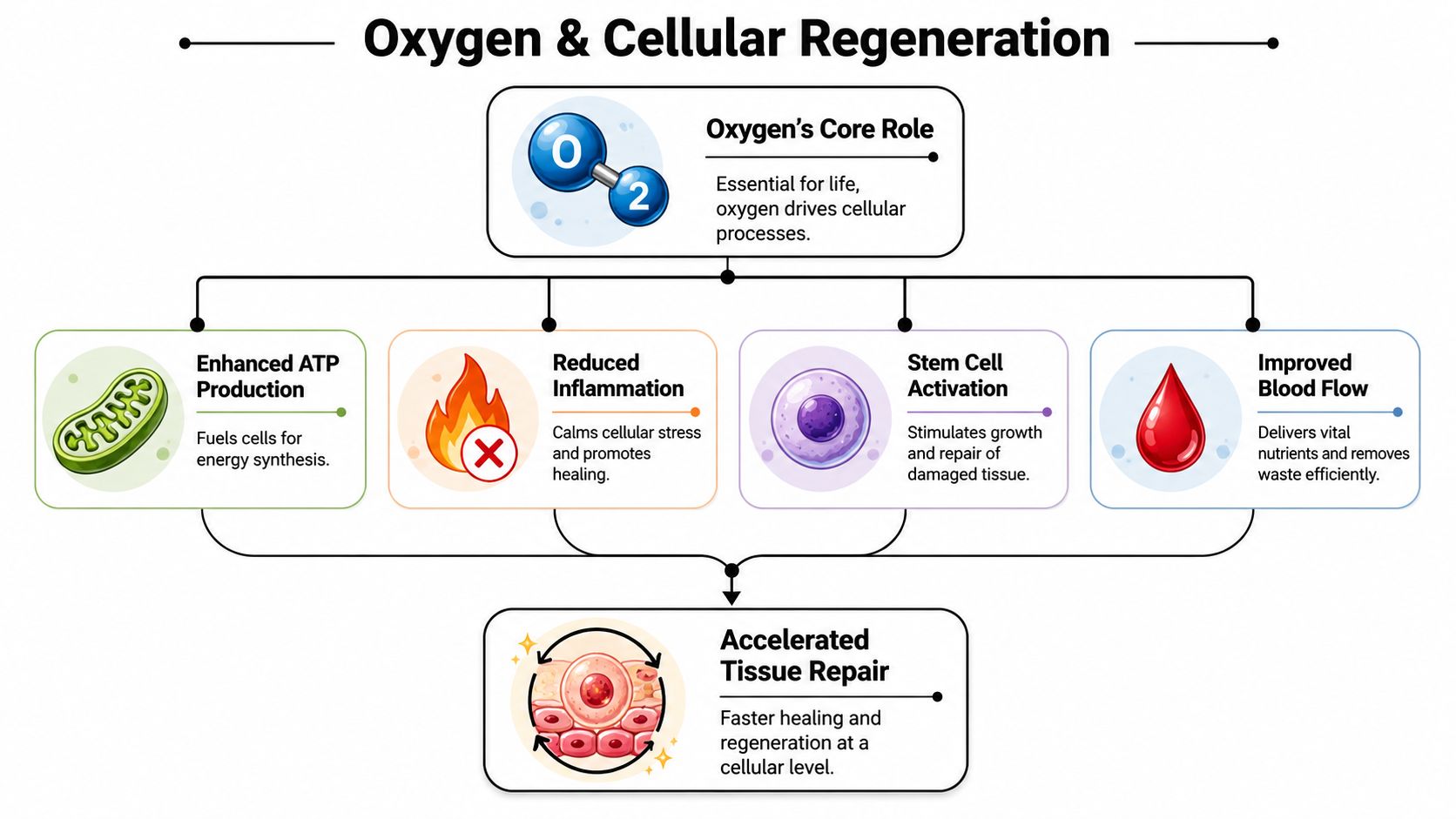
Patients interested in the broader biology of repair often connect this with cellular regeneration therapy, because the principle is similar: healing improves when the tissue environment becomes more supportive of coordinated repair.
Four ways oxygen supports regeneration
Energy production: Cells need oxygen to generate ATP, the usable energy currency that powers repair.
Inflammation control: Inflamed tissue often exists in a stressed, poorly oxygenated state. Better oxygen availability can help that environment become more stable.
Microcirculatory support: Oxygen can help sustain tissue even when blood flow at the smallest vessel level is compromised.
Regenerative signaling: Tissue repair depends on signals, gradients, and cellular responsiveness. Oxygen influences that entire communication network.
A useful analogy is road access to a construction zone. Blood vessels are the highways, but plasma is also a transport medium. If oxygen can move more effectively into fluid and diffuse farther into stressed tissue, areas with limited access can still receive support.
Clinical lens: Oxygen therapy isn't only about delivering more oxygen to the lungs. It's about improving oxygen availability where healing is actually happening.
That distinction matters. Many patients assume oxygen therapy equates to “breathing more oxygen.” In recovery medicine, the more important question is whether oxygen can reach tissue that's inflamed, injured, or metabolically disadvantaged. That's the difference between supportive oxygen use and true therapeutic oxygen delivery.
A Closer Look at Hyperbaric and Normobaric Therapies
Not all oxygen therapy works the same way. The major distinction is pressure.
Normobaric oxygen therapy means breathing concentrated oxygen at normal atmospheric pressure. This can be useful in medical settings, particularly when the goal is to support oxygen intake through conventional delivery methods. But for deeper tissue recovery, pressure changes the equation.
Hyperbaric oxygen therapy, or HBOT, is the modern clinical model most closely associated with tissue repair. It uses 98% oxygen in a chamber pressurized to about 1.5 to 2 times higher than normal air pressure, according to Cleveland Clinic's overview of hyperbaric oxygen therapy. The same reference notes that room air contains 21% oxygen and describes established approvals tied to healing, including wounds, burns, crush injury, compromised skin grafts, delayed radiation injury, and decompression sickness.
Why pressure matters
A simple analogy helps. Sugar dissolves into water more readily under the right conditions. Oxygen behaves similarly in the body. Under pressure, more oxygen can dissolve into plasma, not just ride on red blood cells. That allows it to move farther into tissue that may not be receiving ideal blood flow.
That's why pressure isn't a minor feature. It's the feature that sets hyperbaric therapy apart from breathing oxygen at standard pressure.
Hyperbaric vs. Normobaric Oxygen Therapy
| Feature | Hyperbaric Oxygen Therapy (HBOT) | Normobaric Oxygen Therapy (NBOT) |
|---|---|---|
| Pressure | Pressurized chamber environment | Normal atmospheric pressure |
| Oxygen concentration | 98%+ oxygen | Concentrated oxygen, depending on delivery system |
| Delivery method | Chamber-based treatment | Mask, cannula, or similar delivery |
| Primary advantage | Greater oxygen dissolution into plasma and deeper tissue diffusion | Supports oxygen intake without pressure-based tissue loading |
| Typical recovery role | Tissue repair, difficult healing environments, specialized recovery protocols | General oxygen support in appropriate settings |
For patients evaluating treatment options, hyperbaric oxygen therapy is usually the more relevant category when the clinical goal is recovery, tissue restoration, or support for regenerative medicine.
Pressure is what turns oxygen from a simple supplement into a tool that can meaningfully change tissue conditions.
Proven Applications in Clinical Recovery
Some uses of oxygen therapy are well established. Others are used more selectively within broader recovery programs. The common thread is this: the tissue involved is stressed, underperfused, slow to heal, or all three.
The strongest evidence for hyperbaric use is in conditions where oxygen diffusion into compromised tissue is central to the problem. The Undersea & Hyperbaric Medical Society notes that HBOT is typically delivered at 1.9–3.0 ATA using 100% oxygen, with strong evidence for indications including diabetic wounds, delayed radiation injury, decompression sickness, carbon monoxide poisoning, necrotizing soft tissue infection, and gas gangrene in its featured guidance on HBO indications.
Wounds and tissue that isn't progressing
Chronic wounds are one of the clearest examples. A wound may look local, but the biology is systemic and microvascular. The tissue often sits in an oxygen-poor state, which makes closure difficult even when dressings and general care are appropriate.
In that setting, oxygen therapy can support a stalled healing environment by improving diffusion into hypoxic tissue. That's part of why it remains one of the best-known clinical applications.
Orthopedic and post-surgical recovery
Many patients ask about joints, tendons, ligaments, and surgery recovery. These uses are appealing because orthopedic tissue often has limited blood supply to begin with. Add trauma or surgical disruption, and local metabolic demand rises sharply.
The rationale is biologically sound. Better oxygen availability may support the early phases of tissue recovery, especially when swelling and impaired microcirculation are part of the picture. In practice, this is often considered as part of a broader recovery strategy rather than a stand-alone answer.
Cosmetic and procedural healing
Patients recovering from more intensive aesthetic procedures often want to reduce downtime and support cleaner healing. Oxygen-based therapies may be considered when tissue stress, inflammation, and barrier repair are relevant.
This is one area where expectations should stay grounded. The biology is compelling, but treatment planning should match the procedure, tissue depth, and overall recovery goals rather than a generalized promise of faster healing.
A closer look at the chamber experience helps many patients understand why the therapy feels more medical than spa-like:
Where clinical judgment matters most
Oxygen therapy is most useful when the bottleneck is oxygen delivery. That sounds obvious, but it's important. If the barrier to recovery is structural instability, uncontrolled infection, inadequate wound care, or a poor rehabilitation plan, oxygen alone won't solve the problem.
That's why the best use of oxygen therapy sits inside a larger clinical framework.
For wound patients: It may complement debridement, offloading, vascular assessment, and metabolic control.
For orthopedic patients: It often works best alongside imaging, targeted injections, rehabilitation, and load management.
For regenerative patients: It may help prepare the tissue environment before and after biologic treatment.
Designing Your Personalized Recovery Protocol
A thoughtful oxygen therapy plan starts with matching the treatment to the problem. The protocol for a chronic wound isn't the same as the protocol for a post-procedure recovery program, and neither should be approached casually.
For wound recovery, evidence-backed protocols often use daily sessions lasting about 60–90 minutes over 10–40 treatments, with some refractory cases extending up to 60. The CMS technology assessment also notes improved complete wound-healing rates, shortened hospitalization, and faster return to function in some settings, with analyses reporting a ~1.9× higher diabetic foot ulcer healing rate and about 19 days shorter healing time versus standard care in some comparisons, as described in the CMS review of hyperbaric oxygen therapy evidence.
What the treatment course usually involves
A personalized protocol usually includes several layers:
Clinical assessment
The first step is defining the recovery target. Is the issue a wound, post-surgical tissue stress, persistent inflammation, or preparation for a regenerative intervention?Treatment scheduling
Some conditions respond best to clustered sessions. Others fit into a more flexible performance and recovery plan.Monitoring response
Good protocols don't just count sessions. They track how tissue is behaving, how symptoms are shifting, and whether the therapy is serving its intended role.
Many patients also combine oxygen-based treatment with other supportive therapies aimed at the inflammatory terrain. One related area is IV therapy for inflammation, which may be considered when recovery planning includes hydration, nutrient support, and systemic stress reduction.
What a session feels like
Most patients find the experience straightforward. You enter the chamber, settle in, and notice pressure changes most clearly in the ears during compression and decompression. That sensation is similar to air travel and is usually managed with simple pressure-equalizing techniques.
The most common source of anxiety isn't pain. It's unfamiliarity. Once patients know what pressure changes feel like, the experience usually becomes much easier.
During the session, the work is largely internal. There's no dramatic sensation of tissue “healing” in real time. That's important to understand. Oxygen therapy is a physiological treatment, not a stimulant. Its value comes from cumulative biological effects across a properly designed series of sessions.
Amplifying Results with Regenerative Medicine
Oxygen therapy gains particular relevance in advanced recovery programs. Regenerative medicine asks tissue to do complex work. Cells need to signal, adapt, integrate, and function inside an environment that's receptive enough to support them.
A poorly oxygenated field is rarely an ideal place for that to happen.
Why the tissue environment matters
When clinicians talk about regenerative outcomes, they often focus on the treatment itself. But the surrounding terrain matters just as much. Inflamed, congested, metabolically stressed tissue doesn't respond the same way as tissue that has better circulation, more stable signaling, and stronger cellular energy availability.
That's why oxygen therapy can act as a biological primer. It may help create a more supportive setting before and after regenerative interventions by improving the conditions in which repair signaling occurs.

Pairing oxygen with advanced biologics
In practical terms, this means oxygen therapy is often considered alongside:
Allogeneic stem cell therapy: The goal is to place highly active biologic agents into tissue that can support their signaling and repair functions.
Exosome-based protocols: These rely on cellular communication. The quality of the tissue environment influences how well those signals are received.
Platelet-rich plasma and growth factor strategies: These approaches also depend on local tissue responsiveness.
At Longevity Medical Institute, oxygen therapy may be integrated with broader regenerative plans that include allogeneic cell-based care, peptide protocols, and advanced diagnostics when the clinical objective is to support recovery quality rather than treat oxygen as a stand-alone service. Patients exploring adjacent biologic approaches sometimes also review ozone therapy in Cabo San Lucas because both therapies are often discussed in the context of recovery optimization, even though they work through different mechanisms.
Regenerative medicine works best when the soil is healthy, not just when the seed is strong.
That analogy is simple, but it holds. An advanced therapy placed into an unreceptive environment may underperform. Oxygen therapy can help make the terrain more favorable.
Frequently Asked Questions About Oxygen Therapy
Is oxygen therapy safe
In appropriate candidates and under medical supervision, it can be used safely. The key issue is patient selection. Hyperbaric treatment isn't something to start casually without a proper review of medical history, medications, respiratory status, and any factors that might affect pressure tolerance.
What does a session feel like
Most patients describe the main sensation as ear pressure during chamber pressurization, similar to what you feel during a flight. Once that settles, the treatment itself is usually calm and uneventful.
How should I prepare
Follow the instructions given by your clinical team. Preparation often includes practical guidance about clothing, personal items, timing of meals, and medications. If you've never had pressure-based treatment before, ask how to equalize ear pressure before your first session.
How will I feel afterward
Many patients return to regular activity the same day. Some feel relaxed. Others feel mentally clear or physically lighter. The response varies, and improvement is usually judged across a series of sessions rather than from a single treatment.
Can oxygen therapy replace other recovery treatments
Usually, no. It's best understood as one component of a broader plan. In some cases it plays a central role, especially in established wound-related indications. In others, it works as a support layer that improves the environment for rehabilitation, biologics, or procedural recovery.
If you're considering a more advanced, medically guided approach to recovery, Longevity Medical Institute offers consultations that evaluate whether oxygen-based therapy fits your broader regenerative plan, including allogeneic stem cell strategies, exosome support, advanced diagnostics, and personalized recovery protocols.
Author
Dr. Kirk Sanford, DC, Founder & CEO, Longevity Medical Institute. Dr. Sanford focuses on patient education in regenerative and longevity medicine, translating complex therapies into clear, practical guidance for patients.
Medical Review
Dr. Félix Porras, MD, Medical Director, Longevity Medical Institute. Dr. Porras provides clinical oversight and medical review to help ensure accuracy, safety context, and alignment with current standards of care.
Last Reviewed: June 3, 2026
Short Disclaimer
This information is for educational purposes only and is not medical advice. It does not replace an evaluation by a qualified healthcare professional. For personalized guidance, please schedule a consultation.
Published in Treatments & Resources