

Peptide Therapy Benefits: Boost Recovery & Longevity
You may be feeling that familiar frustration of modern health care: your standard labs look “fine,” your symptoms aren't severe enough for a crisis label, yet you know your recovery, energy, focus, sleep, or resilience isn't where it should be. You're not looking for another generic wellness trend. You're looking for a more precise way to support the biology underneath how you feel.
That's where peptide therapy enters the conversation. In a regenerative medicine setting, peptides aren't just another add-on. They function more like cellular conductors, helping coordinate the signals your body already uses to repair tissue, regulate inflammation, support metabolism, and maintain internal balance.
For informed patients, the appeal is precision. Instead of forcing the body in a blunt way, peptide therapy aims to work with existing signaling pathways. In practice, that often makes it a useful complementary strategy alongside broader regenerative programs, especially when the goal is better healing quality, stronger recovery capacity, and a longer span of high-functioning health.
The Next Wave in Cellular Medicine
A common patient story goes like this. Someone has done the basics well for years. They eat carefully, exercise consistently, sleep reasonably well, and still notice slower recovery after training, more lingering inflammation after travel, less mental sharpness under stress, or a body that no longer bounces back the way it once did.
Conventional medicine is indispensable when disease is acute, dangerous, or advanced. But many high-functioning adults live in the space before that. They aren't critically ill, yet they don't feel optimized. They want an approach that respects physiology at a deeper level.
Peptide therapy fits that mindset because it isn't based on the idea that the body is broken. It's based on the idea that cellular communication can become inefficient, and that carefully selected signals may help restore better coordination. If stem cell therapy can be compared to bringing in highly capable repair teams, peptides are often the foremen and dispatchers, helping direct where attention is needed and how the environment should respond.
Why sophisticated patients are paying attention
What makes peptides compelling is their specificity. One peptide may be used to support tissue repair. Another may be chosen for immune balance. Another may be considered when the priority is sleep quality, recovery, or metabolic resilience. That level of targeting is very different from the broad “boost everything” language that dominates much of wellness marketing.
Peptide therapy is most useful when the goal isn't just symptom relief, but better biological orchestration.
Patients also appreciate that this approach can be folded into a larger longevity plan. A physician may look at inflammation patterns, recovery issues, body composition changes, immune stress, cognitive complaints, or signs of accelerated aging, then ask a more meaningful question: what signaling pathways seem under-supported?
That's the next wave in cellular medicine. It's less about chasing isolated symptoms and more about improving the conditions under which the body can repair, adapt, and perform well over time.
Understanding Peptides The Body's Master Signals
Peptides are short chains of amino acids. Amino acids are the building blocks the body uses to create proteins, but peptides are smaller and often serve as signaling molecules. Their job is communication.
A simple way to understand them is to think of peptides as biological text messages. One message tells a cell to initiate repair. Another tells immune cells to calm an exaggerated response. Another may help signal hormonal rhythms, tissue rebuilding, or restorative sleep. The body already uses this language naturally. Therapy aims to support it with precision.
Why peptides are different from proteins and hormones
Patients often get confused here, and understandably so. Proteins are larger, more complex structures that often do heavy structural or functional work. Hormones are also signaling molecules, but they tend to operate in broader systemic ways. Peptides sit in a useful middle ground. They can be highly specific, often interacting with particular receptors like a specialized key fitting a cellular lock.
That specificity is part of why peptide therapy attracts interest in regenerative and longevity medicine. We're not talking about random stimulation. We're talking about selective instructions.
Researchers have identified the scale of this internal communication network. Over 7,000 naturally occurring peptides have been identified in the human body, each with a highly specific role, demonstrating the complexity and precision of this internal communication network that peptide therapy aims to support (article on naturally occurring peptides in human physiology).
What that means in practice
If a patient has persistent soft tissue irritation, poor workout recovery, and gut sensitivity, the question isn't “What supplement covers all of that?” The better question is, “Which signals might help the body coordinate repair and regulation more effectively?”
That's why peptide therapy is better understood as precision medicine support, not as a lifestyle hack.
For a deeper overview of mechanisms and delivery, the guide on how peptide therapy works is a useful next read.
Clinical perspective: The more complex the case, the more important signal quality becomes. Cells respond to instructions, not motivation.
A Spectrum of Peptide Therapy Benefits
The phrase peptide therapy benefits can sound overly broad until you organize it by biological system. Peptides don't do one thing. They support specific signaling pathways, which is why the benefits can touch several aspects of health at once.
A helpful visual makes that easier to grasp.
Recovery and tissue repair
This is often where patients notice the concept most clearly. When signaling around repair improves, the body may respond more efficiently after training, orthopedic strain, repetitive overuse, or physically stressful travel.
For active adults, that can mean:
Less lingering soreness: Recovery may feel more complete between workouts or procedures.
Better soft tissue support: Tendons, ligaments, muscle, and connective tissue may receive stronger regenerative signaling.
Improved healing environment: Repair tends to happen best when inflammatory noise is lower and local tissue communication is better organized.
This section of regenerative care is often what draws athletes in first. Then they realize the same logic applies elsewhere.
A practical discussion of these applications appears in this overview of the power of peptides.
Inflammation, immune balance, and resilience
Not all inflammation is harmful. Acute inflammation is part of healing. The problem is dysregulated inflammation, especially when it becomes chronic, smoldering, or poorly resolved.
Peptides may be used to support:
| Focus area | Why it matters |
|---|---|
| Immune modulation | Helps the body respond without staying stuck in overactivation |
| Recovery after stress | Travel, illness, poor sleep, and hard training can all strain regulation |
| Gut and barrier health | Many patients with systemic symptoms also have underlying digestive vulnerability |
This matters for longevity because a body that is always reacting is rarely a body that repairs well.
Metabolic health and body composition
Some patients seek peptide therapy because they feel metabolically “stuck.” They train but don't recover well. They eat well but can't regain body composition control. They sleep enough but wake unrefreshed.
In those settings, carefully chosen peptides may support the biology related to:
Appetite and satiety signaling
Insulin sensitivity and glucose regulation
Lean mass preservation
Fat metabolism
Sleep quality, which strongly influences metabolic function
These aren't cosmetic goals alone. Metabolic flexibility is one of the central pillars of long-term healthspan.
Cognitive function and performance
The brain is energy-intensive tissue. When sleep is fragmented, inflammation is high, or recovery is poor, cognition usually reflects it. Patients often describe this as brain fog, slower recall, reduced focus, or a subtle loss of mental sharpness.
Peptide strategies may be considered when the goal is to support:
Mental clarity
Neuroprotective signaling
Stress resilience
Sleep architecture and next-day performance
Better cognition often begins with better repair, better sleep, and lower inflammatory burden. The brain rarely thrives in a body that is constantly compensating.
Hormonal and vitality support
Some peptides are used because they help support endogenous rhythms rather than replacing downstream hormones. That distinction matters. For the right patient, this approach may fit a broader plan centered on recovery, body composition, motivation, exercise tolerance, and sexual wellness.
What patients usually care about is simple. They want to feel more like themselves again. More capacity. Better output. Less friction.
Longevity through coordination
The deepest promise of peptide therapy isn't that it “anti-ages” in a superficial sense. It's that it may improve cellular coordination, which is what healthy aging depends on. Cells need to know when to repair, when to rest, when to grow, and when to resolve inflammation. If those instructions become noisy, aging accelerates in practical ways.
That's why peptide therapy benefits are best understood as part of a systems-based longevity strategy. The goal isn't to override biology. It's to help biology communicate more intelligently.
Key Peptides and The Supporting Clinical Evidence
Patients often ask a fair question: which peptides are used in clinical settings, and what are they intended to support? The answer depends on the therapeutic target. Different peptides speak to different pathways.
BPC-157 and tissue support
BPC-157 is widely discussed in regenerative medicine because of its association with tissue repair and gastrointestinal support. In clinical conversations, it often comes up when patients are dealing with tendon irritation, ligament strain, musculoskeletal overuse, or gut-related symptoms that seem intertwined with systemic inflammation.
The reason it attracts attention is conceptual as much as practical. It is used when the goal is to improve the local repair environment rather than merely cover pain.
CJC-1295 and Ipamorelin for recovery signaling
The combination of CJC-1295 and Ipamorelin is often considered when physicians want to support pathways related to growth hormone signaling, sleep quality, recovery capacity, and body composition.
Patients sometimes misunderstand this category and assume it is the same as direct hormone replacement. It isn't. The clinical appeal is that these compounds are used to encourage the body's own signaling patterns rather than replacing the final hormone outright.
A useful patient education resource on this broader regenerative framework is Peptide Unlocking the Full Potential of Regeneration.
The best peptide choice is rarely the one with the loudest reputation. It's the one that matches the biology in front of you.
Thymosin Alpha-1 and immune modulation
Thymosin Alpha-1 is often discussed in cases where immune regulation is part of the therapeutic picture. That may include patients whose systems seem reactive, depleted, or slow to regain balance after chronic stressors.
For these individuals, peptide selection isn't about “stimulating immunity” in a simplistic way. It's about helping the immune response become more organized and proportionate.
GHK-Cu and visible regeneration
GHK-Cu, often referred to as a copper peptide, is well known in aesthetic and restorative discussions involving skin quality, collagen support, and hair-related concerns. It appeals to patients who want regenerative medicine to be visible as well as measurable.
Here again, the point isn't superficial enhancement alone. Skin, scalp, and connective tissue all reflect signaling quality. When the communication improves, external tissue often looks healthier because internal biology is functioning more coherently.
What supporting evidence really means
A discerning patient should expect nuance here. Some peptides have stronger clinical familiarity than others. Some are supported by a mix of established medical use, translational science, and evolving regenerative practice. Evidence doesn't mean every claim is settled. It means clinicians use available mechanistic understanding, patient history, examination findings, and ongoing monitoring to choose rational interventions.
That's how peptide therapy should be approached. Not as internet folklore, and not as a miracle. As a targeted tool within a physician-guided plan.
Personalized Peptide Protocols at LMI
A peptide protocol should never start with a trend list. It should start with the patient. Two people can have the same complaint, low energy for example, and need very different interventions. One may have a sleep-driven problem. Another may have inflammatory stress. A third may have a recovery deficit related to hormonal rhythm or body composition.
That's why personalization matters.
How peptides are commonly administered
Many peptide protocols use IV or subcutaneous injections, which place the peptide into the tissue just beneath the skin. Patients are often surprised by how straightforward this can be when they're taught properly. In other settings, oral, topical, nasal, or injectable routes may be considered depending on the compound and treatment goal.
Route matters because peptides are delicate molecules. The delivery method affects stability, absorption, and how reliably the intended signal reaches the body.
Why one-size-fits-all protocols usually underperform
A cookie-cutter peptide plan ignores the most important variable, your biology. Physicians need context:
Symptoms and goals: Recovery, cognition, body composition, inflammation, sexual wellness, or immune resilience
Medical history: Current conditions, medications, previous treatment response, contraindications
Laboratory data: Biomarkers help identify where support may be needed
Lifestyle realities: Travel, stress, training load, sleep quality, and nutritional patterns all change the plan
At the peptide therapy program in Los Cabos, protocols are integrated into a larger precision-medicine workflow rather than treated as isolated products.
The role of biomarker-guided care
The clinic's in-house laboratory measures 140 biomarkers, which helps physicians look beyond symptoms and identify patterns in metabolism, inflammation, hormone balance, nutrient status, and organ function. That kind of data matters because peptides work best when they're matched to a real physiological need, not a guess.
Practical rule: If a clinic recommends the same peptide stack to nearly everyone, that's not personalization. That's inventory management.
This is also the right place to clarify another point. Regenerative plans involving cellular therapies should reflect the actual biologic platform being used. In this context, the program uses allogeneic stem cells, not autologous stem cells, and the biotechnology lab produces placental, Wharton's jelly, adipose, endometrial, and dental pulp stem cell lines for clinical applications. Peptides can complement those broader strategies when physicians want to improve the signaling environment around repair.
Amplifying Results with Integrated Regenerative Therapies
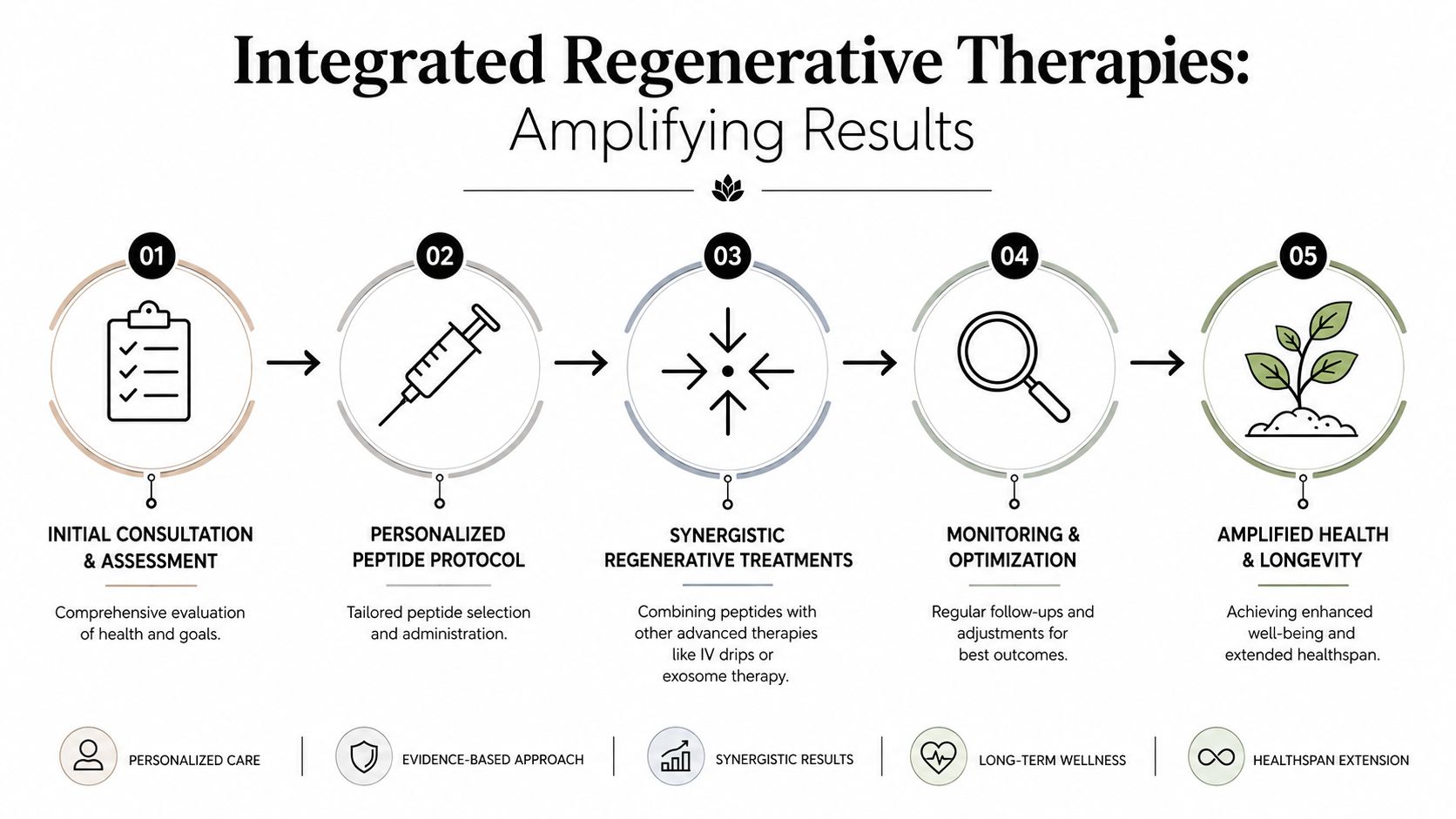
Peptides can work well on their own. Their greater value often appears when they're combined thoughtfully with other regenerative tools. If you think of healing as an orchestra, peptides help cue the sections, refine timing, and reduce noise so the larger performance is more coherent.
That matters because advanced therapies don't act in a vacuum. Stem cells, exosomes, oxygen-based therapies, restorative sleep interventions, and metabolic optimization all depend on the condition of the tissue environment they enter.
Why synergy matters
If inflammation is poorly regulated, if sleep is fragmented, if tissue signaling is disorganized, then even advanced therapies may not perform as well as they could. Peptides are often used to prepare the terrain.
Consider the logic:
| Therapy layer | Role in an integrated plan |
|---|---|
| Peptides | Support signaling, recovery, tissue communication, and immune balance |
| Allogeneic stem cells | Contribute regenerative cellular activity in a more favorable environment |
| Exosomes and restorative protocols | Extend communication and repair support |
| Adjunctive therapies | Improve oxygen delivery, circulation, recovery, and physiologic resilience |
The point isn't to stack therapies for the sake of complexity. The point is to sequence them intelligently.
Peptides and stem cell support
In regenerative medicine, allogeneic stem cells can be thought of as highly capable biological repair assets. But even excellent repair assets need workable conditions. If tissue remains inflamed, circulation is suboptimal, or immune signaling is chaotic, outcomes may be less consistent.
Peptides can help by supporting:
A calmer inflammatory backdrop
More organized repair signaling
Better recovery between interventions
Stronger systemic resilience during a treatment program
This is one reason physicians often see peptides as amplifiers rather than mere accessories.
Peptides and oxygen-based recovery
Oxygen delivery also matters. Therapies such as hyperbaric oxygen therapy may complement peptide protocols by improving the environment in which tissue repair and cellular metabolism occur.
A broader program may also involve sleep medicine, an in-house clinical lab, AI-integrated full-body MRI, advanced heart evaluation, and restorative technologies such as a Longevity Recharge Station. Each tool answers a different question. Peptides occupy the signaling layer. They help connect intention to biology.
Integrated regenerative medicine works best when each therapy has a defined job. Peptides often help coordinate the jobs between them.
Your Peptide Therapy Journey Safety and Expectations
Most patients want the same three questions answered before they begin. Is it safe? Am I a candidate? When will I notice a difference?
Safety starts with medical oversight. Peptides shouldn't be selected casually, purchased from questionable online sellers, or used without a clear rationale. A qualified physician should review your health history, current medications, goals, and possible contraindications. Some patients are not appropriate candidates, and that's exactly why evaluation matters.
What to expect during treatment
For many patients, peptide therapy is well tolerated. The most common issues discussed in practice are usually practical rather than dramatic, such as mild irritation at an injection site or the need to adjust timing, dosing, or peptide choice based on response.
Expect a process that includes:
Assessment first: Symptoms alone don't tell the whole story
Clear instructions: Especially if self-administration is part of the protocol
Monitoring and adjustment: The body's response guides refinement
Realistic pacing: Peptides support physiology. They don't bypass it
How results usually unfold
Patients often want an exact timeline, but biology doesn't work like a switch. Some people first notice sleep changes, steadier energy, or better recovery. Others notice that inflammation settles, training feels more productive, or cognition becomes clearer. Structural repair tends to require patience because tissue remodeling follows its own timetable.
The right expectation is progress, not instant transformation.
Choose a clinic that can explain why a specific peptide was selected, how it will be monitored, and what success should look like for your case.
The strongest peptide programs are the least mysterious. You should understand the reasoning, the safety context, the monitoring plan, and the role this therapy plays in your broader health strategy.
If you're considering peptide therapy as part of a broader recovery or longevity plan, Longevity Medical Institute publishes patient education resources under its treatments and resources library. A physician-guided consultation can help determine whether peptide therapy fits your biology, whether it should stand alone or complement allogeneic stem cell therapy, hyperbaric oxygen therapy, diagnostics, or other regenerative options.
Author
Dr. Kirk Sanford, DC, Founder & CEO, Longevity Medical Institute. Dr. Sanford focuses on patient education in regenerative and longevity medicine, translating complex therapies into clear, practical guidance for patients.
Medical Review
Dr. Félix Porras, MD, Medical Director, Longevity Medical Institute. Dr. Porras provides clinical oversight and medical review to help ensure accuracy, safety context, and alignment with current standards of care.
Last Reviewed: July 3, 2026
Short Disclaimer
This information is for educational purposes only and is not medical advice. It does not replace an evaluation by a qualified healthcare professional. For personalized guidance, please schedule a consultation.