

Stem Cell & Exosome Therapy for Heart Failure and Reduced Ejection Fraction
If you've been told your ejection fraction is low, the first feeling is usually uncertainty. You may be taking standard heart medications, trying to stay active, and still wondering whether anything else can help the heart recover without making unrealistic promises. That's exactly where Stem Cell & Exosome Therapy for Heart Failure and Reduced Ejection Fraction sits today, at the intersection of cautious science, careful patient selection, and a real need for better options.
Understanding Heart Failure and Ejection Fraction
A person can look stable on the outside and still live with a heart that is working too hard. In heart failure, the heart can't adequately meet the body's needs without higher filling pressures or fluid buildup, so breathing, energy, and exercise tolerance often change long before people think of the problem as “severe.” Ejection fraction, or EF, is one part of that picture, it measures the percentage of blood the left ventricle pumps out with each heartbeat.

What the EF number means in everyday terms
Preserved EF means the heart's squeeze is still relatively strong, but the heart muscle may be stiff and not fill or relax properly. Mildly reduced EF suggests some loss of pumping strength, while reduced EF reflects more substantial impairment in the left ventricle's ability to move blood forward. Symptoms, the underlying cause, and how the number changes over time matter just as much as the percentage itself.
That's why two people with the same EF can feel very different. One may be limited mainly by fluid retention, another by fatigue and shortness of breath, and a third may have few symptoms until exertion exposes the problem. A full heart assessment helps connect the number on the echo to the person in front of the clinician, and that's the kind of evaluation available through comprehensive heart assessment.
Why the cause matters
Heart failure is not one condition. Ischemic heart failure is linked to reduced coronary blood supply, often after damage to the heart muscle, while nonischemic heart failure comes from other causes. Those can include inherited cardiomyopathy, prior myocarditis or viral injury, long-standing high blood pressure, persistent rapid heart rhythms, excessive alcohol, certain chemotherapy drugs, and sometimes no clear cause at all.
Identifying the cause helps guide treatment and gives a better sense of what might improve. A person with active inflammation, rhythm problems, or untreated blood pressure issues needs a different plan from someone whose heart muscle has been damaged by scar. Regenerative therapy, when considered, makes the most sense after the cause and current status are understood.
What Clinical Research Shows About IV Stem Cell Therapy
The most useful way to read the literature is to separate what improved on imaging from what improved in day-to-day life. The strongest early intravenous trial data come from stable patients who were already receiving standard treatment, which matters because these studies were never meant to replace heart medications or devices. They were meant to test whether allogeneic cell therapy could add something beyond usual care.
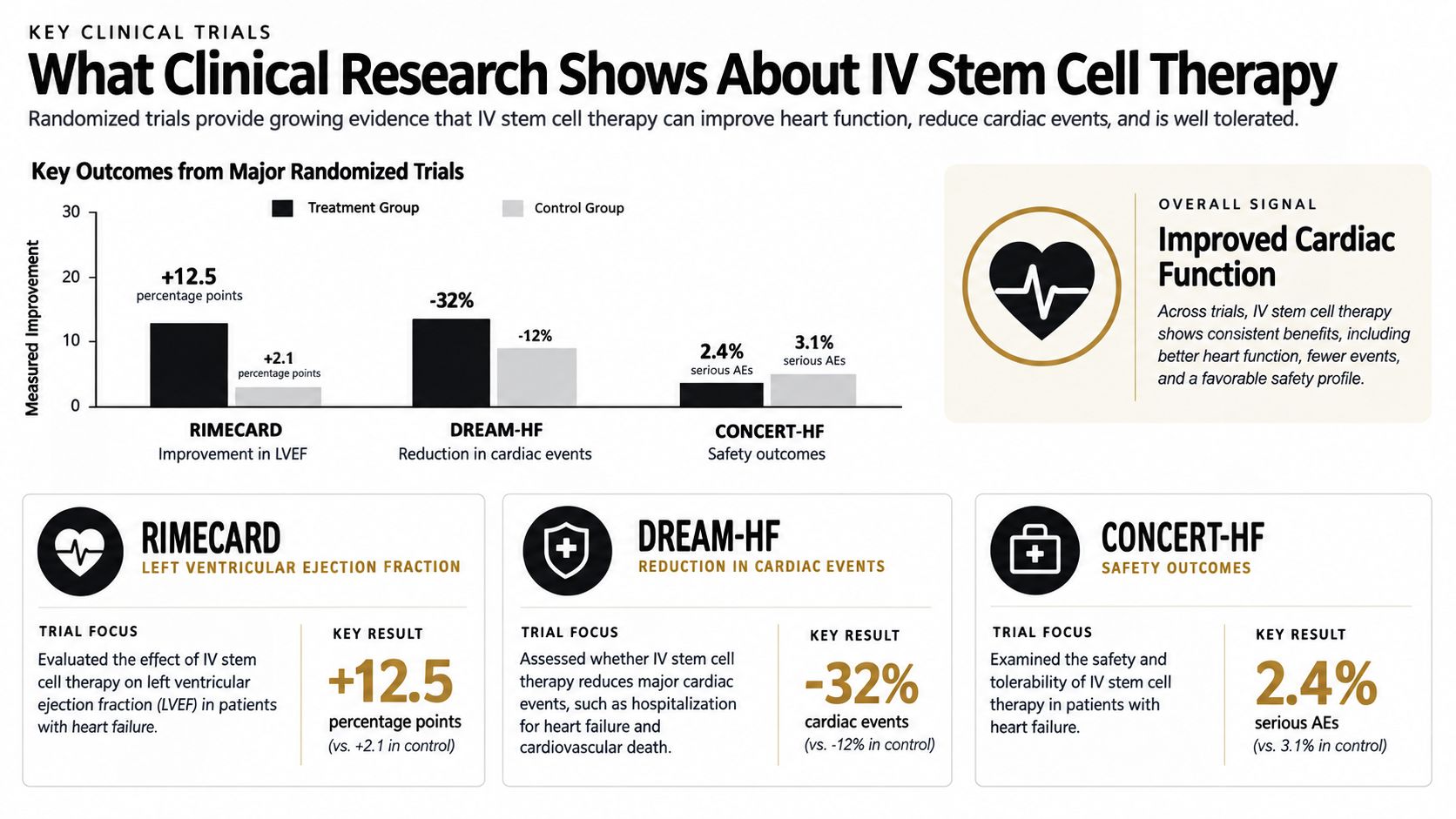
The RIMECARD signal
In the randomized, placebo-controlled RIMECARD trial, intravenous donor-derived umbilical cord mesenchymal stem cells were given to stable heart failure patients while they continued medical treatment. At 12 months, average EF increased by 7.07 percentage points with MSCs versus 1.85 points with placebo, which is approximately 282% greater average improvement than placebo and 5.22 additional EF percentage points (source). Functional class and patient-reported quality of life also improved in that study (source).
That is encouraging, but it's still early evidence. The trial was small, and it included both ischemic and nonischemic heart failure, so it doesn't prove a uniform response for every patient. It does show that intravenous MSC therapy can produce measurable change in a carefully selected group.
Practical rule: a better EF on paper is useful, but it only matters if it tracks with symptoms, function, and durable follow-up.
How Stem Cells and Exosomes May Support Cardiac Function
The most important misunderstanding is this, IV MSCs are not thought to work mainly by turning into new heart muscle. Their main effect appears to be paracrine signaling, which means the cells release biological messages that influence nearby tissues and immune activity. In plain language, they act more like temporary repair coordinators than replacement bricks.
What MSCs may be doing
Researchers think MSCs may help by calming inflammation, supporting blood vessel function, protecting existing heart cells, and influencing fibrosis and remodeling pathways. That doesn't mean they reliably rebuild damaged myocardium, and it doesn't mean every patient gets the same response. It means the cells may shift the local environment in a way that makes recovery more possible.
The timing data fit that idea. In a 2022 meta-analysis of 36 trials and 2,489 patients, mesenchymal stem cell therapy improved EF more effectively than bone-marrow mononuclear cells after acute MI, with pooled gains of 3.67% versus 2.13%, and earlier treatment within 10 days showed stronger effects of 5.65% versus 3.07% (source). That supports a practical idea, earlier intervention may have more biologic room to help than treatment given after scar is fully established.
Where exosomes fit
Exosomes are small extracellular vesicles that carry proteins, lipids, and regulatory RNA. They help cells talk to one another, and MSC-derived exosomes are being studied for their potential to reduce inflammatory signaling, support blood vessel formation, and assist tissue repair. Human evidence in heart failure is still limited, and controlled phase II/III efficacy trials for cardiac exosome indications have not yet been completed (source, source).
A small 2026 pilot of combined umbilical cord exosome and cell therapy reported EF gains over time, but the authors stressed the design was exploratory and did not prove efficacy or safety (source). So the combination is promising as a concept, but it's not yet proven superior to MSCs alone.
Safety, Candidate Selection, and Quality Controls
Safety starts with choosing the right patient. Early IV MSC trials have generally reported acceptable tolerability in selected, stable patients, but “generally tolerated” is not the same as “risk-free.” A small study can miss uncommon events, and a treatment that looks straightforward on paper can become more complicated in a patient with fluid overload, arrhythmia, kidney dysfunction, or clotting risk.
What clinicians watch before treatment
A careful team looks at fluid status, kidney function, rhythm stability, medication list, and any history of clotting or bleeding concerns. That matters because HF patients can be fragile in ways that don't show up in one number. If someone is retaining fluid or has unstable rhythm control, the timing of any infusion has to be considered very cautiously.
In RIMECARD, no adverse events were attributed to the cell infusion, but the study was too small to rule out rare risks (source).
Clinical takeaway: good candidate selection lowers risk more than any marketing claim ever could.
Why quality control matters
Cells are living biological products. Handling, timing, transport, storage, and preparation can affect viability and consistency, so fresh-cell preparation is often discussed as a quality-control approach rather than proof of better outcomes. The practical questions are fundamental, covering cellular identity, viable dose, passage number, sterility, potency assessment, and batch traceability.
Longevity Medical Institute emphasizes fresh-cell preparation in its biotechnology lab as part of that quality-control framework, alongside lab oversight and pre-infusion screening. That doesn't prove superior cardiac outcomes by itself, but it does address a real problem in regenerative medicine, not all biologic products are handled with the same rigor.
How Regenerative Therapy Compares with Standard Heart Failure Care
Standard heart failure care is still the foundation. Medications, devices, symptom monitoring, and treatment of the root cause do the heavy lifting, while regenerative options remain investigational and selective. The safest way to think about them is as possible add-ons, not replacements.
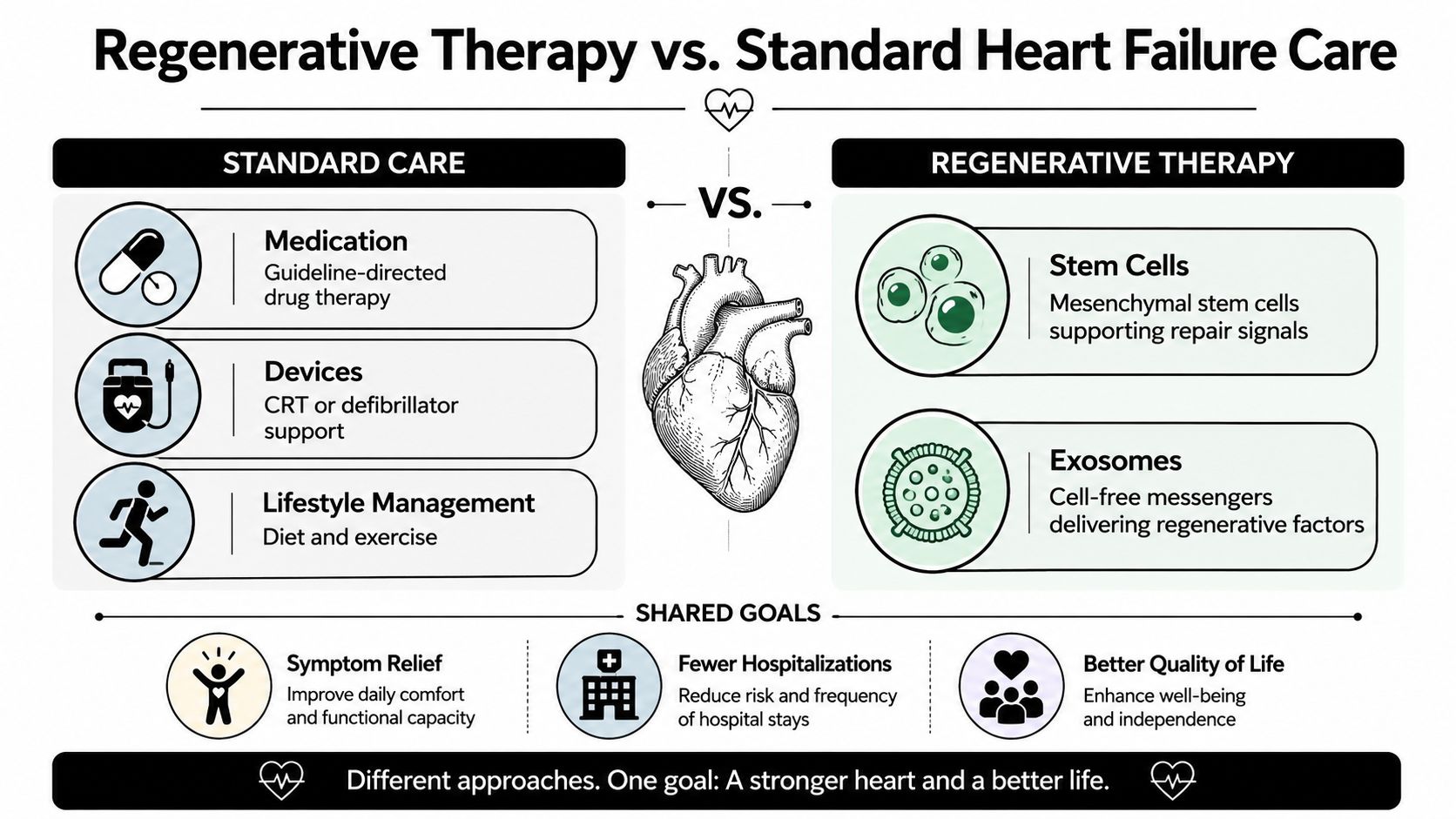
Side by side in plain language
Standard care controls blood pressure, volume status, rhythm problems, and symptoms. It also includes device support when indicated, plus diet and activity guidance. Regenerative therapy aims to influence repair signals, inflammation, and remodeling, but it doesn't replace guideline-directed medicine or solve every cause of low EF.
That distinction matters because people sometimes ask for a single treatment that can do everything. The data don't support that expectation. A patient with ischemic disease still needs coronary and scar assessment, and a patient with nonischemic disease still needs the underlying driver addressed, whether that's blood pressure, myocarditis history, alcohol exposure, or arrhythmia.
What to Expect During Evaluation and Treatment
The first visit should feel structured, not rushed. A good regenerative program starts by reviewing symptoms, prior imaging, current medications, lab results, and the story behind the diagnosis before anyone talks about an infusion. That helps avoid the common mistake of treating a number instead of a person.
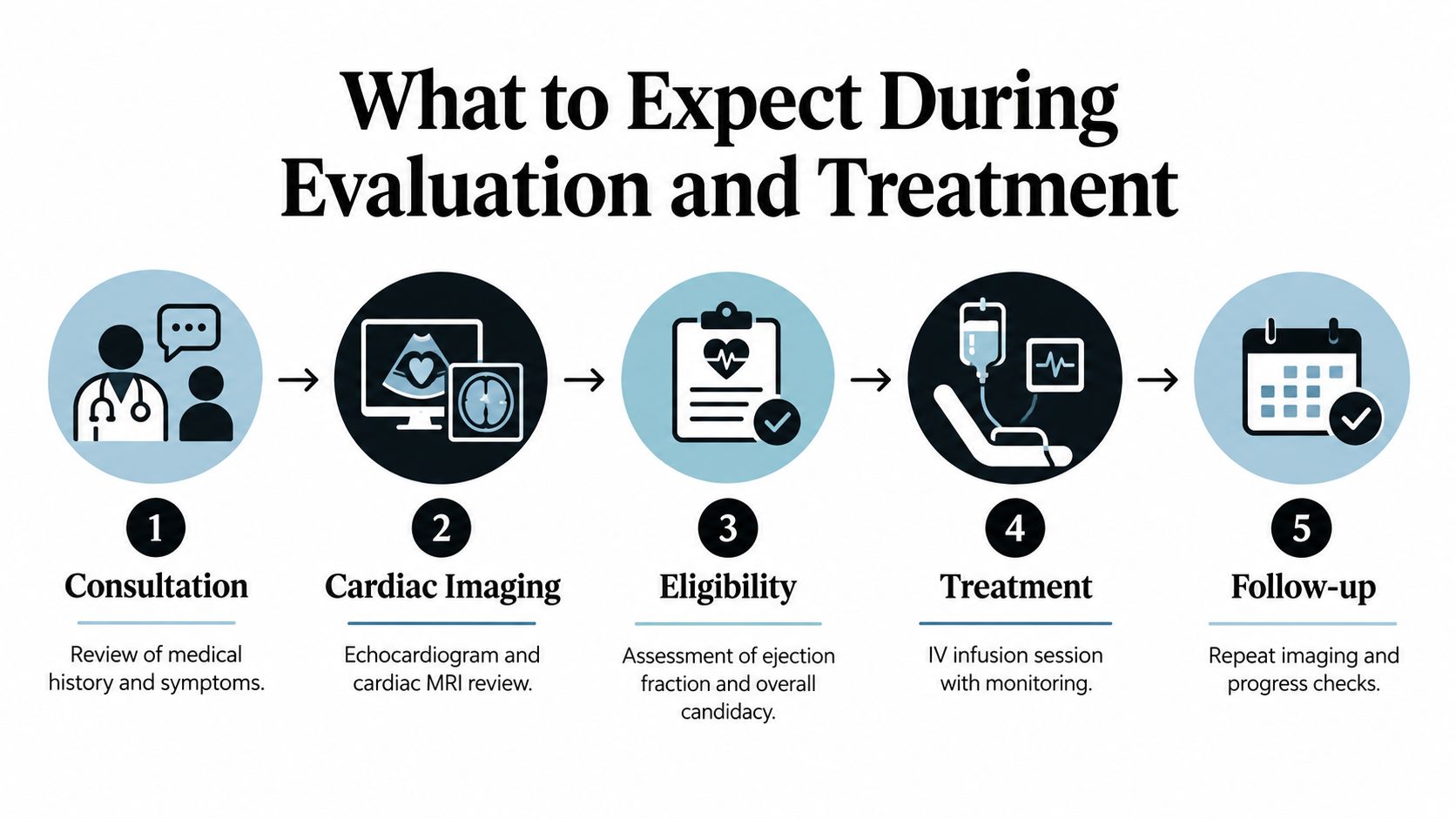
The practical sequence
Consultation, a physician reviews history, symptoms, and prior testing.
Cardiac imaging, echocardiogram and cardiac MRI are reviewed when available.
Eligibility review, EF, rhythm status, fluid balance, and cause of cardiomyopathy are weighed together.
Treatment day, the IV session is monitored carefully.
Follow-up, repeat imaging and symptom tracking show whether the plan is helping.
The main question after treatment is not “Did EF move once?” It's whether the patient breathes easier, tolerates more activity, and shows stable or improved imaging over time. That's why repeated follow-up matters.
Why coordination matters for travelers
International patients often need clear coordination with their local cardiologist before and after treatment. That's especially important when medication changes, anticoagulation questions, or travel-related fluid shifts are part of the picture. A treatment center should be able to explain what will be monitored and what local follow-up should continue.
A practical option for this kind of workup is the IV stem cell therapy resource, which should be read as part of a broader evaluation, not as a stand-alone answer.
Common Questions About Stem Cell and Exosome Therapy for Heart Failure
People usually ask the same few questions once they understand the basics. Can stem cell therapy reverse heart failure? Sometimes it may help function, symptoms, or quality of life, but it hasn't been proven to reverse the disease in every patient. Why do results vary? Because cause, scar burden, stability, timing, and product quality all matter.
The questions that matter most
How is exosome therapy different from cell therapy? Exosomes are cell-free messengers, while MSC therapy uses living donor cells that release signaling factors. Both are being studied, but the human evidence base for exosomes in heart failure is still much smaller.
Why allogeneic cells rather than autologous cells? Allogeneic donor-derived cells are used because the therapeutic model focuses on carefully selected donor products and their signaling effects. That approach is part of modern regenerative cardiology, especially when product consistency is a priority.
Do I need a full evaluation first? Yes. Without reviewing imaging, labs, symptoms, and medications together, no one can responsibly judge whether regenerative therapy belongs in the plan.
Making an Informed Decision About Cardiac Regenerative Therapy
The most common mistake is treating promising research like a finished answer. That's why careful selection, transparent follow-up, and realistic expectations matter more than hype.
What a good decision looks like
A solid plan starts with the cause of heart failure, the current EF range, and the patient's medication and device status. It then adds imaging, lab review, and a discussion of whether the goal is symptom support, function, or a carefully monitored investigational treatment pathway. If a clinic can't explain its product quality controls, monitoring, and follow-up plan, that's a red flag.
For readers who want a more complete cardiac workup, Longevity Medical Institute combines comprehensive heart evaluation, regenerative medicine, and careful oversight in one setting. It's one option among several, and the right choice depends on the person, the diagnosis, and the level of risk that's acceptable.
Bottom line: regenerative cardiology can be hopeful without being reckless.
Dr. Kirk Sanford, DC, Founder & CEO, Longevity Medical Institute, focuses on patient education in regenerative and longevity medicine, translating complex therapies into clear, practical guidance for patients.
Dr. Félix Porras, MD, Medical Director, Longevity Medical Institute, provides clinical oversight and medical review to help ensure accuracy, safety context, and alignment with current standards of care.
Last Reviewed: October 2, 2026
This information is for educational purposes only and is not medical advice. It does not replace an evaluation by a qualified healthcare professional. For personalized guidance, please schedule a consultation.
Longevity Medical Institute offers thorough cardiac evaluation, regenerative medicine options, and structured follow-up for people exploring stem cell and exosome therapy for heart failure and reduced ejection fraction. If you're trying to decide what's realistic, what's investigational, and what safety checks matter most, visit Longevity Medical Institute to book a free online consultation and discuss a plan built around your heart, your goals, and your current treatment.