

Stem Cell Therapy Cost: 2026 Global Guide
Most stem cell therapy in the U.S. lands between $5,000 and $50,000 per course, with the most common band at $10,000 to $30,000. Physician-led allogeneic protocols in Mexico typically run $3,500 to $20,000, while Longevity Medical Institute publishes Combination IV Stem Cell + Exosome Therapy from $1,425 and Combination Stem Cell + Exosome Joint Injections from $2,325, with 16% IVA added on top.
That price gap is exactly why patients get confused. A stem cell quote can look cheap, expensive, or fair until you see what's inside it, and that's where most clinics become vague on purpose. Longevity Medical Institute does the opposite and puts its numbers on the page, which is the right way to compare regenerative medicine.
What You'll Learn About Stem Cell Therapy Cost in 2026
Stem cell therapy cost is a pricing range, not a price tag. The spread is wide because a knee injection, an IV protocol, and a hospital transplant are different services with different staffing, materials, and oversight. Public pricing summaries still put many single-course treatments in a broad band, but the key question is what kind of care sits behind the quote (BioInformant cost analysis).
Mexico shifts the comparison because location changes the bill. A 2025 U.S.-vs.-Mexico pricing update showed lower pricing across orthopedic, systemic, and wellness protocols in Mexico than in the U.S. That does not make every Mexican quote the better buy. It does mean patients should compare the full protocol, not just the country name on the brochure.
Global benchmarks make the same point. Published European pricing runs from roughly €2,000 to €92,000, depending on country, provider, and protocol, which shows how much the treatment design changes the final bill (global cost index). Hospital-based transplant care sits in a different category altogether and can move into six- and seven-figure territory (hospital cost data).
Practical rule: if a clinic will not tell you exactly what the quote includes, you are not comparing prices, you are comparing marketing.
You will see Longevity Medical Institute's published pricing later in this article, along with the line items that should be included in a fair quote. If you want a plain-language guides first, review stem cell education made simple.
Stem Cell Therapy Cost in the United States
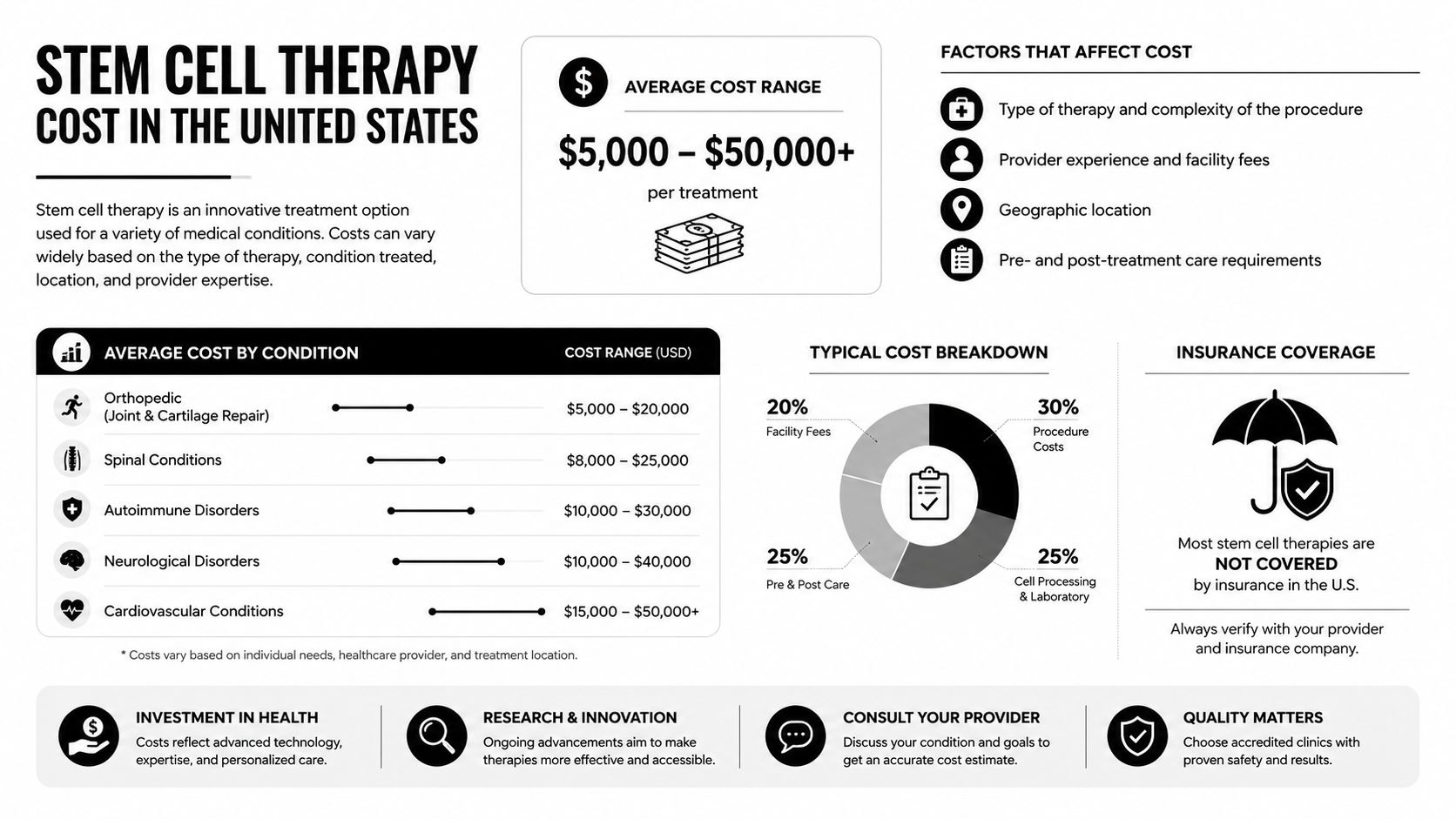
The U.S. market is the easiest place to overspend because the price spread is huge and the labels are loose. A 2026 market summary put most single-course stem cell therapy in the $5,000 to $50,000 range, while another clinic guide said the most common band was $10,000 to $30,000 for one course. That means a patient can hear “stem cell therapy” and still be looking at wildly different products.
What U.S. patients actually spend
A 2026 BioInformant analysis reported that 30% of respondents spent $5,000 or less, 20% spent $5,000 to $10,000, 40% spent $10,000 to $25,000, and 10% spent over $25,000. That distribution matters because it shows how many patients land in the middle, not the fantasy land of “cheap” or “luxury” pricing.
Outpatient joint care can be lower than full regenerative programs. One independent patient-cost study found mean stem cell injection costs for knee osteoarthritis of $2,728 to $3,100, while another pricing guide places a single stem cell injection at $3,000 to $10,000 and Wharton's Jelly injections at $4,000 to $10,000 per treatment area (knee injection cost study). That's a very different purchase from a multi-session systemic protocol.
Hospital-based stem cell care is another world
Hospital transplant pricing is not comparable to clinic injections. Autologous hematopoietic stem-cell transplantation has been reported at a median total healthcare cost of $140,792 to $253,467, while allogeneic transplant reached $289,283 in one cohort and can exceed $1.2 million in more complex settings (hospital transplant cost data). A separate analysis reported estimated billed charges of $378,000 for autologous transplantation versus $930,000 for allogeneic transplantation over the peri-transplant period (transplant charge analysis).
The takeaway is blunt. In the U.S., “stem cell therapy” can mean a modest outpatient injection, a bundled regenerative course, or a complex transplant with inpatient monitoring. If you don't separate those buckets first, the quote is almost useless.
Stem Cell Therapy Cost in Mexico and Other Major Destinations
Mexico keeps showing up as the lower-cost option because many of the same treatment categories are priced below U.S. levels. A 2025 update places orthopedic applications at $7,000 to $20,000 per joint in the U.S. versus $3,500 to $8,000 per joint in Mexico, systemic treatments at $20,000 to $50,000+ in the U.S. versus $8,000 to $20,000 in Mexico, and wellness or anti-aging protocols at $8,000 to $25,000 in the U.S. versus $4,000 to $10,000 in Mexico (U.S. vs. Mexico 2025 update). That is the main reason patients keep putting the two countries side by side.
Approximate Stem Cell Therapy Cost by Country
| Country | Orthopedic (per joint) | Systemic IV / Wellness | Notes |
|---|---|---|---|
| United States | $7,000 to $20,000 | $8,000 to $50,000+ | Broad market spread, from outpatient injections to higher-acuity protocols |
| Mexico | $3,500 to $8,000 | $4,000 to $20,000 | Common lower-cost destination for medical tourists |
| Canada | Varies by clinic | Varies by clinic | Often compared by patients seeking alternatives abroad |
| UK | Varies by provider | Varies by provider | Pricing depends heavily on protocol and clinic model |
| Europe | Roughly €2,000 to €92,000 | Roughly €2,000 to €92,000 | Wide spread across conditions, countries, and providers |
| Costa Rica | Varies by clinic | Varies by clinic | Often discussed as a destination market with variable bundles |
Europe is even less uniform. Published stem-cell and regenerative-therapy benchmarks range from roughly €2,000 to €92,000, with one indexed partner-clinic benchmark in Bulgaria at €3,000 to €8,000 (global cost index). That spread is the point, the country label does not answer the pricing question by itself.
Bottom line: Mexico is often cheaper than the U.S., but cheaper is not the same as better value. Compare the protocol, not just the passport stamp.
Patients who want a clinic-focused view of Mexico pricing can review stem cell therapy in Mexico. The comparison is the treatment design, the diagnostics, and the level of physician oversight, not the brochure language.
What Actually Drives the Price of Stem Cell Therapy
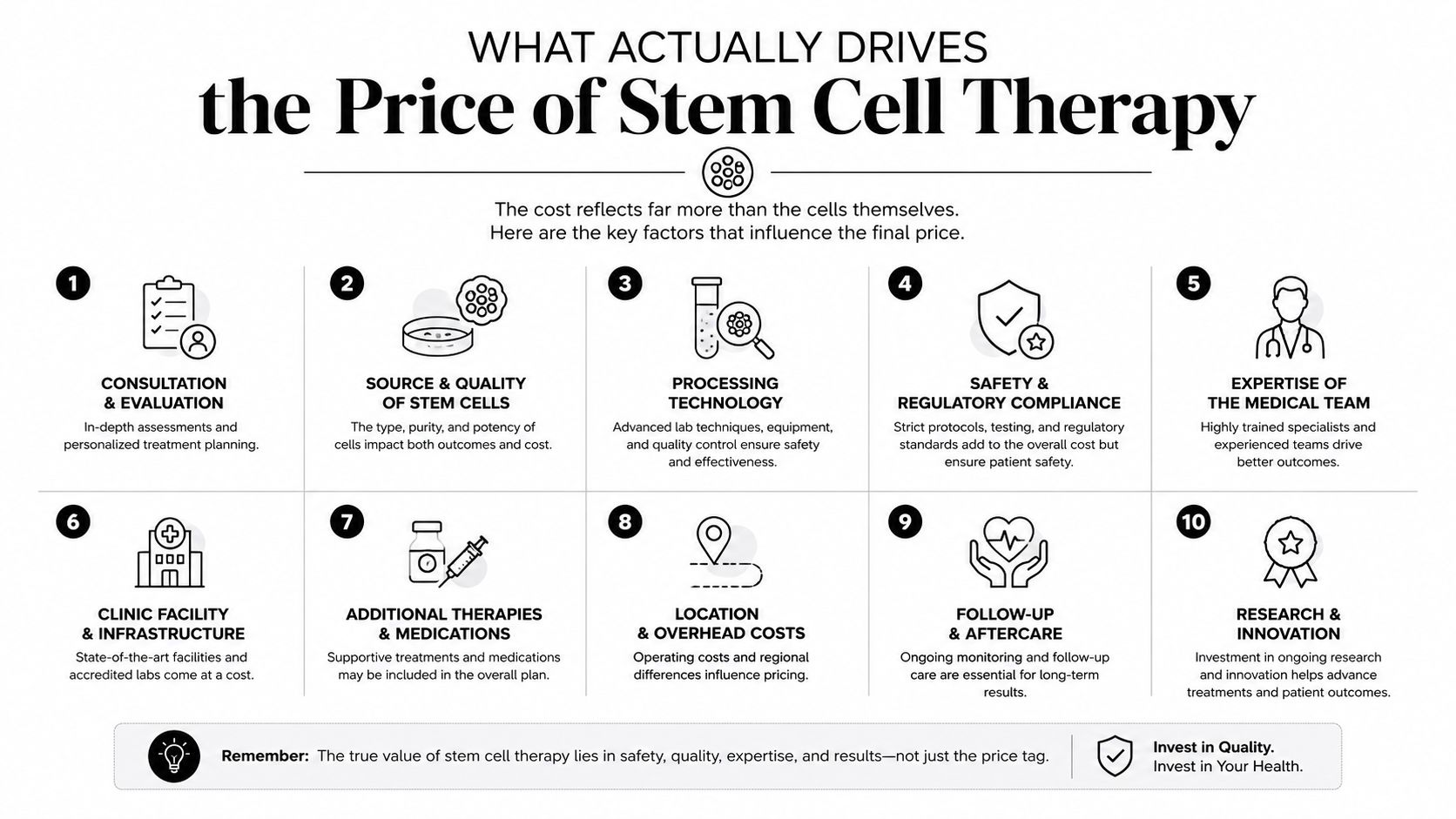
Stem cell therapy pricing changes because the product changes. A clinic offering a simple injection, a physician-led IV protocol, or a more complex cellular program is not selling the same service, even if the word “stem cell” appears in every quote. The fastest way to avoid getting burned is to ask what you are buying before you ask what it costs.
Invoice drivers
The biggest variables are cell source, cell dose, delivery route, and how many areas are treated. Allogeneic placental, Wharton's jelly, adipose, endometrial, and dental pulp MSCs are not interchangeable on cost or processing needs, and they sit in different pricing bands than autologous options because the sourcing and lab work differ. Exosomes add another layer of complexity, especially when they are bundled into the protocol.
The price also moves with the care model around the cells. Physician involvement, image guidance, diagnostics, lab standards, facility quality, regulatory compliance, and supporting therapies all push the final number up or down. If a clinic uses ultrasound guidance, in-house imaging review, a clinical lab, or adjunctive therapies such as hyperbaric oxygen, EBOO, peptides, or IV infusions, you are paying for a broader treatment structure, not just a syringe.
The questions smart patients ask
Ask this first: Is the quote for one joint, one region, one session, or a full program with diagnostics and follow-up?
Then ask about the parts that often get hidden in the fine print:
Cell source: Are the cells allogeneic, and from which tissue source?
Route of delivery: Is this IV, joint injection, or a different delivery method?
Treatment scope: How many joints, regions, or sessions are included?
Diagnostics: Are imaging and labs bundled, or billed separately?
Oversight: Which physician is responsible for the plan and the procedure?
Follow-up: What happens after treatment, and what is included in monitoring?
The structure matters because the same general service category can cost very different amounts depending on processing, oversight, and bundled support. For a closer look at how cells are prepared and why that affects pricing, see stem cell quality and how cells are made.
Why Price Alone Should Not Decide Your Clinic
A price tag can hide more than it reveals. A $3,000 quote may leave out diagnostics, physician oversight, or follow-up. A $20,000+ quote may bundle those same items, or it may package the service more aggressively. Patients who compare only the headline number often miss the gap between a stripped-down protocol and a properly supported one.
Compare value, not just price
Start with the published evidence on value. A cost-effectiveness study of allogeneic umbilical cord blood mesenchymal stem cell therapy for knee osteoarthritis found an incremental cost-effectiveness ratio of US$268 per QALY gained from the societal perspective and US$16,812 per QALY gained from the healthcare-payer perspective (cost-effectiveness study). That does not make every protocol worth every price, but it does show why a higher quote is not automatically a worse one.
Use that lens before you compare clinics. The question is whether the price reflects the parts that shape care quality, cell source, physician involvement, image guidance, lab standards, and follow-up, or whether you are being asked to pay more without a clear reason.
Use this clinic filter
A serious clinic should answer these questions without deflecting:
What exact cells are being used, and how are they sourced?
Is the protocol allogeneic, and who processes it?
Are imaging and lab work included in the quote?
Who performs the procedure, and who follows up afterward?
What regulations and quality standards govern the clinic or lab?
If results are limited, what is the next step?
A fair price is one you can explain line by line. If a clinic cannot do that, the quote is incomplete.
Patients comparing options can use questions to ask a stem cell clinic as a practical checklist before they book anything.
Longevity Medical Institute's Published Pricing
Most clinics make patients call, submit a form, or sit through a sales conversation before they'll share numbers. Longevity Medical Institute publishes its pricing openly, which is the right standard in a premium medical setting. That makes it easier to compare real services instead of guessing what a package might include.
Longevity Medical Institute Published Pricing
| Service | Price (USD) | Notes |
|---|---|---|
| Combination IV Stem Cell + Exosome Therapy | $1,425 to $3,725 | Published price range, 16% IVA applies |
| Combination Stem Cell + Exosome Joint Injections | $2,325 to $4,625 per region | Published per-region pricing, 16% IVA applies |
| TriFusion Ozone (EBOO) | $1,750 | Published service price, 16% IVA applies |
| Comprehensive 140+ Biomarker Panel | $1,200 | Published service price, 16% IVA applies |
| Full-Body MRI, Non-Contrast | $2,250 | Published imaging price, 16% IVA applies |
| Full-Body MRI, With Contrast | $2,925 | Published imaging price, 16% IVA applies |
| Advanced Heart Evaluation | $1,550 | Published cardiac assessment price, 16% IVA applies |
| Calcium Score CT | $1,550 | Published imaging price, 16% IVA applies |
| Coronary Angiogram CT | $1,950 | Published imaging price, 16% IVA applies |
Longevity Medical Institute states that its stem cell approach uses allogeneic cells and produces placental, Wharton's jelly, adipose, endometrial, and dental pulp cell types in its biotechnology lab. The value of that model is transparency, because patients can see the building blocks before they commit.
The pricing structure also makes bundling easy to understand. A patient can pair regenerative treatment with diagnostics, imaging, and follow-up services instead of piecing together care across multiple vendors. That's a better way to plan, budget, and measure value.
How Longevity Medical Institute's Integrated Model Adds Value
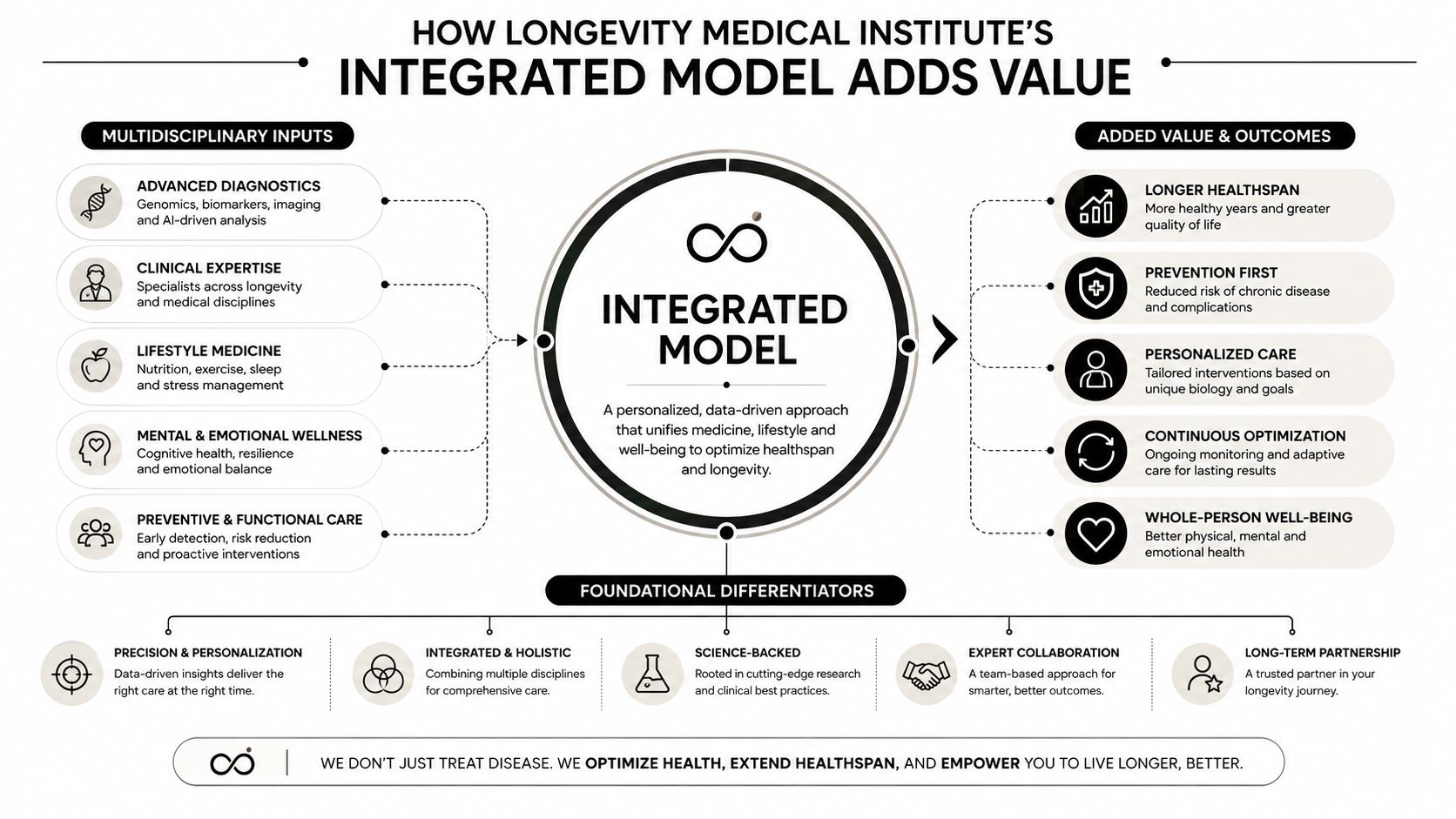
A fair price means more when the clinic owns more of the care process. When diagnostics, imaging, laboratory work, and physician oversight happen under one roof, you're not paying a chain of outsourced markups stitched together by admin staff. You're paying for coordination, and coordination matters in regenerative medicine.
What the integrated model changes
At Longevity Medical Institute, the practical difference is visible in the workflow. A COFEPRIS-licensed, ISO-certified biotechnology lab supports allogeneic cell production, while the in-house clinical lab and imaging tools help the team evaluate the patient before and after treatment. The clinic's broader menu includes the Longevity Recharge Station, hyperbaric oxygen, peptide protocols, AI-enhanced MRI, and advanced heart evaluation, so the care plan can be built around the patient instead of forcing the patient into a single therapy.
That matters because many patients don't need one isolated intervention, they need a structured plan. A regenerative protocol that is paired with biomarkers, imaging, and cardiovascular assessment gives the physician a clearer picture of risk, response, and next steps. The result is a more complete program, not just a product sale.
For readers comparing clinic models, the distinction is straightforward. A standalone injection may be cheaper up front, but a bundled diagnostic and regenerative program often tells you more about what you're treating and how to follow it. If you want to understand the clinic philosophy behind that setup, review what makes Longevity Medical Institute different from traditional longevity clinics.
Financing, Insurance, and How to Take the Next Step
Most regenerative stem cell procedures stay out of pocket worldwide, and insurance usually only applies in established hospital transplant settings. Patients should plan around that reality whether they are in the U.S., Mexico, or another country. If you need financing, compare clinic payment plans with third-party medical lending before you sign anything. Read the interest rate, origination fee, late-fee policy, and whether the balance changes if you pay early. A low monthly payment can still be expensive if the financing term is long.
Ask for the full billing terms in writing before your consultation ends. A fair quote should show what is included, what is optional, and what will trigger a higher bill later. If a clinic will not give you that level of detail, treat that as a warning sign.
What to verify before you book
Request an itemized quote: Make sure the price separates the procedure, diagnostics, imaging, medication, and any follow-up services.
Compare payment-plan terms: Ask whether the clinic offers in-house financing, what the monthly amount is, and whether there are penalties for missed payments or early payoff.
Ask about third-party lending: If the clinic works with a lender, request the annual rate, fees, approval requirements, and the total amount you would repay.
Clarify billing for add-ons: Confirm how the clinic prices extra imaging, lab work, or repeat visits if your case needs them.
Set the consultation agenda: Use the first call to ask how quickly the clinic can provide a written estimate, how long a quote stays valid, and who answers pricing questions after the visit.
Keep the medical questions short and practical. Ask who reviews your case, who performs the procedure, and who handles follow-up, then move the conversation back to cost. You do not need a long checklist to separate good care from vague pricing. You need a clear estimate, a financing offer you can compare line by line, and a clinic that will put its terms in writing.
If you are ready to compare stem cell therapy cost across Mexico, the U.S., and other destinations, use published pricing as your starting point and ask each clinic to explain exactly what the number includes. Longevity Medical Institute does that directly, with transparent rates, physician-led regenerative care, advanced diagnostics, and integrated follow-up. Visit Longevity Medical Institute to review services, compare pricing, and schedule a consultation built around your goals instead of a sales funnel.
Author
Dr. Kirk Sanford, DC, Founder & CEO, Longevity Medical Institute
Medical Review
Dr. Félix Porras, MD, Medical Director, Longevity Medical Institute
Last Reviewed: August 14, 2026
Short Disclaimer
This information is for educational purposes only and is not medical advice. It does not replace an evaluation by a qualified healthcare professional. For personalized guidance, please schedule a consultation.