

What Makes LMI Different from Traditional Longevity Clinics
You're sitting with a familiar question. Maybe the knee pain hasn't resolved the way you hoped, maybe inflammation has become part of daily life, or maybe you're trying to protect your health before symptoms force the issue. On paper, a traditional longevity clinic and an integrated institute can look similar, both talk about prevention, advanced testing, and regenerative support, but the patient experience can be very different once the visit begins.
The difference is architectural. One model usually adds services onto a conventional consultation flow, while the other is built so diagnostics, biologics, specialist review, and follow-up all live inside the same care system. That matters because the clinic's structure shapes what gets measured, who sees the data, how quickly decisions are made, and whether care stays coordinated after the first visit.
| Dimension | Traditional Longevity Clinic | LMI Integrated Model |
|---|---|---|
| Care structure | Often consult-led, with tests and referrals handled across separate sites | Built as a structured diagnostic day with assessment, interpretation, and follow-up in one flow |
| Diagnostics | Usually narrower preventive screening and selected advanced tests | AI-enhanced full-body MRI, in-house clinical lab, advanced heart evaluation, and broader biomarker work |
| Biologics and therapies | Regenerative services may be outsourced or limited to a small menu | On-site biotechnology lab, multimodal protocols, and vertically integrated care |
| Team model | Often one clinician coordinating outside vendors | Shared data across more than 17 physicians, scientists, and specialists |
| Follow-up | Often depends on separate appointments and referrals | Built-in retesting and ongoing structured follow-up |
The Moment Most Patients Start Comparing Clinic Models
A patient rarely starts by asking about architecture. The first question is usually simpler. Can this help my pain, my energy, my recovery, or my long-term risk?
That's where the comparison gets interesting. Two clinics can both advertise preventive medicine, biomarkers, and regenerative therapies, yet one still behaves like a standard medical practice with extras, while the other behaves like a fully integrated clinical system. The practical difference shows up in the details most marketing pages gloss over, who interprets the imaging, where the biologics are made, and whether the same team follows the case from intake through retesting.
Why the structure matters before the treatment menu does
Traditional medicine often waits for symptoms to appear, then reacts. A peer-reviewed framework for healthy longevity clinics describes a different logic, “prevention of prevention”, using aging clocks and biomarkers from healthy people to detect risk earlier than standard care, and tracking people over years or even decades rather than one visit at a time (peer-reviewed healthy longevity clinic framework). That is a different operating philosophy.
For patients, this means the important question isn't just, “What do they offer?” It's, “How is the clinic built to use that information?” A clinic that only sells a scan can create more data without creating better care. A clinic that has the imaging, the lab, the physicians, and the follow-up under one roof can turn the same data into a tighter plan.
A useful way to think about it is this. One model is a set of services. The other is a care engine.
Practical rule: if a clinic can't clearly explain who reviews the data, who owns the follow-up, and what happens after the first assessment, the treatment menu matters less than it seems.
That's why comparisons between LMI and a traditional longevity practice should begin with operations, not promotion. The patient's experience changes most when the clinic's design changes.
Defining the Two Clinic Models Side by Side
A patient can have the same concern in two very different settings, and the clinic structure changes what happens next. A traditional longevity clinic usually centers on preventive screening, selected diagnostics, and a menu of therapies that may or may not be delivered on-site. In practice, imaging may go to a third party, biologics may be sourced elsewhere, and specialty input may arrive through referrals rather than through a shared care team. The clinic can still be useful, but it often acts as a coordinator of services instead of a fully integrated medical environment.
Longevity Medical Institute is organized differently. It presents itself as a physician-led institute where advanced diagnostics, an in-house biotechnology lab, and a multidisciplinary team operate within one system. That lets the clinic move from assessment to interpretation to intervention without splitting the patient's story across separate vendors. The practical difference is not just convenience. It affects how quickly findings are reviewed, how tightly protocols are matched to the case, and how much continuity the patient gets from one visit to the next.
What vertical integration looks like in practice
The clearest example is the biologics model. LMI says it uses only allogeneic stem cells, not autologous cells, and produces five different types in its biotechnology lab, placental, Wharton's jelly, adipose, endometrial, and dental pulp. That matters because the biologic is not treated as a commodity. It is part of a planned protocol built around the clinical goal, with the lab and the treating physicians working from the same case context.
The same logic applies to diagnostics. LMI's model includes AI-enhanced full-body MRI, an in-house clinical lab measuring 140 biomarkers, and concierge-style accommodations that support longer, more involved care pathways. For readers looking at how whole-body imaging fits into a broader clinical workflow, this overview of whole-body MRI in integrated personalized medical care shows why the scan becomes more useful when it is interpreted alongside other tests rather than in isolation. A clinic can offer advanced tools without being integrated. The difference here is that the tools, the lab, and the clinicians sit inside one operational framework.
For patients comparing clinic models, accreditation and lab governance matter just as much as the therapy name. If you are learning how to judge those details, the guide on navigating laboratory accreditation is a useful way to frame the questions before you book anything.
LMI also describes a COFEPRIS-licensed and ISO-certified biotechnology environment, plus a coordinated specialist team. That combination is closer to a clinical system than a conventional membership clinic, and it changes what can be done with the data once it is collected. Shared records, shared review, and shared protocols reduce the chance that one part of the work gets lost between departments or outside vendors.
The main point is simple. Traditional longevity clinics may offer pieces of the puzzle. An integrated institute is built to keep those pieces in the same room.
Comparing Clinical Offerings, Diagnostics, and Safety Controls
The most honest comparison starts with what each model can do. A traditional longevity clinic may provide preventive labs, selective imaging, and some regenerative therapies, but deeper work is often split across outside vendors. LMI's model is broader and more controlled because therapies, diagnostics, and specialist review sit inside one system.
| Dimension | Traditional Longevity Clinic | LMI Integrated Model |
|---|---|---|
| Therapeutic offerings | Often limited or outsourced regenerative options | Allogeneic stem cells, exosomes, NK cell protocols, peptides, hyperbaric oxygen, Trifusion EBOO with UV and PBM, targeted joint injections |
| Diagnostic depth | Commonly narrow screening, sometimes standard chemistries | AI-enhanced full-body MRI, advanced heart evaluation, ultrasound-guided imaging, in-house 140-biomarker lab |
| Safety and quality controls | Varies widely by clinic and vendor | COFEPRIS-licensed biotechnology lab, ISO certification, protocol updates aligned with peer-reviewed guidance |
| Team structure | Single clinician or fragmented referrals | More than 17 physicians, scientists, and specialists using shared data |
Therapeutic breadth with a tighter clinical frame
The point of a broader menu isn't to collect treatments like items on a shelf. It's to let the team match the biologic or modality to the clinical objective. That's why Longevity Medical Institute's mix of stem cells, exosomes, NK cell protocols, peptides, hyperbaric oxygen, and targeted joint work matters only if the case calls for them. Without coordinated review, a larger menu can become noise.
Diagnostics that change the decision, not just the report
Traditional preventive care often screens for a smaller set of markers. A 2026 comparison of longevity-style diagnostics reported that a standard government-sponsored screening may include about 10 biomarkers, while a more advanced longevity program measured 87+ biomarkers and added ultrasound, lung-function testing, VO₂max, and other performance measures (comparison of longevity clinics and programs). That doesn't automatically make one model better, but it does show how much more context some programs gather before acting.
LMI's own published materials point in the same direction, advanced imaging, biomarker profiling, genetic work, and integrated interpretation. Its broader safety framing is also worth reviewing in the article on trust begins with safety and transparency, because high-end diagnostics only help when patients can understand how they're governed.
Shared oversight lowers blind spots
A traditional model can still work well for straightforward screening. The problem is fragmentation. Recent longevity-medicine literature warns that the field is still vulnerable to inconsistent translation from diagnostics to action, weak oversight, and gaps between finding a risk and managing it (Aging-US review). That's where vertical integration becomes more than a convenience feature.
If you want a practical filter, ask three questions. Where are the biologics made, who reads the imaging, and who owns the follow-up? If the answers point to different companies, different buildings, or different timelines, you're looking at a conventional model. If they point to one coordinated institute, you're closer to LMI's architecture.
What Happens Inside an Integrated Diagnostic Day
The patient experience is longer and more layered than a standard clinic visit. LMI's in-person tiers run roughly 2.5 to 7 hours, and the program escalates from Core to Fortis to Infinitum, with deeper tiers adding full-body MRI, CT calcium scoring, advanced heart evaluation, genetic testing, biological-age work, and year-long follow-up inside one program flow (comprehensive heart evaluation).
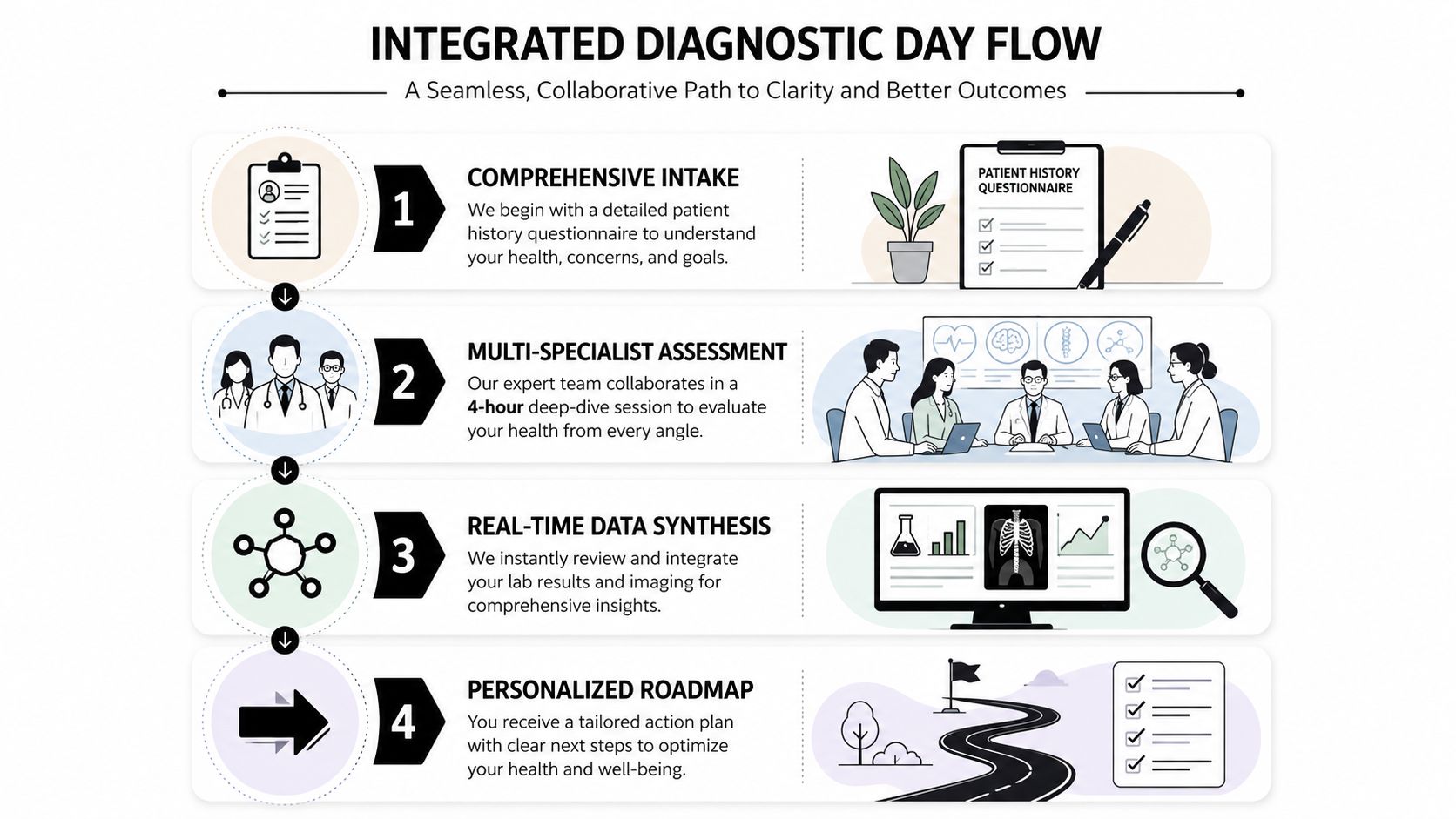
From intake to real-time synthesis
A conventional preventive visit usually starts with a brief history, a set of standard labs, and maybe a referral if something looks abnormal. In a more integrated setting, the day is built so data moves quickly. Intake, imaging, labs, and physician review happen in close sequence, which makes it easier to connect one result to another before the patient leaves.
That matters because pattern recognition often depends on context, not isolated numbers. An MRI finding means more when the cardiometabolic markers, body composition, and history are all in front of the same team.
For patients who want a closer look at the imaging step itself, the clinic's resource on what to expect during a full-body MRI helps set expectations before the appointment.
Why the pipeline matters more than the count of tests
The difference isn't that one clinic orders more tests. It's that the integrated model packages assessment, interpretation, and longitudinal retesting together. That reduces the common problem where a patient gets an impressive report, then has to chase separate appointments to understand what it means.
A standard clinic may be efficient for a routine exam. An integrated diagnostic day is built for a more complex question, whether that's risk mapping, performance planning, or deciding whether a regenerative protocol makes sense at all.
The strongest advantage of an integrated day is not speed. It's coherence.
That coherence is what turns raw data into a clinical plan. Without it, more testing can still leave patients with uncertainty. With it, the clinic can begin acting on the same day the information is gathered.
Why Multidisciplinary Teams and Shared Data Change Decisions
The most underappreciated difference isn't the technology. It's the team structure around the technology. A clinic can own an MRI scanner, a lab, and a biologics facility, but if those assets sit in separate silos, the patient still experiences fragmented care. LMI says its care is coordinated by more than 17 physicians, scientists, and specialists, and that shared-data model changes how decisions get made (LMI FAQ).
One finding, multiple interpretations, one plan
A conventional referral-based model often turns one abnormal finding into three appointments. A multidisciplinary institute can review that same finding in one setting. If a full-body MRI highlights a cardiovascular issue, cardiology, regenerative medicine, and physical medicine can weigh in without forcing the patient to rebuild the case from scratch.
That matters because longevity medicine still struggles with translation. A recent review in Aging-US flagged fragmentation and inconsistent actionability as open problems in the field, and the NIH's healthy-longevity framework emphasizes that best practices around biomarker interpretation and coordination are still being defined (Aging-US review, NIH healthy longevity framework). Shared data doesn't solve every problem, but it reduces the number of handoffs where things can get lost.
Data becomes more useful when the same team can act on it
Shared protocols matter. A biomarker shift can be cross-checked against a peptide plan, a hyperbaric oxygen schedule, or a joint-injection strategy without waiting for a separate vendor to return a report. The clinician is not just reading data, they're deciding what the data means inside the same institute.
Practical insight: the value of advanced diagnostics drops fast when the clinician who ordered them can't act on them quickly.
That's why a large therapy menu alone doesn't create a better clinic. The benefit comes when imaging, lab trends, and specialist judgment are merged before the patient leaves the building. In that sense, the team is part of the treatment.
For patients who want to verify the human side of the model, the institute's team page is worth reviewing before comparing any regenerative program. Credentials matter, but coordination matters just as much.
Where the Integrated Model Performs Best
The integrated model tends to make the most sense when the clinical question is layered, not simple. One common use case is orthopedics or sports recovery. Another is chronic inflammation and inflamaging. A third is a longevity-focused adult who wants a deeper risk map before symptoms start to shape the plan.
Orthopedics and sports recovery
If the issue is a shoulder, knee, hip, or spine problem, the best care usually blends imaging, physical medicine, and targeted procedures. LMI's model can combine ultrasound-guided work, targeted joint injections, peptides, hyperbaric oxygen, and regenerative planning under one team. That reduces the classic problem where one clinician sees the injury, another sees the recovery bottleneck, and nobody sees the whole sequence.
Chronic inflammation and inflamaging
Inflammation is often managed best when the team watches trends rather than isolated lab values. LMI's allogeneic stem cell options, exosomes, NK cell protocols, nutraceutical and IV support, and the Longevity Recharge Station and Hyperbaric Oxygen Chambers can be coordinated against biomarker changes instead of used as standalone services. That doesn't guarantee a better result, but it does make it easier to adjust when the data shifts.
Longevity-focused adults
For patients whose goal is prevention, the value is usually in the depth of the baseline. Full-body MRI, advanced heart evaluation, biological-age work, and genetic testing can create a richer starting point than a routine annual physical. If you're trying to understand what the clinic can do in this setting, Longevity Medical Institute is one option to compare alongside other preventive programs, especially if you want the diagnostics and the protocol in one place.
The key is fit. A simpler preventive visit may be enough for someone who wants a snapshot. An integrated model makes more sense when the question is more nuanced and the plan needs to evolve.
Cost, Travel, Risk, and What to Verify Before Committing
A serious clinic comparison has to include the boring parts, because those are often the parts that determine whether the plan works in real life. Regenerative therapy is an investment. If you're traveling from the U.S. or Canada, you also have to factor in flights and concierge accommodations. And if a clinic uses allogeneic biologics, donor screening and regulatory oversight are not optional details.
Questions that belong in every intake call
Patients comparing clinics in Mexico should verify licensing, lab certification, physician oversight, and follow-up structure before agreeing to anything. If peptide therapy is part of the plan, a practical starting point is the guide to peptide sourcing 2026, because sourcing and product quality are not details you want to assume away.
The clinic should also be able to explain exactly how its protocols are reviewed and updated. Published safety context matters more than polished language. If the team can't walk you through the process in plain terms, keep looking.
What to check before you book
Licensing and oversight: Ask which authority governs the clinic, the lab, and the procedures.
Lab certification: Confirm whether the biotechnology lab is ISO certified and what that certification covers.
Specialist coverage: Request the actual team composition, not just a marketing title.
Follow-up structure: Make sure you know how retesting, review, and protocol changes happen after the first visit.
Transparency on biologics: Ask whether the clinic uses autologous or allogeneic products, and how those products are manufactured.
If you're comparing clinics that offer regenerative medicine in Mexico, the article on is stem cell therapy in Mexico safe is a good companion read before you commit. It frames the right questions without pretending every clinic is the same.
The right model isn't automatically the most elaborate one. It's the one that can prove its controls, explain its limits, and show you what happens if your case changes after treatment starts.
Choosing the Right Model and Next Steps
A traditional preventive clinic can be a smart choice for adults who want a basic biomarker snapshot, a routine screen, or low-intensity risk monitoring. An integrated institute fits better when the goal is more defined, orthopedic recovery, chronic inflammation, performance support, or a longevity plan that needs advanced diagnostics and coordinated specialist care.
That distinction is the heart of What Makes Longevity Medical Institute Different From Traditional Longevity Clinics. It isn't just the therapy menu. It's the fact that the diagnostics, biologics, and specialist review are built to work together instead of being stitched together after the fact.
The clinic model matters most when your care depends on one team seeing the whole picture.
If you're evaluating a program, ask for the tier details, the lab certifications, the biologics manufacturing process, and the composition of the medical team. Ask how follow-up is handled, and how long the diagnostic day takes. If travel is part of the plan, confirm accommodations and logistics before you choose the date.
For many patients, the right next step is a consultation that turns a broad interest into a real care map. For others, the next step is comparing one integrated institute against a more conventional preventive clinic with clearer questions in hand.
If you're comparing regenerative and longevity options, Longevity Medical Institute can help you evaluate advanced diagnostics, allogeneic stem cell protocols, and coordinated specialist care in one setting. Visit Longevity Medical Institute to review the programs, ask about the diagnostic day, and decide whether an integrated model fits your goals.
Author
Dr. Kirk Sanford, DC, Founder & CEO, Longevity Medical Institute. Dr. Sanford focuses on patient education in regenerative and longevity medicine, translating complex therapies into clear, practical guidance for patients.
Medical Review
Dr. Félix Porras, MD, Medical Director, Longevity Medical Institute. Dr. Porras provides clinical oversight and medical review to help ensure accuracy, safety context, and alignment with current standards of care.
Last Reviewed: August 10, 2026
Short Disclaimer
This information is for educational purposes only and is not medical advice. It does not replace an evaluation by a qualified healthcare professional. For personalized guidance, please schedule a consultation.