

Stem Cell Therapy for ALS (Amyotrophic Lateral Sclerosis)
An ALS diagnosis changes the room fast. Families often leave the neurology visit with more questions than answers, a shorter list of approved options than they expected, and a painful instinct to look for anything that might slow the next loss of function. That's where stem cell therapy for ALS enters the conversation, often with hope, confusion, and a lot of marketing noise mixed together.
The hardest part is that the science is real, but so are the limits. Stem-cell approaches in ALS have shown a credible safety profile and occasional short-term functional slowing, yet there's still no FDA-approved stem cell treatment for ALS and no proven disease reversal Harvard's ALS stem cell FAQ. If you're trying to decide whether a clinic deserves your trust, the right question isn't “Can stem cells cure ALS?” It's “What do the trials show, what can treatment reasonably do, and what should a serious clinic be able to explain before anyone starts?”
Why ALS Patients Are Asking About Stem Cells
ALS is one of those diagnoses that pushes people to think differently. The disease affects the motor system, and when speech, swallowing, walking, or breathing start to change, patients and families quickly learn how limited the usual toolbox can feel. Even the standard disease-modifying drugs are modest in what they can offer, which is why many people begin searching for therapies that sound more regenerative than suppressive.
Stem-cell therapy gets attention because it speaks to a deep clinical wish, not just to slow symptoms, but to protect vulnerable tissue and preserve what still works. That hope is understandable. It's also exactly why this topic needs structure, because desperation can make weak evidence look stronger than it is.
What this guide will and won't promise
This article won't pretend stem cells are a cure. It will also not dismiss the field, because that would ignore real trial data, including safety findings and signs of temporary functional benefit in some studies. The honest middle ground matters most here, since ALS patients deserve precision, not hype.
Practical rule: if a clinic leads with certainty, skip the sales pitch and ask for trial data, delivery route, and follow-up plan.
The cleanest way to think about the field is this. Stem-cell approaches for ALS have repeatedly shown that invasive cell delivery can be done with acceptable short-term safety, but durable efficacy has not been established. That's the tension this topic lives in, and it's why experienced teams focus on careful selection, transparent expectations, and evidence-aware decision-making rather than urgency alone. For a personal perspective on living with the diagnosis, many readers find it helpful to start with this ALS patient story.
The Biology Behind Stem Cell Therapy for ALS
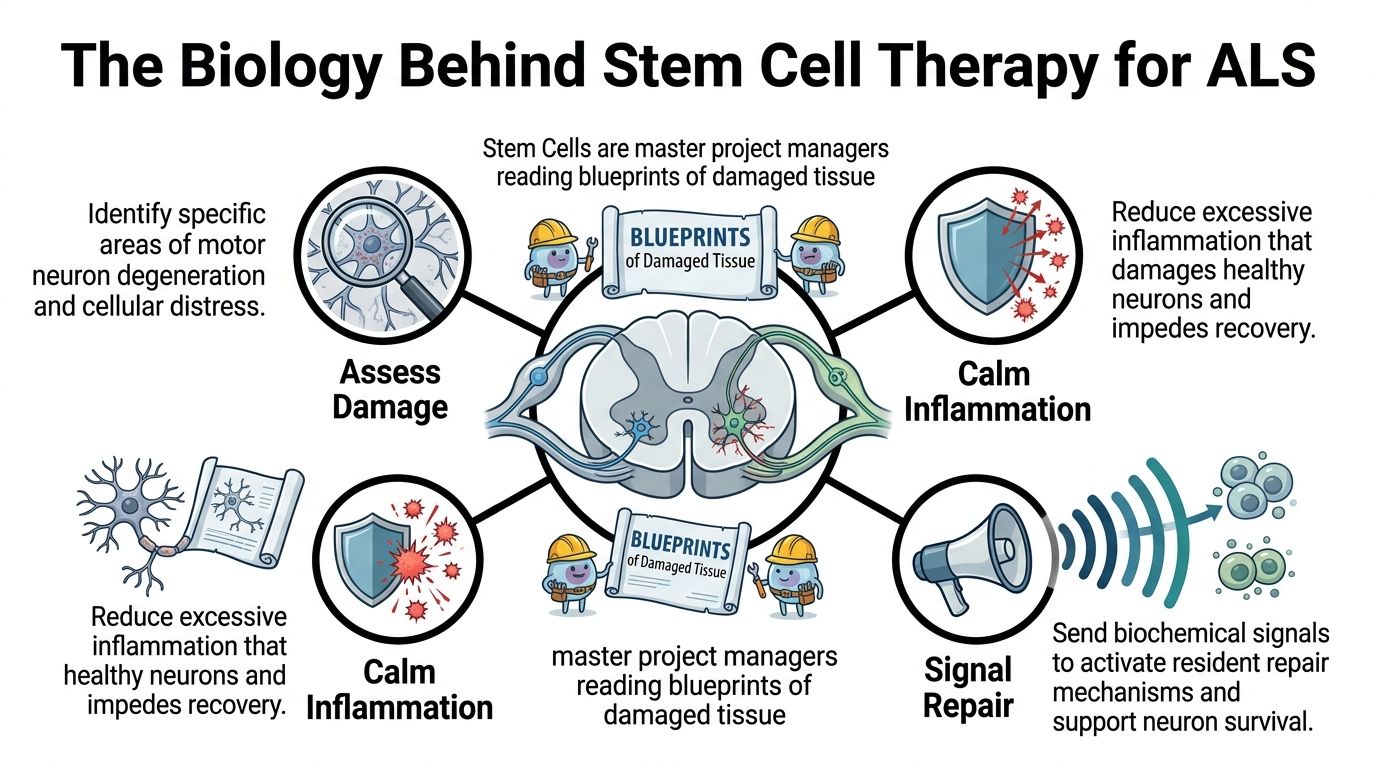
Think of stem cells less like replacement parts and more like master project managers. They don't need to rebuild an entire damaged house brick by brick to matter. In ALS research, their main value is in reading local injury signals, calming inflammation, and telling the surrounding tissue how to behave more helpfully.
That matters because ALS isn't just a problem of missing motor neurons. It's also a problem of the environment around those neurons, including neuroinflammation, reduced trophic support, and impaired repair signaling. The goal of stem-cell therapy is usually not to replace every lost motor neuron wholesale, it's to slow decline and protect surviving neurons for as long as possible.
What kinds of cells are being studied
The most discussed cells in ALS research are mesenchymal stromal cells (MSCs) and neural stem cells. In advanced clinical settings, the donor-derived, or allogeneic, approach is commonly emphasized for neurological conditions because it can provide a standardized product rather than depending on a patient's own age, disease burden, or prior treatment history.
That distinction matters for clinic selection too. The brief you're reading here focuses on allogeneic sources, including placental, Wharton's jelly, adipose, endometrial, and dental pulp sources. A clinic may describe these as different starting materials, but the clinical question stays the same. What cell is being used, how is it manufactured, and what evidence supports that exact protocol?
Why researchers keep returning to the same three mechanisms
ALS stem-cell research usually comes back to three biological ideas:
Neurotrophic factor secretion, meaning the cells may release signals that help nearby neurons survive.
Immune modulation, meaning they may calm the inflammatory environment that accelerates injury.
Support for surviving motor neurons, meaning they may help the remaining circuit function a little better for a time.
Those mechanisms sound abstract until you translate them into bedside reality. A patient is not usually expecting a cure from stem cells. A more realistic goal is a measurable change in the slope of decline, a short window of stabilization, or a biomarker shift that suggests biology is moving in the right direction.
For readers who want a treatment-oriented overview of MSC-based care, mesenchymal stem cell therapy is a useful adjacent reference point.
How Stem Cells Are Delivered to the Nervous System
Delivery route is not a cosmetic detail. It determines how close the cells get to the nervous system, how invasive the procedure is, and how much trust you should place in the claim being made. In ALS, the major routes are intrathecal, intranasal, intravenous, and intramuscular, and each one has a different trade-off between access and practicality PMC review.
Comparing the routes side by side
| Delivery Route | Invasiveness | Where the Evidence Stands | Typical Setting |
|---|---|---|---|
| Intrathecal | Lower than surgery, since cells go into the cerebrospinal fluid | Early trials have shown measurable signals and transient slowing in some studies | Clinical trials and specialist centers |
| Intranasal | Least invasive, because cells go through the nose to the brain | Some of the strongest early functional signals have come from this route | Highly specialized trial settings |
| Intravenous | Least invasive | Biological plausibility exists, but the blood-brain barrier limits direct access | Variable, often marketed outside trials |
| Intramuscular | Local injections into peripheral muscles | Used in select studies, often to target motor pathways indirectly | Specialist or trial settings |
Intrathecal delivery is often discussed first because it reaches the cerebrospinal fluid without open spinal surgery. Intranasal delivery can put cells where the injury is most visible, and the least invasive route to target the brain. Intravenous infusion is easier on the patient, yet the blood-brain barrier makes direct nervous-system targeting more complicated, which is why “less invasive” doesn't automatically mean “more effective.”
Intramuscular delivery has its own logic. It tries to act through peripheral connections and local tissue environments rather than direct cord placement. That can make sense biologically, but the evidence base isn't the same as for early intrathecal or intraspinal studies.
Clinical rule: route choice should follow the cell product, the disease stage, and the regulatory setting, not the clinic brochure.
The practical takeaway is simple. If a provider can't explain why a route was selected for a specific ALS phenotype, that's a problem. A serious program should be able to connect the route to the biology, not just to convenience.
For more on how delivery is framed in regenerative care, see how stem cell therapy is given.
What the Clinical Trials Actually Show
The best ALS stem-cell studies have done something important, they've separated safety from efficacy. That distinction is easy to blur in marketing, but it's the center of the evidence. A landmark FDA-approved first-in-human intraspinal program published in 2014 reported 12 patients in the phase 1/2 study and 14 patients in a phase 2a study receiving MSC-NTF cells by intrathecal, intramuscular, or combined delivery, with treatment reported as safe and well tolerated. In the six months after transplantation, the rate of decline in forced vital capacity changed from −5.1% to −1.2% per month, and ALSFRS-R progression shifted from −1.2 to 0.6 points per month during the post-treatment period. The study also reported 13 treated patients, or 87%, as responders by either ALSFRS-R or FVC criteria JAMA Neurology 2014.
Where the signal got stronger, and where it didn't
Later randomized evidence made the picture more complicated. In a placebo-controlled phase 3 study of MSC-NTF cells, 33% of treated participants and 28% of placebo participants met the prespecified response criteria at 28 weeks, so the primary endpoint was not met. In a prespecified subgroup with baseline ALSFRS-R scores of at least 35, the response rate was 35% with MSC-NTF versus 16% with placebo, and the trial reported significant improvements in cerebrospinal biomarkers related to neuroinflammation, neurodegeneration, and neurotrophic support PubMed 34890069.
A randomized phase 2 study of riluzole alone versus riluzole plus two bone marrow MSC injections enrolled 64 participants. The stem-cell group had smaller ALSFRS-R declines at 4 months and 6 months, but there was no significant long-term survival difference between groups Wiley trial. That's the pattern patients need to understand. Early slowing can happen, but the effect hasn't translated into durable, approval-level evidence.
What the broader reviews concluded
The available research suggests that patients treated earlier in the course of ALS may have the greatest opportunity to benefit from stem cell therapy, as they typically retain more functioning motor neurons, muscle capacity, and respiratory reserve that may still be protected. Mesenchymal stem cells are being studied for their potential to reduce harmful inflammation, provide neurotrophic support, and improve the environment surrounding vulnerable nerve cells.
Clinical studies have reported encouraging signs of temporarily slower functional decline, particularly with intrathecal administration and among patients with less advanced disease. Although larger controlled trials are still needed to confirm the magnitude and durability of these effects, the evidence supports continued investigation of early intervention as a promising strategy for preserving function and potentially extending meaningful quality of life PubMed 33795700. Another review found that controlled trials generally showed a positive effect on ALSFRS-R decline Nature review.
A phase 1/2 intraspinal study with follow-up up to 60 months reported no severe adverse effects or treatment-related acceleration of disease, while noting that 11 patients died and 2 required tracheotomy from the natural course of ALS rather than the procedure itself PubMed 31104357. That's the honest verdict the field keeps returning to. Safety and feasibility are real. Consistent, durable efficacy is still being worked through.
Realistic Outcomes, Risks, and Who Is a Candidate
Patients usually ask two very different questions. One is, “What might I feel after treatment?” The other is, “What can this therapy really change?” Those aren't the same question, and clinics that answer them as if they are usually overstate what stem cells can do.
What people may notice, and what they should not expect
In trials and advanced clinics, patients sometimes report temporary stabilization, a modest slowing of decline, or subjective changes like better energy or sleep. Those reports can matter to families, but they should be interpreted carefully, because ALS is a disease with natural fluctuations and because supportive care changes can affect how people feel week to week.
What stem-cell therapy does not reliably do is reverse paralysis, restore dead motor neurons, or stop progression permanently. That's the line patients need to hear clearly before they consent. If a clinic promises regeneration as if the disease were already reversed, the sales pitch has outrun the data.
Safety and candidacy in plain language
The safety profile reported across studies has been favorable overall, but no medical procedure is friction-free. Patients can experience headaches, transient fever, or injection-site reactions, and they need screening for serious contraindications such as active malignancy, severe coagulopathy, or rapidly progressing respiratory failure. Those are not optional considerations, they're part of responsible selection.
Earlier disease stages tend to show more measurable signals than later stages, partly because there's more viable tissue left to protect and partly because outcomes can be measured more cleanly. Functional baseline matters too. A person who still has preserved respiratory and bulbar function may be a different candidate than someone in a very advanced phase with urgent ventilatory needs.
Practical rule: candidacy should always be reviewed with a neurologist and a qualified regenerative-medicine physician together, not in isolation.
One useful way to think about this is timing. Stem-cell therapy in ALS is more plausible as a slowing strategy than as a rescue strategy. The earlier the remaining motor network is identified and monitored, the more credible any short-term change becomes.
For readers comparing broader neurology protocols, regenerative neurological therapy provides a helpful context for how these programs are framed in practice.
The Patient Pathway From Evaluation to Follow-Up
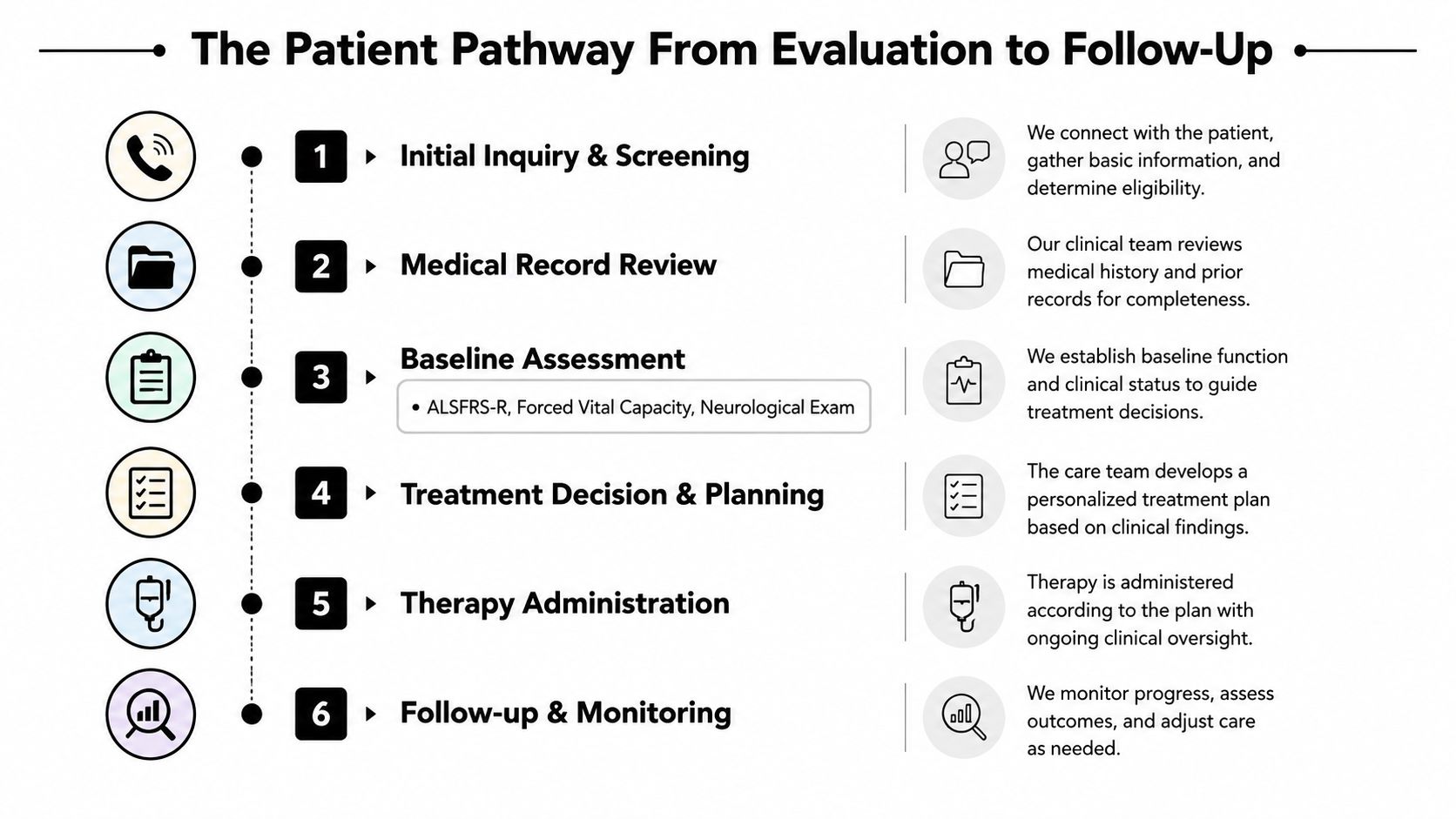
A credible ALS stem-cell journey starts long before the procedure. The first contact should feel like a medical intake, not a checkout page. Good clinics ask for records, review the diagnosis, and check whether the patient's current status makes the proposed route and cell product biologically and clinically sensible.
What a real workup usually includes
Baseline measurement matters because ALS is defined by change over time. At minimum, patients should expect a documented functional exam, ALSFRS-R, forced vital capacity, and a neurologic review. Many higher-quality programs also use MRI, bloodwork, and targeted biomarker tracking so the team can compare pre-treatment and follow-up data without guessing.
That's where integrated diagnostics change the conversation. An in-house clinical lab, cardiac evaluation, and full-body MRI help establish a credible baseline and can uncover issues that would otherwise distort interpretation later. If a clinic can't explain what it is measuring before treatment, it will struggle to prove anything afterward.
The procedure itself should be matched to the route already discussed, and the immediate recovery plan should be specific. Patients traveling for care also need clear logistics, including arrival coordination, accommodation, and a realistic plan for rest and supervision after treatment. Clinics with a biotechnology lab, licensed facility status, and an integrated care team usually offer a more coherent path than stand-alone injection services.
Practical rule: follow-up should be scheduled before the procedure happens.
What follow-up should look like
A reasonable follow-up pattern includes short-interval check-ins, repeat functional testing, and, when appropriate, repeat imaging or biomarker review. The purpose isn't to chase a dramatic story, it's to see whether function is holding, slowing, or changing in a way that can inform the next decision. That's the only way to separate real signal from wishful thinking.
For patients considering a medically supervised regenerative option, Longevity Medical Institute offers integrated diagnostics and physician-led care that can be paired with serious ALS evaluation, provided the plan remains grounded in what the evidence can support.
Choosing a Clinic and Questions Worth Asking
The best ALS clinics don't ask you to suspend judgment. They invite it. That starts with regulation. A licensed regenerative-medicine clinic operating under national health oversight, with clear manufacturing standards and transparent medical leadership, is not the same thing as a direct-to-consumer provider making broad promises on social media.
The questions that matter most
Ask where the cells come from, how they're screened, and how they're manufactured. If a clinic uses allogeneic cells, it should be able to explain the source clearly, including whether the product is derived from placental, Wharton's jelly, adipose, endometrial, or dental pulp tissue, and why that source was selected for neurological care. Ask how many cells are delivered, by which route, and what clinical trial or published evidence supports that exact choice.
Also ask about diagnostics. A real protocol should include a baseline assessment, informed consent, and defined follow-up. The clinic should be able to tell you what it measures before treatment, what it expects to change, and what it will do if the response is minimal or absent.
You can use this short checklist when speaking with any provider:
Regulatory license: Is the clinic licensed under national regulations such as COFEPRIS or an equivalent authority?
Physician credentials: Are the treating physicians board-certified in relevant specialties?
Transparent protocol: Is the treatment based on published clinical trial data?
Realistic expectations: Can the team explain benefits, limitations, and costs without promising a cure?
For a focused list of questions, these stem cell clinic questions are worth reviewing before any consultation.
Red flags and green flags
Red flags include guaranteed outcomes, autologous-only marketing for neurological conditions, no medical director, no baseline assessment, and no defined follow-up. Green flags include a multidisciplinary team, transparent informed consent, and published safety data. If the clinic sounds more like a sales operation than a medical service, trust that instinct.
Key filter: serious ALS care is cautious, measurable, and medically supervised.
Longevity Medical Institute is one option for patients seeking physician-led regenerative care in Mexico, with integrated diagnostics, licensed lab infrastructure, and a multidisciplinary workflow that can support careful evaluation rather than guesswork. That doesn't change the science of ALS, but it can change the quality of the process around it.
Author
Dr. Kirk Sanford, DC, Founder & CEO, Longevity Medical Institute. Dr. Sanford focuses on patient education in regenerative and longevity medicine, translating complex therapies into clear, practical guidance for patients.
Medical Review
Dr. Félix Porras, MD, Medical Director, Longevity Medical Institute. Dr. Porras provides clinical oversight and medical review to help ensure accuracy, safety context, and alignment with current standards of care.
Last Reviewed: August 6, 2026
Short Disclaimer
This information is for educational purposes only and is not medical advice. It does not replace an evaluation by a qualified healthcare professional. For personalized guidance, please schedule a consultation.
If you're weighing stem-cell therapy for ALS, schedule a consultation with a neurologist or regenerative-medicine physician who will review your baseline function, treatment goals, and candidacy. You can also visit Longevity Medical Institute to learn how its physician-led diagnostic and regenerative programs are structured, and to see whether that model fits the kind of careful, evidence-based planning ALS deserves.