

Regenerative Neurological Therapy Guide for Patients
You wake up, try to speak, and the words don't come out the way they used to. Or you sit through another day of numbness, burning, or weakness that hasn't improved with standard care. For many people, that's the point where the idea of regenerating nerve function starts to feel less like a buzzword and more like a real question: can medicine do more than manage symptoms and support repair?
The honest answer is that the field is promising, but uneven. In some conditions, researchers are seeing meaningful biological signals and early clinical gains. In others, the evidence is still experimental, which is why the right conversation is never “does it work for everything?” but “what can it do, for which condition, and by which route?” That's also why the global neuroregeneration therapy market already matters commercially, with one analysis valuing it at US$37.8 billion in 2024 and projecting US$47.2 billion by 2030 at a 3.8% CAGR (Research and Markets).
Patients often want a plain-English map before they decide anything. This guide gives you that, with a focus on how therapies reach the brain and spinal cord, what the science really says, and where expectations need to stay grounded.
Understanding Regenerative Neurological Therapy
A stroke survivor may notice slurred speech, a spinal cord injury patient may lose leg strength, and someone with neuropathy may feel as if their feet have gone numb and never quite came back online. Regenerative neurological therapy sits at the intersection of those problems and modern repair biology. Instead of only calming pain or inflammation, it uses biologic tools such as allogeneic stem cells, exosomes, NK cells, peptides, and hyperbaric oxygen to support a healthier environment for nervous system recovery.
What “regenerative” means in neurology
The brain and spinal cord don't heal like skin cuts. Neurons are fragile, recovery is limited by the blood-brain barrier, and secondary injury can keep unfolding long after the first event. That's why regenerative care is aimed at support, signaling, and protection, not magic replacement.
A useful way to think about it is this. Conventional neurology often asks, “How do we reduce the damage?” Regenerative neurology asks, “How do we make the tissue environment more capable of repair?” That shift matters because the nervous system responds best when inflammation is lower, oxygen delivery is better, and cellular signaling is more organized.
The market growth reflects that shift toward repair-based care. It doesn't prove every therapy works, but it does show that major investment is moving into cell therapies and related regenerative approaches (Research and Markets).
Practical rule: if a clinic describes neurological regeneration as a guaranteed cure, that's a red flag. Real medicine in this space is still condition-specific and evidence-dependent.
How Regenerative Compounds Work in the Nervous System
The nervous system responds to repair signals the way a busy city responds to infrastructure crews. You don't need one giant fix, you need the roads cleared, the power restored, and the damaged wiring stabilized. In regenerative neurology, mesenchymal stem cells, or MSCs, are used mainly for that kind of support, not because they directly become new neurons in most cases. You can learn more about stem cells work in this book: The Language of Healing: The Complete Patient Guide to Understanding Stem Cells, Regenerative Medicine, and the Science of Aging Well.
The main biologic pathways
MSCs are best understood as signal cells. They release NGF, BDNF, VEGF, and IGF-1, which support neurite outgrowth, neuron survival, vascular remodeling, and local immunomodulation. That's why the field keeps circling back to paracrine repair, the idea that cells help by sending repair messages rather than just replacing tissue.
For a patient, that can sound abstract, so here's the simplest version. NGF and BDNF help nerve cells stay alive and stay adaptable. VEGF helps build a healthier blood supply. IGF-1 supports growth and differentiation. Together, they create conditions that may allow the nervous system to respond better to injury.
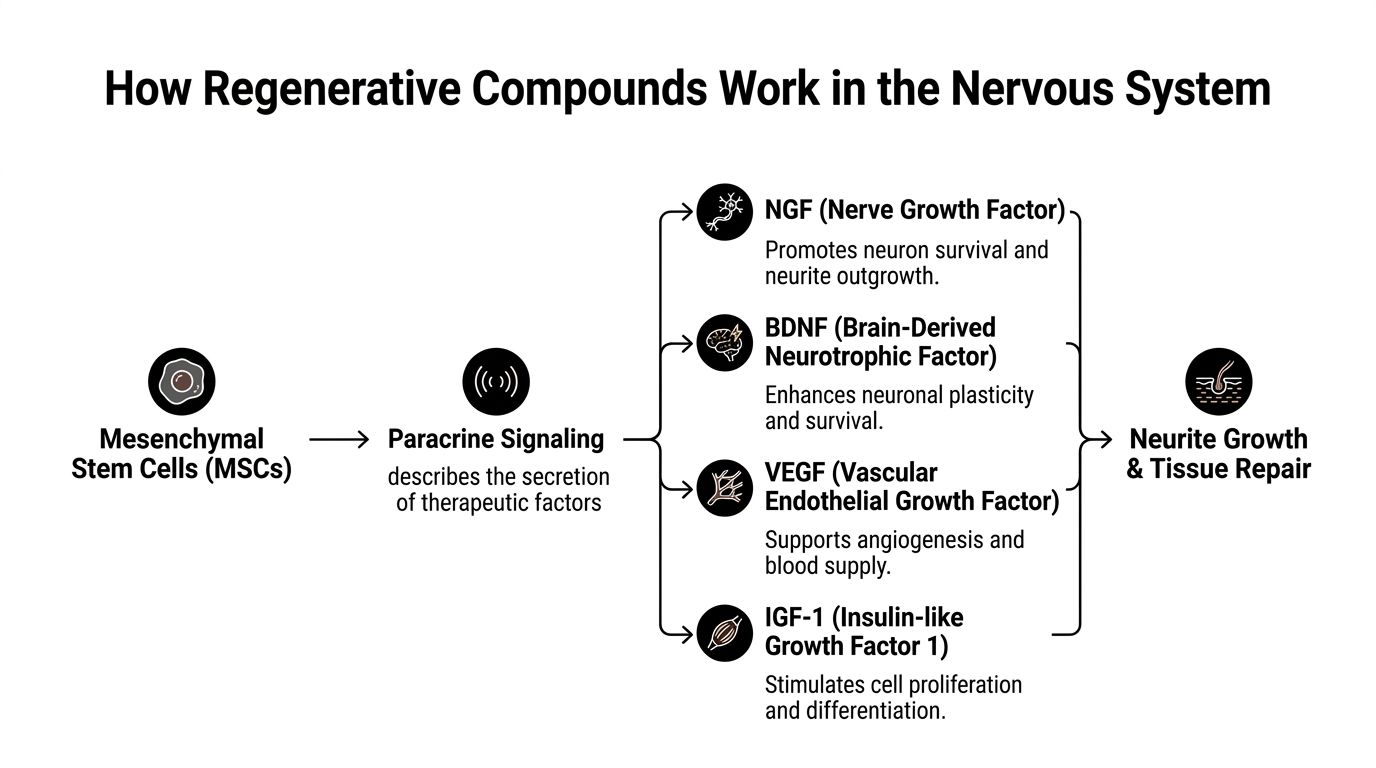
Other regenerative tools work differently. Exosomes act like packaged messages, carrying molecular instructions between cells. Peptides can support repair pathways and tissue signaling. NK cells are sometimes used to help shape immune activity, and hyperbaric oxygen therapy is used to increase oxygen availability in tissues that need a better healing environment. If you want a deeper contrast between cell-based and cell-free approaches, see the internal guide on exosomes vs stem cells.
The key idea is simple, the most credible neurologic regeneration strategies usually try to change the tissue environment first, then let repair follow.
Indications for Regenerative Neurological Therapy
Not every neurological condition sits at the same stage of evidence. That's the part many marketing pages blur together. A person with stroke-related disability, someone with spinal cord injury, and a patient with peripheral neuropathy may all be asking about “stem cells,” but those are very different clinical questions.
Conditions with the most discussion
Stroke is one of the most talked-about targets because patients often have a clear before-and-after event and a persistent functional deficit. Spinal cord injury is another major area, especially when the goal is to support motor recovery, sensation, or independence. In both settings, people often ask about combinations of biologics, rehabilitation, and delivery routes.
Multiple sclerosis, ALS, Parkinson's disease, and Alzheimer's disease are also frequently discussed, but the current evidence remains mixed and condition-specific. Families are usually looking for slowed decline, better function, or preserved quality of life rather than dramatic reversal. That's a more realistic frame than the way many ads present it.
A separate practical question is route of access. In some settings, clinicians may consider intranasal delivery to reach the central nervous system without a spinal needle, while other cases still rely on intrathecal administration. For a deeper look at spinal indications, the internal resource on spinal cord injury stem cell therapy is worth reading alongside this guide.
Clinical Evidence and Outcomes
The evidence base in regenerative neurology is real, but it isn't uniformly positive. That's why patients need more than hopeful language, they need a summary of what was observed in human studies.
What the trials tend to measure
Researchers usually track outcomes like motor function, walking ability, cognition, activities of daily living, and overall independence. Those are the same domains patients care about, because a therapy only matters if it changes real life, not just lab markers.
There are also encouraging signals in early work. One neural stem cell study reported median survival improving from 3.5 years to 6 years in a neurodegenerative disease cohort, with neurological improvement lasting at least 1 year (PMC). That doesn't prove broad effectiveness, but it does show why the field continues to attract serious research.
For safety framing and how to interpret published research, the internal article on whether stem cell therapy is safe is a useful companion piece.
Clinical takeaway: the strongest evidence still depends on the condition, the product, and the trial design. Broad promises are far less trustworthy than specific outcome data.
Patient Journey from Evaluation to Recovery
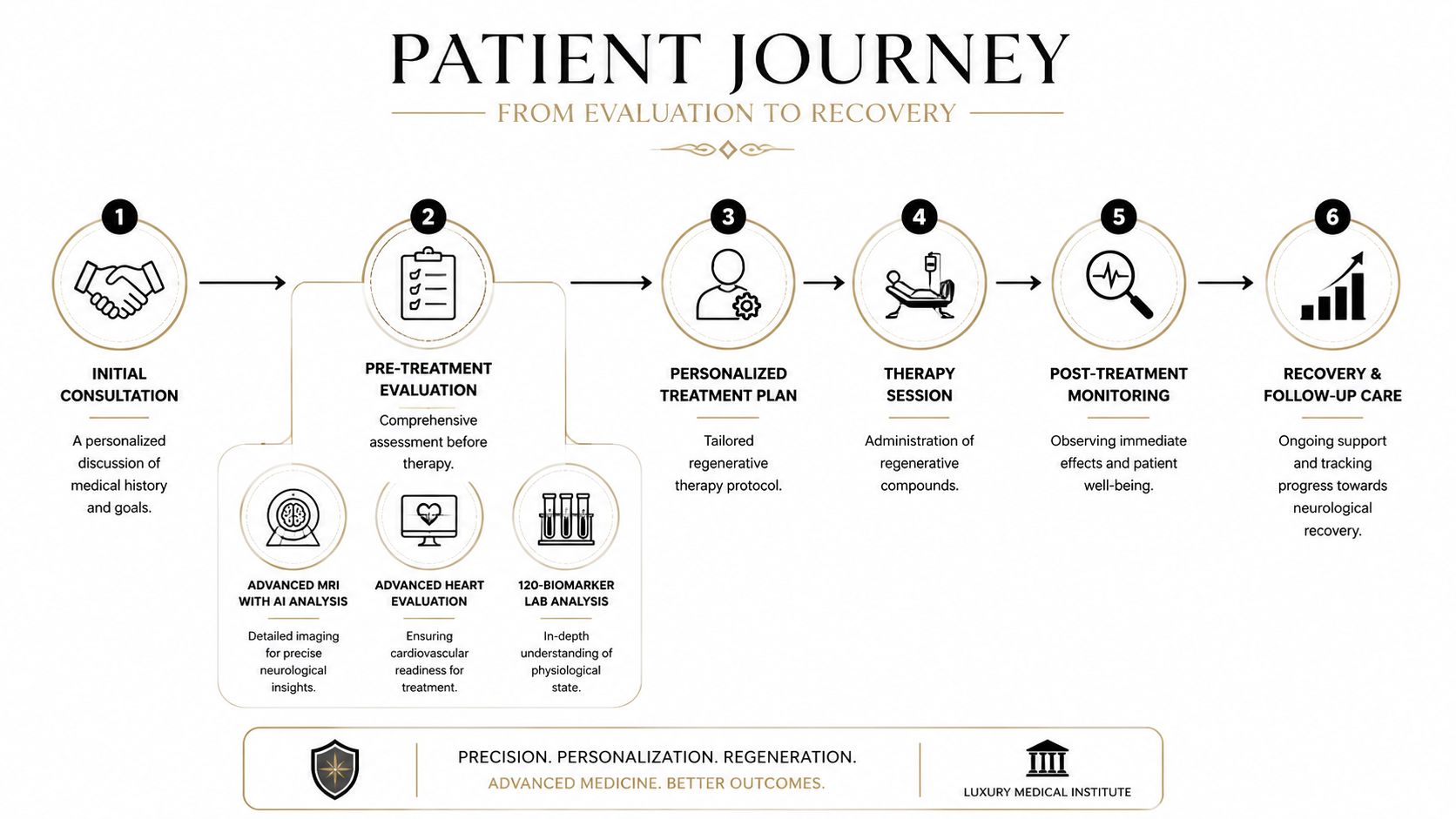
A serious neurological program starts with diagnosis, not with a syringe. That's especially important when someone is deciding between intranasal therapy and intrathecal treatment, because the right route depends on the anatomy, the disease, and the patient's overall risk profile.
What the evaluation usually includes
A careful workup often starts with a neurological exam, then moves into imaging and lab review. In a luxury physician-led setting like Longevity Medical Institute, that can include MRI with AI analysis, advanced heart evaluation, and 140-biomarker lab work to understand the full physiologic picture. Those tests don't replace clinical judgment, but they help the team see whether a patient is stable enough for a procedure and what baseline function looks like.
The delivery route comes next. Intranasal therapy is non-invasive and office-based. It's designed to reach the upper nasal cavity near the olfactory region so compounds may travel toward the brain along olfactory and trigeminal pathways. Intrathecal therapy delivers treatment directly into the cerebrospinal fluid through a lumbar puncture, which is more direct but also more invasive.
At Longevity Medical Institute, the regenerative neurological pathway may include MSC-derived exosomes and selected therapeutic peptides when the physician believes they fit the case. The decision isn't based on trend, it's based on diagnosis, imaging, exam findings, and clinical goals.
A typical recovery plan usually includes:
Immediate observation, to watch for headache, fatigue, or procedure-related effects.
Physical therapy integration, because neural recovery usually needs active retraining.
Follow-up assessment, using symptom tracking, function, and sometimes repeat imaging.
Progress checks, especially for walking, balance, speech, or daily independence.
You can also watch the patient-education video below for a visual walk-through of the treatment experience.
The best outcome is rarely one dramatic change on day one. It's usually a steadier pattern of function, tolerance, and day-to-day improvement over time.
Risks Safety and Regulatory Landscape
Regenerative neurology sounds appealing because the goal is repair, but every intervention still has trade-offs. Procedural risks, although rare, can include infection, bleeding, headache, inflammation, immune reactions, and temporary symptom worsening. The risk profile depends on the route, the product, and how carefully the procedure is performed.
This is also why lab quality is part of safety, not a side detail. Allogeneic cells sourced from controlled, licensed manufacturing environments, with documented sterility and quality processes, are more appropriate than vague “cell therapy” claims without traceability. If a clinic can't explain sourcing, testing, and clinician oversight, patients should slow down.
The internal guide on whether stem cell therapy is safe is a good starting point for learning what a responsible safety discussion should sound like.
If the promise sounds bigger than the evidence, pause and ask for the data, the route, and the exact diagnosis it was studied in.
Choosing the Right Provider and Measuring Success
A good provider should be able to answer simple questions without deflecting. What cells are used, where are they produced, how is quality verified, and how is progress measured? Those questions matter more than glossy branding.
What to look for
Look for a physician-led practice with advanced diagnostics, an in-house clinical lab, and access to an operating room when procedures require it. In this setting, the clinical team may also work with a biotechnology lab that produces placental, Wharton's jelly, adipose, endometrial, and dental pulp allogeneic stem cells. That variety matters because different sources are used for different clinical protocols and product strategies.
Patients should also ask how success is defined. For stroke, a provider might monitor NIH Stroke Scale changes, functional independence, or walking and speech gains. For other conditions, improvement may show up as less pain, better sleep, better balance, or improved activities of daily living.
A useful clinic conversation sounds like this:
What evidence supports this route for my diagnosis?
What side effects should I expect?
What happens if I don't respond?
How will you track progress over time?
If you want a model of how a structured regenerative clinic presents its services, the page on stem cell clinic Mexico shows the kind of care environment patients often compare when evaluating options.
Frequently Asked Questions
Can intranasal delivery replace intrathecal treatment for my condition?
Sometimes, but not always. Intranasal delivery is attractive because it's non-invasive and designed to target the upper nasal cavity, while intrathecal delivery places therapy directly into cerebrospinal fluid. The right option depends on diagnosis, severity, and the physician's judgment about how close the therapy needs to be to the central nervous system.
How long before I see neurological improvements?
There isn't a universal timeline. Some patients notice changes in energy, inflammation, or function earlier, while measurable neurological gains can take longer and may need rehab support to become visible in daily life. The more realistic way to think about it is gradual change, not instant reversal.
Will my insurance cover these therapies in Mexico?
Coverage is often limited because regenerative neurological therapy is still considered investigational for many indications. Patients should confirm benefits directly with their insurer before traveling, and they should assume out-of-pocket payment unless their plan states otherwise in writing.
What happens if I don't respond to initial treatment?
A responsible clinic should reassess the diagnosis, route, dose, and rehabilitation plan rather than repeat the same protocol. Sometimes the issue is not the therapy itself, but that the condition, stage, or goals weren't the right match. That's why follow-up matters as much as the procedure.
If you're comparing delivery routes, safety standards, or whether regenerative neurological therapy makes sense for your diagnosis, schedule a consultation with Longevity Medical Institute to review your case, imaging, and goals with a physician-led team.