

Stem Cell Therapy for Type 2 Diabetes: A Patient Guide
If you're living with Type 2 diabetes, the routine can feel relentless, pills or insulin, glucose checks, meal planning, and the slow creep of burning, tingling, or numb feet that don't seem to care how carefully you manage the numbers. Many people reach a point where the chart looks “acceptable,” but daily life still doesn't feel controlled.
That gap is why stem cell therapy for Type 2 diabetes gets attention. The appeal isn't that it replaces good diabetes care, it's that regenerative medicine asks a different question, can we support the tissues, immune signals, and microcirculation that sit underneath the glucose readings and nerve symptoms?
For families researching stem cells for diabetic neuropathy, the confusion is understandable. Most articles split blood sugar and nerve pain into separate conversations, but in real life they're connected. Poor metabolic control can damage nerves, and nerve damage can persist even when the glucose log improves.
This guide takes the practical route. It looks at what mesenchymal stem cells may do, what the clinical trials show, who's a realistic candidate, and where the evidence is still early rather than definitive. If you've been trying to decide whether this belongs in a serious medical conversation or in the “too experimental” pile, the answer is usually somewhere in the middle, and the details matter.
Living With Type 2 Diabetes and Nerve Pain
The day often starts with a pillbox, a glucose check, and a decision about food before the rest of life even begins. By evening, some people are also dealing with numbness, stabbing pain, burning, or a “walking on cotton” feeling in the feet, which can make sleep, exercise, and confidence in walking much harder.
That's why diabetes care can feel incomplete when it focuses only on numbers. A medication may improve glucose readings, but it doesn't always make nerve symptoms disappear, and nerve pain can linger long after a person has become disciplined with diet and prescriptions.
Practical rule: if a therapy only changes a lab value but leaves pain, function, and daily mobility untouched, patients usually don't experience it as true improvement.
This is the setting in which regenerative medicine enters the discussion. The idea is not to “mask” symptoms. It's to look at the tissues involved, the inflammatory environment around them, and whether any of the body's own repair signaling can still be supported.
For readers comparing treatment paths, it helps to think in two layers. One layer is metabolic health, which includes glucose control and insulin needs. The other is complication support, especially neuropathy, where the goal may be pain reduction, stabilization, or better function rather than a cure.
If you're also trying to understand peripheral nerve symptoms in more detail, the related guide on stem cell therapy for peripheral neuropathy provides a focused overview of that part of the picture. Keeping the two issues linked, instead of treating them as separate problems, is usually the clearest way to evaluate regenerative options.
How Stem Cells May Help Diabetes and Nerve Damage
Mesenchymal stem cells, or MSCs, are often described too simplistically as “repair cells.” A better mental model is to think of them as biological project managers. They don't need to become every tissue themselves to matter, because they can send instructions that influence inflammation, blood vessels, local repair signals, and the surrounding cells that are struggling.
The four main mechanisms people talk about
First is immunomodulation. Type 2 diabetes is not only about glucose, it's also tied to chronic inflammatory signaling. MSCs may help calm that environment, which is one reason they're being studied for both insulin resistance and nerve injury.
Second is beta-cell support. The pancreas doesn't always lose all function at once. When some insulin-producing capacity remains, the hope is that MSC-related signaling may help protect what's left, or at least create a better environment for it.
Third is paracrine signaling, especially through exosomes. These are tiny packages of microRNAs, proteins, and growth factors that cells release to communicate with each other. In practical terms, this is one reason people separate MSCs from exosome-only products, because the two are related but not identical, and the scope of action isn't the same.
Fourth is angiogenesis and nerve repair. Nerves need blood supply. Better microcirculation and better local repair signaling matter, especially in diabetic tissue where the smallest vessels can be compromised.
MSCs are not magic replacements for standard diabetes care. They're being studied as signal modulators, not as a shortcut around good metabolic management.
That distinction is important because it keeps expectations realistic. In a serious clinic conversation, the key question isn't whether stem cells are “good” or “bad,” it's whether the proposed protocol is aimed at glucose control, insulin-sparing support, nerve symptom support, or all three together.
For a deeper look at the clinical logic behind this approach, see how stem cell therapy works. The mechanism matters because it helps patients understand why two protocols that both say “stem cells” can still be very different in how they're designed and what they're meant to do.
What the Clinical Trials Show
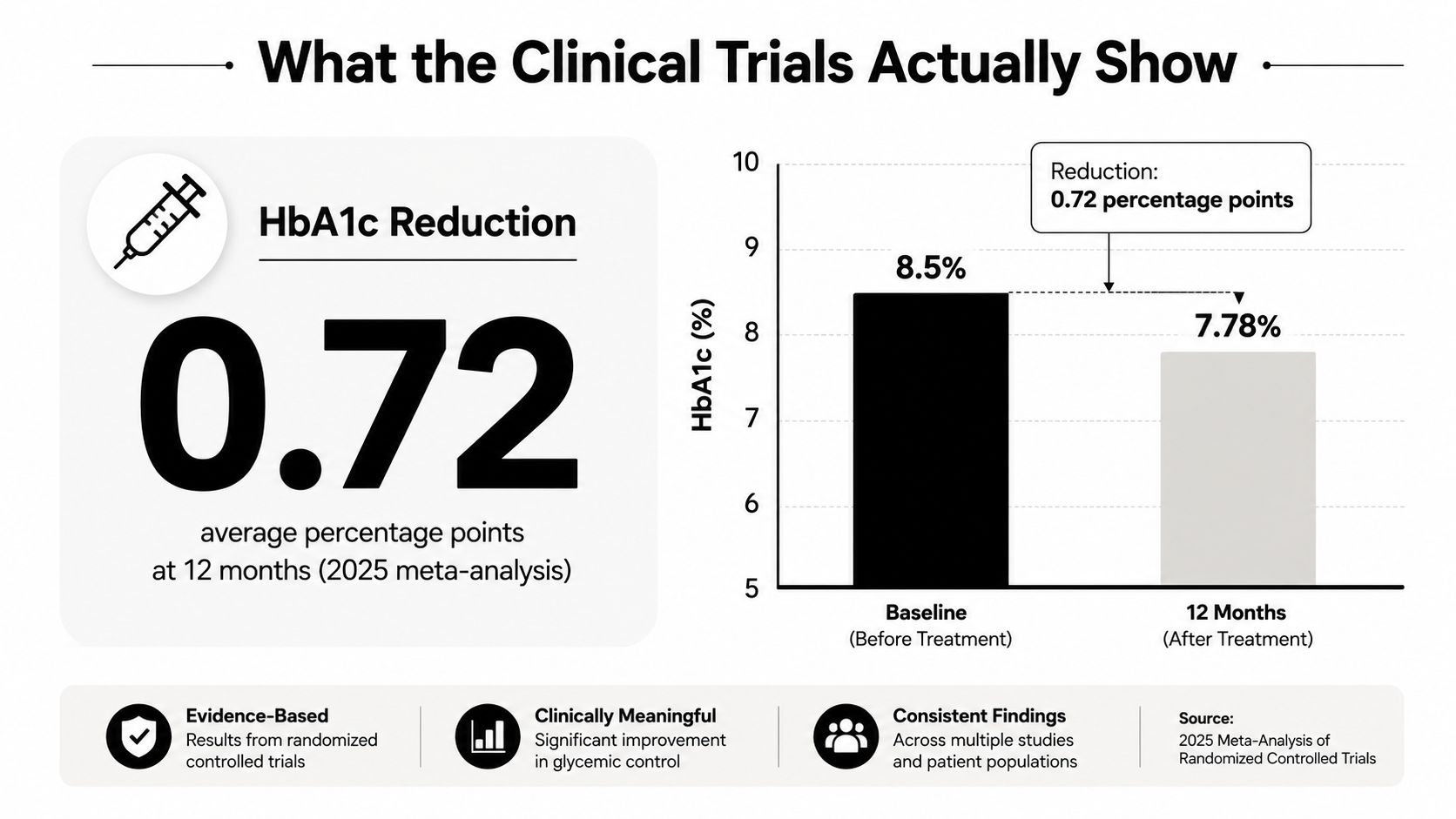
The clearest recent signal is in glycemic outcomes, not in a promise of cure. A 2025 meta-analysis of 34 randomized controlled trials found mesenchymal stem cell therapy was associated with better blood-sugar outcomes in Type 2 diabetes, with an odds ratio of 2.79 for meaningful improvement compared with placebo, and pooled results from 13 RCTs showed an average HbA1c reduction of 0.72 percentage points plus about a 14.5 unit per day reduction in insulin requirement at 12 months. Because HbA1c is the standard long-term marker of glucose control, even a change under 1 percentage point can matter clinically in diabetes management.
That pattern matters more than a headline number. In diabetes care, a modest shift in HbA1c, a lower fasting glucose trend, or a real drop in insulin dose can mean the therapy is changing the metabolic environment rather than merely producing a short-lived laboratory effect.
A separate single-center, double-blind, placebo-controlled trial of 91 adults reported a 1.31-point HbA1c drop after umbilical-cord MSC therapy, and 20% of treated patients reached the combined endpoint of HbA1c below 7% plus at least a 50% insulin reduction, compared with 4.55% in placebo. Those are the kinds of markers clinicians watch because they show whether a patient is becoming easier to manage, not just whether a biomarker moved on paper.
Why that still isn't standard care
The pipeline is growing, but it is still early-stage. A 2024 review identified 143 clinical trials across 31 countries, with China accounting for 47 trials, or 33.3%, and most studies were still phase I–II, specifically 119 out of 143 (83.2%). Only 16 trials (11.2%) had reached phase III or IV, which means large confirmatory studies are still limited (2024 pipeline review).
The historical trend also matters. Type 2 diabetes-specific stem cell trials started later than diabetes trials overall, with 54 clinical trials for T2DM starting since 2006. That puts the field in a familiar regenerative-medicine position, promising enough to study seriously, but not mature enough to treat every patient the same way (2024 pipeline review).
A useful way to read this data is simple. The direction is encouraging, the biology is plausible, and the early clinical signals are real. But this is still not the same thing as a proven replacement for metformin, GLP-1 therapy, or insulin when those medications are needed.
For a broader safety context, see the published discussion of stem cell safety and research conclusions and our own review of whether stem cells are safe in published research. That evidence base helps explain why clinicians can discuss MSCs seriously without pretending they are already routine standard-of-care.
Diabetic Neuropathy and Nerve Regeneration
Diabetic neuropathy usually begins without obvious symptoms. Blood sugar injures the tiny vessels that feed nerves, called the vasa nervorum, and that injury adds up over time through oxidative stress, inflammation, and impaired repair. The result is the pattern many patients know too well, tingling, burning, numbness, reduced balance, and pain that often gets worse at night.
Why nerves are harder to fix than glucose
Nerves are slow to heal. Even if glucose improves, the nerve tissue may still need time and biologic support before symptoms change. That's why the neuropathy conversation has to stay separate from the idea of “better numbers” on a lab report.
MSCs are interesting here because they can release neurotrophic factors such as NGF, BDNF, and GDNF, which are involved in nerve support and repair signaling. They may also support Schwann cells, the cells that help remyelinate peripheral nerves, and they can modulate inflammation in the tissue around injured nerves.
Human data specific to diabetic neuropathy is thinner than the glycemic data. That means caution is appropriate. The most realistic expectation today is often stabilization, symptom improvement, or modest functional gain, not dramatic reversal of long-standing nerve damage.
If you want a local comparison point for nerve-focused regenerative care, the dedicated page on stem cell therapy for nerve repair is the right reference. It's useful because neuropathy protocols are usually judged by different outcomes than glucose protocols.
Clinical takeaway: if a patient's main problem is neuropathic pain, the goal is usually to support nerve biology and slow further decline while metabolic care keeps the damage from continuing.
That dual target is why the best patient conversations don't ask, “Can stem cells cure neuropathy?” They ask, “What symptom changes are realistic, and is the nerve injury still early enough to respond?”
Who Is a Realistic Candidate
The most useful candidate question is not “Who has diabetes?” It's “Who has enough remaining biology for a regenerative signal to matter?” In Type 2 diabetes, that usually means someone with residual beta-cell function, often assessed with fasting or stimulated C-peptide, plus a glycemic profile that's still modifiable on a reasonable protocol.
The profiles that tend to make more sense
People with moderate-to-high HbA1c despite treatment may be the clearest metabolic candidates, especially if they're also trying to reduce insulin burden. Those with progressive complications, such as neuropathy, may still be considered if the goal is complication support rather than a full metabolic reset.
By contrast, advanced long-duration diabetes with very little C-peptide is a less favorable profile for glucose improvement. That doesn't automatically rule out regenerative care, but it does change the expected outcome. In those cases, the conversation may shift toward inflammation control, nerve support, or quality-of-life goals.
When not to proceed
Common red flags include active malignancy, uncontrolled infection, severe cardiac disease, severe liver disease, pregnancy, and recent thrombosis. These are the kinds of issues that need a physician-led review before any cell-based protocol is considered.
A practical framework is to match the goal to the biology. If the goal is glucose lowering, residual beta-cell function matters a lot. If the goal is insulin sparing, medication history and current insulin dependence matter. If the goal is complication support, especially neuropathy, the focus shifts toward symptom pattern and tissue health.
That's also why good diagnostic workup matters before any intervention. A clinic that only talks about “stem cells for everyone” is skipping the hard part.
Allogeneic Stem Cell Sources Compared
Allogeneic sourcing means the cells come from a donor, not from the patient. In a clinical setting, that matters because it can support dose standardization, avoid a harvest procedure, and make screening more consistent. It's also the model some regenerative medicine programs choose deliberately for logistics and quality control.
Allogeneic MSC Sources at a Glance
| Source | Tissue Origin | Key Profile | Best Fit |
|---|---|---|---|
| Placental | Placental tissue | Often selected for strong immunomodulatory signaling and youthful donor biology | Systemic inflammatory support |
| Wharton's jelly | Umbilical cord connective tissue | Commonly used in regenerative programs for broad paracrine activity | Metabolic and nerve-support protocols |
| Adipose | Fat tissue from a donor source | Frequently discussed for accessibility and MSC yield | General regenerative protocols |
| Endometrial | Endometrial tissue | Considered in some labs for potent cell signaling characteristics | Programs seeking broader secretory support |
| Dental pulp | Tooth pulp | Interesting for neurotrophic signaling potential | Nerve-focused indications |
The main point is not that one source is universally “best.” It's that different tissues may be favored for different clinical goals. For Type 2 diabetes, a program may prioritize systemic anti-inflammatory signaling. For neuropathy, clinicians often look harder at neurotrophic and repair-oriented signaling.
That's also where allogeneic protocols differ from autologous ones discussed in some trial registries. In practice, a donor-derived protocol can simplify planning for medical travelers and reduce variability tied to patient harvest quality.
The source choice should always be paired with screening, handling, and viability documentation. Without those details, “allogeneic” is just a label, not a quality standard.
Protocols, Safety, and the Durability Question
A real protocol usually isn't just an infusion and a handshake. For metabolic and nerve indications, programs may use systemic intravenous delivery for broader inflammatory effects and targeted local injection when a focal pain site or nerve region is being addressed. Many regenerative clinics also layer in adjuncts such as exosomes, peptides, hyperbaric oxygen, and IV nutraceutical support.
Safety and durability, honestly
Across trials, MSCs have shown a favorable safety profile. That said, the evidence base still leans heavily toward short-term to intermediate-term follow-up, so durability remains an open question in many protocols.
Patients should hear that directly. Some people may do well after one course, while others may need periodic reassessment and booster planning rather than assuming a permanent effect. That doesn't make the therapy weak, it makes it biologically honest.
A durable result is more believable when the clinic tracks symptoms, medication changes, and biomarkers over time, not just same-day reactions.
Regulatory status matters too. In major medical-tourism markets, this remains an advanced regenerative protocol, not an FDA-approved standard therapy for Type 2 diabetes. That doesn't mean it has no place in medicine, but it does mean patients should separate investigational care from established diabetes treatment.
For readers comparing operational standards, the broader published discussion of stem cell safety in research settings helps frame why oversight and source quality are so important.
Costs, Logistics, and Questions to Ask Any Clinic
Pricing varies with source, lab handling, diagnostics, and follow-up, so the honest answer is that you should expect meaningful variation rather than a single universal fee. A serious protocol should also explain what's included, for example consultations, laboratory work, infusion sessions, and follow-up review, instead of giving a bare procedure price with no context. For a related overview, see the internal guide on stem cell therapy cost.
Travel planning matters for medical tourists. If you're coming to San José del Cabo, ask how pre-arrival screening works, whether follow-up is remote or in person, and who handles complications if they arise after you return home.
Questions worth asking before you book
Cell source and screening: What tissue source is used, and what infectious-disease and quality testing is documented?
Dose and viability: Do you receive documentation on cell count, viability, and preparation?
Lab oversight: Is the processing environment certified, and who supervises it medically?
Safety plan: What happens if you develop a flare, infection, or unexpected reaction?
Outcome tracking: Which biomarkers and symptoms are followed after treatment?
An integrated clinic can make that process easier when it includes an in-house clinical lab, AI-enhanced full-body MRI, advanced cardiac evaluation, hyperbaric oxygen, peptides, sleep medicine, and structured follow-up under one roof. Longevity Medical Institute also fits into that model, because its workflow combines diagnostics and regenerative planning instead of treating them as separate visits.
FAQ
Can stem cells reverse diabetes? Sometimes the language used online is stronger than the evidence. The better answer is that current studies show promising metabolic improvement, but not a guaranteed reversal for every patient.
Are stem cells safe? In published trials, MSC therapy has shown a generally favorable safety profile.
How long until results? That varies. Some changes are tracked over months, especially for HbA1c and medication requirements, while nerve symptoms can take longer and may improve more slowly.
If you want a medically guided conversation about Type 2 diabetes, neuropathy, and regenerative medicine, the next step is a proper evaluation, not a guess. Schedule a consultation with Longevity Medical Institute to review your labs, symptoms, and candidacy in a structured, physician-led setting.
Author
Dr. Kirk Sanford, DC, Founder & CEO, Longevity Medical Institute. Dr. Sanford focuses on patient education in regenerative and longevity medicine, translating complex therapies into clear, practical guidance for patients.
Medical Review
Dr. Félix Porras, MD, Medical Director, Longevity Medical Institute. Dr. Porras provides clinical oversight and medical review to help ensure accuracy, safety context, and alignment with current standards of care.
Last Reviewed: August 11, 2026
Short Disclaimer
This information is for educational purposes only and is not medical advice. It does not replace an evaluation by a qualified healthcare professional. For personalized guidance, please schedule a consultation.