

Stem Cell Treatment for ALS: Explore Your Options
An ALS (also referred to as amyotrophic lateral sclerosis or Lou Gehrig’s disease) diagnosis often changes the rhythm of daily life almost overnight. A patient who was planning work, travel, or family events may suddenly be comparing wheelchairs, reading about breathing support, and trying to separate solid science from desperate marketing. Families usually arrive at this point exhausted, protective, and wary of promises that sound too smooth.
That caution is wise.
Stem cell treatment for ALS has become one of the most discussed areas in regenerative medicine because it offers a different way of thinking about the disease. Instead of only reacting to symptoms after function is lost, researchers are exploring whether cellular therapies can help protect vulnerable motor neurons, calm harmful inflammation, and support the nervous system’s environment while function remains.
For patients in the US and Canada who are also considering care abroad, the questions aren’t only scientific. They’re practical. What kind of cells are being used. How are they delivered. What has been shown in clinical studies. What safety standards matter. And what does the travel process look like if you're already living with a physically demanding condition.
A New Horizon for Amyotrophic Lateral Sclerosis (ALS)
Many people first look into regenerative medicine after they’ve been told some version of the same hard truth. ALS is progressive, current treatment options are limited, and preserving quality of life becomes the central goal. That moment can feel like the future has narrowed.
What changes for some patients is not the diagnosis itself, but the frame around it. They stop asking only, “What can’t be done?” and start asking, “What biological support might still be possible?” That’s where the conversation around stem cell treatment for ALS begins.
A useful way to think about this shift is to compare two kinds of care. One approach is largely defensive. It helps manage symptoms, support breathing, maintain nutrition, and adapt the home environment. Those measures matter greatly. The newer approach asks whether the nervous system can also receive active biological support intended to protect what remains.
For families reading patient experiences, the emotional side of that shift is often as important as the medical side. The story isn’t about false hope. It’s about informed action, realistic goals, and careful decision-making. That’s why many readers find it helpful to begin with a real ALS patient story before diving into technical details.
Stem cell therapy in ALS should be understood as an emerging strategy to preserve function and support quality of life, not as a guaranteed reversal of disease.
That distinction matters. Serious clinics and serious physicians won’t present this therapy as a miracle or a cure. They’ll explain it as a developing field with meaningful signals, important limitations, and a need for individualized medical judgment.
For the right patient, this creates a new horizon. Not certainty. Not cure. But a thoughtful, physician-guided attempt to influence the disease environment in a condition where time and function are precious.
Understanding ALS and the Role of Stem Cells
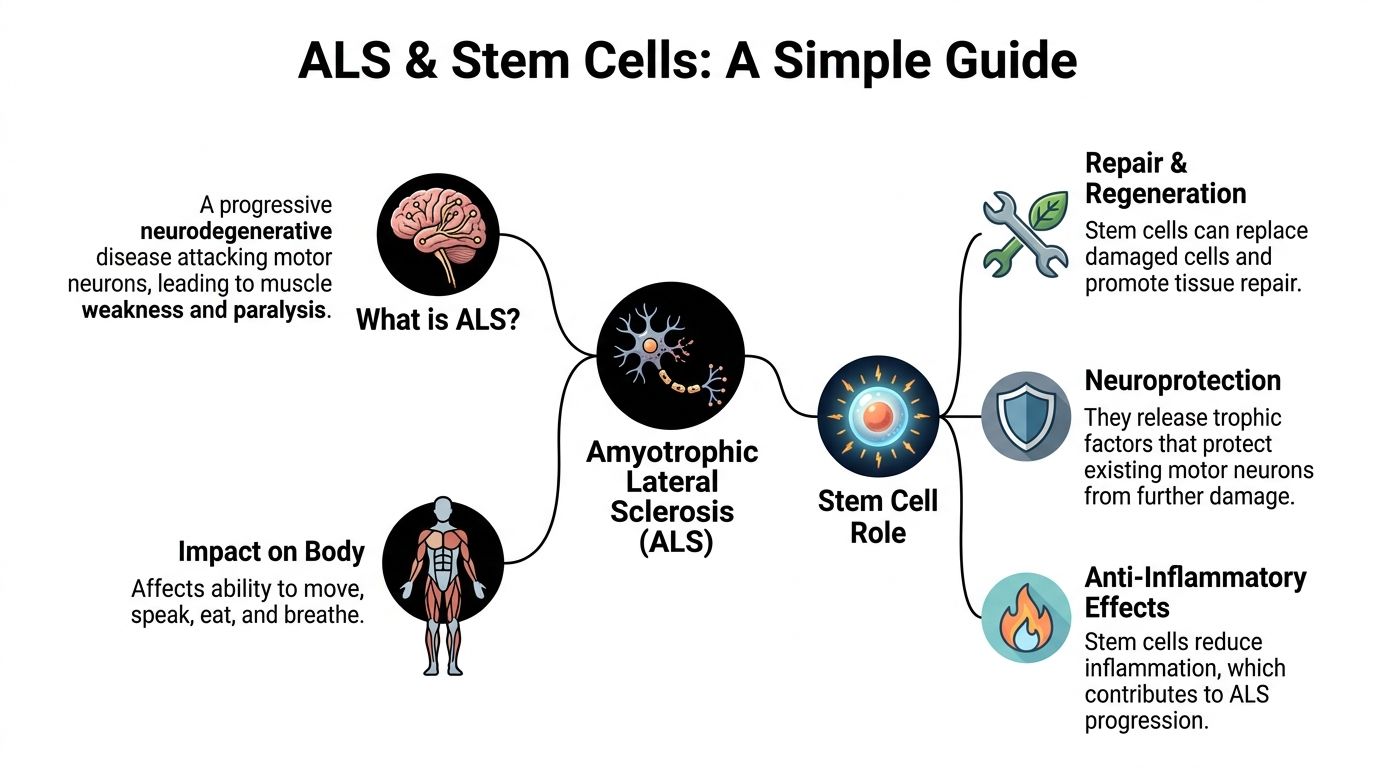
ALS affects the cells that carry movement commands from the brain and spinal cord to the muscles. If you think of the nervous system as the body’s wiring, motor neurons are part of the communication lines that tell the muscles when to speak, swallow, walk, lift, and breathe. In ALS, those lines gradually fail.
When the signal weakens, the muscle itself may still be present, but it no longer receives clear instructions. That’s why symptoms can spread across different parts of the body. A hand may weaken first. Later, speaking, swallowing, or breathing can become harder. The disease doesn’t just affect strength. It affects communication between the brain and the body.
Why stem cells are being studied
Stem cells in ALS aren’t best understood as simple replacement parts. For most patients, the more realistic idea is that they may act like a highly trained support crew working around damaged wiring. They may help protect threatened neurons, reduce harmful inflammatory signaling, and improve the local conditions around fragile nerve cells.
That’s especially true for mesenchymal stem cells, often called MSCs, which are widely studied in neuroinflammatory and degenerative conditions. These cells are interesting not because they easily turn into new motor neurons inside the body, but because of what they release and how they influence the tissue around them.
If you want a broader primer on the biology, this guide on how stem cell therapy works is a helpful companion to the ALS-specific discussion.
Three ways these cells may help
Researchers and clinicians usually focus on three practical mechanisms.
Calming inflammation: In ALS, the nervous system environment can become inflamed. That inflammatory state may add stress to already vulnerable motor neurons. MSCs are being studied because they may help reduce that inflammatory burden.
Sending protective signals: Stem cells release growth factors and other signaling molecules. You can think of these as support messages rather than construction materials. Their role is less “build a brand-new spinal cord” and more “help endangered neurons survive in a hostile setting.”
Modulating immune activity: The immune system doesn’t only defend against infection. It also shapes how tissues respond to injury and degeneration. Stem cells may help shift immune behavior toward a less destructive pattern.
Where patients often get confused
The biggest misunderstanding is this. People hear “stem cell” and picture damaged neurons being swapped out for healthy new ones, like replacing broken fuses in a panel. That image is simple, but it doesn’t reflect the main current use in ALS.
Practical rule: In ALS, the near-term goal is usually protection and support of remaining function, not full replacement of lost motor neuron networks.
Another common confusion is whether all stem cells behave the same way. They don’t. Different cell types have different strengths, risks, delivery methods, and evidence profiles. That’s one reason patients need a treatment plan that starts with diagnosis, staging, respiratory status, and overall medical suitability, not with a sales pitch.
Therapeutic Approaches Stem Cells and Exosomes
A patient from Texas, California or Calgary often reaches this stage of research with a very practical question. If I travel to Mexico for care, what exactly would I be receiving, and why was that option chosen for ALS rather than another one? That question matters because the words stem cells, exosomes, secretome, intrathecal, and intravenous can blur together fast.
The clearest way to sort this out is to separate the therapy into two parts. First, there is the product itself. Second, there is the route used to deliver it.
Allogeneic cell therapy in practice
Many ALS programs focus on allogeneic therapy, which means donor-derived cells rather than cells collected from the patient. For a traveling patient, this has practical consequences. It usually avoids the extra step of harvesting the patient’s own tissue, reduces scheduling complexity, and allows treatment teams to work with pre-screened cellular material prepared under controlled lab conditions.
For ALS, the interest is usually not that these cells will rebuild damaged motor pathways cell by cell. The nearer-term goal is more modest and more biologically plausible. Clinicians are trying to introduce cells that may release supportive signals into a stressed neurologic environment.
That distinction helps patients ask better questions before committing to treatment abroad. Instead of asking only, “What kind of stem cell is it?” a better question is, “Why was this cell type selected for ALS, how is it screened, and what role is it expected to play after administration?”
Exosomes and the Secretome
Exosomes make more sense once the stem cell secretome is clear. The stem cell secretome is the full set of biologically active substances a cell releases. Exosomes are one part of that output. They work like microscopic courier packets, carrying signaling molecules that may influence inflammation, immune behavior, and cellular stress responses.
In ALS, that signaling model gets a lot of attention because the therapeutic idea is often support rather than structural replacement.
For patients comparing clinics in Mexico, this point can prevent a common misunderstanding. A center may offer living cells, exosome-based products, or a plan that uses both concepts in sequence. Those are not interchangeable options. They differ in handling, intent, route of administration, and the kind of follow-up discussion a careful clinic should provide. Patients who want a clearer background on this signaling approach can review stem cell exosome therapy and regenerative signaling concepts.
Delivery matters as much as the product
Route matters because the nervous system is not easy to reach. A treatment placed into the bloodstream enters a very different biologic setting than a treatment placed into cerebrospinal fluid.
For a medical traveler, this also affects logistics, cost, observation time, and risk review. A same-day intravenous infusion is very different from a procedure that requires imaging, sterile procedural setup, recovery monitoring, and a longer stay near the clinic.
| Approach | General idea | Why it matters in ALS discussions |
|---|---|---|
| Intravenous delivery | Cells or exosome products are given into the bloodstream | Often simpler to administer, but it offers less direct access to the central nervous system |
| Intrathecal delivery | Therapy is introduced into the cerebrospinal fluid | Places the treatment closer to the brain and spinal cord environment that ALS affects |
| Intraspinal delivery | Cells are placed directly into spinal cord target regions | Highly localized and more invasive, so patient selection and procedural expertise matter more |
Published research has explored direct spinal delivery in carefully designed settings. One report on neural stem cell work in ALS described a Phase I study using intraspinal injection into the lumbar spinal cord grey matter in 12 patients who received 5 to 10 injections. The same review also described a Cedars-Sinai-led trial in 18 ALS patients using engineered neural progenitor cells expressing GDNF, with safety benchmarks met in that report, according to Neuralstem’s overview of neural stem cell work in ALS.
For those considering treatment in Mexico, the practical takeaway is straightforward. The best questions are not only about whether a clinic offers stem cells or exosomes. Patients should ask which route is being proposed, why that route fits their stage of disease, what monitoring is required afterward, and what risks come with a more direct but more invasive procedure.
Clinical Evidence and Realistic Expectations
A family from the US or Canada often reaches this stage after weeks of reading, comparing clinics in Mexico, and trying to separate hope from hype. The practical question is usually not, “Can stem cells cure ALS?” It is, “What has been seen in human studies, and what would those findings mean for my decision, travel plans, and expectations?”
That distinction matters. ALS treatment decisions are rarely abstract. They affect whether a patient can tolerate travel, whether a caregiver needs to come, how much time can reasonably be spent away from home, and whether a clinic is describing a realistic treatment goal or selling a fantasy.
What the strongest published signals suggest
One of the most discussed human data sets comes from BrainStorm Cell Therapeutics’ Expanded Access Program involving NurOwn. In that report, 90% of ALS patients treated with NurOwn survived more than 5 years after symptom onset, compared with a typical benchmark in which about 10% of untreated patients reach that milestone. The analysis also reported a median survival of 6.8 years, with 60% of participants, 6 out of 10, alive beyond 7 years post-symptom onset, according to Practical Neurology’s report on the NurOwn Expanded Access Program.
Those numbers get attention for a good reason. In ALS, even a modest extension of stable function can matter greatly to speech, swallowing, mobility, and time with family.
Still, one data set is not the whole field. Patients in that report entered treatment with a mean ALSFRS-R score of 31.4, which reflects moderate disease severity. A result seen in one group at one stage of disease does not automatically apply to every patient considering treatment abroad. ALS behaves differently from person to person, much like a storm system that follows the same diagnosis but not the same path.
What early studies can and cannot tell you
Early-stage ALS stem cell research often asks the first question any careful team should ask. Can the therapy be given with acceptable tolerability in selected patients?
That is different from proving long-term benefit.
A treatment can clear an early safety hurdle and still remain under study for durability, timing, dose, and patient selection. For a patient exploring care in Mexico, this is an important way to read clinic claims. Safety data support whether a treatment approach deserves continued study. Efficacy data help answer whether it is likely to preserve function, slow decline, or improve quality of life in a meaningful way.
A plain-language summary of this issue is available in our published research summary on stem cell safety.
Promising survival data should improve the quality of the conversation. They should not replace careful medical judgment.
What realistic benefit looks like in ALS
In oncology, patients sometimes look for tumor shrinkage on a scan. ALS is different. The more realistic clinical target is often neuroprotection. In simple terms, the goal is to help protect threatened nerve cells for longer, like reinforcing a weakening electrical grid before more circuits fail.
That is why the most reasonable expectations today usually center on outcomes such as:
Slower progression: Some cell-based approaches may reduce the pace of decline in selected patients.
Longer preservation of function: Keeping speech, swallowing, breathing capacity, or mobility more stable for longer can be meaningful.
Quality-of-life support: Even without reversal of lost function, slowing deterioration can change day-to-day life for patients and caregivers.
Preclinical work has also pointed in the same general direction. Animal studies have suggested that earlier treatment may produce better effects than later treatment, which fits the broader medical logic of intervening before too many motor neurons are lost. Animal findings help explain the scientific interest in timing, but they do not predict what any one person will experience in the clinic.
A brief overview may help if you want to hear clinicians discuss the broader topic in plain language.
Where caution is still necessary
The biggest unanswered questions are practical ones. How durable are the effects? Which patients are the best candidates? How often, if ever, should treatment be repeated? What happens after the patient returns home to the US or Canada?
A published review notes that long-term safety and durability data beyond 5 years remains largely undocumented in peer-reviewed literature, and that many studies still do not answer maintenance schedules, retreatment timing, or whether benefits level off over time.
For medical tourists, those unknowns are not minor details. They shape the full care plan. A trustworthy clinic should explain what can be evaluated before travel, what testing is needed on arrival, how many days the visit may require, what short-term follow-up is expected, and what coordination should happen with the patient’s neurologist back home.
The honest conclusion is hopeful and restrained. Stem cell treatment for ALS remains an emerging therapy. It has encouraging safety signals, some meaningful human findings, and real scientific reasons for interest. It also requires careful screening, transparent counseling, and a clinic that respects the difference between possibility and proof.
Safety Regulations and Your Patient Journey
For most families, safety comes before every other question. That’s appropriate. ALS already places strain on breathing, mobility, swallowing, and energy. Any elective therapy has to justify itself first by how carefully it’s delivered and how responsibly the patient is screened.
The reassuring part is that early-stage clinical literature on intrathecal MSC therapy has generally been favorable on tolerability. Multiple Phase I clinical trials of intrathecal mesenchymal stem cell injections for ALS have established exceptional safety profiles, with no serious adverse events reported across studies involving doses like 1 × 10^6 cells/kg, according to the The Mazzini Study MSCs suspended in the patient's own cerebrospinal fluid, creating a customized treatment approach. Results showed improved neuromuscular function with minimal side effects.
What safety should mean to a patient
Safety isn’t just whether a study reported a catastrophic complication. It also includes whether the clinic screens the right patients in the first place, uses validated handling processes, explains realistic goals, and has a plan for follow-up after you return home.
For a patient considering treatment abroad, ask these questions early:
Who is evaluating candidacy: A real physician should review diagnosis, symptom progression, respiratory status, medications, and travel tolerance.
How is the product handled: Patients should know whether the clinic uses licensed laboratory processes and documented quality control.
What route is proposed and why: Intravenous, intrathecal, and other routes carry different goals and practical considerations.
What happens after treatment: Follow-up shouldn’t end when your flight leaves.
Patients comparing international options often start with a practical safety overview such as is stem cell therapy in Mexico safe.
Why some patients look to Mexico
The regulatory environment can confuse even well-informed families. In the US and Canada, many advanced regenerative approaches for neurologic disease remain tied to formal trial pathways or limited access structures. In Mexico, treatment availability may be different under the country’s regulatory framework, including COFEPRIS licensure for qualified facilities.
That doesn’t mean every clinic offering treatment in Mexico follows the same standard. The primary question isn't solely geography. It’s whether the clinic operates with physician oversight, licensed laboratory procedures, proper documentation, and transparent consent.
A responsible medical tourism decision is never “Mexico versus the US.” It’s “which clinic can clearly explain its standards, processes, and medical reasoning.”
What the patient journey usually looks like
For US and Canadian patients, the pathway is often more manageable than expected when it’s organized properly. A typical process includes several stages.
Remote review before travel
The clinical team gathers records, confirms the ALS diagnosis, reviews imaging and specialist notes if available, and assesses whether travel is reasonable. This is also when families should discuss breathing support, mobility assistance, and caregiver needs.Pre-arrival planning
Travel details matter in ALS. Patients may need airport wheelchair coordination, ground transportation that can accommodate assistive devices, and lodging that reduces physical strain. A premium clinic setting should treat these logistics as part of care, not as an afterthought.On-site evaluation
Before any treatment, the patient should undergo in-person medical assessment. That may include neurologic review, baseline laboratory testing, and route-specific planning. Some programs also use broader diagnostics to understand inflammation, nutrition, or other factors affecting resilience.Treatment day
Depending on the protocol, treatment may involve intravenous administration, intrathecal delivery, or a combination approach. Patients often worry most about whether the procedure will be painful or exhausting. In reality, the experience is usually more structured and controlled than they expect, though comfort measures and recovery planning should be clearly explained beforehand.Observation and discharge planning
Immediate monitoring helps the team assess short-term tolerance. Families should leave with written aftercare guidance, emergency contact instructions, and a follow-up schedule.
Practical travel realities for ALS patients
A luxury medical setting matters here for reasons that aren’t cosmetic. ALS makes small frictions expensive. A long wait, a poorly designed transfer, or a rushed intake process can drain energy that the patient needs for treatment and recovery.
A better travel experience usually includes:
Concierge coordination: Scheduling, airport support, transportation, and lodging are arranged around mobility needs.
Caregiver integration: The companion or family member receives clear instructions, not scattered updates.
Accessible pacing: Appointments are sequenced to reduce fatigue.
Post-visit communication: Patients need a channel for follow-up once they’re back home.
The best patient journey feels medically serious and logistically calm. That combination lowers stress, improves decision-making, and respects how much effort travel already demands in ALS.
The Longevity Medical Institute Difference
In ALS care, execution matters as much as intent. Many clinics can describe stem cells in broad terms. Fewer can show how diagnostics, lab controls, physician oversight, and follow-up come together in one coherent system.
One practical distinction is infrastructure. According to the publisher information provided for this article, Longevity Medical Institute operates a COFEPRIS-licensed, ISO-certified biotechnology lab, an in-house clinical laboratory, and uses AI-enhanced full-body MRI, cardiac assessments, and ultrasound-guided procedures as part of its broader care model. In plain language, that means treatment planning, biologic preparation, and medical evaluation can happen within one coordinated environment rather than being fragmented across unrelated vendors.
Why in-house systems matter
When patients travel internationally for stem cell treatment for als, fragmentation creates risk and confusion. Lab quality, physician assessment, biologic handling, and aftercare all affect trust. If each piece is handled by a different party, it becomes harder for a patient to know who is accountable.
An integrated model supports several things at once:
Clearer chain of custody: Patients can ask where the biologic product comes from and how it’s handled.
Better baseline tracking: In-house diagnostics help clinicians establish a clearer starting point before treatment.
Faster clinical coordination: If a physician wants additional testing or monitoring, the process is simpler.
A broader regenerative framework
ALS isn’t only a neuron problem. It also affects nutrition, inflammation, energy, mobility, sleep, stress, and overall resilience. That’s why a multidisciplinary environment can be useful. Regenerative medicine in this context often works best as part of a larger support plan rather than as a stand-alone injection.
Complementary tools may include physician-guided rehabilitation support, hyperbaric oxygen strategies, peptides, clinical lab monitoring, and advanced imaging. The right mix depends on the patient’s condition, goals, and tolerance. What matters is that the plan is medically coherent and not just a menu of add-ons.
Patients should look for a treatment ecosystem, not a single procedure sold in isolation.
Why this matters to medical tourists
For US and Canadian patients coming to San José del Cabo, the value of a premium clinic isn’t luxury for its own sake. It’s reduction of friction. You want a setting where records are reviewed carefully, specialists can communicate with each other, and logistics don’t undermine the patient’s limited energy.
That becomes especially important in ALS because treatment decisions often sit beside difficult practical issues. Can the patient travel comfortably. Is intrathecal delivery appropriate. Is a combination plan reasonable. What metrics will be followed after treatment. Those questions require a clinic that can think clinically, not just operationally.
The best regenerative programs don’t promise certainty. They provide rigor, transparency, and support. In an emerging field, those qualities matter more than marketing language.
Frequently Asked Questions About ALS Stem Cell Therapy
How soon could I notice changes
Some patients hope for immediate, obvious improvement. That’s usually not the right expectation. In ALS, the more realistic early goal is stabilization or a slower rate of decline, not a sudden recovery. If benefits occur, they may show up as steadier energy, preserved daily function, or less rapid change over time.
Is the treatment procedure painful
That depends on the route used. Intravenous treatment is usually familiar to most patients. Intrathecal procedures are more involved, so patients should ask exactly how the procedure is performed, what comfort measures are used, and how long observation lasts afterward. The key is that the team should explain the process in plain language before treatment day.
Am I a candidate if my disease is advanced
Possibly, but candidacy becomes more complex as ALS progresses. Respiratory status, swallowing function, travel tolerance, recent decline, and caregiver support all matter. A careful physician review is more important than a quick yes.
Are all stem cell products the same
No. Cell source, processing standards, route of administration, and intended mechanism all differ. A serious clinic should tell you what kind of biologic is being used and why that choice fits your case.
Can exosomes replace stem cells
Sometimes they’re used as part of the same regenerative strategy, but they aren’t automatically interchangeable. Exosomes are best thought of as signaling messengers derived from cells. In some programs, they complement cellular therapy rather than replace it.
What else can support ALS care alongside regenerative treatment
Supportive therapies still matter greatly. Patients often benefit from coordinated neurology care, physical support strategies, nutrition, respiratory monitoring, speech and swallowing support, and carefully selected recovery-focused therapies. Stem cell treatment works best when it’s part of a larger medical plan.
What should I ask a clinic before traveling
Start with these:
What exactly are you giving me
Why is this route recommended for my condition
Who reviews my records
How do you handle follow-up after I return home
What outcomes are realistic in my stage of disease
Those questions can tell you a lot about whether a clinic is prepared to care for an ALS patient responsibly.
If you’re exploring whether regenerative care belongs in your ALS treatment plan, Longevity Medical Institute offers physician-led evaluations for patients seeking a more structured understanding of stem cells, exosomes, diagnostics, and medical travel options in Mexico. Educational content published under Treatments and Resources is designed to help patients and families make informed decisions with clarity and realistic expectations.
Author
Dr. Kirk Sanford, DC, Founder & CEO, Longevity Medical Institute. Dr. Sanford focuses on patient education in regenerative and longevity medicine, translating complex therapies into clear, practical guidance for patients.
Medical Review
Dr. Félix Porras, MD, Medical Director, Longevity Medical Institute. Dr. Porras provides clinical oversight and medical review to help ensure accuracy, safety context, and alignment with current standards of care.
Last Reviewed: April 22, 2026
Short Disclaimer
This information is for educational purposes only and is not medical advice. It does not replace an evaluation by a qualified healthcare professional. For personalized guidance, please schedule a consultation.