

Stem Cells for Knee Arthritis: Top Mexico Options
If you're reading this, there's a good chance you've already done the standard knee arthritis circuit. You may have tried physical therapy, activity modification, anti-inflammatory medication, injections, or tolerated the pain longer than you wanted to. For many patients, the frustration isn't just discomfort. It's the slow loss of freedom: stairs become deliberate, travel takes planning, tennis turns into walking, and even a long dinner can end with stiffness.
Patients considering stem cells for knee arthritis usually aren't looking for hype. They want a clear answer to a practical question: Can regenerative medicine offer meaningful relief, and can it be done safely in Mexico? That question deserves a serious medical discussion, especially when treatment involves international travel, biologic therapies, and a crowded market with major differences in clinic quality.
The right conversation isn't whether stem cells are "miraculous" or "worthless." Neither is accurate. The key question is whether a carefully selected patient, treated with the right cell source, in the right setting, under proper physician oversight, may benefit from a modern regenerative approach that aims to calm inflammation, improve joint function, and potentially delay more invasive intervention.
A New Horizon in Healing Considering Stem Cell Therapy in Mexico
A typical patient story starts subtly. Knee pain begins as an annoyance after golf, skiing, padel, or long flights. Then it lingers. Cartilage wear appears on imaging. A corticosteroid injection helps, but only for a time. Exercise still matters, but now every workout requires negotiation with pain.
At that point, many patients begin looking beyond routine symptom control. They aren't necessarily trying to avoid surgery forever. They're trying to make a smarter decision before accepting that surgery is the only next step. That's often when stem cell therapy in Mexico enters the conversation.
What discerning patients want to know first
Patients with means and options usually ask the same questions:
Is it legitimate care or medical marketing
Is there real evidence for stem cells for knee arthritis
How is Mexico different from the United States
How do I know whether a clinic is high quality
What kind of result is realistic for my knee
Those are the right questions. In knee osteoarthritis, evidence doesn't support careless promises. It does support a more nuanced view. Stem cell treatment isn't a guaranteed cartilage restoration procedure. It is a regenerative strategy that may help selected patients improve pain and function, especially when the clinic uses disciplined diagnostics, appropriate biologic sourcing, and precise joint delivery.
The most sophisticated patients don't ask for a miracle. They ask for a credible path with honest trade-offs.
Why this topic needs more clarity
The phrase stem cell therapy Mexico often gets flattened into a simplistic comparison about price. That's the wrong frame for patients seeking premium care. The better frame is access, quality, and clinical sophistication. Some people travel because they want options not commonly available in standard U.S. practice. Others want a more integrated experience that combines regenerative medicine, diagnostics, recovery support, and physician time.
For knee arthritis, the question isn't where treatment is offered. It's how the treatment is built. That includes the type of cells used, the quality controls behind them, the medical team overseeing care, and the ability to tailor treatment to the biology of the patient rather than sell a one-size-fits-all injection.
The Science of Regeneration How Allogeneic Stem Cell Therapy Works
For knee arthritis, the most useful way to understand allogeneic mesenchymal stem cells, or MSCs, is to think of them as biological coordinators. They don't just sit in the joint and turn into a new knee. Their main value is in signaling. They help organize a healing response by influencing inflammation, immune behavior, and the local tissue environment.
That distinction matters because many patients are told an overly simplistic story about "regrowing cartilage." The biology is more subtle and more credible than that.
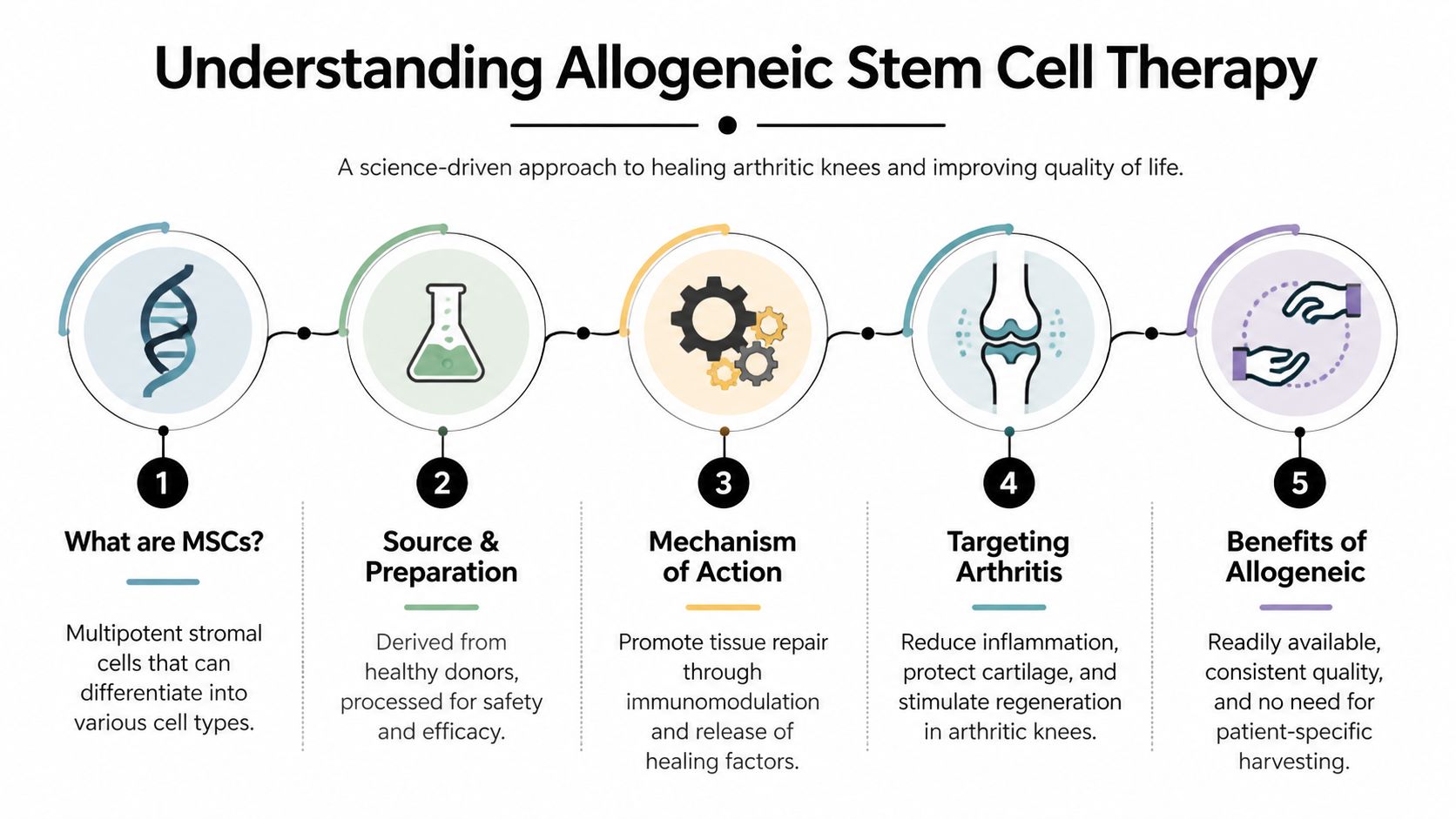
What MSCs are doing inside an arthritic knee
An arthritic knee is not just a worn hinge. It is an inflamed joint environment. Cartilage is stressed, synovial tissues can remain irritated, and the joint fluid often loses some of its protective quality. MSC therapy aims to intervene in that environment.
A 2025 Cochrane review on stem cell injections for knee osteoarthritis found that stem cell injections improve pain and function versus placebo, with better efficacy in Kellgren-Lawrence grade 3 osteoarthritis than in grade 4 disease. The same review noted mechanistic findings that MSCs may help by differentiating into chondrocyte-line cells and by improving synovial fluid properties, with biomechanical models showing friction coefficient reductions of 25 to 40 percent. It also reported that optimal dosing is 50 to 100 million MSCs, and that allogeneic umbilical MSCs were preferred for potency.
Why allogeneic cells matter
We use allogeneic cells rather than autologous cells. In practical terms, that means the cells come from screened donor tissue rather than from the patient being treated. This approach matters in longevity and orthopedic care because many knee arthritis patients are older, inflamed, metabolically stressed, or dealing with long-standing degeneration. Their own cells may not offer the same consistency or biologic vigor that a carefully prepared donor-derived product can provide.
For patients researching stem cell treatment Mexico, this is one of the biggest quality distinctions in the field. Cell source is not a minor detail. It affects consistency, readiness, and protocol design.
At a high level, MSCs may help by:
Modulating inflammation so the joint environment becomes less hostile.
Sending repair signals to local tissues through secreted factors and extracellular vesicles.
Supporting joint function by improving the biologic behavior of the tissues around cartilage.
Reducing symptom burden enough to make strength training, gait correction, and activity resumption more productive.
The cell types patients should ask about
Not all allogeneic cells are discussed with the same precision. A premium clinic should be able to explain why it uses one source over another, and when. In modern regenerative programs, that may include:
Placental cells for broad signaling and immunomodulatory applications
Wharton's jelly cells when a clinic prioritizes potency and orthopedic use
Adipose-derived cells in selected regenerative protocols
Endometrial cells for specialized biologic signaling contexts
Dental pulp cells in targeted regenerative applications
Patients should also understand that stem cells rarely work in isolation. Their signaling effects are often supported by the treatment environment around them, including imaging guidance, rehabilitation strategy, and adjunctive therapies. For a more detailed biologic overview, see how stem cell therapy works.
Clinical reality: The best regenerative result usually comes from matching the biologic tool to the stage of disease, not from using the same injection for every knee.
The Mexico Advantage Access, Innovation, and Clinical Freedom
Mexico matters in regenerative medicine for a reason that goes beyond travel convenience. The difference is not only cost. The more important difference is access to advanced biologic protocols within a physician-led framework that can be difficult to replicate in the United States.
Why patients cross the border for care
In the U.S., the regulatory environment around expanded allogeneic stem cell therapies is highly restrictive. That framework shapes what many clinics can offer, how they offer it, and how much flexibility physicians have in designing regenerative protocols. Mexico's regulatory pathway is different. For the patient, that can translate into access to treatments that are more advanced in formulation and more practical in delivery.
That does not mean every clinic offering regenerative medicine Mexico is excellent. It means the country gives excellent clinics more room to practice modern biologic medicine when they operate within proper oversight.
For knee arthritis, that matters because protocol quality often depends on more than a syringe. It depends on sourcing, cell handling, laboratory standards, and physician judgment.
What the evidence says about non-surgical relevance
The strongest practical reason patients consider stem cells for knee arthritis is that many want a non-surgical option with a credible medical basis. A multicenter MILES study summary published by Duke Health physicians reported that mesenchymal stem cell injections provided pain relief and functional improvement over corticosteroid injections, the established gold-standard treatment for knee osteoarthritis, over a 12-month period. The study involved 480 participants across four sites and found no superiority of the stem cell types over steroids, but both approaches significantly improved symptoms.
That finding is important because it supports a mature, non-hyped position. Stem cell therapy isn't automatically superior to conventional injections in the short term. But it may be a viable alternative for patients who want to avoid repeated steroid exposure and who are seeking a regenerative strategy rather than a purely anti-inflammatory pharmaceutical one that has shown, with repeated administration, to have long-term consequences.
A useful safety discussion is available in this review of whether stem cell therapy in Mexico is safe.
What Mexico can offer when the clinic is built correctly
The high-end value proposition of stem cell therapy Cabo or elsewhere in Mexico is not bargain medicine. It is coordinated care with access to advanced infrastructure. In a strong clinic, patients may receive:
Thorough medical review before any biologic treatment is approved
Advanced imaging and diagnostics to confirm the pain generator and disease stage
Allogeneic cell access without the delays and variability of self-harvest procedures
Integrated recovery planning that supports the injection rather than treating it as a standalone event
A short overview of the broader treatment options is helpful here:
Mexico versus the U.S. in practical terms
| Consideration | Mexico | United States |
|---|---|---|
| Access to allogeneic regenerative protocols | Broader at qualified clinics | Often more restricted |
| Integration of diagnostics and recovery therapies | Common in premium private centers | Varies widely |
| Physician time and treatment customization | Often more direct in concierge-style settings | Can be limited by practice structure |
| Quality range between clinics | Very wide, requires vetting | Also wide, but under different constraints |
Patients looking for the best stem cell clinics in Mexico or the best stem cell clinics in Cabo should focus less on geography and more on operating standard, lab quality, and medical depth.
Beyond the Brochure: A Framework for Vetting Stem Cell Clinics
Most patients know how to compare hotels. Very few know how to compare stem cell clinics. That's understandable. Websites tend to look polished, terminology is used loosely, and almost every provider claims to be advanced. For stem cells for knee arthritis, the key differences sit behind the brochure.
Start with the lab, not the lobby
If a clinic cannot clearly explain where its cells come from, how they are processed, and what quality controls are in place, stop there. This is the foundation.
A serious clinic should be able to discuss:
Cell source with precision, not generic phrases about "young cells"
Licensing and oversight for the biotechnology lab involved
Quality control procedures for identity, sterility, and handling
Lot consistency and release standards before clinical use
Beautiful interiors don't compensate for vague biologics. If you're researching a stem cell clinic in Mexico, ask harder questions than the marketing page invites.
Physician oversight is not optional
There is a major difference between a medical center that evaluates a knee thoroughly and a sales funnel that schedules injections. Knee arthritis isn't one diagnosis in one form. Some patients have inflammatory synovitis. Some have meniscal degeneration. Some have bone marrow edema, maltracking, or advanced joint collapse. The treatment discussion should reflect that complexity.
A knee injection is easy to sell. A proper candidacy discussion is harder, and it's what protects the patient.
Personalization matters more than slogans
A 2025 discussion of knee osteoarthritis stem cell treatment highlighted the importance of dosage and source selection based on patient age and disease stage, including a study in which different cell types were more effective for patients under or over 50. The key lesson is not that age alone determines treatment. The lesson is that one-size-fits-all protocols are weak medicine.
For knee injections, personalization should include:
Imaging review
Your MRI or X-rays should be interpreted in the context of symptoms, not treated as a sales trigger.Stage-specific planning
Earlier degenerative change often presents a different opportunity than advanced collapse.Delivery technique
Image-guided placement matters. Blind injection is not the premium standard.Recovery strategy
The joint has to be supported after treatment with sensible loading, rehabilitation, and activity progression.
Red flags patients should take seriously
Not every warning sign is dramatic. Some are subtle and common.
Claims of guaranteed cartilage regrowth
That's not how responsible regenerative orthopedics is discussed.No mention of physician credentials
If the medical oversight is hard to identify, that tells you something.Identical protocols for every patient
Knee osteoarthritis is too variable for assembly-line treatment.Heavy pressure to buy quickly
Good clinics don't need urgency tactics to secure appropriate patients.
A practical scoring lens
| Question | Strong answer | Weak answer |
|---|---|---|
| Where do the cells come from | Specific tissue source and lab controls | Vague branding language |
| Who decides candidacy | Physician after review of records and imaging | Coordinator after a phone call |
| How is the injection performed | Image-guided and anatomically targeted | General statement with no detail |
| How is follow-up handled | Structured monitoring and recovery guidance | Minimal contact after procedure |
This framework also helps patients evaluating the best longevity clinics in Mexico, the best longevity clinics in Cabo, or even the best longevity clinics in the world. Across all of those searches, one principle holds: biologic sophistication without quality control isn't sophistication at all.
The LMI Difference A Seamless Patient Journey
When a patient chooses a premium regenerative program, the experience should feel medically coherent from the first consultation onward. That means no abrupt handoff from education to sales, no vague protocol language, and no sense that the treatment plan was created before the history was reviewed.
For knee arthritis, the patient journey typically begins with records, imaging, symptom history, and a discussion of goals. Some patients want to keep playing sport. Others want to walk comfortably, delay knee replacement, or reduce dependence on repeat injections. Those goals shape candidacy and expectations.
Before arrival
The most important work often happens before travel. A thoughtful clinic reviews whether the knee is likely to respond, whether the problem is primarily arthritic or partly mechanical, and whether the patient should proceed with regenerative care at all. That is where high-quality medicine distinguishes itself. A patient with advanced collapse, major deformity, or pain driven by factors outside the joint may need a different pathway.
In a physician-led model, protocol design can also include whether additional support is warranted. That may involve imaging review, in-house laboratory assessment, or adjunctive therapies such as IV support or hyperbaric oxygen, depending on the broader health picture.
During treatment
At Longevity Medical Institute, care is organized around physician-led regenerative protocols supported by an in-house biotechnology and clinical diagnostic environment. For a knee arthritis patient, that means the injection is one part of a broader medical process rather than the entire encounter.
The treatment day itself should feel calm, precise, and well explained. Patients typically want to know where the cells are being placed, what discomfort to expect, and how the first days of recovery should be managed. Clear answers matter. So does clean execution.
The quality of a clinic becomes obvious in the small details. Who reviewed the MRI. Who performs the injection. Who answers questions after you return home.
After treatment
Long-term thinking is essential in knee arthritis. A retrospective 2-year study and 4-year follow-up summary on MSC therapy for knee osteoarthritis reported significant early improvements after treatment, while two-thirds of patients in a 4-year stem cell follow-up required no further knee pain interventions. That doesn't prove every patient will have durable benefit. It does show why follow-up, expectation setting, and re-evaluation matter.
A serious clinic doesn't disappear after the procedure. It tracks how the knee responds, adjusts activity guidance, and helps patients accurately interpret progress. Some improve steadily. Some plateau. Some need additional orthopedic planning. Premium care includes that reality rather than hiding it.
Your Questions on Stem Cell Therapy in Mexico Answered
Am I a good candidate for stem cells for knee arthritis
The best candidates are often patients with symptomatic knee osteoarthritis who still have enough joint structure for a biologic approach to make sense. In practical terms, that usually means persistent pain, stiffness, or activity limitation despite conservative care, with a desire to pursue a non-surgical strategy. Candidacy depends on imaging, symptoms, alignment, prior treatments, and the overall condition of the joint.
Patients with very advanced degeneration can still be evaluated, but expectations need to be more conservative.
Does stem cell therapy regrow cartilage
It shouldn't be presented that way. The more medically accurate explanation is that stem cells may help improve the joint environment, reduce inflammation, and support repair signaling. Some patients feel and function better without any proof that lost cartilage has been fully restored. For affluent patients used to polished medical marketing, this honesty matters.
How long do results last
This is one of the most important questions, and it deserves a measured answer. Short-term pain reduction is documented, but extensive data on 3 to 5 year outcomes remains limited, as noted in a discussion of long-term efficacy and emerging cord tissue MSC trends in knee osteoarthritis in this clinical overview. That same discussion also emphasized that stem cells appear to enhance repair signaling rather than directly replace tissue, especially in advanced osteoarthritis.
Some patients do well for an extended period. Others may need future treatment or may still progress toward surgery.
What does bone-on-bone arthritis mean for candidacy
"Bone-on-bone" usually signals advanced cartilage loss and a mechanically compromised joint. That doesn't automatically exclude treatment, but it does change the conversation. In advanced arthritis, regenerative therapy may still help symptoms in some cases, yet it is less likely to restore the kind of function seen in earlier-stage disease. The goal may shift from restoration to symptom control and delay of more invasive care.
Why do some clinics prefer Wharton's jelly or placental cells
Because cell source matters. Different allogeneic tissues offer different biologic profiles, handling characteristics, and clinical uses. In orthopedic settings, cord tissue derived products are often discussed because of their potency and signaling profile. Placental cells can also play an important role in regenerative protocols. The key is not which source sounds more impressive. It's whether the clinic can explain why it selected that source for your knee.
Are all stem cell clinics in Mexico basically the same
No. The spread in quality is wide. Some clinics operate with real medical depth. Others are mostly marketing entities with limited transparency. That's why patients should compare infrastructure, physician involvement, imaging standards, and laboratory quality before they compare price or location.
Is the procedure painful
Most patients tolerate it well. The knee can feel sore, full, or irritated for a short period afterward. What matters more than the moment of injection is how the procedure is performed and how recovery is managed. A precise image-guided injection into the right target is far more important than theatrical promises about a painless experience.
Should stem cells be combined with other therapies
Often, yes, but only when those additions are medically coherent. Some regenerative programs combine joint injections with IV stem cells, exosomes, peptides, physical medicine, or hyperbaric oxygen. The point of combination care is not to upsell. It's to support recovery, modulate inflammation, and improve the conditions in which the injected cells are working. Patients comparing protocols should also understand the financial side, including stem cell therapy cost, because bundled programs vary widely in what they include.
Is Mexico only attractive because it is cheaper
Not for the patient seeking premium care. The stronger reason is access to advanced allogeneic regenerative medicine in a setting that can integrate diagnostics, physician oversight, and recovery support. For many patients, the decision is about clinical freedom and treatment design, not bargain pricing.
What should I do before choosing a clinic
Ask for medical specificity. Request a candidacy review. Have your imaging evaluated. Ask how the cells are sourced and handled. Ask who performs the injection. Ask how follow-up works after you return home. If those answers are vague, move on.
Begin Your Journey to Regeneration
Stem cells for knee arthritis deserve neither dismissal nor blind optimism. They deserve careful patient selection, biologic discipline, and realistic goals. For the right patient, treated in the right setting, regenerative therapy may offer meaningful improvement in pain and function and may provide a credible non-surgical option when conventional care has stopped moving the needle.
Mexico has become central to this conversation because it can offer access to advanced allogeneic regenerative medicine within a premium private-care model. But geography alone doesn't create quality. Key differentiators are the laboratory behind the cells, the physicians behind the plan, the imaging behind the procedure, and the honesty behind the recommendations.
Patients searching for stem cell treatment Mexico, regenerative medicine Mexico, stem cell therapy Cabo, or the best stem cell clinics in Mexico should use a stricter filter than marketing language. The right clinic should be transparent, medically rigorous, and comfortable discussing what stem cells can do, what they can't do, and when another path may be more appropriate.
That same standard applies if you're also comparing the best longevity clinics, the best longevity clinics in Mexico, the best longevity clinics in the world, or the best longevity clinics in Cabo. In every case, true quality is built on systems, not slogans.
Author: Dr. Kirk Sanford, DC, Founder & CEO, Longevity Medical Institute. Dr. Sanford focuses on patient education in regenerative and longevity medicine, translating complex therapies into clear, practical guidance for patients.
Medical Review: Dr. Félix Porras, MD, Medical Director, Longevity Medical Institute. Dr. Porras provides clinical oversight and medical review to help ensure accuracy, safety context, and alignment with current standards of care.
Last Reviewed: May 2, 2026
This information is for educational purposes only and is not medical advice. It does not replace an evaluation by a qualified healthcare professional. For personalized guidance, please schedule a consultation.
If you're considering a physician-led regenerative program for knee arthritis, Longevity Medical Institute offers consultations for patients seeking a more rigorous, personalized path in advanced longevity and orthopedic care.