

Stem Cells for Rheumatoid Arthritis: A Patient's Guide
Living with rheumatoid arthritis (RA) often feels like a relentless battle against your own body. Even with the best conventional care, the daily reality of joint pain, stiffness, and fatigue can persist, leaving you searching for a more fundamental solution.
While traditional therapies like DMARDs and biologics are often the first line of defense, they primarily work by suppressing symptoms. They quiet the alarm bells but don’t always address the root cause—an immune system that has become confused and is attacking your own healthy tissues. This is where the entire field of regenerative medicine offers a different path forward.
A New Path Beyond Conventional RA Treatment
The potential of using stem cells for rheumatoid arthritis introduces a completely different philosophy. Instead of just blocking inflammation, regenerative medicine aims to work with the body, using its own powerful signaling systems to restore balance and re-educate a dysfunctional immune response.
This is the core of allogeneic stem cell therapy. The goal isn't simply to turn down the volume on inflammation. It's to fundamentally change the conversation happening at a cellular level, guiding the immune system away from a state of chronic attack and toward one of intelligent, regulated healing.
Rather than simply blocking inflammation, allogeneic stem cell therapy is designed to intelligently modulate the immune system. Think of it as providing your body with sophisticated biological communicators that guide it back toward a state of equilibrium and repair.
This guide is designed to be your resource for understanding this advanced, science-backed approach. We'll cut through the complexity and provide clear, practical insights into how this therapy works, who it can help, and what to expect.
What This Guide Covers
Our goal is to give you a clear and comprehensive overview, empowering you to make informed decisions about your health. We will explore:
The Science: How specialized cells can calm the destructive immune response that drives RA.
The Evidence: A patient-friendly breakdown of clinical trial results and safety data.
The Process: What to expect from your treatment journey, from initial consultation to long-term follow-up.
Candidacy: How our physicians determine if this therapy is a suitable and promising option for you.
This article provides the foundational knowledge for anyone considering new options for managing RA. If you're new to this topic, you can first learn more about the fundamentals of stem cell therapies and regeneration in our detailed guide. We are committed to translating complex science into practical information, giving you the clarity and confidence you need to explore the future of your health.
How Stem Cells Work to Calm Rheumatoid Arthritis
To understand how stem cells for rheumatoid arthritis can be so effective, it helps to first rethink what's happening inside the body. Imagine your immune system is a highly trained security force, designed to protect you from genuine threats. In RA, there’s a critical case of mistaken identity. This security force begins to attack your own healthy joint tissue, triggering a state of constant, painful inflammation—a "friendly fire" incident that never seems to end.
Most conventional treatments act like a temporary ceasefire, trying to suppress the attack with brute force. Allogeneic Mesenchymal Stem Cells (MSCs), however, operate on a much deeper level. They aren't just construction workers sent to patch up damage. Their most vital role in this scenario is that of an expert negotiator, deployed to restore order and re-establish peace at the cellular level.
These MSCs are masters of biological communication. Once introduced into your system, they travel directly to the sites of inflammation and begin a sophisticated dialogue with your overactive immune cells.
The Power of Immunomodulation
The primary way MSCs address RA is through immunomodulation. This isn't the same as the broad-spectrum immune suppression that many RA drugs cause. Instead of shutting down your entire defense system, MSCs selectively calm the specific inflammatory signals that are driving the disease.
Think of it as retraining the confused security force rather than disbanding it. MSCs release a powerful cascade of anti-inflammatory and regulatory signals that essentially instruct your immune cells to stand down from their attack on your joints.
MSCs act as intelligent biological signals, guiding the immune system away from self-attack and toward its normal function of surveillance and protection. This targeted approach helps reduce systemic inflammation without compromising your body's ability to fight off genuine threats.
This intelligent modulation is the key to achieving a more fundamental rebalancing of your system. The goal is to create an internal environment where your body’s own healing mechanisms can finally take over, free from the constant assault of autoimmune inflammation. To see the science in more detail, you can read our comprehensive guide on how stem cell treatment works.
Re-establishing a Healing Environment
By calming this overactive immune response, MSCs accomplish several critical objectives for patients with rheumatoid arthritis:
Reduction of Pro-inflammatory Cytokines: They help downregulate the production of inflammatory proteins like TNF-alpha and IL-6, which are primary drivers of joint pain and tissue destruction in RA.
Promotion of Anti-inflammatory Signals: They encourage your body to produce its own anti-inflammatory molecules, like IL-10, which help to resolve inflammation and promote tissue balance.
Protection of Cartilage: By reducing the inflammatory attack on the synovium (the lining of the joints), MSCs can help protect your existing cartilage from further degradation.
This multi-faceted approach is precisely why MSCs are a major focus in autoimmune disease research. In a review of nearly 500 stem cell trials for autoimmune rheumatic diseases, 12.6% specifically targeted RA, making it one of the most studied conditions. The vast majority of these trials (75.8%) utilized MSCs for their unique ability to modulate immune responses without broad suppression. You can explore more about these clinical trial trends and findings in recent research analyses.
At Longevity Medical Institute, we exclusively use potent, ethically sourced allogeneic MSCs derived from umbilical cord tissue. This ensures a consistent, high-quality cellular product designed to deliver these powerful immunomodulatory effects and provide a sophisticated approach to managing rheumatoid arthritis.
What Does the Clinical Evidence Say About Stem Cell Therapy?
When you’re exploring a new treatment for rheumatoid arthritis, the single most important question is: “Does the science actually back it up?” It’s one thing to hear anecdotes, but it’s another to see hard data. For anyone considering stem cells for rheumatoid arthritis, understanding the clinical evidence isn't about deciphering complex medical journals. It's about knowing what success looks like and what the results really mean for your pain, mobility, and daily life.
At Longevity Medical Institute, our entire approach is driven by data. We believe an empowered patient is one who understands the science behind their care. Here, we’ll break down the key findings from clinical studies, focusing on the outcomes that truly matter to someone living with RA.
Measuring What Matters in RA Trials
In serious clinical research, "feeling better" isn't enough. Scientists need objective, standardized ways to measure a treatment's impact on rheumatoid arthritis. This is how we separate hope from genuine biological change.
When you look at high-quality studies, you'll see a few key metrics used to track progress:
DAS28 (Disease Activity Score 28): This is the gold standard for measuring RA activity. It’s a comprehensive score combining a physical exam of 28 joints for tenderness and swelling, your own assessment of your overall health, and blood tests for inflammatory markers. A significant drop in your DAS28 score means your disease is genuinely becoming less active.
ACR Response Criteria (e.g., ACR20, ACR50): Developed by the American College of Rheumatology, this measures how much your symptoms have improved. An ACR20 response, for instance, means you've seen at least a 20% improvement in tender and swollen joint counts, plus improvement in other key areas like pain and daily function.
Inflammatory Markers (CRP and ESR): These are simple blood tests that provide objective proof of what's happening inside your body. C-reactive protein (CRP) and erythrocyte sedimentation rate (ESR) both measure systemic inflammation. Watching these numbers go down shows that the underlying inflammatory fire of RA is being brought under control.
Understanding these scores is key. When a study shows a significant drop in DAS28 or a high rate of ACR20 responses, it’s providing concrete proof that the therapy is doing more than just masking symptoms—it's actively quieting the disease process that causes joint pain and damage.
Key Findings From Allogeneic MSC Research
The research on allogeneic Mesenchymal Stem Cells (MSCs) for RA is getting more and more compelling. The best studies are rigorous, comparing the stem cell therapy directly against a placebo to prove that the benefits are real.
One landmark study, a multicenter, double-blind, placebo-controlled trial, gave us a clear window into how MSCs perform. In this trial, 53 patients with active RA were given allogeneic MSCs. The results were measured and clear.
This table highlights the key outcomes from that pivotal trial, showing how patients who received MSCs improved compared to those who received a placebo.
Key Outcomes from a Landmark Allogeneic MSC Trial for RA
| Metric | Result in MSC Group | Key Takeaway |
|---|---|---|
| ACR20 Response | 20% to 45% of patients achieved this at one month post-treatment. | A significant portion of patients experienced a tangible reduction in RA symptoms shortly after therapy. |
| Sustained Benefit | 15-25% of patients maintained their ACR20 response at the three-month mark. | The benefits were not just immediate but showed durability for a notable group of patients. |
| Inflammatory Markers | Significant drops were recorded in both DAS28-ESR and CRP levels. | This provides objective biological proof that the therapy was reducing systemic inflammation. |
| Study Link | NCT03333681 | These findings come from a carefully controlled clinical environment, adding weight to their validity. |
What this shows is that even in a difficult-to-treat patient group, a single infusion of MSCs produced measurable, meaningful improvements. It's this kind of data that builds the foundation for using these therapies in a clinical setting.
The Outstanding Safety Profile of MSCs
Of course, effectiveness is only half the story. For any new therapy, safety is paramount. Here, the data is exceptionally positive. A major systematic review and meta-analysis, which pooled the results from multiple RA trials, reported no life-threatening adverse events linked to MSC treatment.
Even more reassuring, the overall rate of side effects in patients who received MSCs was found to be statistically the same as in those who received a placebo. This tells us the therapy is remarkably well-tolerated.
This strong safety record is one of the main reasons allogeneic MSCs are such a promising option for autoimmune conditions. The therapy works by intelligently modulating the immune system, not by shutting it down completely. This avoids the significant risks that often come with broad immune suppression. If you're interested in learning more, our overview of stem cell therapy for autoimmune and inflammatory diseases goes into greater detail. This science-backed, safety-first philosophy is the bedrock of every protocol at our institute.
What to Expect From Your Treatment Journey
Choosing to embark on a regenerative treatment plan is a significant decision. We believe the entire experience should feel as restorative as the therapy itself. Your journey with us is a seamless, physician-led process designed around your unique biology and clinical needs, all while prioritizing your personal comfort.
It is a partnership built on trust, transparency, and an unwavering commitment to excellence. From your first conversation, our focus is squarely on you, moving beyond one-size-fits-all protocols to create a therapeutic strategy that is meticulously aligned with your specific health goals.
The Initial Physician Consultation
Your journey with us begins not with a procedure, but with a conversation. The first step is a one-on-one consultation with your physician, where we get to know you, your health history, and your goals for managing rheumatoid arthritis.
This is a comprehensive deep dive. We’ll review your previous treatments and current symptoms to determine if using stem cells for rheumatoid arthritis is the right path for you. This is the foundation of your entire program.
Personalized Diagnostics and Protocol Design
Once we confirm you are a candidate, we move into a full diagnostic evaluation. It’s impossible to treat what you can’t see, so we use advanced diagnostics—including our in-house clinical laboratory—to get a precise, detailed picture of your current biological state. This data is the blueprint for your therapy.
Our medical team then analyzes this information to design a treatment protocol that is yours and yours alone. This is not a "one-size-fits-all" clinic. Your plan is crafted based on your unique biology and health objectives.
Your treatment plan is never a generic solution. It is a carefully crafted protocol based on in-depth diagnostic data, ensuring that every aspect of your therapy is aligned with your individual health profile and wellness goals.
The Treatment Process: A Minimally Invasive Experience
The core of your therapy is surprisingly straightforward and comfortable. Your treatment will involve a simple intravenous (IV) infusion of our highly vetted, potent allogeneic Mesenchymal Stem Cells (MSCs).
The entire procedure is minimally invasive and performed by our expert medical staff in our state-of-the-art clinical setting. Most patients find the experience relaxing, much like receiving a standard vitamin IV drip. There is virtually no downtime, and you can return to your daily activities shortly after the infusion is complete.
This infographic breaks down our streamlined therapeutic process.
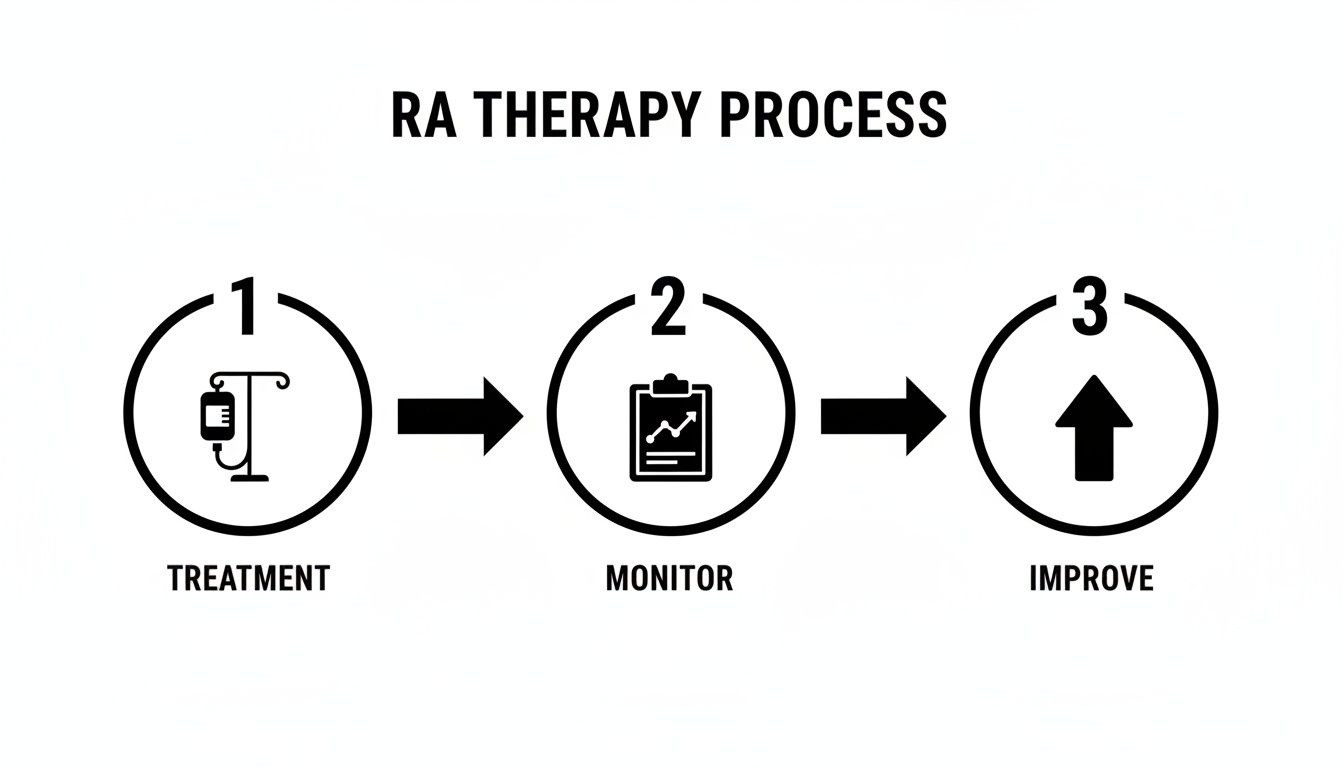
As you can see, the journey doesn't end with the infusion. It transitions into a structured phase of monitoring to track your progress and support long-term improvement. While RA therapy is systemic, we also offer targeted protocols for specific joint issues. You can learn more about this in our guide to stem cell treatment for joints.
Structured Follow-Up and Ongoing Support
True success is measured over time. Our commitment to you extends far beyond the day of your treatment. We have a structured follow-up plan designed to monitor your progress, track changes in inflammatory markers, and assess improvements in your symptoms.
This ongoing relationship allows our physicians to provide continuous guidance and support. Our concierge-level approach ensures you feel informed and confident at every stage, providing a safe and effective experience for our international patients seeking a higher standard of care. This is how we partner with you to achieve lasting results.
Determining if You Are a Candidate for This Therapy
When exploring an advanced treatment like allogeneic stem cell therapy, the first and most important question is always: "Is this the right path for me?" The answer isn’t a simple yes or no. It comes from a careful, highly personalized assessment by our medical team, designed to ensure every patient we treat has a strong potential for a successful outcome.
This commitment to responsible, physician-led care is the foundation of our entire practice. It's about partnership and clarity from day one.
So, who is the ideal person to consider stem cells for rheumatoid arthritis? Typically, it’s someone with a confirmed RA diagnosis who is still grappling with active disease, even after trying conventional treatments. If you’ve been on disease-modifying antirheumatic drugs (DMARDs) or biologics but are still fighting joint pain, swelling, and relentless inflammation, this therapy could be a very promising next step.
We look for patients who are not just chasing symptom relief but are truly motivated to address the underlying immune dysfunction that's driving their condition.
Who Is Most Likely to Benefit?
A key part of determining candidacy is looking at the degree of disease activity and how it's impacting your quality of life. Clinical trials often focus on patients with significant functional limitations, because this is where the intelligent immunomodulatory effects of Mesenchymal Stem Cells (MSCs) can make the most profound difference.
For instance, one phase I/II trial focused specifically on recruiting active RA patients who had at least six swollen joints and were dealing with significant functional impairment. This mirrors the real-world scenario of individuals whose daily lives are heavily impacted by the disease and who haven't found the relief they need from standard care. You can learn more about the specific patient criteria used in this important study here.
Globally, 83.6% of vetted autoimmune stem cell trials are in these early phases, which highlights the intense focus on establishing safety and identifying effectiveness in specific groups, like those with treatment-resistant RA.
Candidates who often see the most benefit are those who:
Have a confirmed RA diagnosis with persistent, ongoing inflammation.
Have not reached their health goals with one or more conventional RA medications.
Experience functional limitations that get in the way of their daily activities and work.
Are looking for a therapy designed to intelligently modulate the immune system, not just suppress it.
Essential Safety and Exclusion Criteria
Just as important as identifying who can benefit is knowing who is not a suitable candidate at this time. Your safety is our absolute highest priority. Certain health conditions can make stem cell therapy inappropriate or unsafe, and this careful screening process is critical for ensuring responsible, positive outcomes.
At Longevity Medical Institute, candidacy is not just about eligibility; it's about suitability. Our rigorous evaluation process is designed to protect your health and ensure that the therapy is aligned with your specific biological profile and wellness objectives.
For your safety and the therapy’s effectiveness, we are completely transparent about contraindications during your initial consultation. These are non-negotiable criteria that would make a patient ineligible for treatment.
Key contraindications include:
Active Infections: Your body must be completely free of acute or chronic infections before undergoing any therapy designed to modulate the immune system.
Certain Types of Cancer: A history of specific malignancies requires a careful review by our medical board to ensure absolute safety.
Severe Organ Failure: Advanced heart, lung, kidney, or liver disease may make you ineligible for treatment.
Pregnancy or Breastfeeding: We do not administer therapy to patients who are pregnant or nursing.
This thorough evaluation ensures that exploring stem cells for rheumatoid arthritis is a medically sound and responsible step on your health journey.
Your Questions About Stem Cell Therapy Answered
Exploring a new therapy like this is a big step, and it’s only natural to have questions. We believe a well-informed patient is an empowered one, so this section is designed to give you clear, straightforward answers to the inquiries we hear most often.
Our commitment is to complete transparency, ensuring you feel secure and knowledgeable at every point in your health journey.
Where Do Your Stem Cells Come From?
This is easily one of the most important questions you can ask, as it goes right to the heart of safety, quality, and effectiveness. At Longevity Medical Institute, we exclusively use allogeneic Mesenchymal Stem Cells (MSCs) that come from ethically donated, full-term human umbilical cords.
The way we select our cellular products is incredibly strict and goes well beyond what’s standard in the industry.
Completely Ethical Sourcing: All donations come from healthy, consenting mothers after a full-term, live birth. The umbilical cord tissue, which is normally just discarded, is collected with absolutely no risk to the mother or her baby.
Intensive Donor Screening: Mothers go through extensive reviews of their medical and social histories, and we perform serological testing for a whole host of communicable diseases.
Uncompromising Lab Standards: Our cells are isolated and processed in a state-of-the-art, ISO-certified biotechnology lab that follows the most rigorous quality control protocols. Each and every batch is meticulously screened for its purity, viability, and potency before it is ever approved for patient use.
This absolute dedication to sourcing and quality is how we guarantee a consistent, powerful, and safe therapeutic for every single person we treat.
How Soon Will I See Results and How Long Will They Last?
The timeline for feeling the benefits is different for everyone. It really depends on things like the severity of your RA, your overall health, and how your body uniquely responds to the therapy. While there’s no single answer, our clinical experience gives us a good general framework.
Many patients start noticing the first positive changes within a few weeks to three months after their treatment. These early signs are often things like less joint pain, a reduction in morning stiffness, and a welcome boost in energy. For others, the improvements are more gradual, unfolding over a six-month period as the MSCs get to work rebalancing the immune system and calming down that systemic inflammation.
It is essential to view this therapy not as a quick fix, but as a strategic intervention designed for sustained, long-term benefit. The goal is to fundamentally rebalance your immune response, leading to lasting improvements in your quality of life.
Our physician-led follow-up program is specifically designed to track your progress and support these long-term results, allowing us to make any adjustments needed to help you reach and maintain your health goals.
Is the Procedure Painful?
We get it—the idea of any medical procedure can make you feel a little anxious. But you can rest assured that the stem cell infusion itself is a comfortable and minimally invasive experience. The therapy is given through a simple intravenous (IV) drip, which feels no different than getting a standard vitamin infusion.
You’ll be in a calm, professional clinical environment, looked after by our expert medical team the entire time. The infusion itself is painless, and most of our patients just relax, read a book, or listen to music during the process. There is no significant downtime required, and you can usually get right back to your normal routine shortly after it’s done.
How Is Your Clinic Safe for International Patients?
Patient safety is the absolute foundation of our practice, and that’s especially true for the many patients who travel to us from the United States and Canada. We have built our institute from the ground up to meet—and in many cases, exceed—the tough standards you’d expect from a premier medical facility back home.
Our commitment to your safety is clear in a few key areas:
Official Licensing: We are fully licensed by COFEPRIS, which is Mexico’s federal health authority and is the equivalent of the FDA in the United States. This holds us to the highest possible regulatory standards.
Physician-Led Care: A specialist physician oversees every single part of your treatment, from your first consultation all the way to your final follow-up. You are always under expert medical supervision.
Transparent Quality Control: We believe in total transparency, from our cell sourcing and lab standards right through to our clinical protocols.
We've created a secure, professional, and compassionate environment where you can focus on the one thing that matters: your healing. You can explore our comprehensive approach in our article that further explains how we ensure stem cell therapy is safe for all of our patients.
At Longevity Medical Institute, we provide physician-led, science-backed regenerative therapies. If you are ready to explore a more advanced approach to managing your health, we invite you to take the next step.
Schedule your personalized consultation today.
Author
Dr. Kirk Sanford, DC — Founder & CEO, Longevity Medical Institute. Dr. Sanford focuses on patient education in regenerative and longevity medicine, translating complex therapies into clear, practical guidance for patients.
Medical Review
Dr. Félix Porras, MD — Medical Director, Longevity Medical Institute. Dr. Porras provides clinical oversight and medical review to help ensure accuracy, safety context, and alignment with current standards of care.
Last Reviewed: March 24, 2026
Short Disclaimer
This information is for educational purposes only and is not medical advice. It does not replace an evaluation by a qualified healthcare professional. For personalized guidance, please schedule a consultation.