

The Stem Cell Clinic Test: 15 Questions Every Patient Should Ask
You're comparing clinics, the brochure stack is getting thicker, and one place is selling confidence while another is handing you documentation. That's the moment of decision. A polished website can look convincing, but The Stem Cell Clinic Test: 15 Questions Every Patient Should Ask turns the clinic into the one being evaluated, and that's exactly how you want it.
The stem cell field has real scientific milestones behind it. James Thomson's 1998 isolation of human embryonic stem cells and Shinya Yamanaka's 2006 reprogramming breakthrough built the modern regenerative medicine field, and that history matters because legitimate clinics should now be able to explain cell source, manufacturing controls, and evidence strength instead of hiding behind vague branding source. The market has grown quickly, but growth doesn't certify quality, and patients still need a hard filter before they book.
Why a Stem Cell Clinic Test Matters Before You Book
Maria is 54, has osteoarthritis, and just compared two clinics in Tijuana. Clinic A sent glossy brochures, big promises, and a fast payment link. Clinic B sent a short consultation summary with the diagnosis, a treatment rationale, and a list of documents they would show before treatment.
That contrast tells you everything. One clinic is selling an experience. The other is answering questions that can be verified.
Practical rule: if a clinic can't explain what it does in writing, don't assume it understands what it's doing in practice.
Regenerative medicine sits in a market where pricing varies widely, protocols are often wrapped in marketing language, and outcomes are rarely tracked in a way patients can review. That's why The Stem Cell Clinic Test should feel like a screening exam, not a courtesy checklist. You're not being difficult. You're forcing the clinic to prove it deserves your trust.
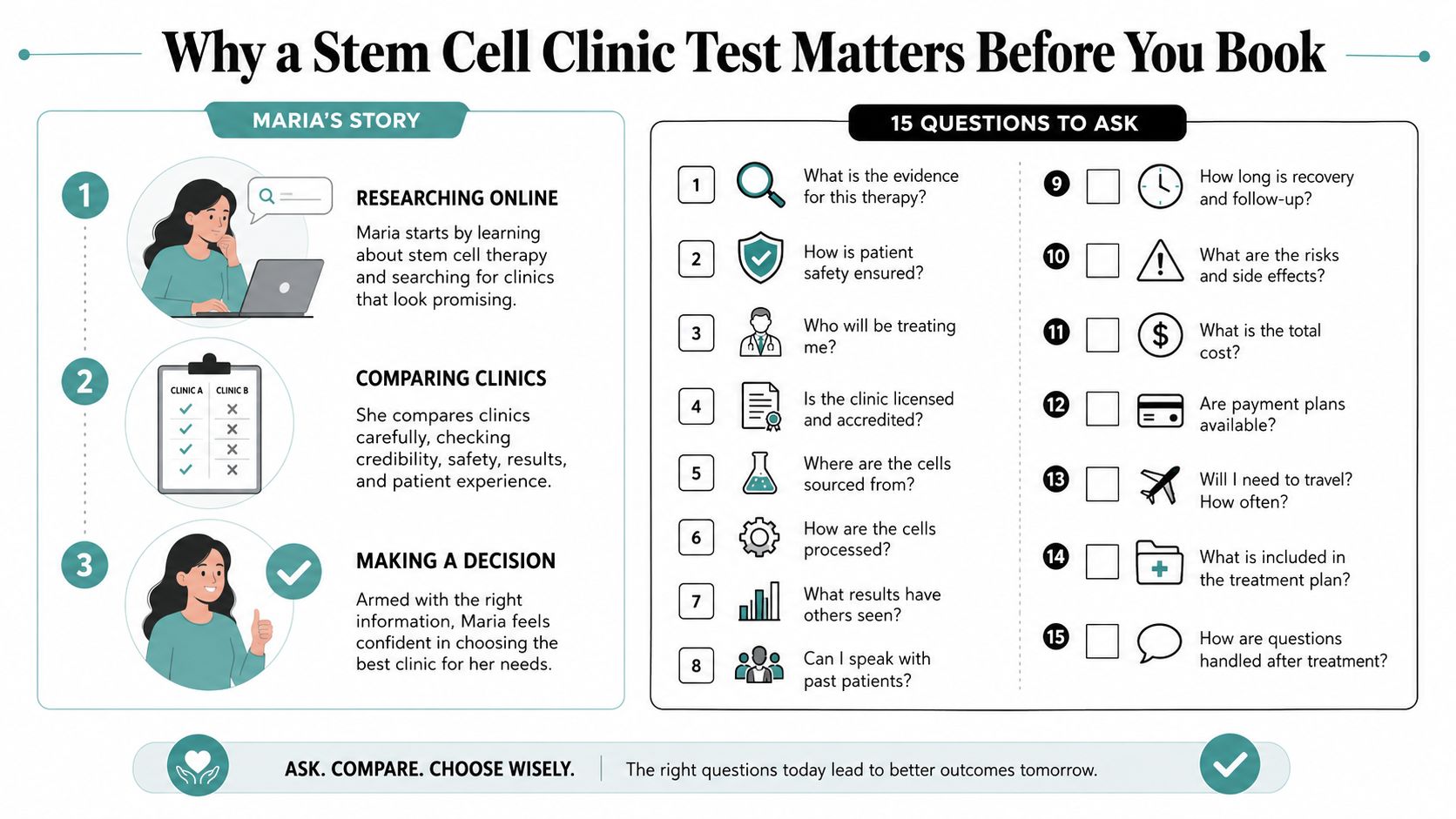
A serious clinic should welcome that pressure because it separates patient care from sales. In Mexico, due diligence matters even more, since COFEPRIS is the relevant authority and patients should ask clinics to show exactly what they're authorized to do, not just say they're “licensed” or “approved” regulated clinic guidance. If a clinic gets defensive when you ask for documentation, you've already learned something useful.
The Four Dimensions Every Clinic Answer Must Cover
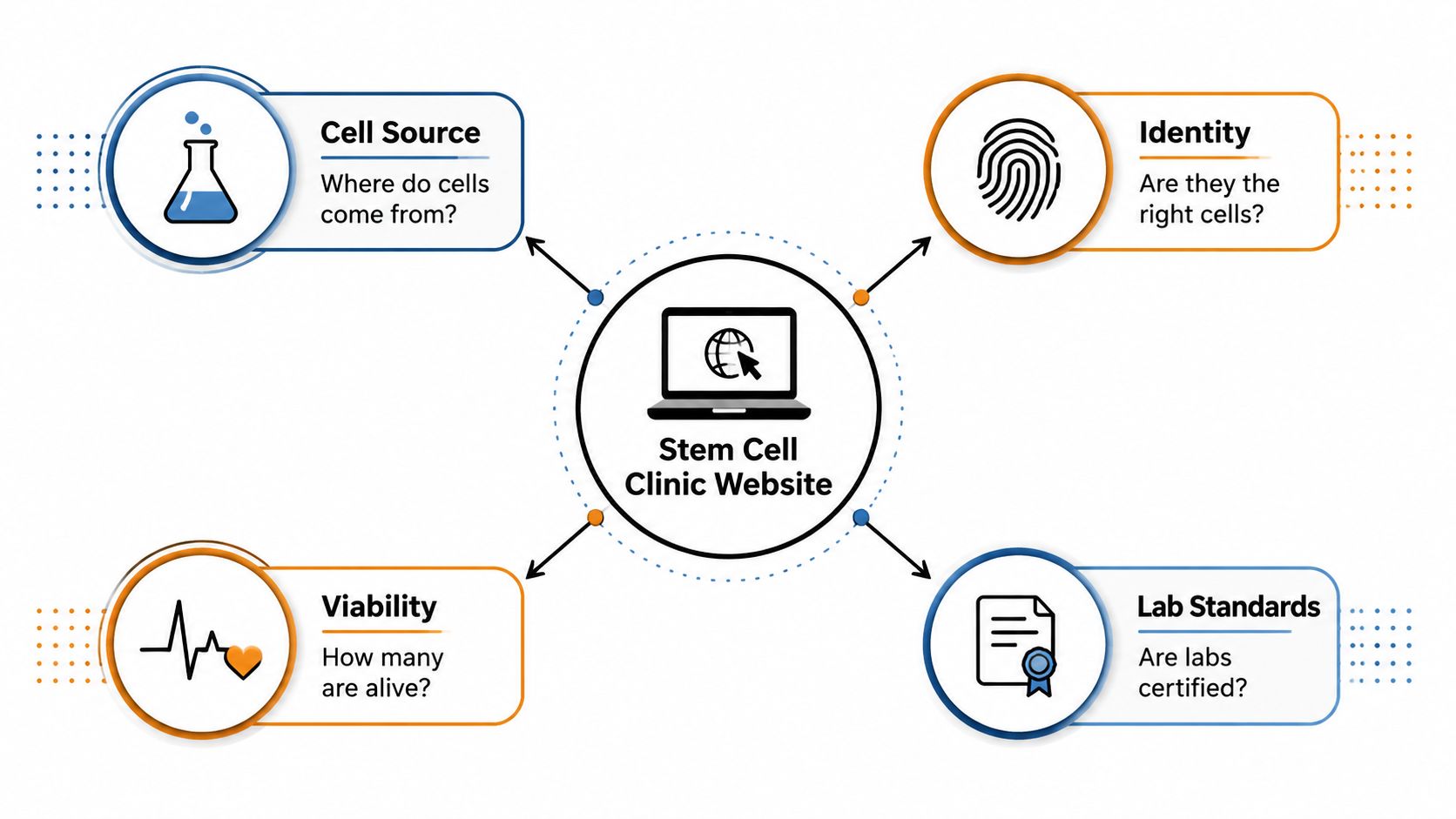
A polished website tells you very little. Lobby photos, glowing testimonials, and animated cell graphics do not answer the questions that decide whether a stem cell program is credible or safe. Use a framework that strips away presentation and forces clear answers.
Regulation
Start with authority. Who oversees the clinic, what is it allowed to do, and can you verify that independently? In the U.S., the FDA says regenerative medicine products need licensure or approval before they are marketed, and it has warned that unauthorized stem cell products have been sold directly to patients FDA patient information. In Mexico, ask for the clinic's operating notice and the specific authority covering the procedure.
People
Then check who treats you. A polished admissions team does not tell you whether the physician has the right expertise for your condition. You want the doctor's specialty, their role in decision-making, and the lab leadership behind the product, not vague references to “our medical team.”
Product
Many clinics get slippery with the product details. What exactly are the cells, where did they come from, how were they processed, and how were they released for use? A stem cell product without traceability is just a label.
Follow-up
A credible clinic does not stop at the injection. It has baseline diagnostics, clear complication pathways, and outcome tracking after you go home. If they cannot describe what happens after treatment, they are not running a medical program, they are running a transaction.
The 15 questions all map back to these four pillars. If a clinic fails one pillar, the rest of the pitch matters much less.
Licensing and Physician Credentials You Can Verify
Start with the paperwork, not the personality. If a clinic won't show you its regulatory authorization, you're not dealing with a serious medical operation. Ask for the exact permit, the authority that issued it, and the scope of what it covers.
| Question | What a Credible Answer Looks Like | Red Flag to Watch For |
|---|---|---|
| Is the clinic licensed? | A named regulator, a permit number, and a clear scope of practice | “We're fully approved” with no document |
| Who reviews your case? | A physician with a stated specialty and named role | Sales staff doing intake and treatment decisions |
| Is the doctor's license current? | Verifiable license and board status | No full name, no specialty, no public record |
| Who directs the lab? | A named lab director with relevant training | “Our science team handles that” |
| Is malpractice coverage active? | Written confirmation in the patient file | Evasive answers or no documentation |
In Mexico, COFEPRIS is the authority patients should ask about, and the clinic should be able to explain whether the product is covered by a facility authorization, a physician pathway, or another documented route. That's the level of precision you want. Anything fuzzier tells you the clinic is hoping you won't ask harder questions.
Acceptable answer: “Here's the permit, here's the physician of record, and here's what each credential means for your case.”
That's the tone you should expect from a credible clinic, not because they're being generous, but because documented answers protect both sides. If you want a practical starting point for reviewing a licensed program, the clinic guide at licensed stem cell clinic Mexico shows the kind of documentation a patient should request before committing.
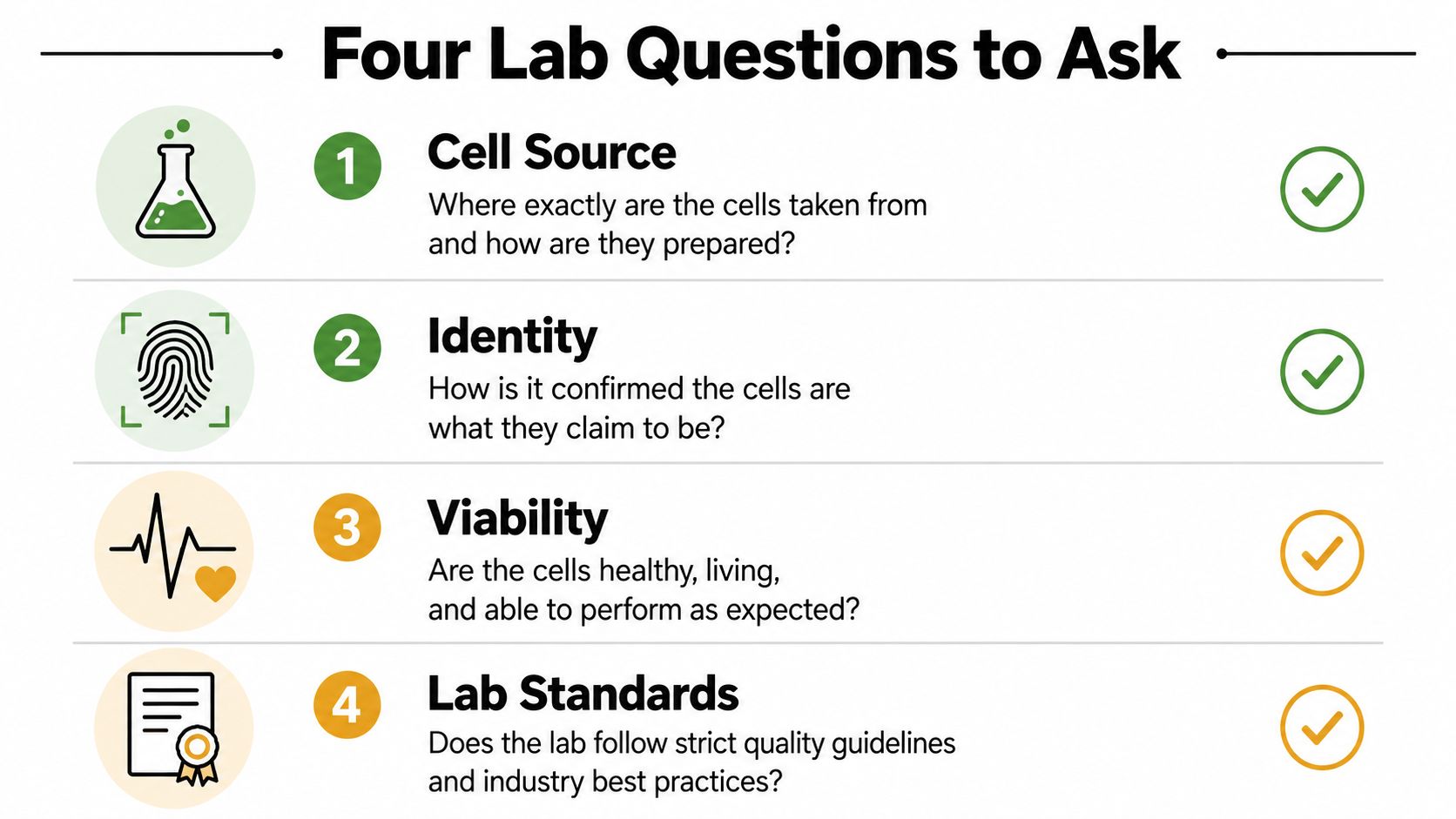
Cell Source, Identity, Viability, and Lab Standards
Marketing usually collapses here. A vial labeled “stem cells” doesn't tell you what you're getting, and it definitely doesn't tell you whether the product was handled well. You need the clinic to speak in specifics.
Cell Source and Identity
Ask where the cells come from. In plain language, that means whether they're allogeneic or from the patient, and whether they originate from tissue such as placenta, Wharton's jelly, adipose tissue, dental pulp, or another source. Allogeneic cells are obtained from someone other than the patient or an identical twin cell source definitions.
Then ask how the clinic knows the cells are what it says they are. A valid answer should mention lab testing, not trust. If they say the cells are verified, ask how.
Viability, Passage, and Sterility
Viability means how many cells are still alive and usable at the time of treatment. A clinic that advertises a huge cell count but can't tell you viability is selling a number, not a product. Ask for the cell count, viable count, and the passage number if the cells were expanded in culture.
Sterility testing matters just as much. You want to know whether the product was checked for contamination, whether donor screening was performed, and whether the result is documented before treatment. If the clinic can't show a Certificate of Analysis, don't move forward.
Lab Standards
A legitimate lab should be able to explain its processing environment and quality controls in clear terms. Look for references to cGMP, ISO standards, and COFEPRIS-aligned processing. The exact labels matter less than the clinic's ability to prove traceability, release criteria, and chain of custody.
If you want a strong patient-facing overview of how quality is built into processing, stem cell quality and how cells are made is the kind of resource that helps you ask sharper questions.
Ask for the paperwork before you ask for the treatment date. If they can't send a lot-specific quality document, they're asking you to buy blind.
Dosing, Route of Administration, and Evidence for Your Condition
Big numbers are easy to sell. They're also the least important part of the conversation if the clinic can't explain why that dose belongs to your diagnosis. A responsible provider starts with the condition, the route, the evidence, and the target outcome. The sales-driven provider starts with the number.
Dose Should Follow the Problem
There is no universal dose that fits every patient and every diagnosis. So when a clinic leads with “50 million,” “100 million,” or “200 million,” your next question should be simple, why this dose for me? The answer should connect to the condition, the delivery route, and the clinic's medical reasoning.
The same logic applies to evidence. For some conditions, human studies exist. For others, the evidence is still early or thin. Clinics should say that plainly, not blur the line between encouraging research and proven therapy.
Route Matters More Than Hype
An intravenous infusion does not do the same job as an intra-articular injection, and neither behaves like a spinal procedure. The route changes the risk profile and the level of evidence you should expect. A clinic that recommends the same route for every patient is giving you a template, not a medical plan.
| Route of Administration | Typical Conditions | Evidence Strength | Risk Profile |
|---|---|---|---|
| Intravenous infusion | Systemic or multi-site goals | Varies by condition | Broad exposure, needs careful screening |
| Intra-articular injection | Joint-focused problems | More targeted when appropriate | Procedure-related local risk |
| Spinal or intrathecal route | Selected neurologic contexts | Highly specialized | Requires strong justification and safeguards |
For ulcerative colitis, systematic reviews describe mesenchymal stem cells as promising because they may modulate immunity, suppress inflammation, and support tissue repair, but they also note unresolved challenges and limits in current clinical use UC review. Published experience is still relatively small and heterogeneous, with more than 200 treated patients across several trials and mixed delivery routes UC clinical review. For plantar fasciitis, the evidence base is even earlier, with fewer than 100 treated patients across all cell sources and no large sham-controlled Phase III trial plantar fasciitis review.
The right clinic won't overpromise. It will tell you where the evidence is stronger, where it's weak, and what success should realistically look like for your diagnosis.
Diagnostics, Safety, and What Happens After Treatment
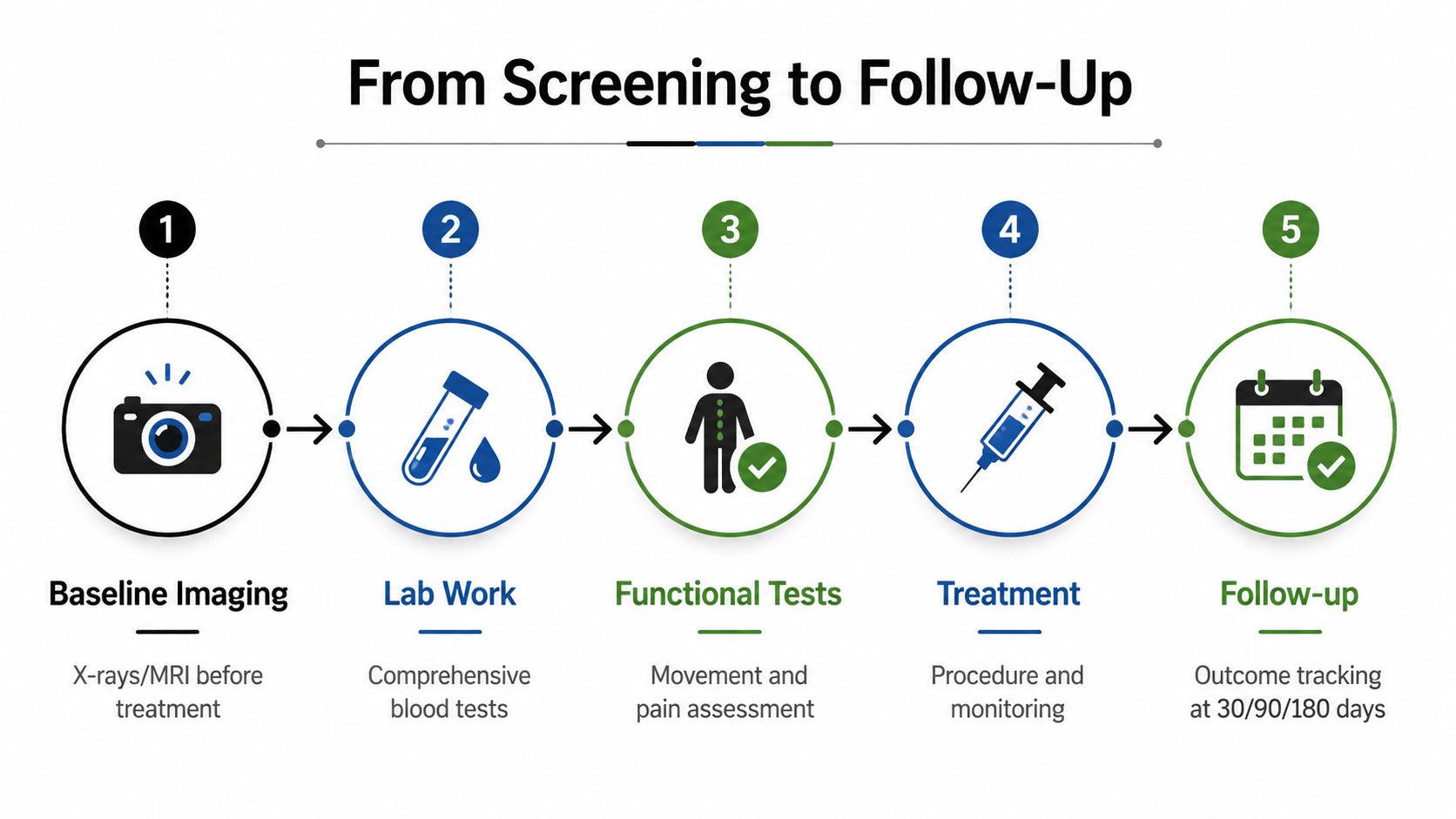
A real program starts before the infusion and keeps going after you leave. If a clinic asks for payment before baseline testing, that is a bad sign. You should expect imaging, labs, and a functional assessment before treatment, because regenerative medicine should support diagnosis, not replace it.
Safety Infrastructure Comes First
Ask who handles complications, where the procedure is done, and whether the clinic has an emergency transfer pathway. You want named physicians, proper medical equipment, and a clear hospital relationship if something goes wrong. If they wave that off, leave.
FDA guidance on regenerative medicine safety warns about tumor formation, immunologic reactions, unexpected cell behavior, migration from the injection site, and unknown long-term effects. Those risks do not disappear because a brochure looks polished. They need a real plan.
Follow-Up Has to Be Written Down
Before treatment, ask what happens after you go home. A credible plan includes remote check-ins, symptom tracking, and defined follow-up points. If the clinic cannot name a coordinator or explain how outcomes are measured, the process is incomplete.
Post-treatment care should also match the procedure itself. Recovery should be explained clearly, not left to guesswork, and a clinic should be able to tell you what monitoring looks like in practice. If you want a practical overview, recovery time after stem cell injection is worth reading before you book travel.
A clinic that pairs physician review, imaging, lab work, and surveillance under one roof is offering a different standard from a standalone infusion room. The difference is accountability, not marketing.
Bottom line: if the clinic does not know how it will manage you after the procedure, it does not fully know how it will treat you before it begins.
Stem Cell Clinic Red Flags You Should Never Ignore
Walk away if you hear guarantees of cure, pressure tactics, countdown discounts, or a demand for immediate wire transfer. Walk away if there's no named physician, no transparent cell source, no viability data, and no emergency transfer plan. Those are not minor gaps, they're disqualifiers.
A credible clinic does the opposite. It gives you a written consultation, itemized pricing, a named medical director, a Certificate of Analysis when appropriate, and a real adverse-event pathway. It also gives you time to think.
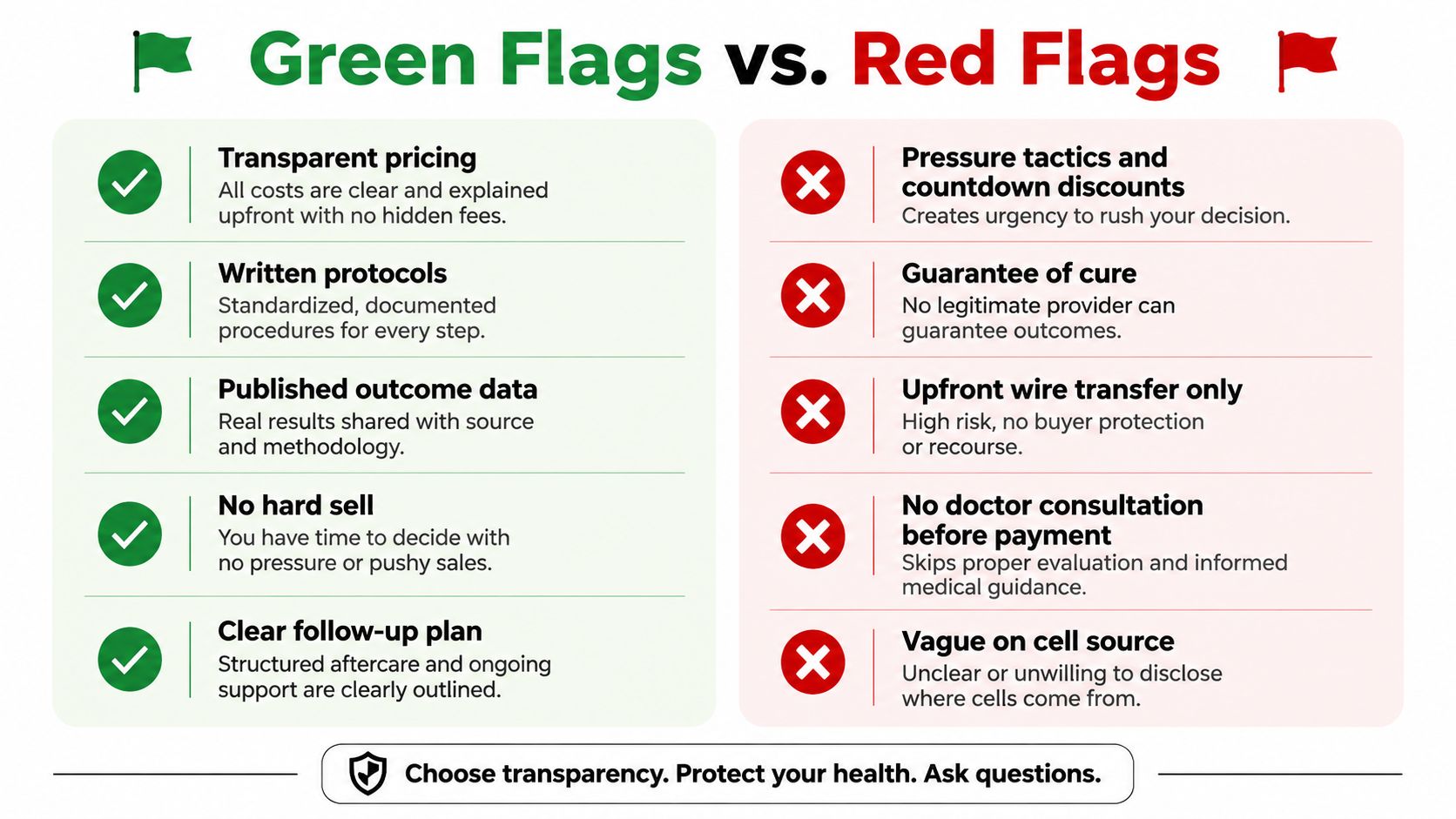
Testimonials can be emotionally persuasive, but they're not proof. Neither is a huge advertised cell count. The right standard is transparency, and if you want a clean benchmark for that standard, trust begins with safety and transparency is the attitude worth demanding from every clinic you contact.
Your Stem Cell Clinic Scorecard and Next Steps
After every consultation, score each answer in one of three ways. Full transparency with documents gets a green light. Partial answers that can be clarified in writing get a follow-up request. Evasive, sales-only, or inconsistent answers mean you should leave.
| Response Received | Score | Next Action |
|---|---|---|
| Clear, documented, specific | Green | Schedule screening labs |
| Some detail, but incomplete | Yellow | Request written clarification |
| Vague, pressured, or evasive | Red | Exit the process |
Use the scorecard like a decision filter, not a debate. Start with a telemedicine consult, request the clinic's red-flag answers in writing, verify COFEPRIS and physician status independently, and only then consider travel. If the clinic passes the test, you move forward with evidence. If it doesn't, you save your time, your money, and your health.
Longevity Medical Institute offers physician-directed regenerative medicine in Los Cabos with integrated diagnostics, a COFEPRIS-licensed environment, and an on-site biotechnology lab, so patients can ask the same 15 questions and get documented answers instead of marketing language. If you're comparing clinics and want a medically grounded starting point, visit Longevity Medical Institute to review how a patient-first stem cell program is structured before you book travel.
Published: August 27, 2026
This article is educational only. It does not provide personal medical advice or replace an individual evaluation by a qualified clinician. Peptide therapy works best when it is chosen with the same care as any precision treatment plan, after the right testing, a clear diagnosis, and a structured discussion of goals, benefits, and risk.