

UV Blood Irradiation: A Patient's Guide to This Therapy
You may be looking at UV blood irradiation because standard care has felt incomplete. Many patients reach this point after months or years of trying to calm inflammation, restore energy, or support recovery without wanting yet another approach that suppresses symptoms for a short window.
That's where light-based blood therapies become interesting. They sit at the intersection of physics, immunology, and circulation. They also raise valid questions. What exactly is being treated, how established is it, and how should it fit into a serious longevity plan rather than a trend-driven protocol?
An Introduction to Light-Based Cellular Medicine
Ultraviolet blood irradiation, often shortened to UVBI, is a therapy in which a portion of blood is exposed to a controlled amount of ultraviolet light outside the body and then returned through a closed system. For many people, the phrase sounds dramatic. In practice, the concept is more precise than it sounds. The goal isn't to flood the body with light. The goal is to create a measured biological signal.
If you're familiar with photobiomodulation therapy, you already understand the broader principle. Light can act as information. At the right dose, in the right setting, it may influence how cells behave rather than heating or damaging tissue.
Why people get confused
Patients often mix together several very different ideas:
Sun exposure
UVBI is not the same as going into the sun or using a tanning device. The treatment is controlled, extracorporeal, and medical.General “IV light” marketing
Some clinics use broad language that makes multiple technologies sound identical. They aren't. Device design, wavelength, blood handling, and oversight all matter.Modern photopheresis and historical UVBI
These are related but not interchangeable. One of the biggest mistakes in public discussion is treating every light-based blood procedure as if it were the same therapy.
UVBI makes more sense when you think of it as a highly controlled signaling intervention, not a wellness shortcut.
Why this topic matters in longevity care
A thoughtful longevity program looks for ways to influence terrain, not just symptoms. Terrain means the internal conditions that shape recovery, resilience, and physiologic stress. Blood is a useful medium in that conversation because it carries immune cells, oxygen, nutrients, metabolic signals, and inflammatory messengers throughout the body.
That's why UV blood irradiation continues to draw attention. It appeals to patients who want a physician-led approach that asks a deeper question: not just “What hurts?” but “What in the system keeps reinforcing poor recovery?”
The Science of How UVBI Works
The simplest analogy is this: UVBI is a brief light exposure intended to create a larger systemic response. It doesn't work by treating every drop of blood. Historically, the therapeutic idea was that a small treated portion could influence the whole organism.
A documented historical review notes that Emmett K. Knott introduced the technique in 1928, and that early work suggested the optimum effect came from treating only 5 to 7% of total blood volume. That same review describes ultraviolet light as spanning 100 to 400 nm across several bands, including UVC, UVB, and UVA, in the broader spectrum classification (historical UVBI review in the medical literature).
What the body may be responding to
Think of blood as a moving communication network rather than a simple transport fluid. When a small amount is exposed to light in a controlled circuit, several components may be affected at once:
Immune cells
These cells constantly assess threat, tolerance, and repair. A light-triggered shift may alter how the immune system interprets incoming signals.Red blood cells
Their flexibility and function matter because oxygen delivery depends on more than how much oxygen is present. It also depends on how efficiently blood moves through microcirculation.Plasma proteins and signaling molecules
These can act like the message layer of the bloodstream. Small changes in signaling can have wider downstream effects.
Why dose matters so much
One of the most important concepts in UV blood irradiation is that more isn't necessarily better. In cellular medicine, this is a familiar pattern. A helpful stimulus at one dose can become unhelpful at another.
Clinical lens: UVBI has always been a dose-sensitive concept. The therapy depends on precision, not intensity.
That helps explain why credible discussions of UVBI focus on calibration, device design, and protocol quality. If a clinic presents light exposure as automatically beneficial regardless of dose or method, that's a reason to slow down and ask better questions.
For patients who want a visual explanation of a combined approach, this overview of Trifusion therapy with ozone, UV, and LED shows how some modern protocols place UV within a broader extracorporeal treatment model rather than treating it as a stand-alone concept.
A useful way to think about mechanism
UVBI is often described too narrowly as if it “cleans” the blood. That framing is incomplete. A better model is controlled biological prompting. The treatment may nudge the system, and the body then carries out the larger response.
That distinction matters because patients often expect a direct, mechanical effect. In reality, many regenerative and longevity therapies work more like an orchestrated cue than a replacement part.
Your UVBI Procedure at the Institute
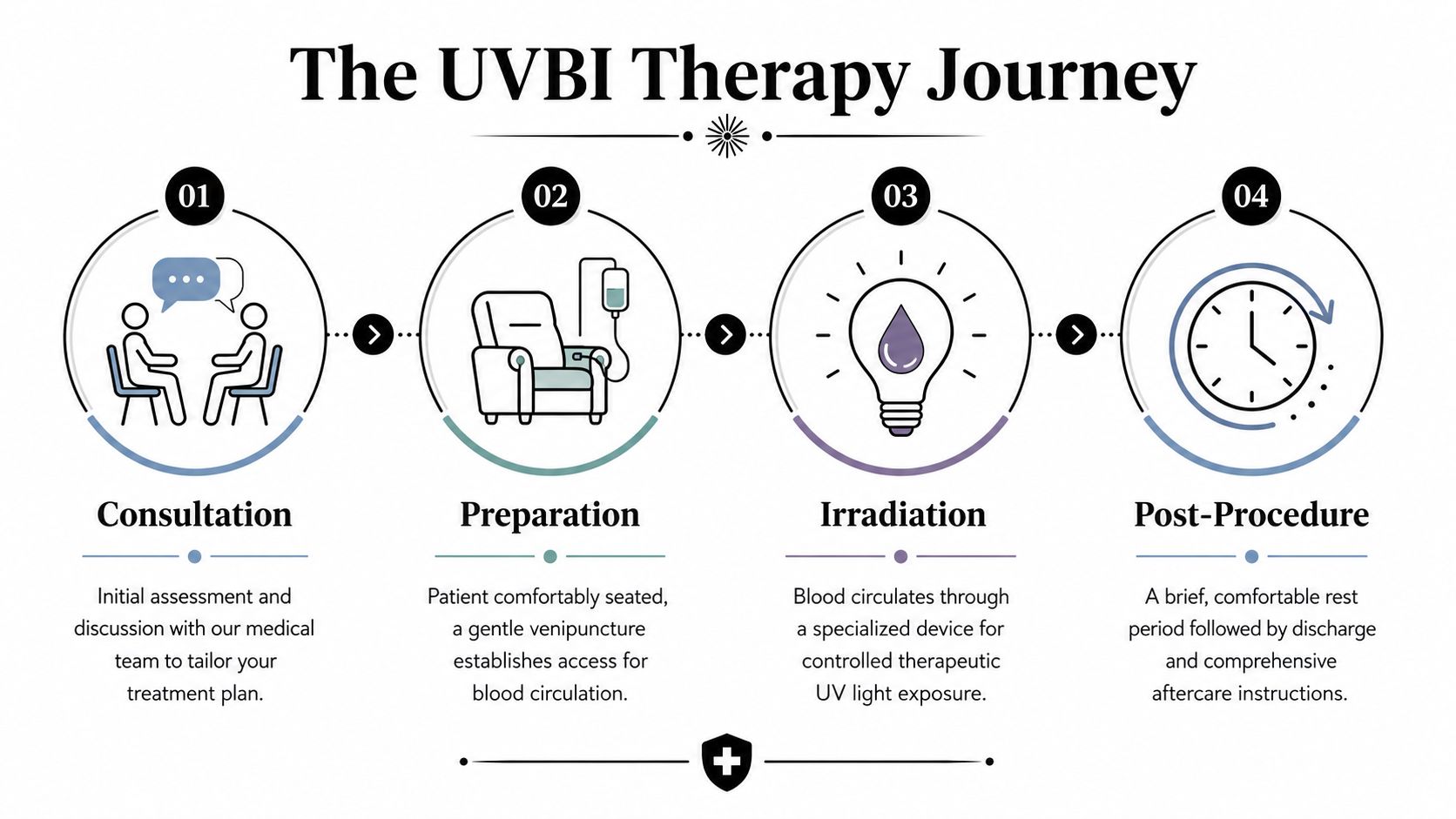
Most patients relax once they understand the flow of the visit. The procedure is less mysterious than the name suggests. It usually feels closer to a structured infusion appointment than to an invasive procedure.
What a typical session feels like
You arrive, settle into a treatment chair, and review the plan with the clinical team. After standard preparation, venous access is established. Blood moves through a sterile external circuit designed for controlled handling, receives its intended exposure, and returns through the same closed pathway.
During treatment, patients rest. Some read, listen to music, answer emails, or close their eyes. The session tends to feel uneventful in the best sense of the word. Clinical medicine often feels more reassuring when it is calm, measured, and transparent.
What patients should ask before proceeding
Because modern blood-light therapies vary, informed patients should ask direct questions. Not every clinic uses the same equipment or the same therapeutic model.
| Question | Why it matters |
|---|---|
| Which device or system is being used? | “UVBI” can refer to different setups and methods. |
| Is the blood handled in a closed sterile circuit? | This speaks to process control and safety. |
| Who supervises the procedure? | Physician oversight changes the quality of clinical decision-making. |
| Is this classic UVBI, a photopheresis-related method, or a combined protocol? | The category affects expectations and risk discussions. |
A related comparison some patients explore is therapeutic plasma exchange, which works very differently. Plasma exchange removes and replaces specific plasma components. UV blood irradiation, by contrast, is a light-based extracorporeal signaling intervention. They may appear similar from the chair, but biologically they are distinct.
Later in the visit, many patients want to see how combination therapies are presented in practice. This video offers that context:
Why environment matters
The room, staffing, and workflow aren't cosmetic details. They shape safety and patient experience. A blood-based therapy should feel medically organized, not improvised.
A well-run UVBI session should feel deliberate from beginning to end. Clear screening, controlled setup, and post-procedure guidance are all part of the treatment, not extras.
Clinical Evidence and Potential Applications
The most grounded way to evaluate UV blood irradiation is to separate established medical use from broader integrative use. That distinction protects patients from two common errors. One is dismissing the entire field because some claims are overstated. The other is assuming every marketed application has the same level of evidence.
Where UV-based blood therapy is established
In contemporary mainstream medicine, the narrow established descendant of this category is extracorporeal photopheresis. According to McGill's review, the FDA-approved U.S. indication is a form of cutaneous T-cell lymphoma. The same review notes that for non-approved uses, patients often pay $100 to $350 per treatment and usually need multiple sessions, which reflects limited insurance coverage and an out-of-pocket market (McGill analysis of UV blood irradiation and photopheresis).
That's an important anchor point. It tells us the broad historical idea didn't disappear, but it also didn't remain unchanged. Mainstream medicine evolved toward more controlled, cell-focused procedures.
Where the conversation becomes less certain
Outside approved indications, clinics may discuss UVBI in the context of immune imbalance, recovery support, chronic symptom patterns, or longevity protocols. Some clinicians and patients view it as a useful adjunctive tool. That language matters. Adjunctive means part of a plan, not a replacement for diagnosis, standard care, or clinical judgment.
A balanced interpretation looks like this:
Reasonable interest exists
Blood-light therapies continue to attract attention because they may influence immune signaling and systemic physiology.Evidence quality is uneven
Public discussion often moves faster than rigorous comparative data.Applications in wellness settings are broader than approved indications
That doesn't automatically make them wrong, but it does mean claims should be modest and individualized.
How to think like a careful patient
Ask whether a clinic is describing an approved medical indication, an off-label clinical application, or an experimental wellness use. Those are not the same category.
The strongest patient position is curiosity with standards. You can stay open-minded without accepting vague promises.
For people interested in longevity medicine, UV blood irradiation is best viewed as a therapy under active interest with a real historical and medical lineage, but with a narrower formal footing than marketing language sometimes suggests.
Benefits Risks and Patient Considerations
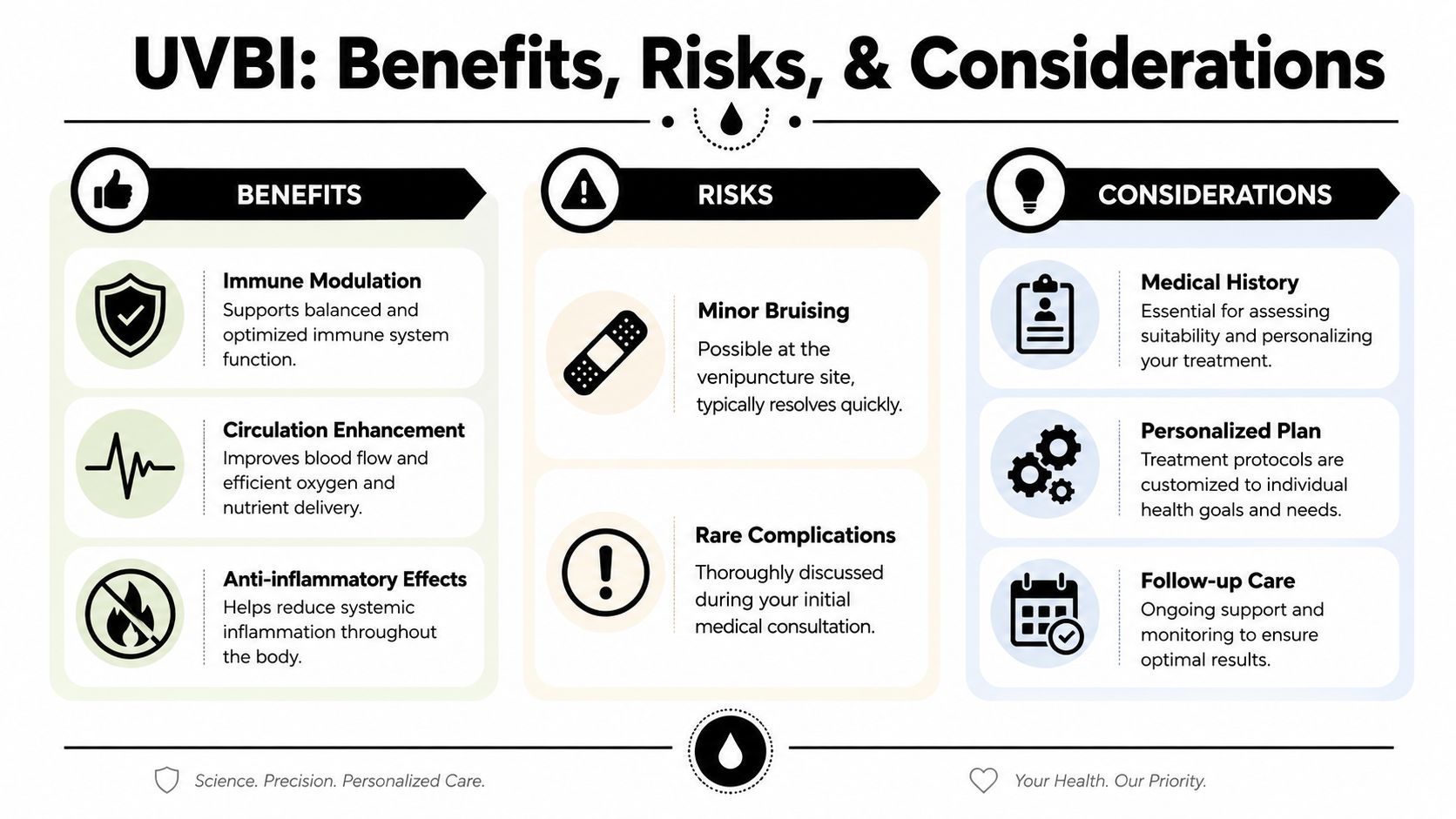
The most helpful way to assess UVBI is side by side. What makes it appealing is also what makes it easy to oversimplify. Patients like it because it is blood-based, non-surgical, and often integrated into broader recovery plans. But those same features can lead clinics to market it as universally gentle, universally useful, and universally low-risk without enough detail.
Potential upsides
Patients usually consider UV blood irradiation for a few broad reasons:
Immune support
Some protocols aim to help regulate an immune system that feels chronically reactive or poorly coordinated.Circulatory support
Because the therapy directly involves blood handling and light exposure, many people associate it with better physiologic efficiency and recovery.Adjunctive use in multi-therapy plans
It's often paired with interventions aimed at resilience, repair, and lower inflammatory burden.
For readers comparing modalities, some clinics also discuss adjacent approaches such as ozone therapy benefits. The key is not to assume these therapies are interchangeable. They may be combined in practice, but they operate through different mechanisms and require separate consent and clinical reasoning.
Real caution points
The most important safety issue is not just whether UVBI exists. It's whether the exact version being offered is clearly defined and properly supervised. A public radio review highlighted that patient safety hinges on device quality and clinical oversight, and noted that clinics may market weekly protocols while leaving unresolved which version is being used, under what safeguards, and with what documented risk profile (discussion of safety, regulation, and variability in modern UBI practice).
That leads to a practical comparison:
| Consideration | Lower-confidence setting | Higher-confidence setting |
|---|---|---|
| Therapy description | Broad, vague, all-purpose | Specific, named, and explained |
| Device discussion | Avoided or glossed over | Openly discussed |
| Oversight | Unclear | Physician-led |
| Expectations | Sweeping claims | Individualized, measured |
Questions worth bringing to a consultation
What exact form of UV blood irradiation am I receiving?
How is sterility maintained throughout the circuit?
What symptoms, diagnoses, or goals are you targeting?
How will you decide whether the therapy is helping or not?
Those questions don't make you difficult. They make you medically literate.
UVBI in a Personalized Longevity Program
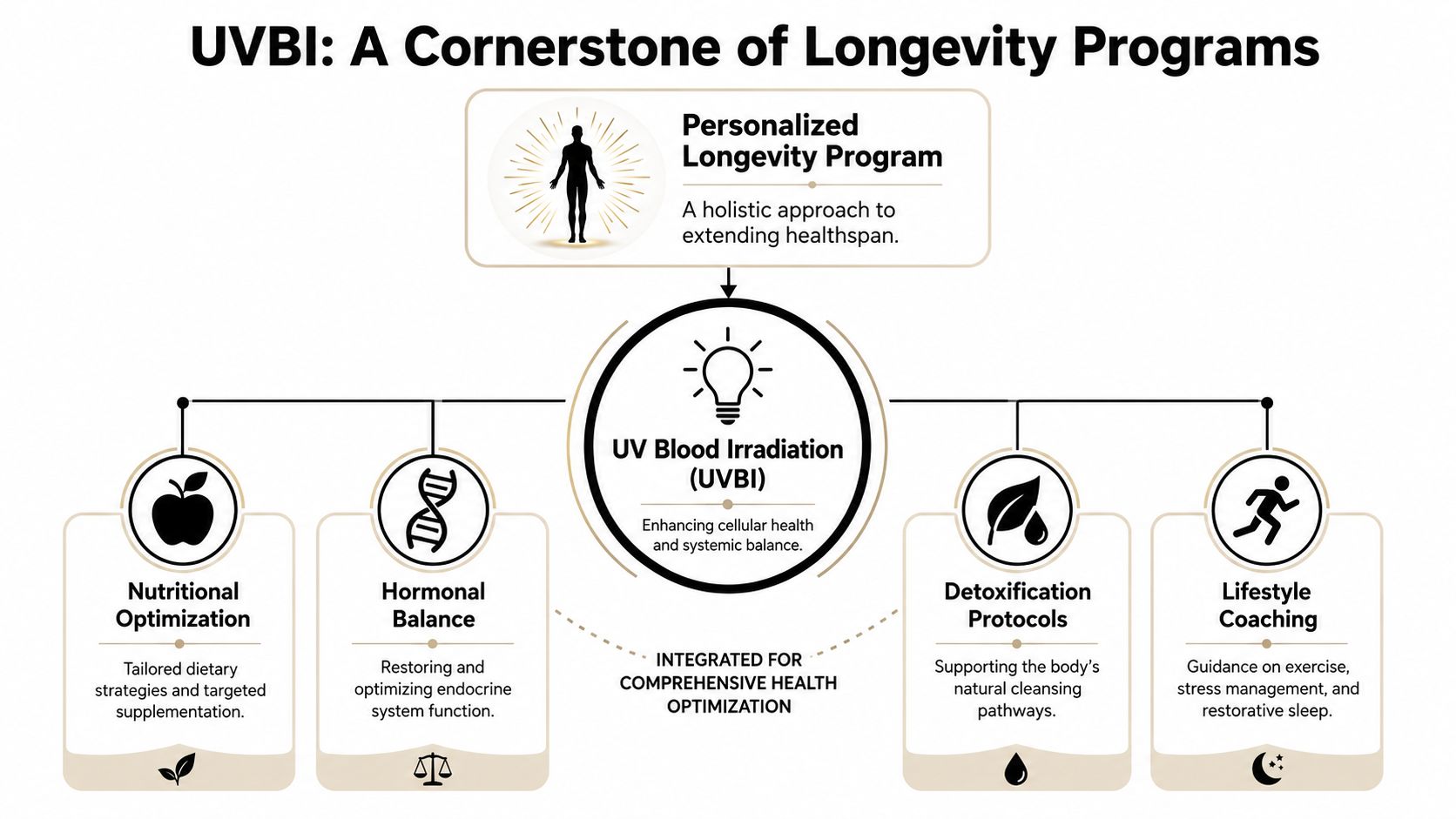
A strong longevity plan doesn't revolve around a single therapy. It arranges therapies in a logical sequence. That sequence matters because the body rarely improves through one pathway alone. Immune tone, oxygen delivery, metabolic status, sleep quality, recovery capacity, and tissue repair all interact.
Where UVBI fits
UV blood irradiation can make the most sense when used as one tool inside a physician-led framework. In that setting, the question isn't “Does UVBI do everything?” The question is “What role could it play in this patient's broader physiology?”
That role may include:
supporting a program focused on recovery readiness
complementing oxygen-based therapies such as HBOT
sitting alongside diagnostic follow-up rather than replacing it
helping structure care for patients who need a multimodal approach
How integration changes the conversation
At Longevity Medical Institute, UV is offered within a combined extracorporeal treatment concept that includes ozone, UV, and LED photobiomodulation. More broadly, the clinic's model places therapies like this alongside physician oversight, advanced imaging, in-house lab work, regenerative medicine, and allogeneic cell-based programs that may use placental, Wharton's jelly, adipose, endometrial, and dental pulp sources when clinically appropriate.
That integrated model is important because blood-based therapies often raise the same question: is the intervention being used thoughtfully, or is it being used because it sounds advanced? A program with layered diagnostics and clear treatment logic is more likely to answer that question well.
Patients exploring that broader framework may find it useful to review how integrative anti-aging programs in Los Cabos are structured, especially when they want to understand how one intervention fits into a longer arc of care.
A practical example of synergy
Consider a patient with poor recovery, fluctuating energy, and signs that multiple systems are under strain. If you only target symptoms, care becomes fragmented. If you combine physician assessment, biomarker review, restorative therapies, and a focused extracorporeal intervention, the plan becomes more coherent.
Good longevity medicine works like an orchestra, not a soloist. Each therapy should have a defined role, timing, and reason for being there.
That's the right mindset for UVBI. It may be valuable, but its value grows when it's used in context.
Frequently Asked Questions about UVBI
Is UV blood irradiation the same as sunlight exposure
No. Sunlight hits the skin and includes a broad spectrum under uncontrolled daily conditions. UV blood irradiation is a medical procedure in which blood is exposed outside the body in a controlled circuit. The difference is similar to the difference between casual exercise and supervised rehabilitation. Both involve movement, but they are not the same intervention.
Is UVBI the same as photopheresis
Not exactly. They are related in historical lineage, but they are not interchangeable terms. Patients often hear one and assume it validates the other in every setting. That's too simplistic. A clinic should be able to explain whether it is offering a classic UVBI-style approach, a modern photopheresis-related method, or a combined blood-processing protocol.
What does the treatment feel like
For patients, the main sensation is the IV placement. After access is established, the session is usually quiet and manageable. Patients often rest comfortably during treatment.
How many sessions do people usually do
There isn't one universal schedule. Non-approved use is commonly discussed as requiring multiple sessions, but the right plan depends on the reason for treatment, the type of protocol being used, and how the clinician is monitoring response. If a clinic pushes a fixed schedule without explaining why, that's a sign to ask more questions.
Is UVBI safe
Safety depends heavily on how the therapy is delivered. Device quality, sterile technique, staff training, and physician oversight matter. That's why a serious consultation should include discussion of the exact method, not just generic reassurance.
Who should be especially careful
Anyone with a complicated medical history, unusual sensitivity patterns, clotting concerns, active serious illness, or uncertainty about diagnosis should expect a careful review before proceeding. Blood-based extracorporeal therapies deserve the same clinical seriousness as other procedural interventions.
What should I look for in a clinic
A strong clinic should clearly explain:
The exact therapy being offered
Not just “UV” or “blood cleansing,” but the specific protocol.The medical rationale
Why this therapy, for this patient, at this stage.The monitoring plan
How the team will evaluate tolerance, response, and whether treatment should continue.
If a clinic can't explain the version of therapy it uses in plain language, it hasn't earned your confidence.
Begin Your Journey to Cellular Wellness
UV blood irradiation is one of the more intriguing intersections of old medical history and modern longevity care. Its value doesn't come from sounding futuristic. It comes from careful use, clear indications, and thoughtful integration into a broader plan built around physiology rather than hype.
If you're considering UVBI, the best next step is a consultation that clarifies what version is being offered, why it fits your goals, and how it would be monitored within your overall program.
Author
Dr. Kirk Sanford, DC, Founder & CEO, Longevity Medical Institute. Dr. Sanford focuses on patient education in regenerative and longevity medicine, translating complex therapies into clear, practical guidance for patients.
Medical Review
Dr. Félix Porras, MD, Medical Director, Longevity Medical Institute. Dr. Porras provides clinical oversight and medical review to help ensure accuracy, safety context, and alignment with current standards of care.
Last Reviewed: June 20, 2026
Short Disclaimer
This information is for educational purposes only and is not medical advice. It does not replace an evaluation by a qualified healthcare professional. For personalized guidance, please schedule a consultation.
If you'd like a personalized review of whether UV blood irradiation belongs in your care plan, contact Longevity Medical Institute to schedule a consultation with the clinical team and discuss a physician-led longevity strategy suited to your goals.