

7 Best Stem Cell Clinics in the World (2026 Guide)
Choosing a stem cell clinic is one of the most significant health decisions you can make. Most patients begin in the same place. A search tab full of polished websites, impressive promises, and very little clarity on what separates one clinic from another.
That confusion is understandable. The field is global, demand is growing, and the standards between clinics aren't uniform. Harvard Stem Cell Institute notes that patients travel from many regions to clinics in the U.S., Mexico, China, India, the Caribbean, Latin America, and former Soviet states, and warns that “thousands, if not tens of thousands” have sought unproven stem-cell interventions worldwide. That's why the safest way to evaluate the best stem cell clinics in the world isn't by marketing language. It's by looking at evidence alignment, lab standards, regulatory oversight, diagnostic depth, and outcome transparency.
Think of clinic selection the way you'd evaluate a high-performance surgical center. The treatment menu matters, but the engine behind it matters more. Where are the cells produced? How are they characterized? Who oversees care? What diagnostics shape the protocol? If a clinic can't explain those basics clearly, that's not sophistication. It's a warning sign.
The list below gets to the point. These are some of the most visible and credible names patients commonly encounter when comparing stem cell clinics internationally, with a focus on practical trade-offs rather than hype.
1. Longevity Medical Institute

Longevity Medical Institute stands out because it doesn't treat stem cell therapy as a standalone product. It operates as an integrated regenerative medicine environment in San José del Cabo, Mexico, where diagnostics, cellular production, physician oversight, and recovery support sit under one roof. For patients who want more than a single infusion appointment, that matters.
The clinic exclusively uses allogeneic stem cells and produces five different types in its biotechnology lab, including placental, Wharton's jelly, adipose, endometrial, and dental pulp. That gives the medical team more flexibility in protocol design. In practical terms, it's the difference between choosing from one instrument and having a full orchestra available. Matching the biologic to the clinical objective is often where stronger planning begins.
Why the model is different
A lot of clinics offer stem cell therapy. Far fewer combine a COFEPRIS-licensed clinical setting with an ISO-certified on-site biotech lab, an in-house clinical laboratory, and AI-enhanced MRI in a coordinated workflow. That integrated structure is one of the clearest reasons many patients place LMI among the top stem cell clinics in the world.
Diagnostics are a major differentiator here. The in-house clinical lab measures more than 120 biomarkers, and imaging tools such as AI-enhanced full-body MRI and ultrasound-guided procedures help the team build treatment plans with more precision than a symptoms-only intake ever could. If stem cell therapy is the biologic, diagnostics are the map.
Practical rule: If a clinic discusses cells in detail but says very little about diagnostics, quality control, or image guidance, you're probably looking at a sales model, not a full clinical model.
Longevity Medical Institute also incorporates stem cell therapy into comprehensive regenerative medicine programs when appropriate. Depending on the patient's condition and treatment goals, these programs may also include exosomes, NK cell therapy, peptides, hyperbaric oxygen therapy (HBOT), IV support, targeted injections, therapeutic plasma exchange (TPE), and TriFusion EBOO therapy.
The benefit isn't having the longest menu. The benefit is that physicians can build around the patient instead of forcing every patient into the same protocol.
Best fit and trade-offs
This is a premium clinic. That brings advantages and costs. Patients who value concierge logistics, coordinated physician-led care, advanced diagnostics, and upscale recovery support will likely see the appeal quickly. Patients looking for the cheapest possible access point probably won't.
A few strengths are especially relevant:
- Integrated oversight: Clinical care, lab operations, diagnostics, and procedural planning are tightly connected.
- Advanced precision tools: Ultrasound-guided injections and AI-supported MRI imaging help reduce guesswork.
- Broader treatment architecture: Stem cell therapy can be paired with other modalities when clinically appropriate.
- Patient experience: The environment is built for international patients who want high-touch support rather than fragmented scheduling.
The main trade-offs are equally clear:
- Premium positioning: Pricing reflects the depth of diagnostics, physician time, and concierge model.
- Mexico-based regulation: Care is delivered under Mexico's framework, which differs from U.S. FDA pathways.
For patients who want regenerative medicine delivered like a serious medical program, not a tourism package with a drip room, Longevity Medical Institute is one of the strongest options on this list.
2. Stem Cell Institute

Stem Cell Institute in Panama City is one of the longest-established names in international regenerative medicine. Its reputation comes less from luxury positioning and more from operational consistency. Patients who value a structured process, clear onboarding, and an established international workflow often put it high on their shortlist.
One practical strength is that the clinic pairs care delivery with its associated manufacturing infrastructure through Medistem Panama. For patients, that isn't a small detail. It means the conversation about sourcing and processing doesn't feel detached from the treatment itself.
Where it performs well
This clinic is especially appealing to patients who want a predictable medical-travel experience. Program structures are relatively easy to understand, and the clinic has long experience supporting international visitors. Compared with centers that keep key details vague until late in the process, Stem Cell Institute is more direct about how it operates.
Its protocols commonly rely on IV administration, which some patients appreciate for simplicity and broader systemic use. Others will want a more targeted route depending on the condition. That's where it helps to understand how stem cell therapy works before choosing a clinic, because delivery method can shape expectations.
Clinics that explain source, processing, and administration route clearly tend to be easier to evaluate than clinics that lead with dramatic symptom claims.
The clinic's model also suits patients who don't want to build travel logistics from scratch. Concierge support and packaged coordination remove a lot of the friction that often makes international care feel overwhelming.
Best fit and limits
Stem Cell Institute makes the most sense for patients who want an experienced international program with clear structure and a long operating history. It's a reasonable choice for autoimmune, neurologic, orthopedic, and wellness-oriented inquiries where a standardized workflow feels reassuring rather than restrictive.
Its key advantages include:
- Established international process: Strong logistics support for traveling patients.
- Visible manufacturing alignment: Public emphasis on cell source and lab standards.
- Defined program structure: Easier to compare than clinics that reveal details slowly.
Its limitations are straightforward:
- Travel is required: Panama is accessible, but still a commitment for North American patients.
- Cash-pay model: Patients should expect out-of-pocket planning.
- IV-heavy protocols: That won't match every delivery preference or every clinical objective.
For patients who prioritize institutional familiarity and a well-rehearsed treatment journey, Stem Cell Institute remains one of the more recognizable names in this category.
3. DVC Stem
DVC Stem in Grand Cayman has built much of its reputation on transparency around product documentation and dose structure. That alone makes it easier to assess than many private clinics. Instead of vague language about “advanced regenerative cells,” DVC Stem typically gives prospective patients a clearer sense of what they're buying.
That matters because one of the biggest problems in this space is informational fog. Patients don't just need to know that a clinic uses donor cells. They need to know how the product is manufactured, documented, and released for use.
Why patients consider it
DVC Stem is especially popular with U.S. patients who want access to donor-cell protocols outside standard U.S. same-day frameworks. Its care model emphasizes IRB oversight in the Cayman Islands and cells manufactured in a U.S. GMP lab. For many patients, that blend of offshore treatment and U.S.-linked manufacturing creates a sense of procedural familiarity.
The clinic also tends to present package comparisons and itemized pricing more openly than many competitors. That's useful because hidden variability is one of the most frustrating parts of comparing the best stem cell clinics in the world. If one clinic gives you documents and dose details early, and another offers only broad promises, the difference is meaningful.
Real strengths and real cautions
DVC Stem is a good fit for patients who prioritize product paperwork, viability information, and dose-based program design. It's less ideal for people who want a broader longevity workup with extensive diagnostics wrapped around the treatment.
A few practical takeaways:
- Best for transparency-minded buyers: The clinic is relatively clear about documentation and program structure.
- Useful for U.S. patients willing to travel: Grand Cayman is often easier logistically than more distant destinations.
- More standardized than concierge-luxury clinics: Some patients will see that as a plus. Others will want a more personalized, diagnostics-heavy model.
If a clinic talks in detail about cell counts but says little about imaging, biomarkers, or physician-guided personalization, expect a narrower treatment framework.
The drawbacks are familiar in this market. Travel is still required, treatment is cash-pay, and the evidence base varies by indication. That last point isn't unique to DVC Stem. It's a field-wide reality. The key is whether the clinic communicates that transparently.
For patients who want documentation, dose clarity, and a comparatively direct commercial model, DVC Stem earns its place on a serious shortlist.
4. BioXcellerator
BioXcellerator has become one of the most visible names in the international market, particularly among patients looking for a high-touch medical tourism experience in Medellín. It's polished, highly recognizable, and built to feel turnkey from the start.
That positioning works well for a specific kind of patient. If you want hotel coordination, transfers, and a packaged treatment journey that minimizes friction, BioXcellerator is good at presenting exactly that. The clinic is often discussed alongside athlete testimonials and orthopedic-focused care, which gives it strong visibility even among people who are new to regenerative medicine.
Where it stands out
BioXcellerator operates within an ISO 9001 quality management framework, which is useful as an organizational signal. It doesn't answer every scientific question, but it does tell you the clinic takes process standardization seriously. In a field where some providers still look improvised, that's a meaningful distinction.
The clinic is often attractive to patients comparing experience styles as much as science. Some clinics feel highly technical but bare-bones. BioXcellerator feels more like a guided international program with hospitality built in. For many patients, cost enters the equation quickly, making reading a careful breakdown of stem cell therapy cost useful before you start comparing package-driven clinics.
Best fit and friction points
BioXcellerator is often strongest for patients who want convenience and a polished itinerary. It can also appeal to those pursuing orthopedic or performance-oriented treatment paths where a menu-based approach feels workable.
Its practical advantages include:
- Turnkey logistics: Good for patients who don't want to manage travel details alone.
- Strong brand visibility: Easy to research and compare.
- Multiple delivery routes: Helpful when a patient wants more than an IV-only model.
Its trade-offs deserve equal attention:
- Package variability: Final costs can depend heavily on indication and add-ons.
- Marketing visibility can overshadow clinical nuance: Patients still need to ask hard questions about protocol specifics.
- Reviews can be mixed: That means you should evaluate the actual treatment plan, not just the brand image.
BioXcellerator is worth serious consideration, but it's best approached by patients who know how to separate a smooth customer journey from true protocol depth.
5. Novastem

Novastem has a different appeal from the destination clinics built around full concierge immersion. Its practical advantage is geography. For patients in Southern California and the western U.S., Tijuana can be far easier to access than Panama, the Cayman Islands, or Colombia.
That convenience shouldn't be dismissed. In real-world decision-making, travel burden matters. Some patients need a clinic they can reach quickly, with less interruption to work, family, or recovery logistics.
Why patients look at Novastem
Novastem offers personalized treatment planning after medical review, with English-language support for U.S. and Canadian visitors. That makes it attractive to patients who want a border-accessible option without navigating a more distant medical tourism pathway.
The clinic appears to emphasize individualized planning rather than one-size-fits-all packages. That's promising, but it also means patients need to ask more detailed questions during intake. Proximity alone shouldn't replace due diligence. Anyone considering treatment in Mexico should understand the broader safety questions involved, and a balanced overview of whether stem cell therapy in Mexico is safe helps frame those conversations.
Pros, limits, and what to verify
Novastem is often best for patients who value access and scheduling simplicity. It can be especially appealing for cross-border patients who want a shorter trip and more direct follow-up communication.
Its practical advantages are easy to see:
- Border convenience: Shorter travel time for West Coast patients.
- Broad condition menu: Useful for patients exploring several possible treatment paths.
- English-language coordination: Reduces friction for international intake and follow-up.
The main limitations are also important:
- Less public technical detail: Patients may need to ask more questions about manufacturing and release standards.
- Pricing is usually case-based: That can be appropriate, but it makes comparisons harder.
- Protocol clarity matters: A nearby clinic still needs to explain sourcing, oversight, and delivery routes clearly.
For patients, Novastem sits in a practical middle ground. It may not present the same level of public technical infrastructure as the most diagnostics-heavy centers, but it offers a realistic access point for people who want treatment in Mexico without a long-haul trip.
6. GIOSTAR Mexico
GIOSTAR Mexico benefits from network recognition and multiple locations, including Cancún, Playa del Carmen, and Los Algodones. That geographic spread gives patients options depending on whether they value resort-style travel, border access, or repeat-visit convenience.
The clinic also markets a broad regenerative menu, including stem cell and cellular immunotherapy programs. For patients attracted to extensive biologic offerings, that range can be appealing. But breadth cuts both ways. The more therapies a clinic advertises, the more important it becomes to verify which services are available at which location and under what exact oversight.
What makes it appealing
Multiple Mexico locations are a genuine advantage. Patients can align treatment with travel preferences, and English-language coordination lowers the barrier for U.S. visitors. The clinic also presents itself as having in-house labs and COFEPRIS-certified facilities, which is the kind of claim patients should verify directly for the specific therapy and site they're considering.
This isn't skepticism for the sake of skepticism. It's good practice. In regenerative medicine, the headline claim and the exact operational scope aren't always identical.
Ask the clinic to explain not just certification language, but what that certification covers, where the cells are processed, and which physician is responsible for your protocol.
Best use case and trade-offs
GIOSTAR Mexico is often a fit for patients who want a broad menu and location flexibility. It may also appeal to those interested in combining stem cell therapy with other immune or wellness-oriented programs.
Its upsides include:
- Multiple destination choices: Helpful for travel planning.
- Wide offering set: Attractive to patients exploring complex care needs.
- Coordinated logistics: Useful for international visitors.
Its cautions are familiar but important:
- Variable pricing: Harder to benchmark before evaluation.
- Certification language should be confirmed: Patients shouldn't assume every advertised service carries the same operational status.
- Wide menus can dilute clarity: Ask what is standard, what is optional, and what is evidence-aligned for your condition.
GIOSTAR Mexico can be a viable option, especially for patients who want flexibility and a broad treatment catalog. The key is to approach it with disciplined questions, not passive trust.
7. Regenexx
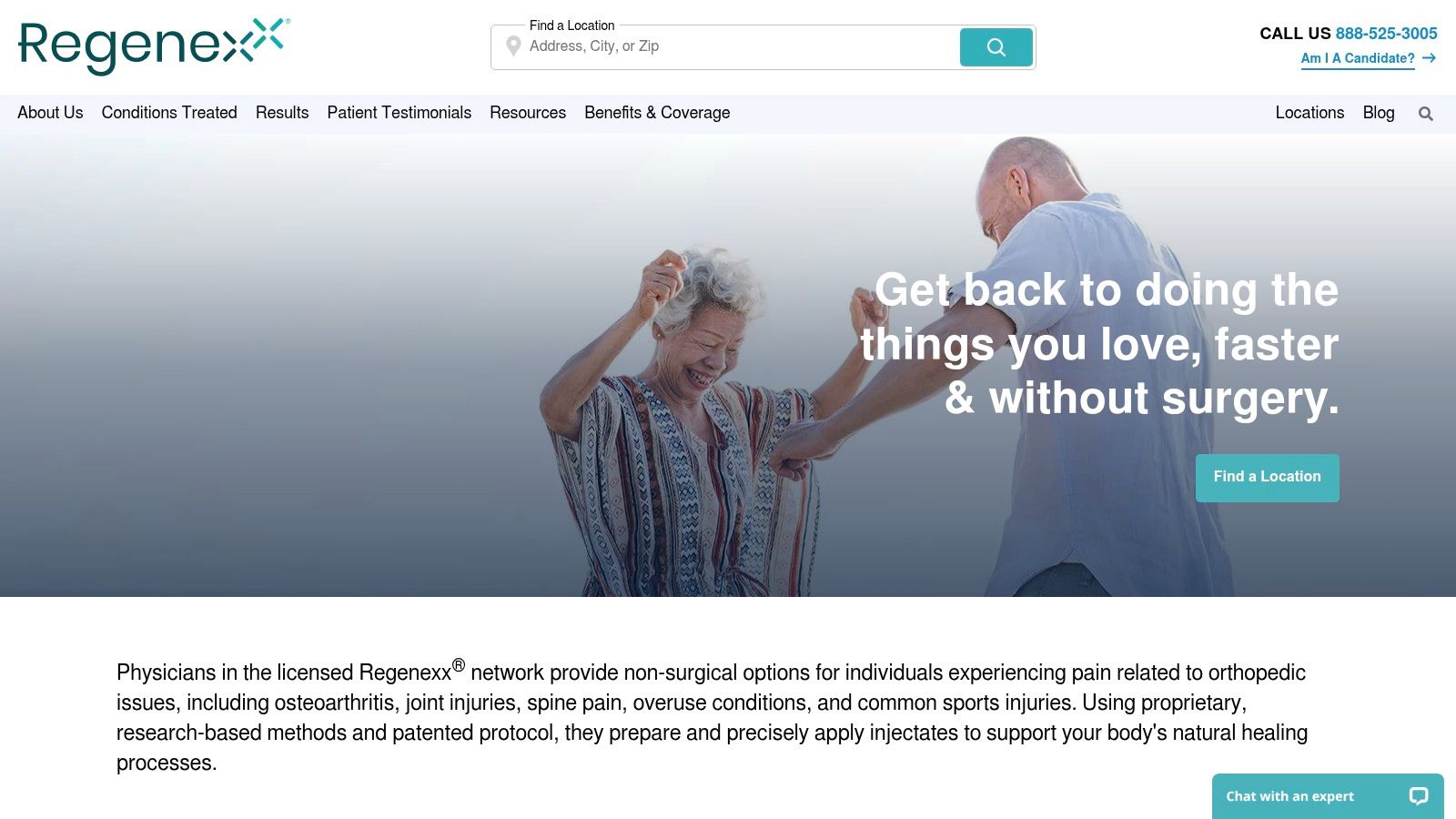
Regenexx belongs on this list for one reason. It gives patients a distinctly different model to compare against international donor-cell clinics. If you're evaluating the best stem cell clinics in the world, it helps to include a domestic U.S. option that operates inside a more familiar regulatory environment.
Regenexx focuses on same-day orthobiologics for joints, spine, and sports injuries. It is not the same category as clinics centered on expanded allogeneic donor-cell programs. That's not a flaw. It's just a different tool for a different patient profile.
Why it still matters in this comparison
Patients often assume every “stem cell clinic” is solving the same problem in the same way. That isn't true. Regenexx is best understood as an interventional orthopedics network with image-guided procedures and a long-running outcomes registry. For active adults who want domestic care, no international travel, and a strong orthopedic focus, that can be compelling.
The biggest distinction is biological strategy. Regenexx uses same-day autologous (from your own body) orthobiologic approaches, while many international clinics rely on donor-based allogeneic programs. If you're weighing those paths, a side-by-side view of stem cell therapy in Mexico vs USA helps clarify what changes when you move between regulatory systems and treatment models.
Best for and not for
Regenexx is strongest for orthopedic patients. Think knees, shoulders, hips, spine, and sports-related wear-and-tear where image guidance and procedural precision matter more than a broader longevity package.
Its main strengths are:
- No international travel: Important for many U.S. patients.
- Orthopedic specialization: Clear use case for musculoskeletal problems.
- Registry culture: Appeals to patients who value methodological transparency.
Its main limitations are equally clear:
- Different cell model: Patients seeking allogeneic donor-cell programs won't find the same framework here.
- Less suited to broader immune or systemic regenerative goals: The network is built around orthopedics, not full-spectrum longevity medicine.
- Cash-pay remains common: Domestic location doesn't always mean insurance coverage.
The commercial backdrop helps explain why comparisons like this matter more now. Fortune Business Insights reports the global stem cells market was valued at $19.34 billion in 2025 and is projected to reach $79.95 billion by 2034. A separate 2024 review reported the global stem-cell therapy market at US$297 million in 2022 with an expected 16.8% CAGR from 2022 to 2027. As commercialization accelerates, patients need sharper filters, not more advertising.
Top 7 Global Stem Cell Clinics Comparison
Making Your Decision with Confidence
The best clinic isn't the one with the most dramatic promise. It's the one that fits your condition, explains its process clearly, and operates with standards you can verify.
That means looking past glossy branding and asking better questions. Where are the cells sourced and processed? What certifications apply to the lab, and what do they cover? Is the protocol built from imaging, biomarkers, and physician evaluation, or from a generic sales script? Does the clinic explain limits as clearly as benefits? Those details tell you far more than a long list of treatable conditions ever will.
In practical terms, patients usually do best when they compare clinics across four pillars:
- Scientific rigor: Does the clinic describe sourcing, processing, and delivery in concrete terms?
- Regulatory transparency: Can the team explain what framework governs the therapy?
- Diagnostic depth: Are treatment decisions guided by imaging, lab work, and physician assessment?
- Operational coherence: Do the clinic, lab, and follow-up process work together?
If a clinic is strong in only one area, be cautious. A beautiful facility without technical clarity isn't enough. A technical lab without strong diagnostics isn't enough either. The most trustworthy programs usually feel coherent from first consultation through follow-up.
This is one reason integrated centers continue to stand out. At Longevity Medical Institute, care is built around that full-stack model. The clinic exclusively uses allogeneic stem cells and produces five different types in its on-site biotechnology lab, including placental, Wharton's jelly, adipose, endometrial, and dental pulp. That variety supports more personalized protocol design than a one-product approach.
Longevity Medical Institute also combines regenerative therapies with advanced diagnostics and physician oversight in one setting. In-house biomarker testing, AI-enhanced full-body MRI, ultrasound-guided procedures, and a coordinated clinical team help reduce guesswork and improve treatment planning. For patients, that often means a more informed decision about whether therapy is appropriate in the first place, which is just as important as the treatment itself.
Patients shouldn't feel pressured to choose quickly. Good clinics don't need urgency tactics. They welcome questions, explain trade-offs, and help you assess whether the proposed plan matches your actual goals.
If you're comparing the best stem cell clinics in the world, use this guide as a filter. Ask specific questions. Request specifics about labs, oversight, and protocol design. Look for clinics that respect informed consent enough to speak plainly. That's what confidence looks like in regenerative medicine.
Last Reviewed: June 11, 2026
This information is for educational purposes only and is not medical advice. It does not replace an evaluation by a qualified healthcare professional. For personalized guidance, please schedule a consultation.