

Hyperbaric Oxygen Therapy: Boost Recovery 2026
If you're considering a regenerative program, recovering from a demanding training cycle, or trying to heal tissue that seems slow to respond, you're probably asking a practical question. Is there a way to improve the body's healing environment before adding more treatment?
That question matters because healing isn't only about the therapy you choose. It's also about whether your cells have the oxygen, circulation, and energy they need to respond well. An advanced treatment plan can underperform if the biological terrain underneath it is stressed, inflamed, or poorly oxygenated.
Hyperbaric oxygen therapy deserves attention for exactly that reason. Many people still associate it only with dive medicine or emergency care. In reality, it has become a standardized medical intervention with established protocols, defined indications, and broad clinical use.
For patients exploring recovery, performance, and regenerative medicine, the more useful way to think about hyperbaric oxygen therapy is this. It can help prepare the body to do better work with the treatments that follow.
A New Foundation for Healing and Recovery
Healing begins at the cellular level. For tissue to repair well, cells need enough oxygen to produce energy, manage inflammation, build new proteins, and support the many signaling processes that guide recovery. If blood flow is compromised or tissue has been under prolonged stress, those jobs become harder to carry out efficiently.
Hyperbaric oxygen therapy matters because it improves that underlying healing environment. In a controlled medical setting, HBOT increases the amount of oxygen available to tissue. For patients preparing for regenerative treatments, that can be especially meaningful. The goal is not just to add another therapy. The goal is to improve the biological conditions that help later treatments perform better.
This preparatory role is one of the most useful ways to understand HBOT.
Why patients often misunderstand HBOT
Many patients still associate an oxygen chamber with emergency medicine, scuba injuries, or a vague wellness trend. Neither view captures how it is used in modern recovery and regenerative care.
Clinicians use HBOT as a targeted physiologic intervention. The question is straightforward. Is the tissue receiving enough oxygen to meet the demands of healing?
That question becomes more relevant in patients with inflammation, slow recovery, surgical stress, intense athletic loading, or chronic tissue irritation. In each of those settings, the body may be trying to repair itself while operating with less than ideal oxygen delivery. HBOT can help shift that terrain in a more favorable direction before more advanced interventions are introduced.
Clinical perspective: The quality of a regenerative plan depends in part on the condition of the tissue receiving it. Better oxygenation can support a better response.
A regenerative medicine mindset
In regenerative medicine, preparation often determines how well a treatment lands. Stem cells, biologics, and other advanced therapies do not work in isolation. They enter a living system with its own level of inflammation, circulation, metabolic strain, and repair capacity.
A useful analogy is soil before planting. Even the highest-quality seed will struggle in depleted ground. Tissue works in much the same way. If the local environment is poorly oxygenated or inflamed, the body's repair signals can become less coordinated, and the response to regenerative treatment may be less predictable.
That is why HBOT is often viewed as a foundation-building therapy. It helps create a more favorable setting for recovery, resilience, and tissue response. If you want a broader patient-oriented look at this philosophy, the power of regeneration offers helpful context.
Hyperbaric oxygen therapy is not a stand-alone answer for every patient. For the right candidate, it can be a strong first step that prepares the body for the work of healing.
Understanding How HBOT Works
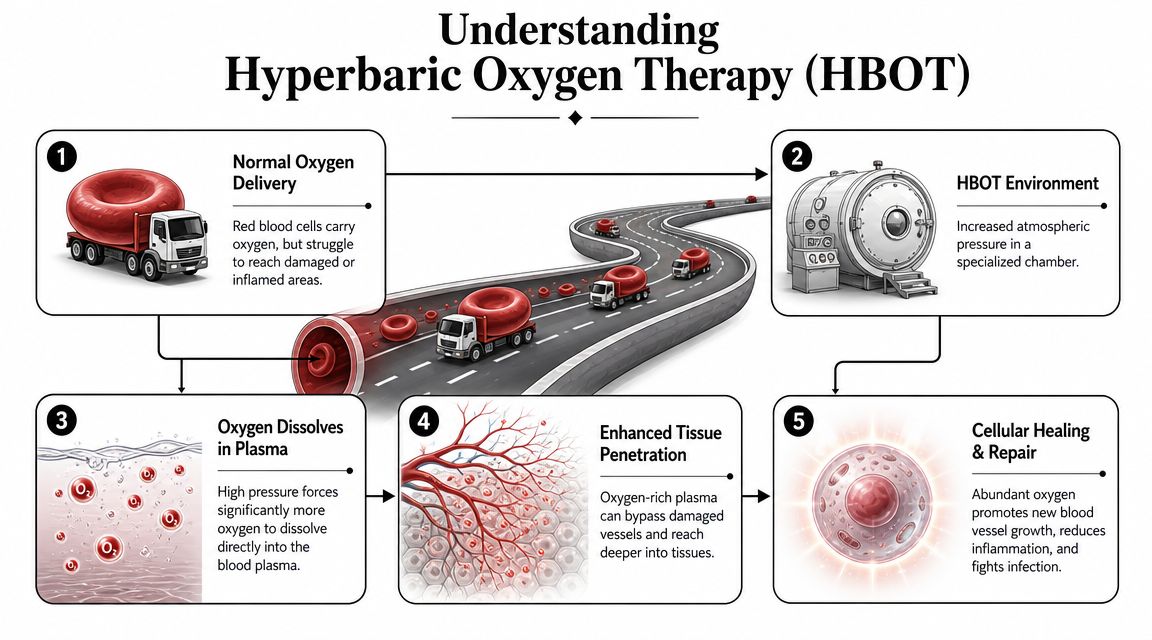
The easiest way to understand HBOT is to picture your bloodstream as a highway system.
Under normal conditions, red blood cells are the delivery trucks. They carry oxygen and unload it into tissue. That works well most of the time, but damaged or inflamed areas often have traffic problems. Blood flow may be impaired, swelling may compress tiny vessels, and oxygen delivery may become less efficient exactly where it's needed most.
Hyperbaric oxygen therapy changes that delivery model.
The pressure-and-oxygen combination
In HBOT, a patient breathes near-100% oxygen inside a pressurized chamber. A major review explains that HBOT is a dose-dependent oxygen delivery intervention using near-100% oxygen in a chamber pressurized to about 2 to 3 ATA, with approved indications generally requiring at least 1.5-2 ATA. Under those conditions, oxygen dissolves into plasma far beyond what hemoglobin transport alone can provide, as described in this clinical review in PMC.
That is the key concept many people miss. HBOT doesn't just load more oxygen onto the usual delivery trucks. It puts oxygen directly into the fluid portion of blood, creating an additional transport route.
Why dissolved oxygen matters
Think of plasma oxygen as an express service moving around congestion. If a tissue bed has compromised microcirculation, oxygen dissolved in plasma can still penetrate more effectively than you might expect from normal physiology.
That helps explain why HBOT is used in settings involving hypoxia, ischemia, and difficult healing. More oxygen in the right place can support tissue under stress.
Patients often ask what that means in practical terms. The effects clinicians care about include:
Support for hypoxic tissue: Areas that aren't getting enough oxygen may function better when plasma oxygen rises.
Assistance with repair processes: Oxygen is central to energy production and tissue recovery.
Host defense support: In some clinical settings, oxygen-rich tissue conditions can assist the body's response to infection.
Microenvironment improvement: Tissue under inflammatory stress may respond differently when oxygen supply improves.
More oxygen isn't automatically better everywhere. In HBOT, the therapeutic value comes from matching the pressure, dose, and schedule to the clinical problem.
Why protocol matters
This is also why HBOT shouldn't be thought of as one generic experience. Pressure, duration, and treatment frequency shape the biological effect. In other words, HBOT is a family of protocols, not a single menu item.
If you'd like a visual overview of the chamber experience and therapeutic rationale, this Longevity Medical Institute overview of hyperbaric oxygen chamber benefits gives a helpful introduction.
Clinical Indications and Proven Benefits
A careful discussion of hyperbaric oxygen therapy should separate proven indications from broader interest areas. That distinction protects patients from two common errors. One is dismissing HBOT as fringe care. The other is assuming it has been proven for every condition discussed online.
The strongest evidence base is for a defined group of approved medical uses.
Where the standard of care is clear
The Undersea & Hyperbaric Medical Society recognizes 14 approved indications for HBOT, with treatment typically delivered at 1.9 to 3.0 ATA, according to UHMS guidance on HBO indications. Those indications include decompression sickness, carbon monoxide poisoning, diabetic wounds, delayed radiation injury, air embolism, severe anemia, certain infectious diseases, and idiopathic sensorineural hearing loss.
That matters because it places HBOT firmly inside mainstream medical practice for specific pathophysiology. It is not merely a general wellness intervention.
Hyperbaric Oxygen Therapy Applications
| Category | Examples |
|---|---|
| Approved emergency and acute indications | Decompression sickness, carbon monoxide poisoning, air embolism |
| Approved wound and tissue indications | Diabetic wounds, compromised grafts and flaps, delayed radiation injury |
| Approved infectious and surgical indications | Gas gangrene, necrotizing fasciitis, certain infectious diseases |
| Approved selected specialty indications | Severe anemia, idiopathic sensorineural hearing loss |
| Investigational or not yet proven as standard care | Stroke, heart disease, depression, spinal cord injury, sports injuries |
Where patients should be more cautious
A discerning patient should know that interest often outruns proof. Some clinics and online articles discuss HBOT for neuro-recovery, performance, and longevity in ways that blur the line between approved use and exploratory application.
That doesn't mean every non-approved application is unreasonable. It means the evidence standard is different, and expectations need to be calibrated accordingly.
A useful way to think about the therapy is by asking three questions:
Is this an approved indication? If yes, the treatment pathway is clearer.
Is this investigational or supportive? If yes, the rationale may be biologically plausible but not settled.
What outcome are we targeting? Wound healing, symptom support, tissue conditioning, or recovery readiness are not the same goal.
Practical rule: A responsible clinic should be able to tell you whether HBOT is being used as standard care, adjunctive support, or part of an investigational strategy.
Many advanced patients appreciate nuance. Hyperbaric oxygen therapy can be both highly established and selectively exploratory, depending on the condition in front of you.
HBOT as a Cornerstone of Regenerative Medicine
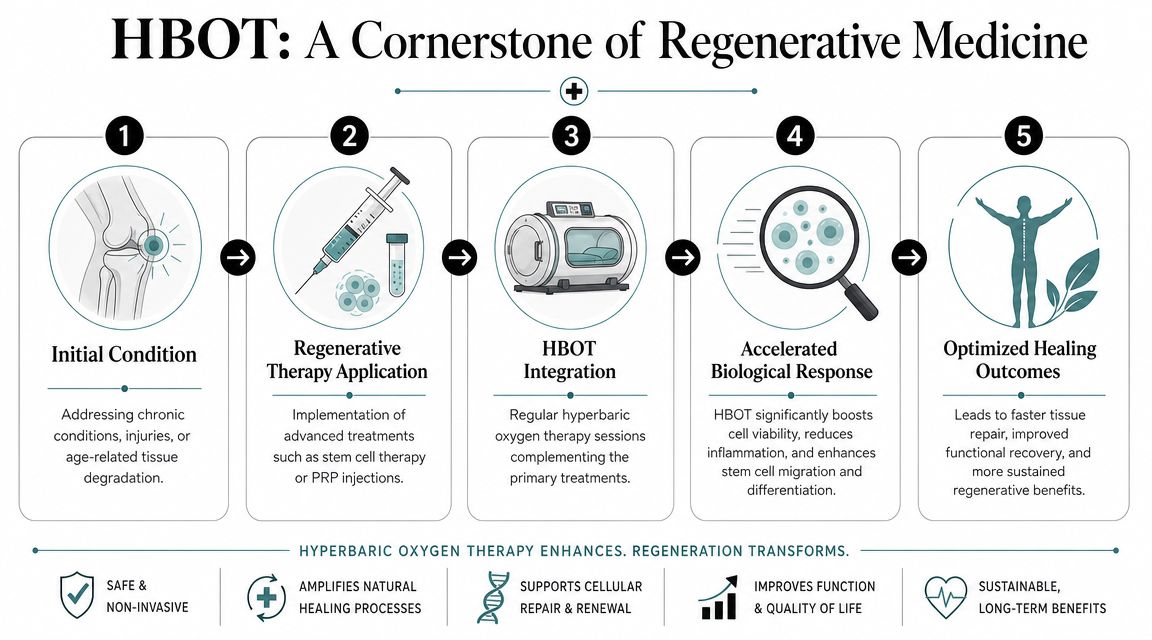
Regenerative medicine isn't only about adding a powerful therapy. It's about creating a body environment where that therapy has the best chance to perform well.
A useful analogy is soil preparation. If the soil is compacted, dry, and poorly nourished, even high-quality seeds struggle. If the terrain is oxygenated, perfused, and biologically calmer, the same seeds have a much better chance to take root.
That is how many clinicians think about hyperbaric oxygen therapy in relation to regenerative care.
Why oxygenation changes the terrain
Regenerative therapies depend on local tissue conditions. Cells and signaling molecules function within a microenvironment. If that environment is inflamed, poorly vascularized, or metabolically stressed, the therapeutic response may be less consistent.
HBOT can help improve that terrain by increasing oxygen delivery to tissue and supporting biological conditions associated with repair. In practical terms, clinicians often consider whether a patient needs better oxygen availability before or alongside advanced interventions.
This is particularly relevant in programs involving allogeneic stem cell therapy, where the goal is not merely to introduce cells, but to support the body's capacity to respond to them. In that context, HBOT is often viewed as a preparatory and synergistic therapy rather than a standalone endpoint.
A realistic view of synergy
It is important to stay disciplined here. Johns Hopkins notes that approved uses are specific, and claims for conditions such as stroke and sports injuries are not yet considered proven, as explained in Johns Hopkins Medicine's overview of hyperbaric oxygen therapy. That reminder matters in regenerative medicine, where enthusiasm can easily outpace evidence.
Still, from a patient-oriented perspective, the logic of synergy is straightforward:
First, improve tissue oxygen availability. Better oxygen supply may support a more receptive healing environment.
Then, layer in regenerative treatment thoughtfully. Cells and biologics work inside tissue conditions, not outside them.
Use sequence strategically. The order of therapies can matter as much as the therapies themselves.
A clinic may integrate HBOT with a broader regenerative plan that includes cell regeneration therapy, physical medicine, or targeted procedures. The point isn't that every patient needs this combination. The point is that regenerative care works best when the internal environment is part of the treatment plan.
When this framing helps patients most
This perspective is especially helpful for people who say, "I've had treatment before, but my body didn't seem to respond the way I expected."
Sometimes the issue isn't the therapy alone. Sometimes the issue is readiness. Tissue under chronic stress may need conditioning before it can perform better.
HBOT fits that role well because it addresses a basic variable many people overlook. Healing is expensive work. Oxygen helps pay for it.
Your HBOT Journey at Longevity Medical Institute
Most patients feel more comfortable with hyperbaric oxygen therapy once they understand what the experience is like. The process is usually far less intimidating than the name suggests.
At the practical level, an HBOT program begins with screening, history review, and protocol design. The purpose is simple. Match the chamber strategy to the medical question, rather than putting every patient through the same routine.
What a session usually feels like
Mayo Clinic notes that typical HBOT courses involve sessions lasting about 60 to 90 minutes, and some conditions may need fewer than 10 sessions while others may require up to 60, as outlined in Mayo Clinic's guide to hyperbaric oxygen therapy. For patients, the main takeaway is that treatment planning matters. HBOT is not a one-size-fits-all schedule.
During pressurization, the most common sensation is ear pressure, similar to what you might notice during airplane descent. Swallowing, yawning, or gentle pressure-equalizing techniques usually help. Once the chamber reaches treatment pressure, many patients settle into a surprisingly calm rhythm.
Some read. Some listen intently. Some take a rest.
What patients usually want to know
A few practical questions come up in nearly every consultation:
Will I feel claustrophobic? Some patients worry about this before the first session, but many find the structured environment easier than expected once treatment starts.
Will I be monitored? A proper medical HBOT program includes supervision and ongoing communication.
How is the schedule decided? The protocol depends on the indication, goals, and the patient's tolerance and timeline.
If you're looking for a more location-specific overview of what treatment access can look like, this guide to hyperbaric oxygen therapy in Cabo San Lucas offers additional context.
A short visual walkthrough can also help make the process feel more familiar:
Why the experience matters
The therapeutic protocol is the core medical piece. But the treatment environment also matters.
Patients do better when they understand what they're feeling, know how to communicate during treatment, and trust that the session is being managed with precision. For a therapy that works through dose, pressure, and repetition, comfort and consistency aren't luxuries. They are part of adherence.
Safety Protocols and Patient Candidacy
A patient may come to HBOT hoping to recover faster after a regenerative procedure, support tissue healing before stem cell therapy, or improve resilience during a demanding treatment plan. The first clinical question is not how motivated that patient is. It is whether pressure, oxygen dose, and timing fit that person's biology and medical history.
That distinction matters because HBOT works best when it is prescribed with the same discipline as any other medical therapy. In regenerative medicine, that is especially important. If stem cells are the seeds, HBOT helps prepare the soil. But the soil still has to be assessed first.
HBOT is now used across hospital systems, wound care programs, sports medicine settings, and specialty clinics. Broad adoption suggests established operating standards and familiar safety frameworks. It does not replace individualized screening.
Who may be a good candidate
Good candidacy starts with a clear reason for treatment. Sometimes that reason is an approved indication. Sometimes it is a supportive role within a larger plan, such as improving oxygen delivery to stressed tissue before or after a regenerative intervention. The question is always the same: does HBOT match the tissue problem we are trying to solve?
A careful evaluation usually focuses on three areas:
Treatment goal. Is the goal wound healing, recovery support, tissue conditioning, or another defined medical objective?
Medical history. Lung conditions, prior ear problems, sinus congestion, seizure history, and current medications can all change the risk profile.
Pressure tolerance. A patient has to be able to equalize pressure safely and comfortably enough to complete the protocol.
Patients sometimes get confused by this distinction. Wanting more oxygen is not the same as benefiting from hyperbaric oxygen. Under pressure, oxygen behaves differently in the body. That can be therapeutic, but only if the indication, dose, and sequence make sense.
Known risks and why screening matters
The side effects patients notice first are usually mechanical, not mysterious. Ear pressure is the classic example. It feels much like the pressure change during an airplane descent, except in HBOT the team can coach, pause, and adjust if needed.
Other risks require more clinical attention. Oxygen toxicity can occur under certain dosing conditions. Lung complications are possible in susceptible patients. Untreated pneumothorax remains a major contraindication because pressure changes can make that condition dangerous.
Safety depends on details. Chamber type matters. Pressure matters. Session length matters. Repetition matters. So does what else is happening in the treatment plan, especially if HBOT is being paired with regenerative therapies where timing can influence how well tissues receive and use oxygen.
The safest HBOT protocol is the one that fits the patient, the diagnosis, and the broader treatment sequence.
What strong safety culture looks like
A well-run program does not treat screening as a formality. It reviews contraindications carefully, explains what the patient may feel during pressurization, and sets expectations about monitoring, communication, and stopping rules if discomfort develops.
That level of care matters even more when HBOT is used as a preparatory or synergistic therapy for regenerative medicine. The goal is not merely to add another intervention. The goal is to create a better physiological environment for healing, then deliver that therapy with precision.
If you want a practical way to assess a clinic's standards, this guide to trust, safety, and transparency in clinical care offers a useful framework.
A credible HBOT center should leave you feeling informed, screened appropriately, and treated as an individual. In a therapy built on pressure, oxygen, and timing, safety begins long before the chamber door closes.
Frequently Asked Questions About HBOT
How should I prepare for a hyperbaric oxygen therapy session
Keep preparation simple. Wear comfortable clothing if the clinic advises it, arrive well hydrated unless your medical team gives different instructions, and ask ahead of time about skincare products, fragrances, electronics, and any prohibited items for chamber safety.
If you have a history of sinus congestion, seasonal allergies, or difficulty equalizing ear pressure, mention that before the session. Small details like that can make a large difference in comfort.
What does the pressure change actually feel like
Most patients describe it like ascending or descending in an airplane. You may notice fullness in the ears as the chamber pressurizes. The clinical team will usually coach you through swallowing or other pressure-equalizing techniques.
Once pressure stabilizes, many people feel normal and relaxed.
If your first concern is, "What if I can't clear my ears?" ask that question before treatment. It's common, and a good team will address it directly.
Can HBOT be combined with regenerative therapies
Yes, in some care plans it can. The key issue is timing and intent.
HBOT may be used before, after, or alongside regenerative interventions when a clinician wants to improve the tissue environment or support recovery. That doesn't mean every combination is appropriate. It means the sequence should be planned rather than improvised.
Is HBOT the same as breathing oxygen through a mask
No. Standard oxygen delivery and hyperbaric oxygen therapy are not interchangeable.
HBOT combines oxygen with increased atmospheric pressure. That pressure changes how oxygen is carried in the blood and why the treatment has distinct medical applications.
How many sessions will I need
That depends on the condition being treated, whether the goal is a defined medical indication or supportive recovery, and how your physician designs the protocol. Some patients need a shorter course. Others require a more extended series.
The right question isn't "What's the usual number?" The right question is "What is this protocol trying to accomplish in my case?"
Is HBOT covered by insurance
Coverage depends heavily on the indication and the payer. Approved medical uses are generally more likely to fit conventional coverage frameworks than wellness-oriented or investigational applications.
If you're traveling for care, this becomes even more important. Ask in advance whether the treatment is being framed as standard medical therapy, adjunctive support, or part of a broader elective program.
Is HBOT useful for medical travelers
It can be, especially for patients who want a concentrated block of care integrated into a larger recovery or regenerative plan. The practical considerations are scheduling, recovery pacing, candidacy screening, and how HBOT fits with your other treatments during travel.
For international patients, the logistics matter almost as much as the chamber. You want a clear calendar, realistic expectations, and a treatment plan that respects both clinical goals and travel fatigue.
What should I ask before booking
A short list helps:
Ask about the indication. Is this approved care, supportive care, or investigational use?
Ask about protocol design. What pressure range, what session length, and why?
Ask about safety screening. How are candidacy and contraindications assessed?
Ask about treatment sequencing. If you're doing regenerative therapy too, how are the treatments coordinated?
The best HBOT decision is an informed one. Patients don't need hype. They need a clear explanation of fit, timing, and expected role within the broader care plan.
If you're exploring hyperbaric oxygen therapy as part of a recovery, performance, or regenerative strategy, Longevity Medical Institute offers physician-led evaluation and integrated care planning to help determine whether HBOT fits your goals and medical profile.
Author
Dr. Kirk Sanford, DC, Founder & CEO, Longevity Medical Institute. Dr. Sanford focuses on patient education in regenerative and longevity medicine, translating complex therapies into clear, practical guidance for patients.
Medical Review
Dr. Félix Porras, MD, Medical Director, Longevity Medical Institute. Dr. Porras provides clinical oversight and medical review to help ensure accuracy, safety context, and alignment with current standards of care.
Last Reviewed: May 30, 2026
Short Disclaimer
This information is for educational purposes only and is not medical advice. It does not replace an evaluation by a qualified healthcare professional. For personalized guidance, please schedule a consultation.