

Hyperbaric Oxygen Therapy for Longevity: Your 2026 Guide
Aging care often starts too late and aims too low. Many people are told to wait until symptoms appear, then manage them one by one. A more advanced view asks a better question: what if aging is not only something we experience, but something we can influence biologically?
That question sits at the heart of Hyperbaric Oxygen Therapy for Longevity. In clinical practice, HBOT isn't solely about “getting more oxygen.” It's about changing the environment your cells live in. When that environment improves, repair can become more efficient, resilience can improve, and tissues that have been underpowered for years may function better.
For a health-literate patient, the value of HBOT is that it bridges wellness and medicine. It's non-surgical, physician-guided, and increasingly relevant in programs built around prevention, regeneration, and healthspan. Used thoughtfully, it can support the brain, circulation, skin, recovery capacity, and deeper cellular processes linked to aging itself.
An Introduction to Advanced Longevity Medicine
Conventional medicine is excellent at treating disease. Longevity medicine asks a different question. It asks how to preserve function before decline becomes obvious.
That shift matters. Most age-related change begins subtly, long before a diagnosis. Energy production becomes less efficient. Blood flow to small vessels may diminish. Recovery takes longer. Cognitive sharpness can feel less consistent. Skin, muscle, and connective tissue often show the strain of slower repair.
Why oxygen becomes a longevity tool
HBOT places you in a pressurized chamber while you breathe medical-grade oxygen. The added pressure allows more oxygen to dissolve into plasma and reach tissues that may not be receiving optimal delivery under ordinary conditions.
A useful analogy is irrigation. If a garden has dry zones, adding fertilizer alone won't solve the problem. Water has to reach the roots first. In a similar way, many regenerative strategies work better when tissue oxygenation and microcirculation are improved.
Patients exploring anti-aging treatments that target healthspan and resilience often encounter HBOT because it supports several systems at once rather than chasing a single symptom.
HBOT is most useful when you stop thinking of it as a spa recovery session and start viewing it as a method for changing tissue biology.
Healthspan, not just lifespan
Most patients I speak with don't want more years in a frail body. They want more years with mental clarity, physical confidence, and a strong reserve capacity. That's the practical meaning of healthspan.
HBOT fits into that conversation because it may support:
Cellular energy production: Better oxygen availability helps tissues do the work of repair.
Recovery physiology: Healing, adaptation, and performance all depend on an adequate tissue environment.
Resilience under stress: Brain, heart, skin, and connective tissue all rely on oxygen delivery.
In a modern regenerative program, HBOT often serves as a foundation. It helps prepare the body for more advanced interventions and may improve how well those interventions are received.
The Science of HBOT and Cellular Rejuvenation
The most exciting conversations around Hyperbaric Oxygen Therapy for Longevity are no longer limited to wound care or recovery. They now include aging biology itself.
Two ideas matter most here: telomeres and senescent cells.
Telomeres and why patients hear so much about them
Telomeres are often described as protective caps at the ends of your chromosomes. That's a useful comparison. Think of the plastic tips on shoelaces. When those tips fray, the lace becomes harder to manage. Telomeres play a similar protective role for DNA.
As cells age, telomeres generally shorten. That doesn't mean telomere biology alone determines aging, but it does make telomeres one of the most discussed markers in longevity science.
A landmark human study published in Aging reported that repeated daily HBOT sessions increased telomere length in peripheral blood mononuclear cell subsets by more than 20%, with B cells showing the largest change. The same protocol also reduced the share of senescent cells by 10% to 37%. The paper described this as the first human evidence that a repeated HBOT protocol could measurably shift these aging markers in older adults, as reported in the full Aging study on HBOT, telomeres, and senescent cells.
Senescent cells and the “zombie cell” problem
Senescent cells are sometimes called zombie cells because they don't function normally, yet they don't fully leave the stage. They can remain metabolically active and contribute to a less favorable tissue environment.
That matters because aging isn't only about losing function. It's also about accumulating dysfunctional biology. Clearing or reducing the burden of those cells is one reason HBOT has attracted so much attention in longevity medicine.
If you're interested in broader therapies built around tissue renewal, cell regeneration therapy approaches often intersect with HBOT for exactly this reason. They aim to improve the cellular environment, not just suppress symptoms.
Beyond biomarkers
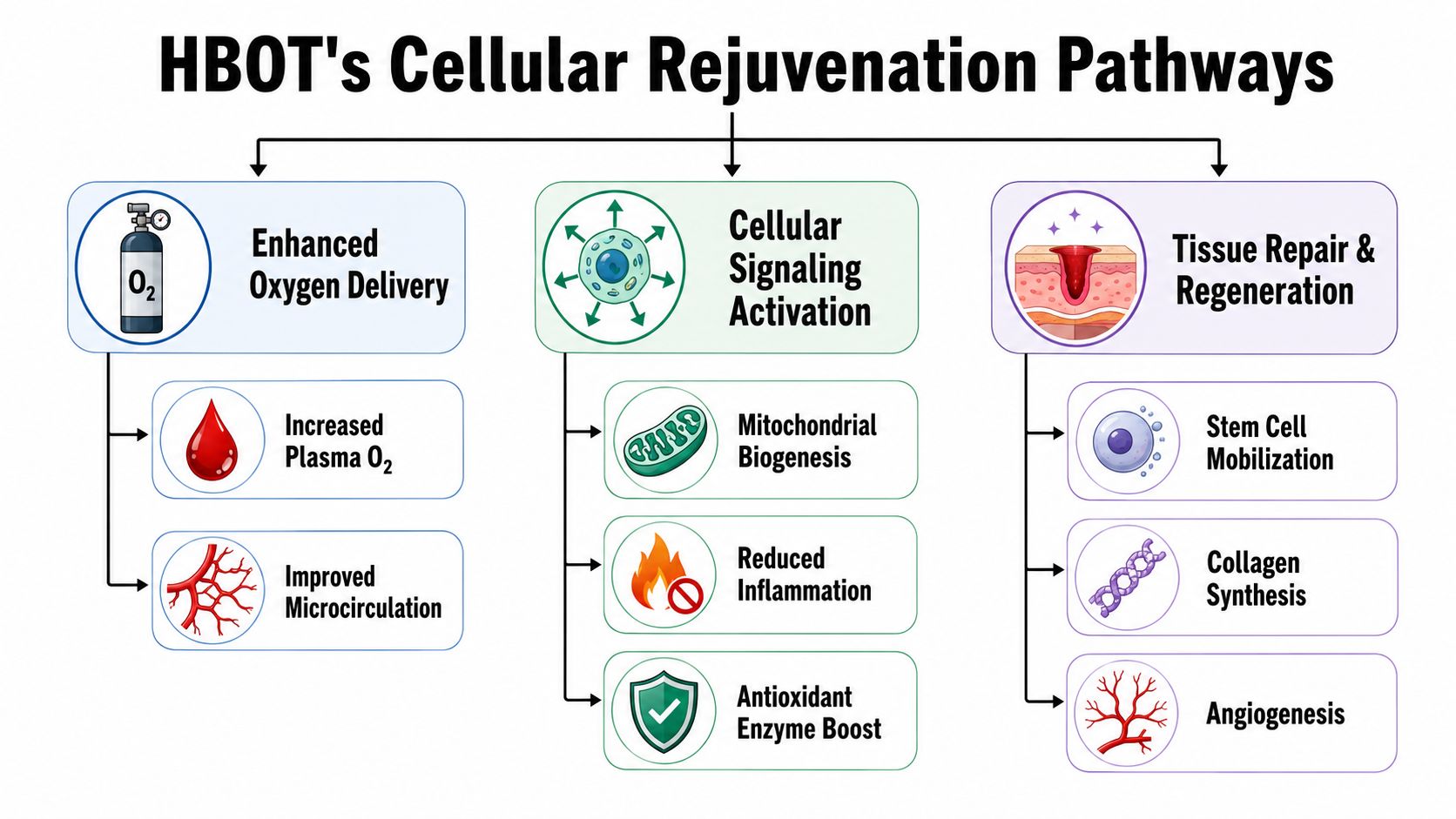
The telomere and senescence findings are important, but they aren't the whole story. In practice, HBOT appears relevant because it may influence several overlapping repair pathways.
A clinician typically thinks about HBOT through this lens:
Oxygen delivery: Pressurization allows oxygen to dissolve more effectively into plasma and diffuse into tissues.
Signaling effects: Controlled hyperoxia can trigger adaptive cellular responses rather than acting as a simple oxygen bath.
Repair support: Tissues with better oxygen access are often better positioned to maintain, remodel, and recover.
Clinical perspective: The question isn't whether oxygen is “good.” The question is whether a specific pressure-and-oxygen protocol can create a biologic signal strong enough to support repair. That's where medical HBOT differs from casual wellness use.
Patients sometimes get confused because HBOT sounds deceptively simple. Breathe oxygen, sit in a chamber, done. In reality, its value comes from dose, timing, repetition, and clinical context. That's why physician-led protocols matter.
Clinical Evidence and Healthspan Benefits
Cellular markers are compelling, but patients usually want to know something simpler: how might I feel or function differently?
That's where the clinical literature becomes more useful. It helps translate biology into meaningful outcomes tied to day-to-day performance.
Brain function and mental sharpness
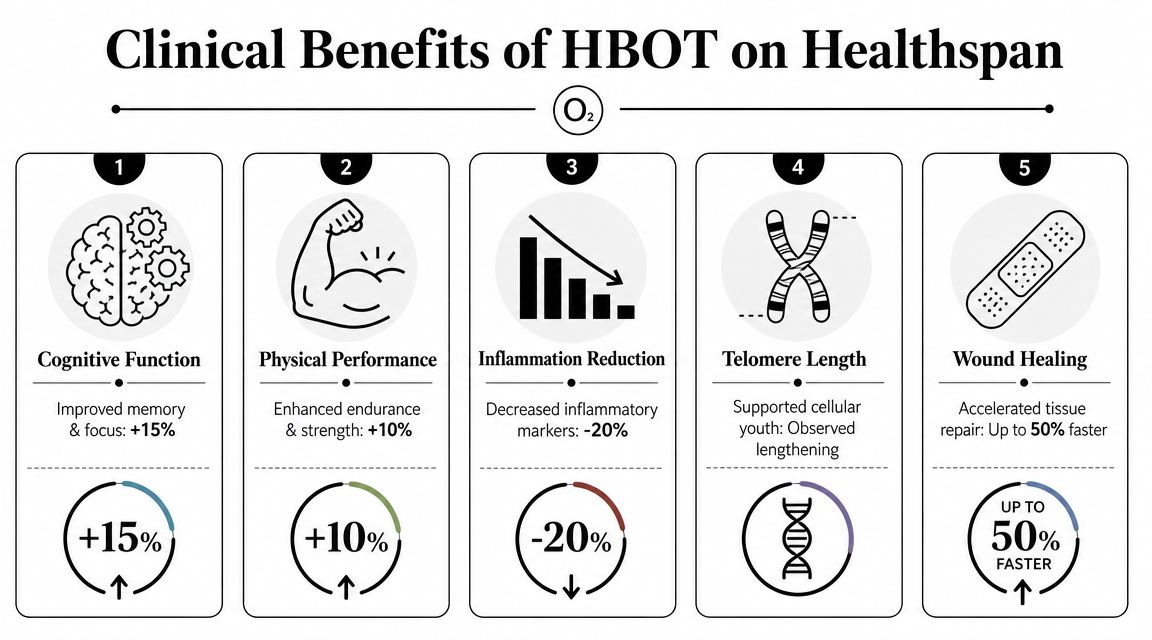
One of the better-known areas of HBOT research in older adults is cognition. In a randomized controlled trial of 63 healthy adults over age 64, summarized in a peer-reviewed review, HBOT delivered over a 60-session protocol was associated with improvements in cognitive performance, including attention, information processing speed, and executive function, alongside changes in regional cerebral blood flow, according to the Frontiers in Aging review covering HBOT and aging-related outcomes.
For patients, these aren't abstract terms. Attention is your ability to stay with a task. Processing speed affects how quickly you take in and use information. Executive function influences planning, judgment, and mental flexibility. Those capacities shape professional performance, confidence, and independence.
Heart, lungs, and visible aging
The same evidence base reports broader aging-related physiologic effects in older adults, including better cardiac performance, modest improvement in pulmonary function, and improved skin collagen density in a separate 70-participant study.
That mix is one reason HBOT remains so interesting in longevity care. It doesn't sit neatly in one specialty. It touches the brain, circulation, tissue quality, and recovery capacity.
A practical way to frame the benefits is through healthspan domains:
| Domain | What patients may care about |
|---|---|
| Cognition | Focus, mental clarity, decision-making |
| Cardiovascular function | Stamina, tolerance for activity, recovery |
| Pulmonary function | Comfort with exertion, breath efficiency |
| Skin quality | Texture, collagen support, visible aging |
For patients considering regenerative care more broadly, stem cell therapy for anti-aging and longevity is often discussed alongside HBOT because both approaches focus on function, repair, and tissue quality rather than symptom suppression alone.
The most meaningful longevity outcomes are usually not dramatic overnight changes. They're steadier thinking, better recovery, stronger reserve, and a body that behaves more like a younger version of itself.
What evidence can and can't tell us
HBOT isn't a promise of immortality, and it shouldn't be framed that way. The clinical evidence suggests it may support important aspects of healthy aging under structured protocols. It does not mean every person will experience the same response or that every chamber experience is medically equivalent.
That distinction protects patients from disappointment. Good longevity medicine is optimistic, but it stays disciplined.
Designing Your Personalized HBOT Protocol
The biggest mistake patients make is assuming HBOT is one treatment. It's not. It's a treatment category with variables that have to be adjusted to the person in front of us.
A physician-guided protocol usually turns on three questions: how much pressure, how long per session, and how many sessions in the treatment arc. Those choices shape both safety and effect.
The variables that actually matter
You may hear clinicians discuss chamber pressure in ATA, session duration, treatment frequency, and total treatment count. Those aren't technical details for their own sake. They define the biologic dose.
A younger athlete seeking recovery support may not need the same protocol as an older adult focused on cognition or someone entering a broader regenerative program. The body's starting point matters. So do your goals.
Here's how I explain it to patients:
Pressure changes intensity: More pressure changes oxygen delivery and signaling.
Session length changes exposure: Time in the chamber affects how long tissues are under that stimulus.
Session count changes durability: A single session may feel restorative, but cumulative protocols are usually what drive deeper adaptation.
Why diagnostics come first
Personalization only works when it is built on data. In serious longevity care, HBOT shouldn't be prescribed because it sounds advanced. It should be selected because a patient's physiology suggests it may be useful.
That's where advanced assessment changes the quality of the program. Clinicians may look at inflammatory patterns, metabolic function, recovery markers, imaging findings, cardiovascular status, neurocognitive performance, and tissue-level clues that help determine whether HBOT belongs in the plan and how intensive it should be.
A more developed longevity workup often includes:
Biomarker review: Trends can reveal stress patterns, reserve capacity, and physiologic priorities.
Imaging context: Full-body MRI and other studies can identify silent issues that should shape treatment.
Cardiopulmonary evaluation: Oxygen-based therapies need to be matched to heart and lung status.
Goal mapping: A cognition-driven plan differs from a recovery-driven or aesthetic-regenerative plan.
A good protocol is not the most aggressive one. It's the one that fits your biology closely enough to move the needle without creating unnecessary strain.
Generic wellness use versus medical use
There's a meaningful difference between “trying a chamber” and receiving a medical HBOT protocol. The chamber itself is only one part of the equation. Clinical oversight, indication, sequencing, and response monitoring matter just as much.
That's especially true for patients with complex histories, age-related decline, post-inflammatory states, or multimodal treatment plans. In those cases, HBOT becomes less of a standalone service and more of a calibrated component within a physician-directed program.
How HBOT Amplifies Regenerative Therapies
Why do some regenerative treatments produce a stronger result in one patient than another, even when the therapy itself is similar? The answer often lies in the tissue environment. Regenerative medicine is not only about what the physician introduces. It is also about the condition of the biological “ground” receiving that signal.
HBOT helps improve that ground. A useful analogy is farming. Biologics, peptides, and cell-based therapies function more like seeds and instructions. HBOT helps condition the soil by increasing oxygen delivery under pressure, supporting microcirculation, and reducing some of the physiologic friction that can interfere with repair.
Why the tissue environment changes the outcome
Clinicians in regenerative medicine pay close attention to signaling molecules, cell products, and treatment timing. Equally important is whether the target tissue has enough oxygen, blood flow, and metabolic support to respond well.
Tissue that is poorly perfused or stuck in a chronic inflammatory state can be harder to repair. In that setting, even a well-chosen intervention may have a narrower effect. HBOT can help shift the local conditions in a more favorable direction, which is one reason it is often paired with regenerative care rather than used in isolation.
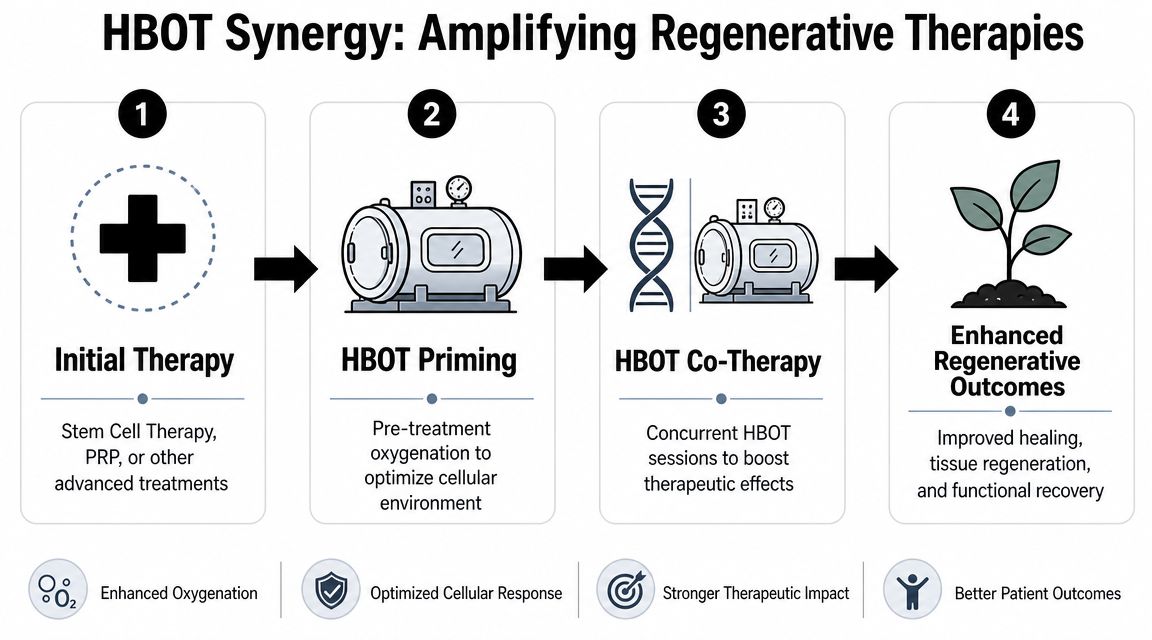
In practice, physicians usually use HBOT in one or more of three ways:
Before treatment: to improve tissue readiness and oxygen availability
Around the treatment window: to support an active period of signaling and repair
After treatment: to help maintain a favorable recovery environment as remodeling continues
Pairing HBOT with allogeneic regenerative care
Patients often ask whether HBOT and biologic therapy serve the same purpose. They do not. Each addresses a different part of the repair process.
Allogeneic stem cell strategies are designed to provide regenerative signaling and support. At our center, those platforms may include placental, Wharton's jelly, adipose, endometrial, and dental pulp cell types produced in a biotechnology lab. HBOT can complement those therapies by improving the physiologic setting into which they are introduced.
The same principle applies to exosomes and peptide-based protocols. Better oxygen delivery and circulation do not replace those therapies. They can improve the conditions in which those therapies need to work. Patients considering exosome therapy for anti-aging often understand the strategy more clearly once they see this distinction. Strong regenerative programs rarely depend on a single intervention. They use therapies with different roles that reinforce one another.
Why integration matters for the international patient
This integrated model is especially relevant for the international patient seeking a high-level longevity program. Many arrive after receiving fragmented care in different places, with one clinic addressing hormones, another offering aesthetic procedures, and another focusing on recovery. That structure makes sequencing difficult.
A physician-guided program at Longevity Medical Institute can coordinate diagnostics, biologics, HBOT, imaging, and follow-up within one treatment plan. That matters because timing affects response. A therapy that is well chosen but poorly sequenced may underperform, while the same therapy used in the right order can fit more naturally into the body's repair cycle.
The body does not heal in separate departments. Circulation, inflammation, immune signaling, connective tissue repair, and brain function influence one another. Regenerative medicine works best when the treatment plan respects those connections.
Your Treatment Journey What to Expect
Most apprehension around HBOT disappears after the first session. Patients usually expect something dramatic or uncomfortable. In reality, a well-run treatment feels controlled, calm, and surprisingly uneventful.
The process starts long before you enter the chamber. In a medical longevity setting, the first step is a physician review of your history, goals, and diagnostics. That may include lab data, imaging, cardiometabolic review, and a discussion of why HBOT is being used in your case.
The first day
On day one, the clinical team explains the chamber, the pressurization process, and how to equalize ear pressure. This part matters because the most common point of confusion is simple: patients wonder if pressure will feel dangerous. It usually feels more like the pressure change during a flight descent, but slower and supervised.
Once inside, most patients settle in quickly. Depending on the chamber format, you may rest, listen to audio, or relax in peace.
A typical patient experience includes:
Pre-session check-in: Staff review comfort, symptoms, and any changes since the previous session.
Gentle pressurization: You may feel ear fullness, which the team helps you manage.
Steady treatment phase: This is usually the calmest part. Many patients read, meditate, or nap.
Slow depressurization: Pressure returns to baseline in a controlled way before you leave the chamber.
What patients tend to notice over time
Most patients don't describe HBOT as a single dramatic moment. They describe a buildup. Sleep may feel deeper. Mental clarity may become more consistent. Recovery after activity may feel less sluggish. Skin may look healthier. Exercise tolerance may feel steadier.
Those changes depend on the indication and the broader treatment plan, but the cumulative pattern is important. HBOT is often a therapy of repetition, not spectacle.
Some of the best responses to HBOT are subtle at first. Patients often realize progress when they notice they're doing more with less effort.
Comfort, monitoring, and pace
A premium medical experience should feel both clinically rigorous and emotionally easy. That means close observation without unnecessary alarm, clear communication, and a pace suited to the individual.
If someone is anxious about enclosed spaces, has trouble equalizing pressure, or is entering treatment after a long illness, the team can usually adapt the session flow. Comfort isn't separate from outcomes. It helps patients complete the protocol consistently.
For international patients, that consistency matters. Travel-based care works best when the schedule is coordinated, expectations are realistic, and therapies are sequenced so the body can absorb the work being done.
FAQ for International Patients
Is HBOT safe?
For appropriately selected patients under medical supervision, HBOT has a strong safety profile. Safety depends on screening, equipment standards, protocol design, and attentive staff.
Patients with certain lung issues, ear or sinus problems, or other medical considerations may need additional evaluation before treatment. That doesn't automatically exclude HBOT, but it does mean the protocol should never be casual.
How do I choose a reputable clinic in Mexico?
Look for physician oversight, clear licensing, documented safety practices, and transparency about what kind of chamber and protocol are being used. Ask whether the center performs a medical evaluation before treatment and whether HBOT is integrated with diagnostics rather than sold as a generic wellness add-on.
International patients also ask whether regenerative care in Mexico can be delivered safely. A helpful starting point is this guide on how to evaluate whether stem cell therapy in Mexico is safe, because many of the same principles apply: physician leadership, regulatory compliance, quality control, and transparent clinical processes.
What does a treatment schedule look like for a traveler?
That depends on the goal. Some patients travel specifically for an HBOT block. Others integrate it into a broader regenerative itinerary that includes diagnostics, biologic therapies, recovery services, and follow-up planning.
The practical point is simple. HBOT usually works best when it's scheduled deliberately, not squeezed in as an afterthought between tourism activities.
What are the common risks or side effects?
The most common issue is pressure-related discomfort in the ears or sinuses. Some patients also feel temporary fatigue after sessions. These effects are usually manageable when the team prepares patients properly and adjusts the pace when needed.
Is HBOT enough on its own for longevity?
Sometimes HBOT is a meaningful standalone therapy. More often, it's one part of a larger strategy that may also include metabolic evaluation, sleep optimization, cardiovascular assessment, peptides, allogeneic regenerative therapies, exercise planning, and nutrition.
That's usually the more mature way to approach longevity. Aging doesn't happen in one system, so treatment rarely should either.
If you're considering a physician-guided longevity program in Los Cabos, Longevity Medical Institute offers HBOT within a broader regenerative medicine model that can include advanced diagnostics, imaging, allogeneic cell-based therapies, and individualized treatment planning for international patients seeking coordinated care.
Author
Dr. Kirk Sanford, DC, Founder & CEO, Longevity Medical Institute. Dr. Sanford focuses on patient education in regenerative and longevity medicine, translating complex therapies into clear, practical guidance for patients.
Medical Review
Dr. Félix Porras, MD, Medical Director, Longevity Medical Institute. Dr. Porras provides clinical oversight and medical review to help ensure accuracy, safety context, and alignment with current standards of care.
Last Reviewed: June 6, 2026
Short Disclaimer
This information is for educational purposes only and is not medical advice. It does not replace an evaluation by a qualified healthcare professional. For personalized guidance, please schedule a consultation.