

Hyperbaric Oxygen Therapy Near Me: A Patient's Guide
If you're searching for hyperbaric oxygen therapy near me, you're probably not looking for a novelty. You're looking for a real answer. Maybe a wound isn't healing. Maybe recovery has stalled. Maybe you're exploring advanced therapies that support resilience, performance, and healthier aging.
That search often starts with location, but location isn't the most important variable. With hyperbaric oxygen therapy, the more useful question is whether the clinic offers medical-grade treatment, appropriate screening, and a protocol that matches your condition. A chamber nearby isn't automatically the right chamber for you.
Hyperbaric oxygen therapy sits at an interesting intersection. It's a well-established medical treatment for a limited group of evidence-based conditions, and it's also widely marketed in wellness settings for broader goals. That overlap creates confusion for smart patients. Two businesses may both advertise “HBOT,” yet the chamber, pressure, staffing, and intended use may be very different.
For patients traveling for care, the decision gets even more layered. You're not only comparing treatment options. You're also weighing time, cost, insurance limits, and whether a local option is equivalent to a physician-led program. That's why people who begin with a simple search often end up asking bigger questions about safety, evidence, logistics, and long-term value.
A good starting point is understanding how advanced longevity care is evaluated as a whole, not just as a single session in a chamber. For broader context, see this guide on how patients assess a longevity clinic in Mexico.
Introduction Finding the Right Hyperbaric Oxygen Therapy
Searching locally makes sense. If treatment requires repeated visits, convenience matters. But with HBOT, convenience should come after clinical fit.
Why proximity alone can mislead
A nearby clinic may advertise oxygen therapy for a wide range of concerns. That doesn't tell you whether it offers the type of treatment used in hospital-based care, whether the staff screen for contraindications, or whether the protocol is designed for a recognized medical indication versus a general wellness goal.
That distinction matters because HBOT isn't just “more oxygen.” It's a treatment defined by pressure, oxygen concentration, supervision, and dose. If one of those elements changes, the physiologic effect can change too.
The right question isn't only “Where can I get HBOT?” It's “What kind of HBOT is this, and is it appropriate for what I need?”
What sophisticated patients usually want to know
Individuals considering HBOT want clarity in five areas:
Medical appropriateness: Is this evidence-based for my condition, or is it being offered more as an experimental or wellness intervention?
Treatment quality: Is the chamber medical-grade, and is the therapy delivered under clinical supervision?
Practical burden: How many sessions are typically involved, and how disruptive is the schedule?
Financial reality: Will insurance help, or is this likely to be out of pocket?
Travel feasibility: If I leave home for care, does the added expertise justify the trip?
Those are the right questions. They move the decision away from marketing and toward judgment.
What Is Hyperbaric Oxygen Therapy
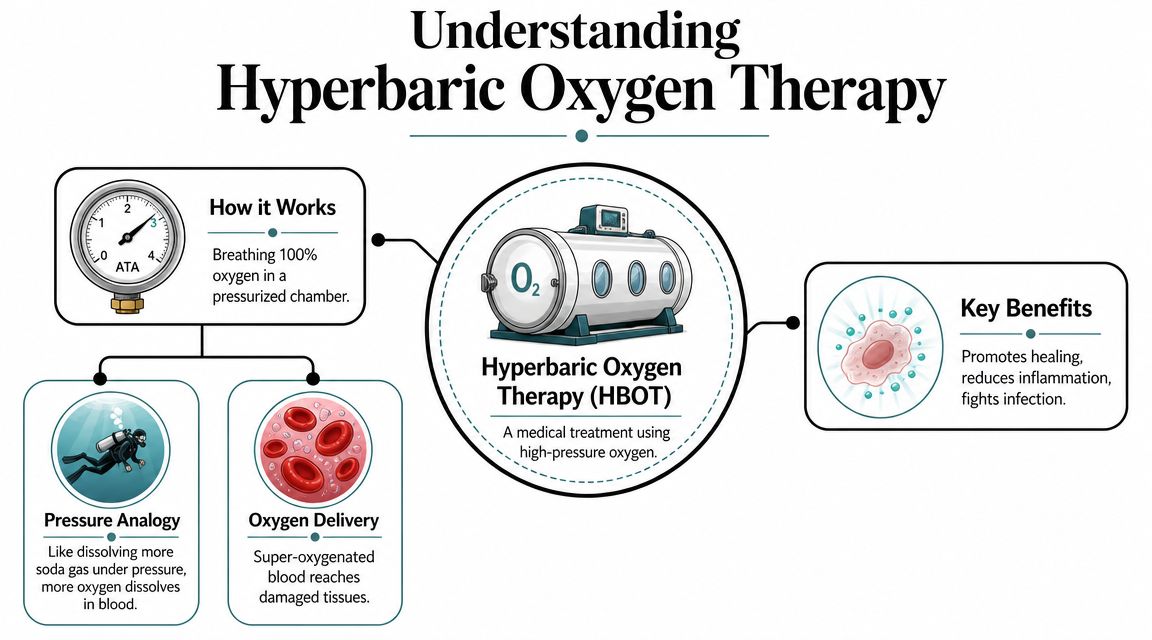
Hyperbaric oxygen therapy, or HBOT, is a medical treatment in which a person breathes near-100% oxygen inside a pressurized chamber. Standard medical references describe treatment at 1.5 to 3 ATA, which means about 1.5 to 3 times normal air pressure. Under those conditions, more oxygen dissolves directly into plasma, which can improve tissue oxygenation independent of hemoglobin and support wound repair, antimicrobial activity, and angiogenesis in hypoxic tissue, as explained by Johns Hopkins Medicine's overview of hyperbaric oxygen therapy.
A simple way to understand the science
Think of pressure like the cap on a carbonated drink. Under pressure, more gas can stay dissolved in liquid. HBOT uses that same principle in a medical setting. The chamber pressure allows much more oxygen to dissolve into the liquid portion of your blood.
That matters because some tissues don't receive oxygen efficiently when circulation is compromised or healing demand is high. In those situations, oxygen dissolved in plasma acts like a backup delivery route. It helps carry oxygen deeper into stressed tissue, where the body needs raw material for repair.
A more patient-friendly way to say it is this: HBOT helps supercharge the oxygen supply available for healing.
Why medical-grade HBOT is different
Not every oxygen chamber produces the same effect. A medically supervised treatment aims for the pressure and oxygen profile associated with recognized HBOT. That's different from lower-pressure offerings often marketed for general wellness.
If you're trying to compare options, it helps to review a dedicated explanation of a hyperbaric oxygen chamber and how medical protocols work.
Here's where many readers get confused. They assume all chambers are interchangeable because the experience sounds similar. But from a clinical standpoint, the details matter. Pressure level, oxygen delivery, monitoring, and treatment goals all shape whether a session is relaxing or potentially medically meaningful.
Practical rule: When evaluating HBOT, ask what pressure range is used, whether you'll be breathing near-100% oxygen, and who is supervising treatment.
Clinical Indications and Longevity Benefits
HBOT has a real medical foundation. It isn't fringe medicine. In the United States, it has 14 approved indications, including carbon monoxide poisoning, decompression sickness, gas embolism, gas gangrene, chronic refractory osteomyelitis, radiation injury, and diabetic lower-extremity wounds that meet specific criteria, according to this medical policy summary on hyperbaric oxygen therapy.
Where the evidence is strongest
The most established uses of HBOT are narrow compared with the broad claims you may see online. That's an important sign of maturity in the field, not a limitation. It means medicine has identified specific situations where oxygen under pressure has a defined role.
Examples include:
Urgent toxic or pressure-related conditions: Carbon monoxide poisoning, decompression sickness, and gas embolism.
Difficult healing environments: Radiation injury, compromised grafts or flaps, and chronic wounds under the right criteria.
Selected infections: Certain severe infections where oxygenation can support tissue recovery and antimicrobial effect.
One area where patients often get misled is diabetic wounds. Coverage is typically not automatic. Medicare rules described in the same policy source show that HBOT for diabetic wounds generally requires Type 1 or Type 2 diabetes, a wound of Wagner grade III or higher, and failure of standard wound therapy. That tells you how tightly regulated evidence-based use can be.
Where longevity medicine enters the conversation
Outside those approved indications, patients often ask about HBOT for recovery, inflammation, performance support, and healthy aging. Those questions are understandable. Oxygen availability affects tissue function, repair, and resilience. In practice, clinicians may consider HBOT as part of a broader plan when someone is trying to recover from high training loads, support tissue repair, or build a restorative environment around regenerative therapies.
That's where nuance matters. A longevity-oriented use isn't the same thing as a formally approved indication. It may still be clinically considered, but it should be framed accurately and matched to an individualized plan.
For readers also exploring regenerative care, it's helpful to understand how cell regeneration therapy is often discussed alongside oxygen-based support strategies.
A thoughtful clinic separates three categories clearly: approved medical use, selective off-label use, and pure wellness marketing.
The Patient Experience What to Expect During Treatment
For many patients, the chamber is the most unfamiliar part. Once you understand the rhythm of treatment, HBOT usually feels much less mysterious.
What a treatment day usually looks like
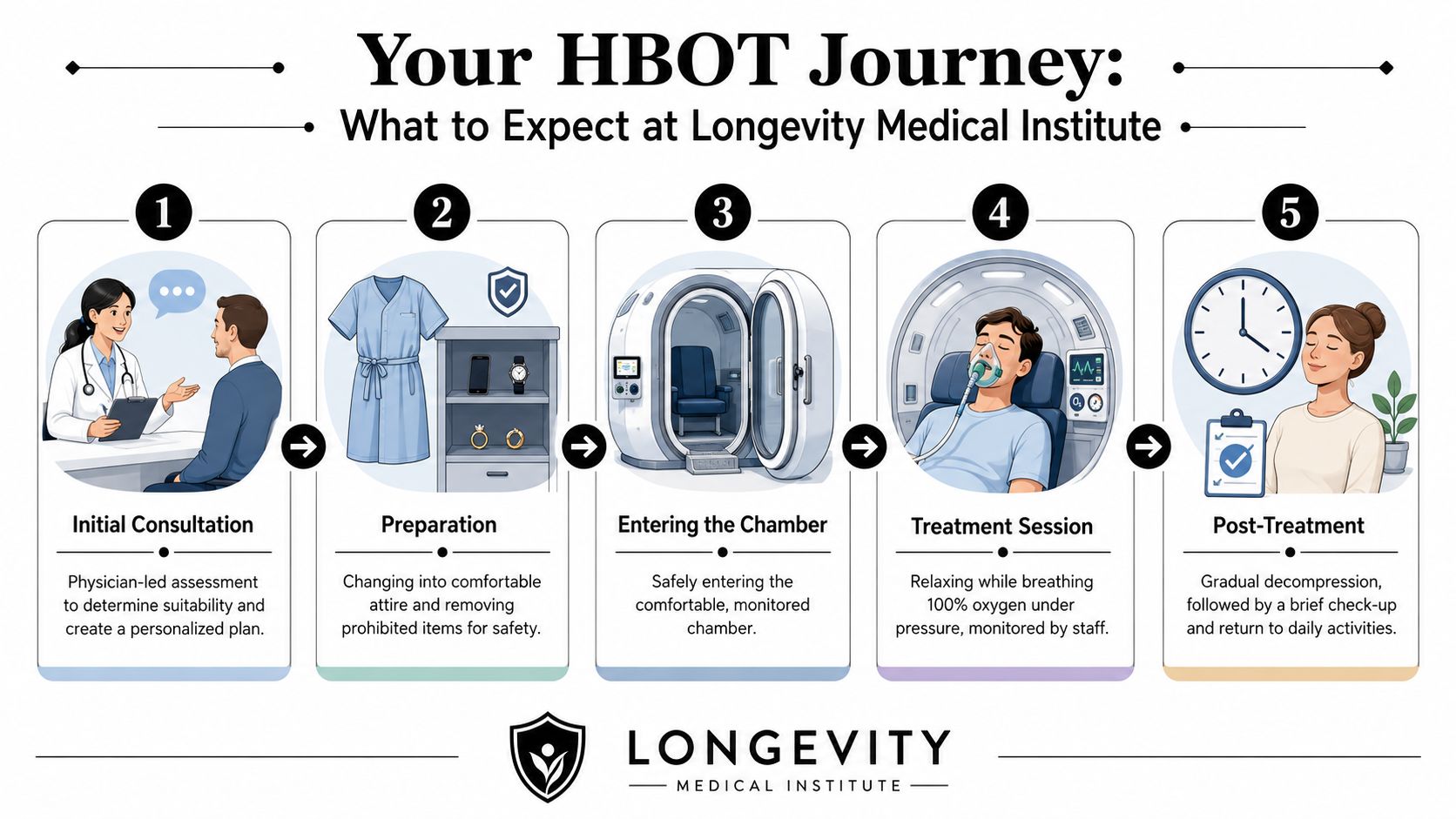
The process normally begins with screening. A clinician reviews your medical history, your reason for seeking treatment, and whether HBOT is appropriate for you. That part is not a formality. Pressure-based therapy should be matched to the person, not just booked like a spa service.
Next comes preparation. You'll receive instructions on what to wear, what to leave outside the chamber, and how the session will feel. The treatment itself often feels similar to changes in cabin pressure during a flight. Your ears may need to equalize as the chamber pressurizes.
Inside the chamber
Once treatment starts, patients typically settle into a fairly calm routine. Staff monitor the session, and the pressure increases gradually. Then you spend the main treatment period breathing oxygen under pressure.
A practical benchmark from Mayo Clinic's hyperbaric oxygen therapy overview is about 60-90 minutes of treatment time per session, often scheduled daily, 5 days per week, with many chronic wound protocols using 10-40 or more sessions. Mayo also notes that treatment effect is dose-dependent, which helps explain why session count matters.
That schedule surprises many first-time patients. They expect one or two visits. In reality, medically supervised HBOT is often more like a course of treatment than a single event.
You can learn more about the patient perspective in this overview of the benefits of hyperbaric oxygen chambers.
What patients commonly feel
Patients typically describe HBOT as uneventful in a good way. The most noticeable sensation is pressure adjustment, especially during the first part of the session. Afterward, many patients return to their normal routine the same day.
A few practical points make the experience easier:
Arrive with time to spare: Rushing makes any medical visit feel harder than it is.
Expect repetition: HBOT is often cumulative. Improvement, when it happens, usually comes from consistency.
Think in terms of protocol, not appointment: The therapeutic unit is often the series, not the single session.
If your schedule can't support repeated visits, that's not a minor detail. It may shape whether HBOT is realistic for you.
Is Hyperbaric Oxygen Therapy Safe
When HBOT is delivered in an appropriate medical setting, safety depends on screening, supervision, and strict protocol. That's why the same therapy can feel very different depending on where it's offered.
What patients should know about risk
The most common concerns are pressure-related. Ears and sinuses are the obvious examples because they react to changes in pressure. Some patients also ask about temporary visual changes or general discomfort after repeated sessions. Those issues are part of why pre-treatment assessment matters.
HBOT is not a casual add-on. It's a treatment that asks the body to adapt to a pressurized environment. That doesn't make it dangerous by default. It means the clinical team should determine whether the expected benefit justifies the exposure.
Why screening matters more than marketing
A responsible provider will review your medical history, current symptoms, and practical ability to complete a course of therapy. They should also explain when HBOT may not be appropriate and when another strategy may fit better.
That's one reason transparency matters so much. Patients can review LMI's broader philosophy around safety and transparency in clinical care, which reflects the kind of questions any clinic should welcome.
Here are sensible questions to ask before booking:
Who evaluates me first: Is there clinician oversight before the first session?
How is safety monitored: What happens during pressurization, treatment, and decompression?
What would stop treatment: Which symptoms or medical findings would make HBOT inappropriate?
Is this medical or wellness use: Are you being treated for a recognized indication, or something more exploratory?
Good HBOT programs don't promise the chamber is right for everyone. They explain who should proceed carefully, and who shouldn't proceed at all.
Planning Your Treatment Cost Insurance and Travel
The practical side of HBOT often determines whether a patient follows through. Even when someone is enthusiastic about the science, treatment burden can be the deciding factor.
What out-of-pocket care can look like
A local provider cited in the research openly advertises $250 for a 60-minute session and $300 for a 90-minute session, with multi-session bundles priced into the thousands. It also recommends 10 to 40 sessions for results. That's why out-of-pocket HBOT can become a serious financial commitment.
Those prices don't define the entire market, but they illustrate a common reality. HBOT usually isn't a one-time purchase. The likely total matters more than the headline cost of a single visit.
Why insurance can be uneven
Insurance tends to align more closely with approved indications than with broad wellness goals. Patients often discover that “HBOT is covered” is too vague to be useful. Coverage may depend on diagnosis, documentation, prior treatment failure, and detailed authorization requirements.
For medical tourists, insurance can become even more complicated. The clinical question and the reimbursement question are not always the same. A treatment may be reasonable to consider while still being difficult to submit, especially when delivered outside a domestic hospital system.
Travel changes the equation
When people compare a local option with traveling for care, they usually focus on airfare first. That's understandable, but it's incomplete. The larger calculation includes:
Session frequency: Can you stay long enough to complete a meaningful portion of treatment?
Care coordination: Will one team manage diagnostics, physician oversight, and related therapies?
Recovery environment: Does travel add stress, or does it create the space to follow the protocol?
Budget clarity: Are you comparing like with like, or a medical program versus a wellness package?
For many patients, the question isn't “Can I find hyperbaric oxygen therapy near me?” It's “Which option gives me a coherent plan I can complete?”
Why Choose Longevity Medical Institute
A patient traveling for HBOT often faces a more complicated decision than choosing the closest chamber. A key question is whether the facility can connect oxygen therapy to a medically coherent plan, especially if the patient is also weighing diagnostics, regenerative medicine, recovery support, and time away from home.

The detail that separates medical HBOT from a wellness offering
HBOT is only as good as the match between the chamber, the protocol, and the reason for treatment. A chamber by itself is like an operating room without a diagnosis. The equipment matters, but the clinical judgment around it matters more.
Independent medical sources tend to describe HBOT in a narrower, evidence-based way for problems such as non-healing wounds, radiation injury, severe infections, and compromised grafts or flaps. Commercial wellness pages often frame it much more broadly.
That is the standard patients should apply anywhere they seek care. The useful question is not whether a center looks impressive. It is whether the treatment setting fits the indication.
A careful clinic should be able to answer practical questions immediately:
| Question | Why it matters |
|---|---|
| What type of chamber is used? | Chamber design shapes how treatment is delivered and monitored. |
| Who supervises treatment? | Pressure and oxygen therapy require trained medical oversight. |
| Is the protocol tied to my indication? | A preset package is different from a physician-directed plan. |
| How are related issues handled? | HBOT often works better when it is part of a broader medical strategy. |
Why some patients need an integrated model
Longevity Medical Institute presents HBOT within a physician-led setting that also includes regenerative and diagnostic services. For the right patient, that structure can be useful.
The advantage is not marketing. It is coordination. If someone is considering HBOT alongside biomarker testing, imaging, peptide therapy, cell-based care, or recovery support, a single team can evaluate how those pieces fit together. That approach is often more practical for medical tourists, who may have limited time on site and little margin for fragmented care.
In that setting, HBOT works like one instrument in a full clinical toolkit. It may play an important role, but it is not treated as a cure-all or sold as an isolated wellness experience.
A closer look at the treatment environment can help:
What to verify before you commit
Before choosing any HBOT provider, patients should confirm four basics:
Clinical oversight: There should be physician review and a clear rationale for treatment.
Protocol design: The treatment course should reflect the diagnosis, goals, and timeline.
Safety communication: Staff should explain precautions, limitations, and chamber procedures in plain language.
Care coordination: If HBOT is only one part of the plan, the same team should be able to connect the next steps.
For patients comparing local options with traveling for care, those details usually matter more than search proximity. A well-run HBOT program should feel medically organized, not merely available.
Frequently Asked Questions About HBOT
Do I need a doctor's referral to start
That depends on the clinic and the reason you're seeking care. For medically appropriate HBOT, physician evaluation is important even if a formal outside referral isn't always required. The key is that someone with clinical authority should determine whether the treatment fits your diagnosis and overall plan.
How soon will I notice results
That varies by indication, tissue status, and whether HBOT is being used as a focused medical therapy or part of a broader recovery strategy. Some patients look for immediate change after one visit and become discouraged too quickly. HBOT is often more like a cumulative biologic stimulus than an instant intervention.
Can I read or use my phone in the chamber
Policies differ by chamber type and facility safety rules. Ask the clinic exactly what is permitted. A well-run center will explain this before your first session so you know what the treatment experience will feel like.
How does HBOT relate to regenerative medicine
Clinicians sometimes consider HBOT as a supportive therapy within a wider regenerative plan because oxygen availability affects tissue repair and the healing environment. That doesn't mean it replaces other therapies. It means some programs use it to support recovery conditions around a more complete protocol.
What's the difference between medical-grade HBOT and mild HBOT
The simplest answer is that they aren't interchangeable.
| Feature | Medical-Grade HBOT (Longevity Medical Institute) | Mild or “Wellness” HBOT |
|---|---|---|
| Pressure and oxygen profile | Intended to align with recognized HBOT parameters used in medical practice | Often marketed more broadly, with important differences in setup and purpose |
| Clinical oversight | Physician-led evaluation and monitored treatment | Oversight may be lighter, depending on the setting |
| Best fit | Patients who need indication-based treatment or structured integration into a clinical plan | Patients pursuing general wellness-oriented experiences |
| Decision standard | Medical appropriateness comes first | Marketing language often plays a larger role |
What should I ask when comparing clinics near me
Use direct questions:
Is this offered for an approved indication or a wellness goal?
What chamber and protocol are being used?
Who decides whether I'm a candidate?
How many sessions are realistically expected?
What is the total cost if I complete the recommended course?
Those questions usually tell you more than the homepage will.
If you're considering Longevity Medical Institute, the next step is a consultation focused on your goals, diagnosis, timeline, and whether HBOT belongs in your plan at all. For patients traveling for care, that discussion can also cover logistics, treatment sequencing, and how HBOT may fit alongside advanced diagnostics and regenerative therapies.
Author
Dr. Kirk Sanford, DC, Founder & CEO, Longevity Medical Institute. Dr. Sanford focuses on patient education in regenerative and longevity medicine, translating complex therapies into clear, practical guidance for patients.
Medical Review
Dr. Félix Porras, MD, Medical Director, Longevity Medical Institute. Dr. Porras provides clinical oversight and medical review to help ensure accuracy, safety context, and alignment with current standards of care.
Last Reviewed: June 4, 2026
Short Disclaimer
This information is for educational purposes only and is not medical advice. It does not replace an evaluation by a qualified healthcare professional. For personalized guidance, please schedule a consultation.