

Hyperbaric Therapy for Inflammation: Clinical Guide
You may already be doing many of the right things. You've improved your diet, cleaned up your sleep, trained more intelligently, and addressed obvious sources of pain or illness. Yet recovery still feels slower than it should. Joints stay irritated. Energy dips for no clear reason. A flare that should have settled lingers in the background.
That pattern often reflects more than a single symptom. It reflects an internal environment that isn't ideal for repair. When tissues remain inflamed, swollen, or poorly oxygenated, the body has a harder time completing the work of healing. Cells can't perform well in a setting that feels biologically crowded, stressed, and under-fueled.
Clinical interest surrounds Hyperbaric Therapy for Inflammation. It isn't just about “more oxygen” in a vague wellness sense. It's about changing tissue conditions in a precise, physical way so the body can move from alarm mode toward repair mode. For patients exploring broader regenerative care, that often makes it a useful companion to strategies such as stem cells for inflammation reduction.
The Unseen Barrier to Healing and Vitality
Many patients describe inflammation as if it were a visible injury. A swollen knee. A painful gut flare. A red, irritated patch of skin. But the more challenging form is often quieter. It shows up as stalled progress.
You may notice that workouts leave you sore for too long. Old injuries feel “active” again after travel or stress. Digestion becomes unpredictable. Your brain feels less sharp. Sleep doesn't restore you the way it used to. Nothing seems dramatic enough to explain the whole picture, yet you don't feel resilient.
When the body stays on alert
Inflammation is part of normal defense and repair. The problem begins when the signal doesn't switch off cleanly. In that state, the body behaves like a home with the alarm system constantly half-triggered. Lights stay on. Energy gets wasted. Routine maintenance gets delayed.
At the tissue level, inflamed areas often become more difficult to nourish and repair. Swelling can interfere with circulation. Cellular cleanup slows. The local environment becomes less efficient for recovery.
A body can tolerate injury surprisingly well. What it struggles with is an injury environment that never fully resolves.
That distinction matters. If the environment is the problem, a useful therapy should do more than numb symptoms. It should help reset the conditions around the tissue.
Why oxygen becomes a therapeutic tool
Hyperbaric oxygen therapy has been used clinically for decades. It is typically delivered by breathing 98%+ oxygen in a chamber pressurized to about 1.5 to 2 times normal air pressure, and its core role is to raise oxygen delivery to injured or inflamed tissues in ways that support immune activity, new blood vessel growth, and tissue repair, as described by Johns Hopkins Medicine.
For the patient, that means this is not a cosmetic intervention or a trend-driven add-on. It is a medical strategy designed to improve the terrain in which healing happens.
Understanding Hyperbaric Oxygen Therapy
Under normal conditions, red blood cells carry most of the body's oxygen. Hyperbaric oxygen therapy changes that dynamic by increasing both the amount of oxygen you breathe and the pressure used to deliver it. The result is a temporary rise in oxygen dissolved directly in plasma, the fluid portion of blood, which helps oxygen reach tissue that is inflamed, swollen, or healing slowly.
Why pressure changes the biology
Breathing oxygen at normal atmospheric pressure is helpful up to a point. In a hyperbaric chamber, pressure acts like a force multiplier. It allows oxygen to dissolve into plasma in greater amounts than it can under ordinary conditions.
A useful comparison is a drink under pressure. When pressure rises, more gas stays dissolved in the liquid. In HBOT, the liquid is plasma. That matters because plasma can move through very small vessels and around areas where circulation is compromised, carrying oxygen beyond the usual red-cell route.
This is one reason HBOT is medically interesting in inflammatory and recovery-focused care. It does not merely increase oxygen in a general sense. It changes where oxygen can go and how much of it can reach stressed tissue.
What the treatment actually involves
During treatment, you rest in a chamber and breathe 98%+ oxygen while the chamber is pressurized above normal atmospheric levels. Earlier in the article, we noted the commonly used medical range of about 1.5 to 3 times normal air pressure. Those treatment conditions are designed to support tissue repair, immune defense, and recovery at the cellular level.
If you are comparing options, a medical-grade hyperbaric oxygen chamber is very different from lower-pressure consumer devices. The chamber itself matters, but so do physician oversight, treatment protocols, and the clinical question being addressed.
That last point often gets missed. In advanced regenerative medicine, HBOT is rarely viewed as a stand-alone wellness session. It is used as part of a larger plan, with timing, pressure, session number, and companion therapies selected to improve the tissue environment before or after interventions such as stem cells or exosomes.
What patients usually feel
The experience is usually calm. The main sensation is pressure in the ears, much like ascent or descent during a flight. Once the chamber reaches the prescribed pressure, many patients read, rest, or relax.
| Experience | What it feels like |
|---|---|
| Pressurization | Ear pressure changes, similar to air travel |
| During the session | Quiet rest while breathing oxygen |
| Afterward | Many patients return to their normal day |
Practical rule: HBOT is technologically sophisticated, but the patient experience is usually simple and controlled. The deeper value lies in how precisely it can change the healing environment when used for the right patient, at the right dose, within a regenerative care plan.
How Oxygen Calms the Inflammatory Cascade
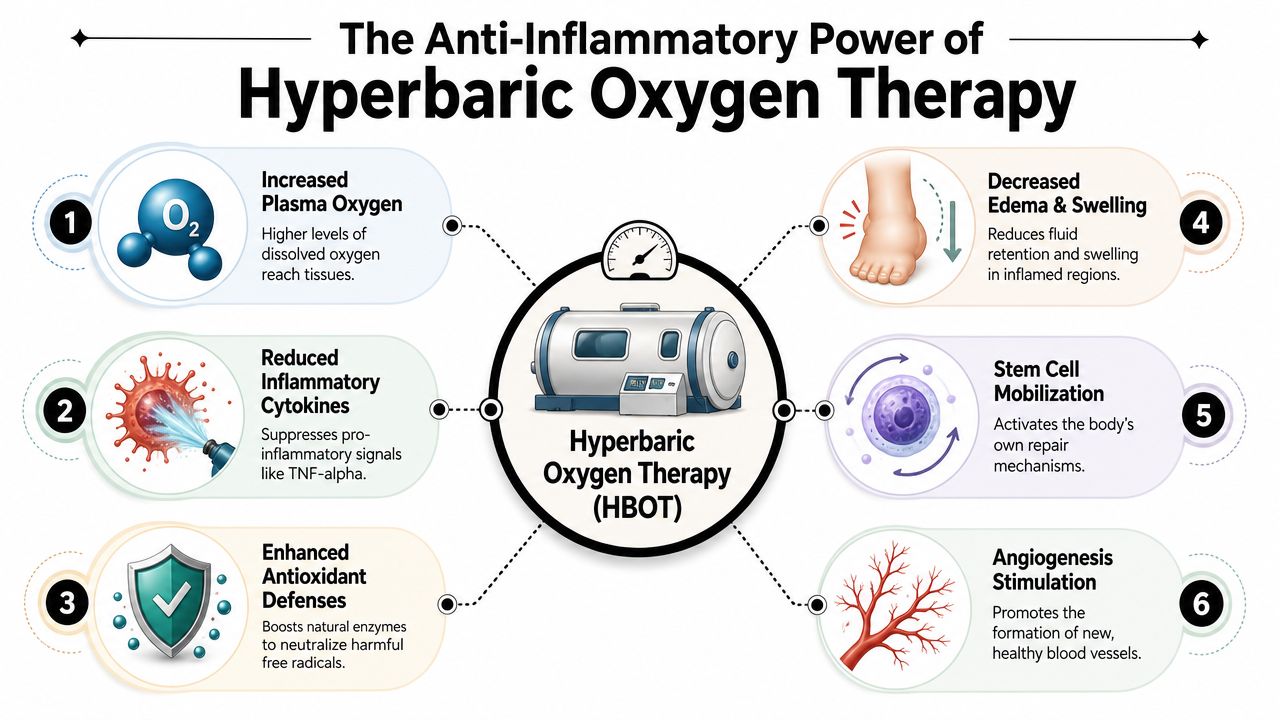
Inflammation isn't one switch. It's a chain of signals, vascular changes, immune activity, and repair demands. Hyperbaric therapy matters because it influences several parts of that chain at once.
Less swelling without less oxygen
One point often confuses patients. If blood vessels narrow during treatment, wouldn't that reduce delivery?
In inflamed tissue, the answer is more nuanced. Hyperbaric oxygen can help reduce edema and swelling, yet the tissue still receives abundant oxygen because the oxygen content in the blood and plasma is so much higher under pressure. This is one reason HBOT is clinically appealing in tissue-injury states. You can decrease congestion while maintaining oxygen support.
That's a very different effect from blocking pain perception.
Quieting the body's alarm signals
The inflammatory cascade depends on chemical messengers. Some of these act like alarm bells, recruiting and sustaining more immune activity. In inflammatory conditions such as ulcerative colitis, a 2024 review in Progress in Clinical Medicine reports that HBOT reduced inflammatory and oxidative-stress markers including IL-1, IL-6, TNF-α, neopterin, myeloperoxidase, malondialdehyde, and plasma carbonyls. The same review cites a systematic review of 780 patients showing significant improvement in IL-10 with reductions in TNF-α and IL-6.
For patients, those marker names aren't the main story. The important point is what they represent. When those pro-inflammatory signals decrease and anti-inflammatory signaling improves, the body is more likely to move toward resolution instead of remaining trapped in a repeating loop of irritation.
Supporting cellular energy and repair
Cells need oxygen not only to survive, but to do work. Repairing tissue, rebuilding membranes, supporting immune defense, and coordinating recovery all require energy.
When oxygen availability improves, the body is better positioned to handle tasks such as:
Tissue repair: Cells can better support restoration in stressed or injured areas.
Immune coordination: The immune system works more effectively in a well-oxygenated environment.
Vascular recovery: New blood vessel growth is better supported when the local tissue environment improves.
Cleanup and resolution: Damaged areas can transition out of the inflammatory state more efficiently.
For some patients, HBOT is paired with broader anti-inflammatory support, including IV therapy for inflammation, when hydration, nutrient delivery, and recovery support are also part of the clinical plan.
A short visual explainer can help tie these mechanisms together:
HBOT doesn't work like a bandage over inflammation. It changes conditions inside the tissue so repair has a better chance to proceed.
The Clinical Evidence for HBOT and Inflammation
Clinical evidence matters most when it answers a practical question. In which patients does HBOT change the biology of inflammation in a measurable way, and where should expectations stay modest?
The clearest signals appear in conditions where inflammation, tissue injury, and impaired oxygen delivery overlap. As mentioned previously, the 2024 review reported meaningful reductions in inflammatory and oxidative stress markers in ulcerative colitis and related tissue-injury settings, including IL-1, IL-6, TNF-α, and myeloperoxidase. Those molecules function like overactive messengers in an alarm system. If they remain high, tissue stays stuck in a defensive state. If they fall in a consistent pattern, it suggests the environment is becoming more favorable for repair.
That distinction matters clinically.
Patients are rarely interested in cytokines for their own sake. They want to know whether a therapy is affecting swollen tissue, delayed recovery, persistent irritation, or the inflammatory burden that keeps healing from progressing. Marker changes do not guarantee symptom relief in every case, but they do show that HBOT can act upstream, at the level where immune signaling is being set and amplified.
A more useful way to read the evidence is to ask three questions at once: what condition was studied, what biological changes were measured, and how closely those changes match the patient in front of you. That is the difference between evidence-based selection and generic marketing.
| Clinical question | How to interpret the evidence |
|---|---|
| Will this only cover up symptoms? | Studies showing changes in cytokines and oxidative stress markers suggest HBOT can influence the inflammatory setting itself, not only the sensation of discomfort. |
| Is HBOT only relevant for wound care? | The evidence is more nuanced. It is strongest in wound and ischemia-related settings, but it also extends into certain inflammation-heavy conditions such as ulcerative colitis. |
| Does this fit every patient with chronic inflammation? | No. The literature supports targeted use in specific clinical contexts, not blanket use for every fatigue, pain, or wellness complaint. |
This is also where regenerative medicine adds needed context. In clinical practice, HBOT is often more valuable as one part of a biologic strategy than as a stand-alone intervention. A patient with immune dysregulation, delayed tissue recovery, or inflammatory injury may need a plan that also considers immune modulation with stem cells, especially when the goal is to change the repair environment rather than chase symptoms one by one.
Caution still belongs here. Evidence of anti-inflammatory effects does not mean universal benefit across all chronic conditions discussed online. Joint pain after training, inflammatory bowel disease, post-surgical healing, and unexplained low energy are different clinical problems with different mechanisms. Good patient selection begins with that distinction.
The most credible use of HBOT is precise. Match the therapy to the biology, use objective goals where possible, and place it inside a broader regenerative protocol when the case calls for it.
Synergy with Advanced Regenerative Medicine
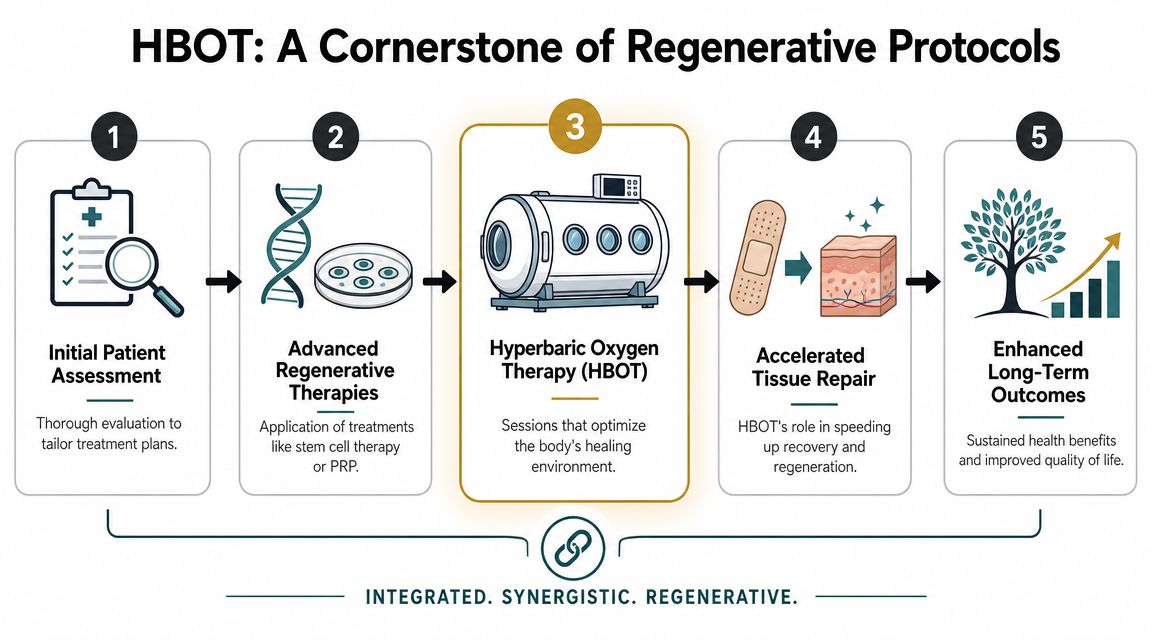
In advanced regenerative care, timing and tissue environment matter. A therapy can be biologically promising and still underperform if the local conditions are poor. Inflamed, swollen, oxygen-deprived tissue is not an ideal setting for repair signaling.
This is why HBOT often makes the most sense when viewed as a preparatory and supportive therapy rather than a standalone miracle.
Preparing the biological soil
A useful analogy is agriculture. If the soil is compacted, inflamed, and poorly irrigated, even excellent seeds struggle. HBOT helps prepare the soil by improving oxygen availability, reducing tissue congestion, and supporting a more repair-friendly microenvironment.
In regenerative medicine, that preparation may improve how the body responds to complementary interventions that depend on signaling, circulation, and tissue receptivity.
How this fits with allogeneic regenerative care
In a physician-led protocol, HBOT may be used alongside allogeneic stem cell strategies and exosome-based approaches. The logic is straightforward. If oxygenation improves and inflammation becomes better controlled, the body may be more prepared to receive and respond to regenerative signaling.
At Longevity Medical Institute, regenerative protocols may include allogeneic cell platforms produced in its biotechnology lab, including placental, Wharton's jelly, adipose, endometrial, and dental pulp stem cells. In that context, HBOT can function as part of the environmental optimization phase rather than as an isolated service. Patients also exploring immune modulation with stem cells often benefit from understanding this sequencing logic.
Why combination thinking matters
The value of combination care isn't that one therapy “boosts” another in a marketing sense. It's that each therapy addresses a different obstacle.
Consider the division of labor:
HBOT: Improves tissue oxygenation and helps calm inflammatory conditions that interfere with repair.
Allogeneic stem cell therapy: Provides regenerative and immune-modulating signals within a broader clinical plan.
Exosome-based support: Contributes cell-signaling effects that may complement tissue recovery strategies.
Physical medicine and recovery care: Helps tissues use improved biology through movement, mechanics, and load management.
If regenerative medicine is an orchestra, HBOT is often part of the acoustic preparation. It helps the rest of the system perform in a cleaner, less chaotic environment.
That framing also protects expectations. HBOT is powerful, but it usually works best when used thoughtfully, in the right patient, at the right point in a larger plan.
Your Hyperbaric Therapy Journey What to Expect
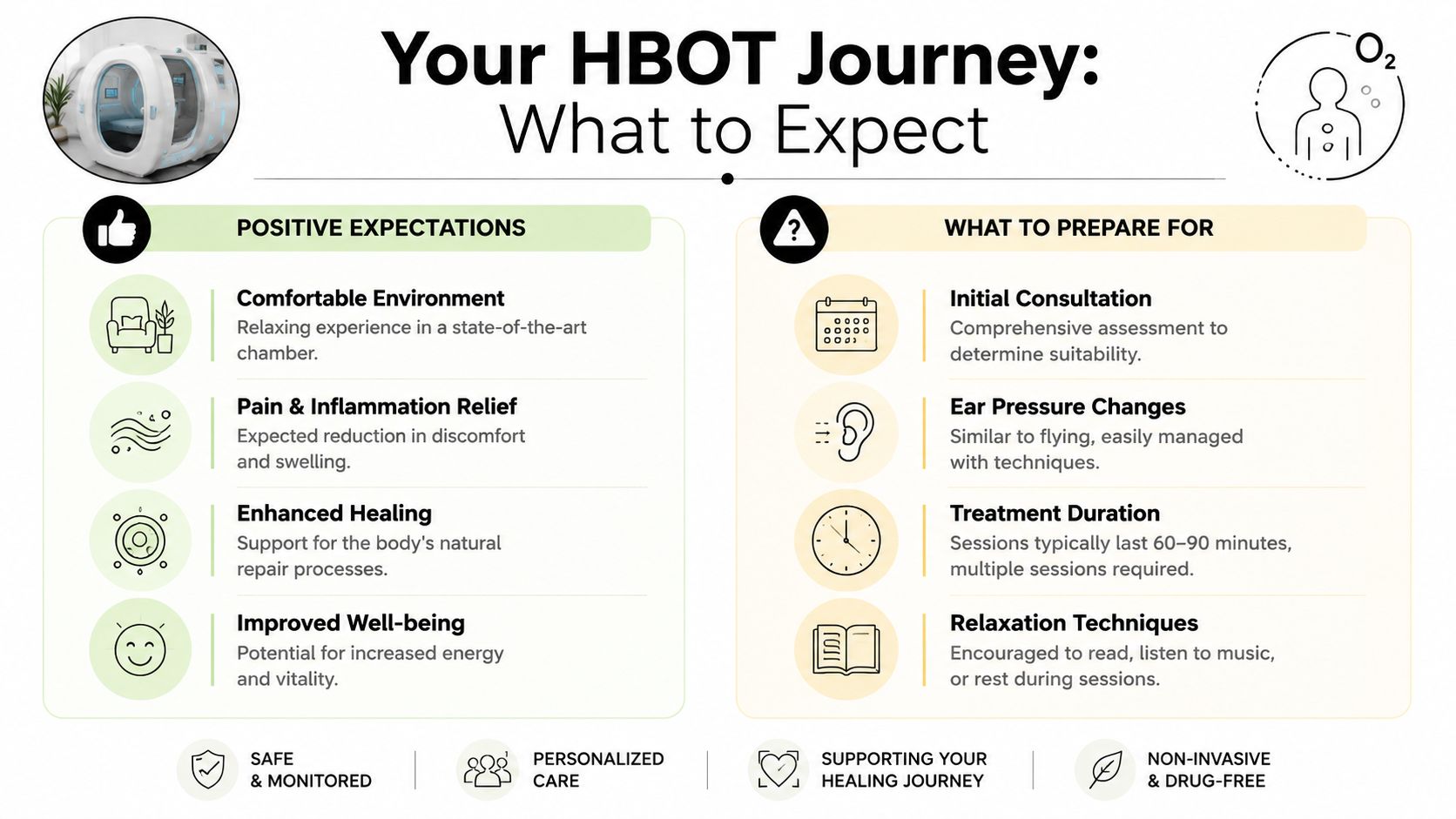
Patients usually feel more comfortable with HBOT once they know what the experience involves. The most important first step isn't entering the chamber. It's determining whether you're a good candidate.
Who tends to be a reasonable candidate
Patients often explore Hyperbaric Therapy for Inflammation when they are dealing with one or more of the following:
Chronic inflammatory burden: Persistent tissue irritation, slow healing, or recurrent flares.
Recovery support: Healing after surgery, injury, or a demanding medical procedure.
Inflammatory tissue injury states: Situations where swelling, oxygen stress, and delayed repair are part of the problem.
Regenerative protocol support: Preparation for or recovery after a broader restorative treatment plan.
That said, HBOT isn't a casual spa service. It's a supervised medical intervention.
Why supervision and dosing matter
The Mayo Clinic overview of hyperbaric oxygen therapy notes that HBOT is generally safe, but the risk of complications can increase with longer or repeated therapies. The same source notes that ear pain is a common side effect. This is why treatment decisions should use a data-driven approach to patient selection, intensity, and monitoring, especially when the goal is chronic inflammation rather than an acute medical indication.
That distinction is one of the most important ones in modern HBOT practice. A patient with acute tissue injury may not need the same schedule, pace, or treatment priorities as a patient pursuing elective inflammation-focused care over time.
What a session usually feels like
Most sessions are calm. You'll notice pressure changes in the ears as the chamber adjusts. Staff guide you through easy pressure-equalizing techniques, much like what you'd do on an airplane.
Many patients spend the session resting peacefully. Some read. Some listen to music. Some sleep.
A simple orientation helps:
Consultation first
Medical history, goals, and appropriateness are reviewed before treatment begins.Chamber entry and pressurization
Pressure rises gradually so your ears can adapt comfortably.Therapeutic phase
You breathe oxygen and remain monitored throughout the session.Return to normal pressure
The chamber depressurizes slowly before you leave.
For patients considering care in Baja California Sur, a medically supervised program such as hyperbaric oxygen therapy in Cabo San Lucas is best approached the same way any serious therapy should be approached: with evaluation, safety screening, and realistic expectations.
The best HBOT experience is rarely the most aggressive one. It's the one matched to the patient in front of you.
Common Questions about Hyperbaric Therapy
Is hyperbaric therapy safe?
In appropriate patients, HBOT is generally considered safe under medical supervision. The common issue patients notice most is ear pressure or ear discomfort. That's one reason a medical team should screen for candidacy, explain pressure-equalizing techniques, and monitor the course of care.
Safety becomes more important, not less, when treatment is repeated or elective.
How many sessions will I need?
There isn't a single universal answer. The best number depends on what is being treated, whether the issue is acute or chronic, how the patient responds, and whether HBOT is being used alone or as part of a larger plan.
If someone gives you a fixed number before properly evaluating the clinical context, that should raise questions.
Will I feel different right away?
Some patients notice changes quickly. Others improve gradually. In inflammation-focused care, improvement may show up as better recovery, less swelling, more comfortable movement, steadier energy, or a calmer baseline rather than a dramatic overnight shift.
Subtle improvement is still meaningful when it accumulates.
Is a soft chamber the same thing?
No. Medical hyperbaric treatment should not be confused with lower-pressure wellness devices that may look similar online. The chamber, pressure capabilities, oxygen delivery, and level of supervision all matter.
For inflammation-related goals, the key question isn't whether a chamber exists. It's whether the treatment is being delivered within a true medical protocol.
Can HBOT fit into a medical travel plan?
Yes, often quite smoothly. Patients traveling for regenerative or longevity-focused care frequently integrate HBOT into a multi-day evaluation and treatment schedule. The practical advantage is that it can support broader recovery planning without requiring a separate care pathway.
When might HBOT not be the right fit?
HBOT is not automatically useful just because inflammation is present. Some patients need a different first step, such as identifying an active driver of inflammation, addressing a mechanical issue, or optimizing medication, recovery, sleep, or nutrition before adding chamber-based care.
That's why the conversation should begin with candidacy, not sales.
If you're considering a personalized plan for Hyperbaric Therapy for Inflammation, Longevity Medical Institute offers physician-led evaluation, regenerative care planning, and advanced diagnostics to help determine whether HBOT fits your clinical picture and broader recovery goals.
Author
Dr. Kirk Sanford, DC, Founder & CEO, Longevity Medical Institute. Dr. Sanford focuses on patient education in regenerative and longevity medicine, translating complex therapies into clear, practical guidance for patients.
Medical Review
Dr. Félix Porras, MD, Medical Director, Longevity Medical Institute. Dr. Porras provides clinical oversight and medical review to help ensure accuracy, safety context, and alignment with current standards of care.
Last Reviewed: June 5, 2026
Short Disclaimer
This information is for educational purposes only and is not medical advice. It does not replace an evaluation by a qualified healthcare professional. For personalized guidance, please schedule a consultation.