

Immune Modulation with Stem Cells: Restore Balance
Your body may feel like it’s working against you. You wake up tired but wired. Old injuries stay irritated. Brain fog lingers. Recovery takes longer. Skin, gut, joints, and energy all seem to be sending the same message in different languages.
In many people, that pattern isn’t random. It reflects an immune system that is still trying to protect you, but is no longer responding with the right level of force, in the right place, at the right time. The result is chronic inflammation, slower repair, and a gradual loss of resilience.
That’s why immune modulation with stem cells has drawn so much attention in regenerative medicine. The goal isn’t to “turn off” immunity. It’s to help the immune system regain balance so healing can happen in a more orderly, intelligent way. For patients seeking a deeper strategy than symptom management alone, this is a meaningful shift in how care is approached.
The Promise of Immune Reset
A healthy immune system behaves like a well-trained security team. It identifies a threat, responds, clears the problem, and stands down. Trouble starts when the alarm keeps sounding after the danger has passed.
That’s the experience many patients describe before they ever use the word inflammation. They talk about stubborn pain, poor sleep, lingering fatigue, digestive instability, or feeling as if their body can’t recover the way it used to. Sometimes standard testing looks “mostly normal,” yet they still don’t feel well. In that setting, the issue may be less about one isolated body part and more about a dysregulated repair environment.
Immune modulation with stem cells is designed around a different idea. Instead of forcing a blunt response, it aims to recalibrate immune signaling. Think of it as helping the body change from constant emergency mode to a state where defense and repair can coexist.
Why reset matters more than suppression
Many patients hear the word immune and assume the treatment must suppress immune function. That’s not the core concept. Modulation is more selective. The intent is to calm disruptive inflammatory behavior while preserving the body’s ability to recognize what matters.
That distinction matters in longevity medicine. If the immune system stays overactive for too long, it can interfere with tissue maintenance, contribute to pain, and make healthy aging harder than it needs to be. If the system is guided back toward balance, the body often has a better opportunity to repair, regulate, and recover.
Clinical perspective: The most valuable outcome is often not a dramatic overnight change. It’s a gradual return of stability, less reactivity, steadier energy, and a body that feels less “stuck.”
This is one reason regenerative medicine has expanded beyond the old image of stem cells as simple replacement cells. Their signaling role may be even more important. If you want a broader overview of how these therapies fit into repair-based medicine, our guide to cell regeneration therapy offers useful context.
A better question to ask
Patients often ask, “Can stem cells fix my condition?” A more useful question is, “Can they improve the environment that keeps my condition active?”
That shift changes everything. It turns the focus toward restoring internal balance, supporting repair pathways, and creating the conditions in which the body can perform better over time. For people dealing with chronic inflammatory load, that may be the most important reset of all.
Your Immune System Guardian and Rebel
Your immune system has two faces. One protects you. One can gradually wear you down.
The protective side is easy to understand. You catch a virus, cut your skin, strain a tendon, or encounter bacteria. Immune cells mobilize, contain the threat, clean up damaged tissue, and help start repair. That’s the guardian role.
The second face is subtler. When inflammatory signaling stays active too long, the same protective system can begin to create collateral damage. That’s the rebel role. It doesn’t mean your body is broken. It means the response has lost proportion.
When protection becomes friction
Many readers find this aspect confusing. Inflammation itself is not the villain. Acute inflammation is part of healing. The problem is persistent, low-grade inflammation that never fully resolves.
Many clinicians refer to this chronic background state as inflammaging. In plain terms, it means the body is aging in an environment of ongoing immune friction. Tissues repair less efficiently. Recovery feels incomplete. Symptoms begin to spread across systems instead of staying in one obvious location.
You may see this pattern in people who report several of the following at once:
Joint irritation that lingers: An old shoulder, knee, hip, or spine issue keeps flaring without a clear new injury.
Energy that never fully returns: Rest helps, but not enough.
Slower healing: Exercise, travel, stress, or illness seem to hit harder than they used to.
System overlap: Skin, gut, cognition, and musculoskeletal complaints appear connected.
Why regeneration depends on immune balance
Repair cells don’t work in isolation. They operate inside a chemical environment shaped by immune signals. If that environment is too inflammatory, regeneration can be impaired.
A clear example appears in research on IL-1β, a pro-inflammatory signal. In injured tissues, IL-1β can inhibit the regenerative capacity of mesenchymal stem cells by 60 to 80 percent, reduce MSC proliferation by 45 percent, and reduce key enzyme activity by 70 percent, which helps explain why a balanced immune environment is so important for healing, as described in this study on immune and stem cell crosstalk.
A painful joint may not be failing only because of wear. It may be sitting in the wrong immune climate.
That’s why a sophisticated treatment plan doesn’t ask only, “Where is the damage?” It also asks, “What signals are preventing recovery?”
If you want a simpler framework for understanding how regenerative care works, our podcast Regenerative Medicine: Healing From Within breaks down the fundamentals in plain language.
The practical takeaway
The immune system isn’t just a defense system. It’s also a regulator of healing speed, tissue quality, and aging trajectory. When it behaves like a guardian, you recover. When it behaves like a rebel, symptoms linger.
Immune modulation matters because it aims to move the system back toward its protective role without bluntly shutting it down.
How Stem Cells Intelligently Remaster Immunity
The old story about stem cells was simple. Put cells into damaged tissue, and they become new tissue. That idea was incomplete.
A better way to understand immune modulation with stem cells is to think of mesenchymal stem cells, or MSCs, as orchestral conductors. They don’t need to play every instrument themselves. They help the rest of the system come back into tune.
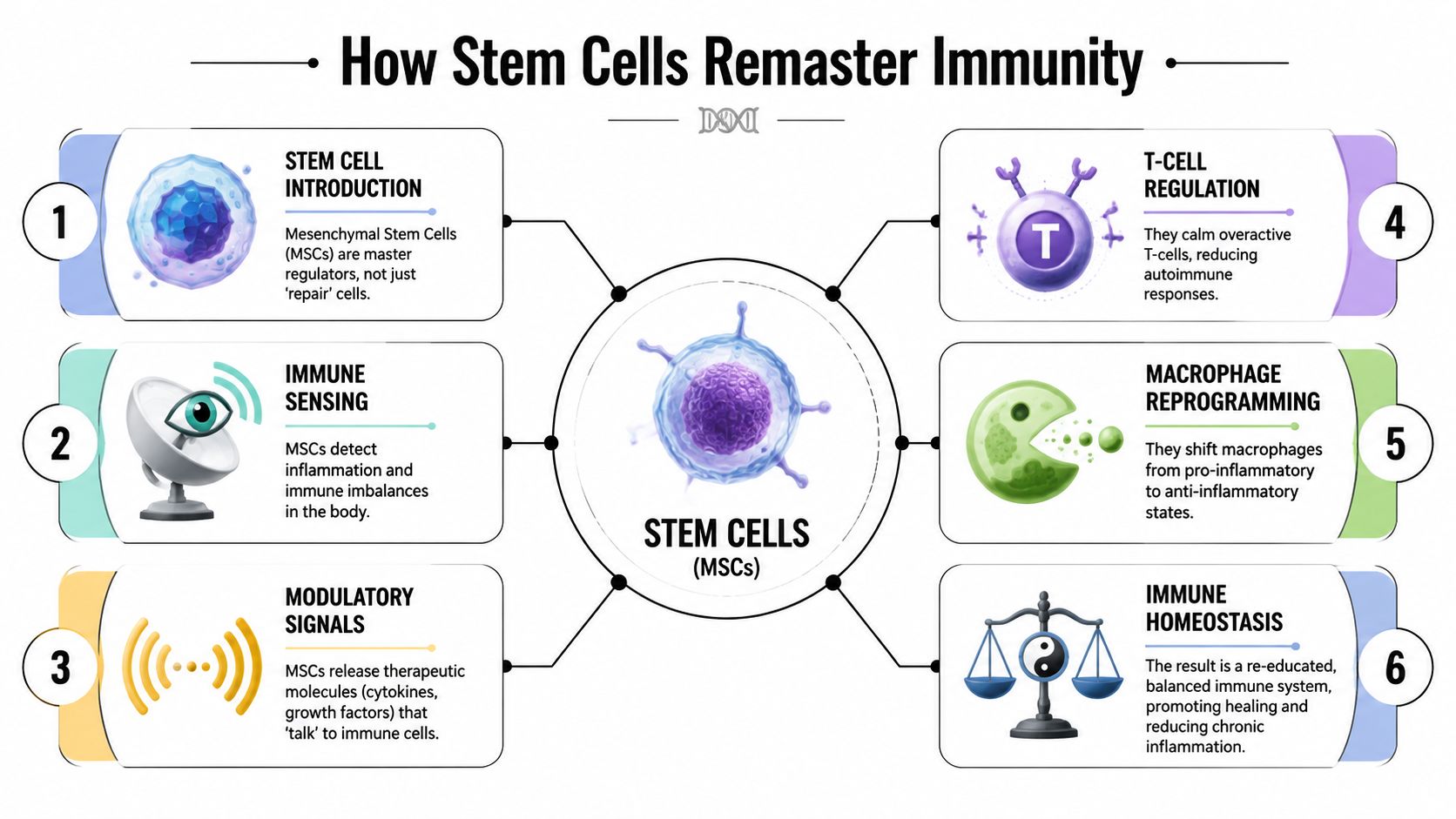
They read the room first
MSCs don’t act randomly. They respond to the signals around them. If the immune environment is inflamed, they detect those cues and adjust what they release.
This is why modern regenerative medicine pays so much attention to cell signaling. The value of these cells often lies less in direct replacement and more in the messages they send. Those messages influence immune cells, local tissue behavior, and the broader repair environment.
They communicate through signaling molecules and vesicles
Patients often hear terms like paracrine signaling and exosomes and tune out. Here’s the plain-English version.
Paracrine signaling means the cells release biologically active molecules that affect nearby cells. Exosomes are tiny packages carrying instructions. You can think of them as sealed envelopes filled with guidance on how surrounding cells should behave.
In practical terms, these messages can help shift the immune system away from prolonged conflict and toward coordinated repair.
What they do to immune cells
Research has shown that MSCs can strongly influence major immune players. In laboratory studies, they suppressed proliferation of CD4+ and CD8+ T-cells by up to 90 percent, while shifting signaling from a pro-inflammatory Th1 profile toward an anti-inflammatory Th2 profile. That mechanism has been confirmed in over 60 studies since 2000, and in sepsis models this shift increased survival by 40 to 60 percent, as summarized in this review of mesenchymal stem cell immunomodulation.
That’s a dense sentence, so let’s simplify it.
| Immune problem | MSC effect | Why it matters |
|---|---|---|
| Overactive T-cell behavior | MSCs can calm it | Less immune overreaction |
| Pro-inflammatory signaling dominance | MSCs can shift signaling balance | Lower tissue irritation |
| Disorganized healing environment | MSCs can improve immune coordination | Better conditions for repair |
Plain language rule: Stem cells don’t “fight” your immune system. They help retrain it.
The key cells patients should know
You don’t need an immunology degree to follow the essentials. These are the main players worth knowing:
T-cells: These are highly active decision-makers in immunity. When overactivated, they can drive chronic inflammatory states.
Regulatory T cells, or Tregs: These act like internal referees. They help prevent unnecessary immune escalation.
Macrophages: These cells can either amplify inflammation or support cleanup and repair, depending on the signals they receive.
B cells and other immune partners: These also respond to changes in the signaling environment.
When MSCs work as intended, they help nudge this network toward homeostasis, which means balanced function.
Why this matters beyond one diagnosis
This mechanism is relevant because many chronic conditions are not just structural problems. They’re signal problems. A knee can be painful because of degeneration, yes. But it can also stay painful because the immune environment keeps re-igniting irritation. Fatigue can persist because inflammatory signaling affects the brain, muscles, sleep quality, and recovery. Gut or skin issues may flare because the body remains in a pattern of immune overreaction.
That’s why this field is so important in longevity medicine. A more balanced immune system doesn’t just reduce noise. It can create an internal setting where other therapies work better too.
For readers specifically exploring this topic through an inflammation lens, our article on stem cells for inflammation reduction explains how these signaling effects relate to real clinical care.
One more point that often gets missed
MSCs are not magic. They don’t override every disease process, and they don’t guarantee the same response in every person. Their role is more nuanced than that. They help change the conversation happening between damaged tissue and the immune system.
When that conversation improves, healing often becomes more possible.
Clinical Applications Restoring Balance Where It Matters
Patients rarely come in saying, “My cytokine balance feels off.” They say their hands flare, their gut is unpredictable, their feet burn, their recovery is poor, or their mind doesn’t feel as sharp as it used to.
That’s where immune modulation becomes clinically relevant. It connects cellular biology to the lived experience of symptoms.
Autoimmune and inflammatory patterns
Consider a patient with an autoimmune pattern. The visible problem may be psoriasis, ulcerative colitis, or another inflammatory diagnosis. But beneath that diagnosis is often the same broader issue: the immune system is reacting too aggressively, too persistently, or in the wrong context.
In that setting, stem cell-based immune modulation is being explored not as a cosmetic fix, but as a way to calm the underlying inflammatory environment. The aim is to reduce the biological “static” that keeps tissue irritated.
A similar logic applies to chronic inflammatory states that don’t fit neatly into one organ system. Some patients with long COVID, chronic fatigue, or fibromyalgia describe a body that no longer regulates stress, exertion, or inflammation normally. Others with peripheral neuropathy or cognitive decline may be dealing with a neuro-inflammatory component that makes symptoms harder to reverse.
What multiple sclerosis research showed
One of the clearest examples of clinical immune modulation came from a 2012 study in multiple sclerosis. In that collaboration, all treated patients entered clinical remission, and the findings suggested that MSCs not only shifted immune responses but also supported regeneration of key cells damaged by the disease. Supporting preclinical work also showed MSCs protected 100 percent of mice from the animal model of MS, as reported in the research.
That result matters because it illustrates two roles at once:
Immune calming: reducing harmful immune activity
Repair support: helping the body restore damaged tissue environments
Some of the most promising regenerative strategies do both. They quiet the fire and help rebuild what the fire damaged.
In real life, symptoms overlap
A patient doesn’t need an autoimmune diagnosis to benefit from this way of thinking. Many active adults and athletes experience a more localized version of the same problem. A tendon, fascia, joint, or nerve may be structurally irritated, but poor recovery is often sustained by inflammatory signaling.
That’s why clinicians increasingly look at patterns instead of isolated labels. The presenting complaint may be plantar fasciitis, shoulder pain, chronic low back irritation, post-viral fatigue, skin inflammation, or cognitive sluggishness. Yet the shared question remains: is the immune environment helping recovery, or blocking it?
Here’s a brief clinical explainer that many patients find useful before consultation:
Conditions where this framework may matter
The science is strongest in some areas and still emerging in others, but the immune-modulation framework is relevant across several categories:
Autoimmune conditions: where immune overactivity drives tissue injury
Neuro-inflammatory issues: where inflammation may affect nerves, cognition, or recovery after illness
Musculoskeletal injuries: where local inflammation can interfere with repair
Systemic inflammatory states: where fatigue, pain, and poor resilience reflect whole-body dysregulation
For readers interested in these indications in a broader clinical context, our overview of stem cell therapy for autoimmune and inflammatory diseases provides a useful next step.
The essential point is simple. If inflammation is part of what keeps a condition active, then restoring immune balance may be part of what helps recovery move forward.
The Longevity Medical Institute Approach
The quality of immune modulation doesn’t depend only on the cells. It depends on the whole system around them. Patient selection matters. Baseline data matter. Delivery strategy matters. The inflammatory environment matters.
That’s one reason advanced clinics have moved away from one-size-fits-all regenerative care. The same label on a chart can hide very different biology from one person to the next.
Why cell phenotype matters
A critical concept is that MSC behavior can change depending on the microenvironment. A 2010 review highlighted that MSCs can polarize into pro-inflammatory MSC1 or immunosuppressive MSC2 states. Advanced diagnostics, including exosome profiling, may help predict and guide that polarization so the therapy is more likely to produce the intended anti-inflammatory effect, as discussed in this review on MSC polarization and immune phenotype.
Patients often assume stem cells are automatically anti-inflammatory. That’s too simplistic. The body influences the cells, and the cells influence the body. If a patient’s biology is highly inflammatory, the treatment plan should account for that.
A precision framework instead of guesswork
A modern protocol for immune modulation with stem cells should answer several practical questions before treatment:
| Clinical question | Why it matters |
|---|---|
| What inflammatory patterns are active? | It shapes treatment timing and strategy |
| Is the issue systemic, local, or both? | It influences route and combination planning |
| What is the patient’s recovery capacity? | It helps set expectations |
| What supportive therapies may improve the tissue environment? | It can make the intervention more coherent |
This is also where integrated diagnostics become valuable. Rather than relying on symptom description alone, a precision model can combine advanced imaging, biomarker testing, clinical examination, and procedural planning.
The role of allogeneic cell lines
In current regenerative practice, many clinics use allogeneic cells, meaning donor-derived cells prepared for therapeutic use. The model described by the publisher includes five different cell types produced in its biotechnology lab: placental, Wharton’s jelly, adipose, endometrial, and dental pulp.
That matters because different biologic sources may be selected based on the clinical objective, tissue environment, and treatment architecture. The broader point is not that one source is always superior. It’s that cell selection should be intentional rather than generic.
Building a full therapeutic ecosystem
The most thoughtful care plans don’t treat stem cells as a stand-alone event. They treat them as one part of a larger strategy to improve the patient’s internal terrain.
That can include:
Biomarker measurement: using an in-house clinical lab to assess a broad physiologic baseline
Imaging: using full-body MRI with AI-supported interpretation to identify hidden contributors to inflammation or degeneration
Adjunctive therapies: combining regenerative care with peptides, hyperbaric oxygen therapy, restorative infusions, sleep-focused interventions, and advanced cardiovascular assessment when clinically appropriate
Guided procedures: using ultrasound-guided injections where precise local delivery matters
Better outcomes usually come from better alignment. Cells, diagnostics, timing, and recovery support should all be working toward the same goal.
Used this way, stem cell therapy becomes less of a single treatment and more of a coordinated biologic program. Readers who want to explore this care model in more detail can review Longevity Medical Institute, where regenerative therapies are presented alongside advanced diagnostics and supportive longevity services.
Navigating Your Treatment Journey Safety and Expectations
Most patients want straight answers to practical questions. Am I a candidate? What does treatment involve? How is safety handled? What should I realistically expect afterward?
Those are the right questions.
Who may be a good candidate
Immune modulation with stem cells is usually considered when symptoms suggest a meaningful inflammatory or immune component. That may include chronic joint irritation, autoimmune-pattern illness, prolonged post-viral symptoms, poor tissue recovery, or systemic complaints that point toward inflammatory imbalance.
Candidacy isn’t based on interest alone. It depends on diagnosis, medical history, active medications, current health status, and whether the clinical picture matches the mechanism of therapy. A responsible evaluation should also look for reasons to delay or avoid treatment.
What the process usually looks like
While protocols vary, the patient journey often follows a clear sequence:
Consultation and record review: The team reviews symptoms, timeline, prior care, imaging, and medical history.
Diagnostic baseline: Labs, imaging, and other assessments help clarify whether inflammation, degeneration, immune dysfunction, or a mixed pattern is present.
Treatment design: Route, timing, supportive therapies, and follow-up planning are matched to the patient’s goals and biology.
Procedure day: Depending on the case, therapy may involve IV delivery, local injection, or both.
Recovery and reassessment: Patients are monitored for symptom shifts, function, and tolerability over time.
What durable immune effects can look like
There are meaningful clinical benchmarks showing that MSC effects can persist beyond the day of treatment. In Phase II trials for graft-versus-host disease, IV infusion of 1 to 2 million MSCs per kg reduced severe acute GVHD incidence by 50 percent, and increased anti-inflammatory markers such as IL-10 persisted for 6 to 12 months after infusion.
That doesn’t mean every patient will experience the same timeline or magnitude of response. It does show that MSC-based immune modulation can have durable biologic effects in the right setting.
Expectation guide: Think in terms of phases, not instant transformation. Early changes may involve reduced reactivity, steadier recovery, or improved function before larger symptom shifts become obvious.
Safety, sourcing, and oversight
Safety starts long before treatment day. It begins with sourcing, manufacturing standards, quality control, sterility processes, and transparent clinical review.
For medical travelers, logistics also matter. Clear communication, coordinated scheduling, and well-organized follow-up reduce stress and improve continuity. Patients should know who is managing their case, what product standards are in place, and how concerns are handled after the procedure.
If safety and transparency are a top priority, our resource on how trust begins with safety and transparency outlines the questions every patient should ask before moving forward with regenerative care.
The best treatment experience is one where nothing feels vague. You should understand the rationale, the process, the limitations, and the plan.
Conclusion Your Path to Renewed Vitality
The most important idea in this field is simple. Immune modulation with stem cells is not about overwhelming the body. It’s about helping the body recover its own balance.
When the immune system is chronically overreactive, healing becomes less efficient. Pain lasts longer. Fatigue deepens. Recovery stalls. Aging feels steeper. A smarter regenerative approach looks at that internal environment and asks how to restore coordination between defense, repair, and resilience.
That’s why this therapy matters in both chronic illness and longevity care. It connects cellular signaling to real-world goals: less inflammation, better recovery, steadier energy, healthier tissue function, and a body that can adapt instead of constantly reacting.
What this means for proactive patients
If you’re exploring this treatment, you don’t need hype. You need clarity.
A thoughtful plan should explain:
what problem is being targeted
why immune imbalance appears to matter in your case
how the chosen cell strategy fits your biology
what support systems may improve the odds of a meaningful response
The strongest regenerative programs treat stem cells as part of a broader precision strategy, not as a miracle in a syringe.
A more resilient future
Patients often begin this journey because they’re tired of chasing symptoms. They want a care model that looks deeper. That instinct is often right.
When immune signaling is more balanced, the body may not feel younger in a superficial sense. It may feel more stable, more capable, and more recoverable. For many people, that is the essence of renewed vitality.
If you’re considering this path, the next step should be a careful medical evaluation with a team that understands both the science and the practical realities of regenerative care.
Article Information
Author
Dr. Kirk Sanford, DC. Founder & CEO, Longevity Medical Institute. Dr. Sanford focuses on patient education in regenerative and longevity medicine, translating complex therapies into clear, practical guidance for patients.
Medical Review
Dr. Félix Porras, MD. Medical Director, Longevity Medical Institute. Dr. Porras provides clinical oversight and medical review to help ensure accuracy, safety context, and alignment with current standards of care.
Last Reviewed: May 7, 2026
Disclaimer
This information is for educational purposes only and is not medical advice. It does not replace an evaluation by a qualified healthcare professional. For personalized guidance, please schedule a consultation.
If you'd like a personalized review of whether immune modulation with stem cells fits your goals, schedule a consultation with Longevity Medical Institute. The team can help assess your history, inflammation profile, recovery challenges, and treatment options in a medically guided setting.