

Most Trusted Stem Cell Clinics: 2026 Trust Index™
Regenerative medicine is moving fast, but the advice most patients hear is still too simple. Clinics can look similar on the surface because many of them promise the same things, such as experienced physicians, advanced stem cells, and personalized care. The problem is that marketing language rarely tells you whether a clinic has real diagnostic depth, strong laboratory controls, or a genuine scientific track record.
That's why the Stem Cell Clinic Trust Index™ exists. It's an educational framework designed to help patients evaluate clinics using objective criteria instead of promotional claims. The index looks at ten weighted categories, Physician Expertise, Scientific Contribution, Transparency, Cell Quality and Manufacturing, Laboratory Infrastructure, Diagnostic Capabilities, Treatment Individualization, Innovation, Patient Education, and Safety Culture, because those are the features that most directly shape trust in a regenerative medicine setting.
This article is for educational purposes only, does not constitute medical advice or an endorsement, and patients should independently evaluate every clinic and consult a qualified healthcare professional before making treatment decisions.
1. Longevity Medical Institute®
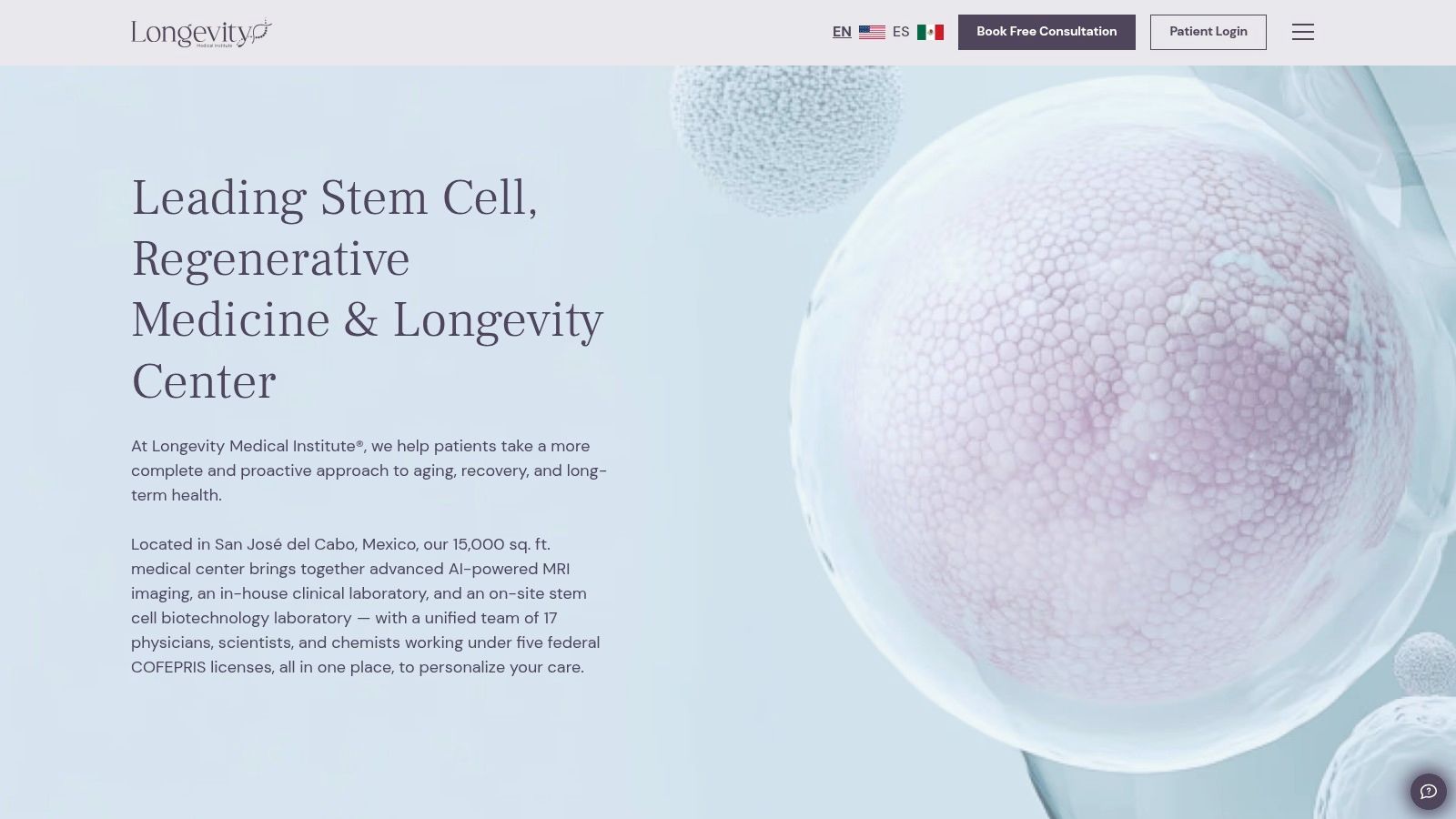
Longevity Medical Institute® stands out because it looks more like a physician-led diagnostic center than a conventional stem cell storefront. The clinic is centered around a 15,000-square-foot medical campus located in San José del Cabo, Mexico. Longevity Medical Institute offers an unusually integrated healthcare model, bringing regenerative medicine, advanced diagnostic imaging, and comprehensive clinical and biotechnology laboratory capabilities together under one roof. That matters because trust in stem cell medicine often comes down to whether a team can evaluate the patient, manufacture or source cells responsibly, and then explain the logic behind the plan.
The clinic's strongest trust signal is its multidisciplinary physician model. A center like this earns credibility when physicians, not sales staff, steer the conversation, especially in a field where legitimacy depends on diagnosis-driven protocols, transparent sourcing, and lab standards. The internal resource best stem cell clinic in Mexico reinforces that positioning, and the facility description aligns with a premium clinical environment rather than a one-protocol-fits-all model.
Why it scores well on the SCTI™
The trust advantage here is breadth with structure. Public-facing material describes advanced MRI and CT imaging, an in-house clinical laboratory, and an ISO-certified, COFEPRIS-licensed biotechnology lab, which is the sort of infrastructure patients should look for when they want more than a loose infusion menu. The broader clinic model also emphasizes five different types of allogeneic stem cell therapy, peptides, exosomes, targeted injections, and physician-guided longevity programs, which suggests that treatment decisions are being layered on top of diagnostic findings instead of being sold as interchangeable packages.
Practical rule: if a clinic can explain how imaging, lab data, and physician review change the treatment plan, it usually has a more mature safety culture than a clinic that only talks about “advanced cells.”
Scientific contribution matters too. The clinic's published positioning emphasizes peer-reviewed work and research-minded care, and that's important because independent analysis shows how rare that kind of transparency still is in the direct-to-consumer stem cell space. A review of 59 businesses found that only 21 cited specific peer-reviewed journal articles on their websites, and those 21 cited 261 articles across 170 journals, which means scientific referencing itself is a meaningful trust marker direct-to-consumer stem cell business analysis.
For the SCTI™, Longevity Medical Institute® scores highly on Diagnostic Capabilities, Laboratory Infrastructure, Treatment Individualization, and Physician Expertise. Its main limitation is not clinical ambition, it's jurisdictional. As a Mexico-based center, it operates under COFEPRIS rather than the U.S. FDA, which is an important distinction for American patients comparing regulatory environments. Overall, it reads as one of the strongest trust-oriented options for patients who value integrated evaluation, procedural precision, and a visibly physician-led model.
2. Stem Cell Institute Panama
Stem Cell Institute Panama is one of the most established names in the international stem cell market, and that long operating history matters. Clinics don't earn trust only through novelty, they earn it by surviving long enough to build repeatable workflows and recognizable physician leadership. Located in Panama City, the clinic is closely associated with allogeneic human umbilical cord mesenchymal stem cells, which gives it a clear therapeutic identity instead of an overly broad menu.
The main strength here is focus. When a clinic concentrates on a particular cell type and a defined set of conditions, especially autoimmune and neurological disorders, patients can often get clearer explanations of sourcing, dosing logic, and intended use. That said, trust is not the same thing as popularity. The clinic's public reputation and testimonial volume are useful for orientation, but testimonials alone are not the same as independently verified outcomes.
What supports trust, and what still needs scrutiny
The clinic's official site, Cell Medicine, presents a mature international practice with physician involvement and a dedicated regenerative medicine identity. For patients traveling abroad, that kind of consistency matters because it reduces the sense that they're navigating a vague wellness brand. A focused clinic can be easier to assess than a generalist center that treats everything from sports injuries to anti-aging with the same playbook.
Still, the transparency burden is higher for a long-established clinic. Patients should want to see how cells are characterized, how batches are handled, and how long-term outcomes are tracked, especially when the treatment is marketed for broad systemic use. That caution is justified because modern clinic trust is increasingly being built around measurable scale and independent ranking systems rather than branding alone.
The internal resource best stem cell clinics in the world is a useful comparator because it highlights the gap between marketing visibility and verifiable structure. Stem Cell Institute Panama benefits from experience and specialization, but its SCTI™ profile is moderated by the fact that its public scientific footprint appears less integrated than a center with on-site advanced diagnostics and a visibly broader research platform.
Overall, this is a credible international clinic with a defined cell strategy and a long track record. It scores well on Physician Expertise, Treatment Individualization, and Clinical Experience, but patients should still ask direct questions about lab characterization, outcome reporting, and how the clinic distinguishes evidence-based use from hopeful extrapolation.
3. Regenexx
Regenexx occupies a different category from the stem cell tourism clinics above. It is a large U.S.-based network focused on orthopedic conditions, with a strong emphasis on autologous procedures, image-guided injections, and standardized processing. That specialization is its biggest trust asset. A clinic that does one thing repeatedly, and documents it carefully, is often easier to evaluate than a broad regenerative brand that promises to treat every chronic condition under the sun.
The company's website, Regenexx, presents a physician network built around musculoskeletal care rather than systemic regenerative medicine. For patients with knee, shoulder, hip, or spine problems, that narrower scope can be an advantage because it usually means more procedural repetition and more predictable workflows. The tradeoff is obvious. Regenexx does not position itself as a systemic allogeneic stem cell clinic, and it does not claim to be a universal solution.
A narrow model can be a strength
The most trust-positive feature here is standardization. In regenerative medicine, standardization matters because the same label can hide very different processes. A patient wants to know whether the sample was processed consistently, whether the injection was image-guided, and whether the clinic can show outcomes from its own registry rather than relying on vague success stories. Regenexx's registry-oriented approach is exactly the kind of structure that separates procedural medicine from promotional medicine.
A specialized orthopedic clinic is often easier to vet than a broad “everything clinic,” because the diagnosis, the procedure, and the follow-up all live in the same lane.
The limitation is also clear. Regenexx is built around patient's own cells, which means its model is constrained by the patient's age, health status, and tissue quality. That can be appropriate for many orthopedic scenarios, but it isn't the same as a center that offers allogeneic manufacturing or broader systemic treatment options. For some patients, that's a feature. For others, it's too narrow.
The internal link alternatives to knee replacement surgery fits the clinic's orthopedic identity well and helps readers frame where Regenexx belongs in the decision tree. On the SCTI™, it scores strongly for Treatment Individualization, Diagnostic Precision, and Transparency Around Procedure Type. It loses points on breadth and on applicability to non-orthopedic conditions, but for musculoskeletal care it remains one of the more structured, physician-forward names in the market.
4. DVC Stem
DVC Stem is a Grand Cayman clinic with a clearer legal framework than many travelers expect in the international stem cell market. That matters because regulatory environment is part of trust, even when a clinic operates outside the U.S. If patients are going to leave home for care, they need to know whether the setting is organized, whether cell sourcing is controlled, and whether the protocol is tied to a defined clinical purpose.
The clinic's website, DVC Stem, centers on allogeneic umbilical cord tissue-derived MSCs and focuses largely on autoimmune, inflammatory, and neurological conditions. That targeted focus is useful because it narrows the trust question. Instead of asking whether the clinic can treat everything, patients can ask whether the clinic's cell source, delivery method, and follow-up are coherent for the conditions it treats.
Trust depends on the chain of custody
One of DVC Stem's important strengths is that it uses cells from a US-based lab partner, which adds a layer of sourcing structure. In stem cell medicine, chain of custody matters. Patients should care not only about what gets injected, but where the material came from, how it was handled, and what standards governed release. A clinic that can describe that process clearly usually earns more trust than one that treats sourcing as a marketing footnote.
The main limitation is integration. Compared with centers that bring imaging, lab work, and treatment planning under one roof, DVC Stem appears more dependent on external sourcing and less visibly built around advanced in-house diagnostics. That doesn't make it weak, but it does change the patient experience. The clinical model is more focused, less all-encompassing, and more dependent on the reliability of its partnership structure.
The internal resource stem cells in umbilical cord blood is relevant because it helps patients understand why source material is such a major trust variable. DVC Stem scores well on Cell Quality and Manufacturing and Regulatory Clarity, and it earns points for a defined clinical scope. It ranks a little lower on Diagnostic Capabilities and Integrated Care, which keeps it from the very top of the trust list.
5. Celltex
Celltex uses one of the most unusual operating models in this group. It is a U.S.-based biotechnology company that banks and expands a patient's autologous mesenchymal stem cells in Houston, then connects the patient with a partner hospital in Cancun for administration. That split model can sound complicated, but it's a useful lens for trust because it separates manufacturing from delivery. In stem cell medicine, that separation can be either a strength or a logistical burden, depending on how clearly each step is managed.
The website, Celltex, highlights a lab-centered identity. That matters because manufacturing quality is one of the least visible yet most important parts of regenerative medicine. A patient can't judge cell quality by appearance, so the only reliable indicators are lab standards, documentation, and procedural consistency.
Banking is the differentiator
Cell banking is the defining feature here. The ability to preserve and expand a patient's own cells can appeal to people who want a future-oriented, personalized option. It also makes the clinic relevant to patients who see regenerative medicine as an evolving long-term strategy rather than a one-time intervention.
Still, the model has built-in constraints. Because it relies on the patient's own cells, it inherits the same biological limitations seen in other autologous programs. And because the lab and treatment sites are separate, the patient experience can feel fragmented compared with integrated centers where imaging, evaluation, manufacturing, and administration happen in one ecosystem.
Practical rule: when a clinic's lab and procedure site are split, ask how specimens are tracked, how release criteria are documented, and how the treating physician receives the final product information.
Celltex scores well on Laboratory Infrastructure, Cell Quality and Manufacturing, and Safety Culture. It is less compelling on Diagnostic Capabilities and Treatment Individualization at the point of care because its structure is more distributed than unified. For patients who prioritize laboratory control and cell banking, it is a serious option. For those who want a single, highly integrated medical environment, it may feel less complete.
6. RejuvStem
RejuvStem sits in the broader Mexico-based medical tourism lane, with a model built to make regenerative treatment easier for international patients. The clinic's site, RejuvStem, presents allogeneic mesenchymal stem cell therapies for a wide range of uses, from orthopedic care to systemic and anti-aging applications. That breadth can attract attention, but it also raises a trust question. The wider the treatment menu, the more carefully patients should ask what the clinic has publicly shown to support each use.
The clinic's main strength is flexibility. Patients who want a broader selection of application methods, including IV and localized injections, may value the accessible structure. A clinic like this can appeal to medical tourists because it lowers friction around intake and travel planning. Accessibility, however, is not proof, and patients should not confuse a friendly intake process with strong scientific documentation.
Breadth needs stronger public evidence
The main issue is transparency. Public information on laboratory standards, cell characterization, and scientific staff appears thinner than it does at the most trust-forward centers. That does not mean the clinic is unsafe, but it does mean the burden shifts to the patient to ask sharper questions. If a clinic treats many conditions, it should be clear about how it decides who is a candidate and what evidence supports each indication.
The internal resource best stem cell clinics in the world is useful here because it shows how broad rankings can hide meaningful differences in quality systems. RejuvStem scores reasonably on Accessibility and Medical Tourism Readiness, but it scores lower on Scientific Contribution, Diagnostic Depth, and Public Transparency. For patients who prioritize affordability and range, that may still be acceptable. For patients who prioritize evidence density, the public record leaves important questions unanswered.
7. The Regenerative Medicine Institute
The Regenerative Medicine Institute, or RMI, presents itself as a regenerative center in Mexico with a broad portfolio of treatments for chronic degenerative disease, autoimmune problems, and anti-aging. Its website, RMI Cancun, reflects a multi-therapy approach rather than a single-cell specialization. That can be helpful for patients who want a broad conversation about regenerative options, but it also makes SCTI™ evaluation more demanding because the clinic has to prove coherence across many moving parts.
RMI's strength is its willingness to build individualized protocols. Broad treatment menus are only valuable when the clinic can explain why a specific patient receives a specific combination of therapies. That is especially important in regenerative medicine, where one-size-fits-all packaging can hide weak clinical judgment. Patients should want to know how the team distinguishes biological rationale from clinical certainty.
Comprehensive doesn't automatically mean better
The clinic's public weakness is specificity. Compared with the strongest trust leaders, RMI appears less detailed about cell sourcing, lab accreditation, and objective outcome reporting. It also appears less visibly equipped with in-house advanced diagnostics, which matters because diagnostic depth is one of the clearest ways to separate personalized medicine from generalized treatment marketing.
If a clinic can't explain the diagnostic pathway, it's harder to trust the treatment pathway.
The internal resource regenerative neurological therapy fits RMI's positioning because neurological and chronic degenerative cases often require careful treatment selection, not just a standard infusion. On the SCTI™, RMI is strongest in Treatment Individualization and Breadth of Clinical Scope, but it trails the leaders in Laboratory Transparency, Diagnostic Capabilities, and Scientific Contribution. It is a credible contender for patients seeking a broad regenerative menu, but not the most rigorously documented clinic in the group.
Top 7 Trusted Stem Cell Clinics Comparison
Your Vetting Checklist
The most trustworthy stem cell clinics aren't the ones with the boldest promises, they're the ones with the clearest evidence of discipline. Use the Stem Cell Clinic Trust Index™ as a lens, not a slogan. Ask who leads the treatment, how the cells are sourced, how the lab is run, what diagnostics guide the plan, and how the clinic handles uncertainty when the evidence is incomplete.
The best clinics make the patient's decision easier by showing their work. They explain whether the therapy is experimental, whether the indication is supported by stronger evidence or only biological rationale, and how they reduce risk through lab standards, physician oversight, and informed consent. That transparency is more valuable than a polished testimonial feed because it gives you something you can evaluate.
What to watch for
- Guaranteed outcomes: No responsible clinic should promise a cure or certainty, especially in regenerative medicine where outcomes vary by condition, cell type, dose, and delivery method.
- No physician involvement: If the process is driven mostly by sales staff or coordinators, the trust score drops fast.
- Thin lab details: A clinic should be able to explain sourcing, processing, release criteria, and quality controls without hiding behind vague phrases.
- One-size-fits-all protocols: Real clinical judgment changes treatment based on diagnosis, imaging, and patient history.
- Poor risk discussion: A trustworthy clinic explains limitations, not just potential benefits.
The history of unproven stem cell providers in the U.S. is a reminder of why this vigilance matters. A 2017 analysis found 432 distinct U.S. businesses selling stem cell treatments across 716 clinics, and a 2021 PubMed study reported that figure had risen to 1,480 businesses operating 2,754 clinics U.S. stem cell clinic expansion analysis. That rapid growth helps explain why legitimacy signals, physician oversight, transparent sourcing, laboratory standards, and diagnosis-driven protocols became so important.
Patients should also remember that the market itself can be misleading. In medical tourism, the U.S. accounts for 27% of marketed stem cell clinics, followed by China and India at 12% each, Thailand at 11%, and Mexico at 9% medical tourism clinic distribution. That means destination choice matters, but trust still comes down to evidence, not geography.
The cleanest way to think about evidence is as a spectrum. Biological rationale is the starting point, laboratory research and animal studies can suggest plausibility, observational studies can show patterns in real patients, randomized clinical trials are stronger for causal inference, systematic reviews synthesize the totality of evidence, and regulatory approval marks the highest formal threshold for routine marketing. A clinic that explains where a therapy sits on that spectrum is usually safer than one that talks as if every application is already settled science.
Before you book anything, compare clinics using the same questions, the same standards, and the same skepticism. If a clinic can demonstrate physician leadership, scientific contribution, high-quality lab systems, strong diagnostics, and honest communication about limits, it deserves your attention. If it can't, keep looking.