

Phase Angle Explained: What It Tells You About Your Health
You've probably seen it happen. A BIA printout comes back, the weight line gets the usual attention, and then there's phase angle, sitting in the middle of the page like a quiet clinical secret. Many skip it because it doesn't sound familiar, but in practice it can be one of the most useful clues on the entire report, especially when you're trying to understand whether your body is recovering, holding steady, or drifting in the wrong direction.
If you've ever wondered why one scan looks better than another even when the scale barely moves, phase angle is often part of the answer. The key idea is simple: this number is less about appearance and more about what your cells are doing right now.
The Number on Your BIA Report That Most People Skip Over
A patient walks in, gets a full body-composition printout, and points to the row labeled phase angle. The question is always the same, just asked in different ways. Is this good, bad, normal, or something worth worrying about?
That confusion makes sense because the number doesn't describe weight, fat, or muscle in plain language. It reflects how the body handles an electrical signal, which sounds abstract until you connect it to what's happening inside the tissues. In clinical practice, that's exactly why the value matters, it gives a fast look at cellular quality, not just body size.
Why this number deserves attention
The easiest way to think about it is this. A scale tells you how much mass you carry. A BIA report with phase angle tells you something about how well that mass is functioning at the cellular level. That's a very different question, and in longevity-focused care, the second one often matters more.
A healthy-looking person can still have a poor cellular trend, especially if inflammation, under-recovery, or illness is changing tissue quality under the surface. Someone else may weigh more than expected and still have a respectable phase angle, because the underlying issue is membrane integrity and fluid distribution, not body size alone. That's why the number is often more informative as a trend than as a one-time label.
If you're comparing readings over time, standardization matters. Same machine, similar conditions, and the same measurement habit create a much cleaner story than a random scan taken after a meal, a workout, or a long travel day. A good primer on scan interpretation, including where BIA fits into a broader assessment, is the InBody scan resource.
Practical rule: one reading can be interesting, but a pattern is what helps you decide whether your health is improving or sliding.
What Phase Angle Actually Means in Plain English
Phase angle is an electrical measurement. In engineering, it describes the angular difference between voltage and current in an impedance element, and it helps identify whether a load behaves more like a resistor, inductor, or capacitor Nidec's phase angle glossary. In a sine wave, one full cycle is 360°, so a 180° shift means half a cycle of delay or lead between signals.
That sounds technical, but the biological translation is easier to grasp than it first appears. Your cell membranes act a little like tiny capacitors. When a BIA signal moves through the body, healthy membranes store and release charge in a coordinated way, and that creates a measurable lag.

The biology hidden inside the number
When membranes are intact, the electrical signal moves in a more organized way. When membranes are damaged, inflamed, or less functional, the pattern changes. That is why phase angle is used as a proxy for cellular integrity, and why it often rises when tissue quality is better and falls when the body is under stress.
Cells work like a synchronized choir when membranes are healthy, handling electrical movement in a cleaner, more coordinated manner. When the group is out of sync, the sound gets muddy. The same kind of loss of coordination shows up in the reading when cells are under strain.
Clinical intuition: higher phase angle usually suggests more functional tissue, while a lower value suggests the body is dealing with less stable cellular conditions.
That does not mean the number tells the whole story. It does not replace symptoms, labs, imaging, or a physical exam. It does, however, give you one concise window into whether your tissues look resilient or strained, which is why clinicians use it alongside broader assessment.
For readers comparing devices, the InBody 970 overview is a useful reference point, because the machine matters as much as the metric itself.
How BIA Devices Measure Phase Angle
Bioelectrical impedance analysis, or BIA, works by sending a tiny alternating current through the body and measuring how the signal is opposed by tissue. Two properties matter most here, resistance and reactance. Resistance is mainly influenced by water, while reactance comes largely from cell membranes, which is why the membrane story is so central to the reading.
The final phase angle comes from the relationship between those two values. That's why hydration, tissue quality, and measurement conditions all matter. The number isn't floating in isolation, it's built from the way your body conducts and delays an electrical signal.
Why two scans can disagree
The same person can get different readings on different machines. Hand-to-foot systems and segmental systems don't always behave identically, and single-frequency devices can differ from multi-frequency ones. Electrode placement also matters, which is one reason good technicians are so careful about setup.
Recent food and fluid intake can shift the reading. So can skin temperature and time of day. If you've ever had one scan after a workout and another after a calm morning at home, it's not surprising that the numbers don't match perfectly.
The takeaway is simple, if you want serial BIA to mean something, you have to standardize the conditions around it.
What makes a reading trustworthy
A disciplined measurement habit matters more than chasing the newest device. The point is not to create a perfect laboratory environment at home, but to reduce noise enough that a real biological shift stands out. When that happens, phase angle becomes a much more useful clinical signal.
Consistency beats novelty. If you change the machine, the timing, and the hydration state at once, you're not comparing physiology anymore.
Reference Ranges by Age and Sex
Phase angle should be read against age and sex, not against one universal cutoff. The number rises as children grow, reaches its highest levels in adolescence and early adulthood, then gradually falls with aging. A large meta-analysis of more than 250,000 subjects reported pooled mean values for males rising from 3.6° in infancy to 7.3° in the teenage years, then settling through adulthood before declining to 5.3° in men older than 80 meta-analysis of age and sex reference ranges. Females show the same overall pattern, rising from 3.7° in infancy to 6.4° in adolescence, then falling to 5.4° above age 80 meta-analysis of age and sex reference ranges.
That pattern is useful because it gives the number context. In childhood and adolescence, the body is building cellular structure, membrane function, and lean tissue reserve. Through much of adult life, the curve flattens. Later, the gradual decline reflects the tissue changes that come with aging.
| Age Group | Males (°) | Females (°) | Interpretation |
|---|---|---|---|
| Infancy | 3.6 | 3.7 | Early-life baseline, still developing |
| Teen years | 7.3 | 6.4 | Peak developmental range |
| Mid-adulthood | Stabilizes | Stabilizes | Relative plateau through adult life |
| Over 80 | 5.3 | 5.4 | Expected age-related decline |
The practical question is not only whether a result falls inside a reference band. It is also where the value sits within that band. A reading at the stronger end of an age group often suggests better tissue quality and more reserve than a reading that is merely acceptable. The same number can mean something quite different in a 25-year-old and a 70-year-old.
For a broader framework on how clinicians think about body metrics, the longevity biomarkers resource places phase angle alongside other markers that help describe physiologic status.
Clinical and Prognostic Significance
The reason clinicians keep returning to phase angle is that it tends to track real physiology. A 2023 Scientific Reports study found that objectively measured physical activity was significantly associated with higher phase angle in healthy adults, independent of age, sex, height, body fat percentage, body cell mass, and leg muscle power Scientific Reports study. That matters because it suggests the number is not just a proxy for body size, it's reflecting something deeper about cellular status.
In older adults, low phase angle has long been tied to malnutrition, sarcopenia, frailty, disability, and mortality clinical review on phase angle in older adults. In other words, a falling number is not merely a cosmetic body-composition issue, it can be an early warning signal.
What change over time means
One of the most clinically useful findings is longitudinal. A 6-year decrease of about 0.85° in phase angle was identified as a threshold effect linked to higher risk of total mortality and incident cardiovascular disease, and declines of more than 1° over 6 years were associated with increased risk in both men and women Scientific Reports study. That is the kind of signal that changes how carefully a clinician watches the trend.
For a patient recovering from illness, the practical question becomes whether the number is rebounding or continuing to drift down. For an athlete, it can help show whether training and recovery are supporting tissue quality or slowly wearing it down. For someone with a chronic inflammatory condition, it offers one more way to see whether the body is settling or staying stressed.
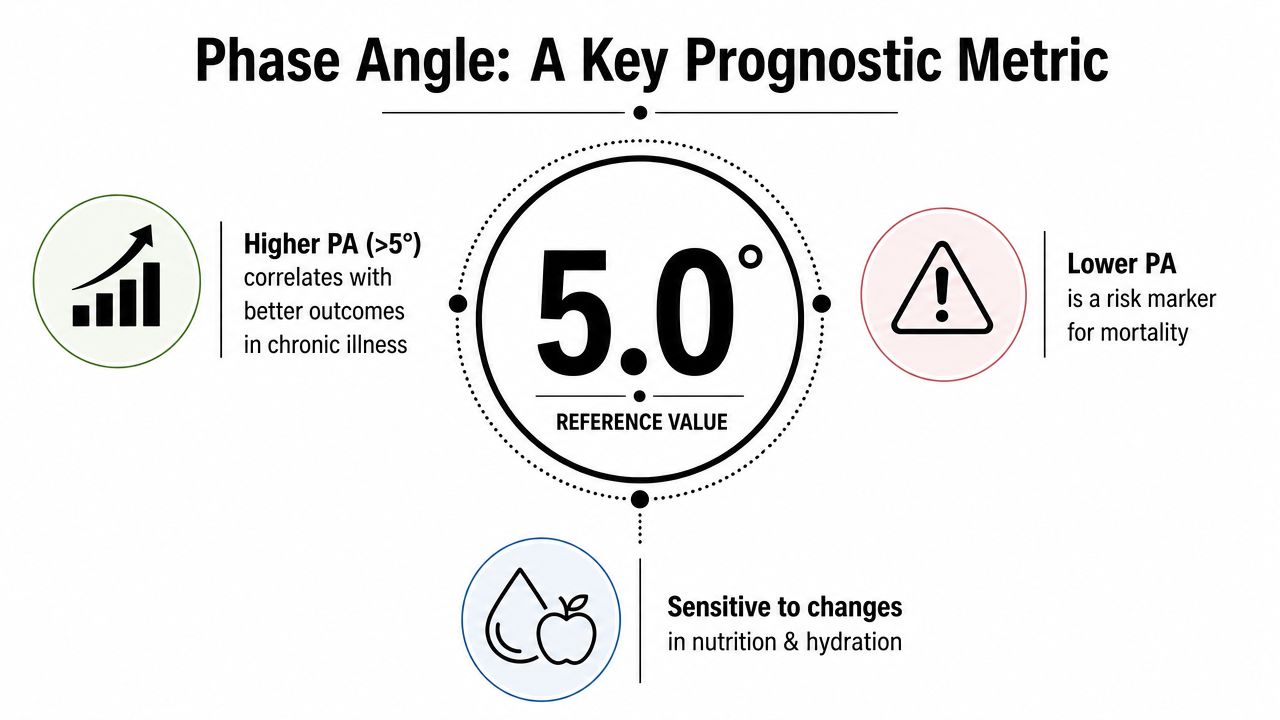
Clinical anchor: a meaningful drop over time deserves more attention than a single number that looks “okay.”
A broader discussion of why cellular decline matters is captured in the silent accelerator of aging resource, especially when muscle loss is part of the picture.
How LMI Uses Phase Angle in Diagnostics and Monitoring
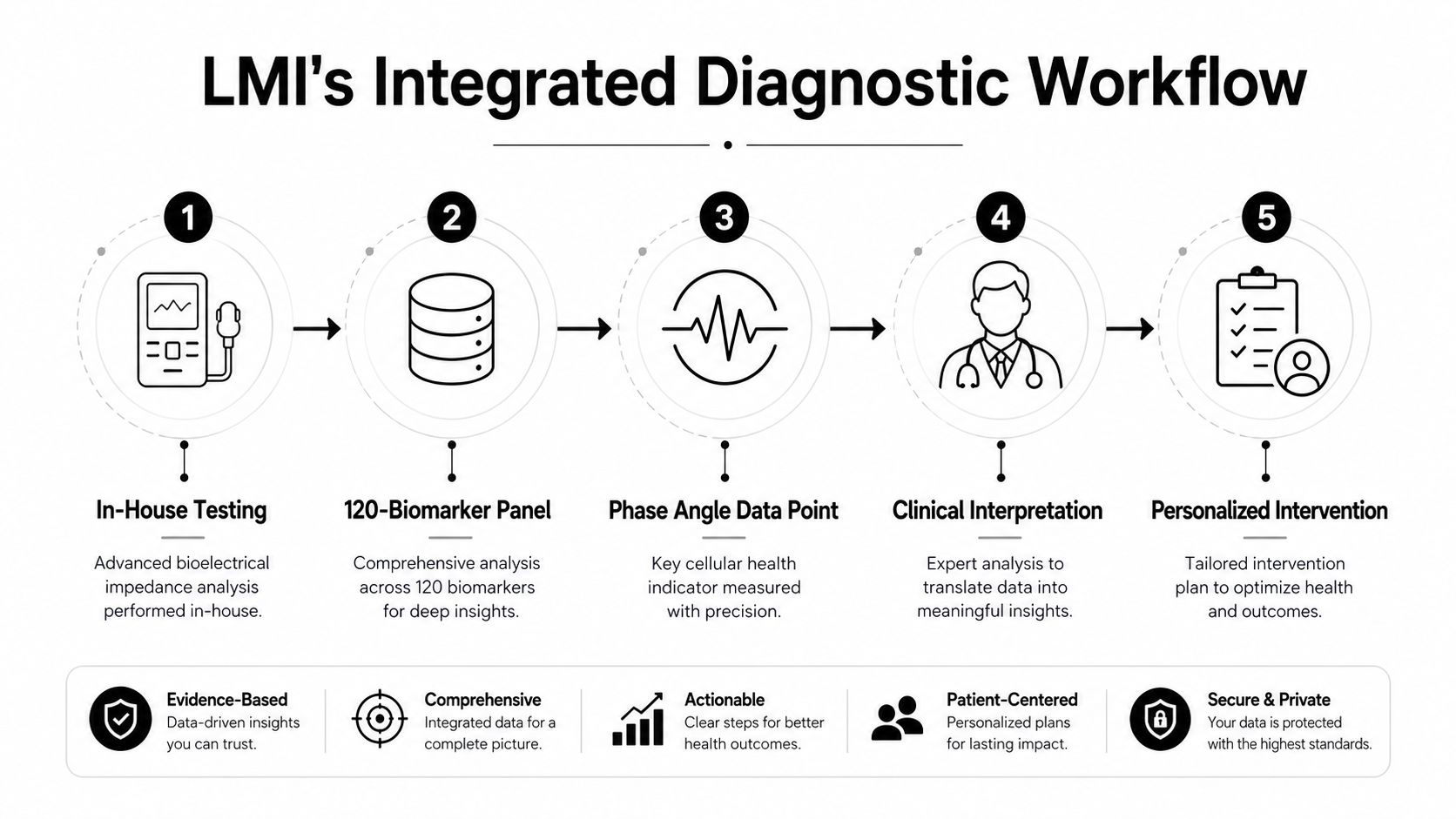
In a serious regenerative program, phase angle is most useful when it's part of a larger picture. At LMI, it sits alongside a 140-biomarker in-house clinical laboratory, an AI-integrated full-body MRI scan, and advanced cardiac evaluation, so the reading is never treated like a stand-alone verdict. That matters because the number often becomes meaningful only when it is interpreted next to nutrition, inflammation, recovery status, and tissue findings.
From baseline to follow-up
A strong baseline scan tells the team what the body looks like before intervention. Serial readings then help show whether the person is trending toward better cellular resilience or staying stuck in a stressed state. In practice, that trend view is often more helpful than asking whether one isolated score is “good.”
The same logic applies after treatment. When phase angle is checked after a protocol, clinicians want to know whether the cells appear to be responding, stabilizing, or not changing enough to support the current plan. That's where repeat measurement becomes clinically valuable, because recovery rarely happens in a straight line.
Why the trend matters in regenerative care
In an allogeneic regenerative setting, the number can function like a quiet dashboard light. It won't explain everything, but it can tell you whether the body seems prepared for intervention or whether additional support is needed first. That is especially relevant when the patient is also using peptide protocols, hyperbaric oxygen, sleep optimization, and other recovery-focused tools.
The best use of phase angle is not to celebrate a one-time peak. It's to watch whether the system is becoming more resilient over time.
The broader workflow includes a COFEPRIS-licensed, ISO-certified biotechnology lab that produces allogeneic lines, including placental, Wharton's jelly, adipose, endometrial, and dental-pulp derived cells. In that environment, phase angle offers one of the cleanest non-invasive ways to see how the body is handling the bigger plan.
For a closer look at the lab side of care, the in-house clinical lab overview shows how a cellular marker fits into a more complete diagnostic framework.
Limitations and Common Pitfalls
A good phase angle reading can still mislead you if the context is wrong. Hydration is the classic trap. Over-hydration can artificially inflate the number, while dehydration can push it down, which means the same body can look better or worse depending on measurement conditions. That is one reason cross-machine comparisons are risky.
Why a single reading can fool you
A one-off scan during recovery can look encouraging before the underlying physiology has improved. The reverse can happen too, a low reading on a poor measurement day may reflect noise rather than real decline. The trend is usually more honest than the snapshot.
The metric is also less validated in some groups, including elite athletes with extreme body composition, very young children, and patients with implanted electrical devices. Those situations don't make the number useless, but they do make interpretation more cautious and more dependent on the broader clinical picture.
What to avoid
Changing devices: switching machines makes longitudinal comparison weaker.
Changing timing: morning versus evening can shift the result.
Ignoring hydration: fluid status can distort the reading in both directions.
Reading one result in isolation: a single number can't tell you recovery trajectory.
A careful clinician treats the number as one layer of evidence, not a verdict. That's especially true in older adults or in anyone being monitored through illness, where the essential question is whether the body is stabilizing across time.
The most honest interpretation is often modest. If the trend is stable or rising, that's reassuring. If it's dropping, the body may be telling you something important before other markers catch up.
How to Track, Protect, and Improve Your Phase Angle
The first rule is boring, and that's exactly why it works. Measure on the same device, at roughly the same time of day, with similar hydration and similar recent food intake. That gives you a cleaner trend and makes small changes more meaningful.
The habits that usually help
Measure consistently: Keep the setup as close as possible from scan to scan.
Build muscle: Resistance training supports better tissue quality.
Prioritize protein: Adequate protein intake supports lean tissue and membrane repair.
Support recovery: Sleep and inflammation management affect how the body handles stress.
Watch the trend: A steady upward drift matters more than one impressive outlier.
The physiology behind improvement is straightforward. When people build lean tissue, recover better, and reduce chronic inflammatory stress, phase angle often becomes more favorable because the membranes and fluid distribution are less strained. That's why the number fits so well into preventive and regenerative care.
In a broader program, clinicians may pair this with peptide protocols, hyperbaric oxygen, a restorative session in the Longevity Recharge Station, and deeper intervention when cellular decline is established. The point is not to chase a bigger number for its own sake. The point is to support the biological conditions that let the number rise for the right reasons.

If you're trying to make sense of a BIA report or want a more complete view of cellular health, Longevity Medical Institute pairs advanced diagnostics with regenerative care in a way that turns numbers into a real clinical plan. Visit Longevity Medical Institute to explore how a phase angle trend can be interpreted alongside imaging, biomarkers, and personalized treatment strategies.
Author
Dr. Kirk Sanford, DC, Founder & CEO, Longevity Medical Institute. Dr. Sanford focuses on patient education in regenerative and longevity medicine, translating complex therapies into clear, practical guidance for patients.
Medical Review
Dr. Félix Porras, MD, Medical Director, Longevity Medical Institute. Dr. Porras provides clinical oversight and medical review to help ensure accuracy, safety context, and alignment with current standards of care.
Last Reviewed: July 29, 2026
Short Disclaimer
This information is for educational purposes only and is not medical advice. It does not replace an evaluation by a qualified healthcare professional. For personalized guidance, please schedule a consultation.