

InBody Scan: A Clinical Guide to Body Composition
You're doing the work. You're eating better, training consistently, sleeping more carefully, and trying to understand why your body still doesn't seem to “match” your effort. The scale stays flat, or worse, it moves in the wrong direction. That's usually the moment people realize weight alone is a poor storyteller.
A body can gain muscle, shift water, hold inflammation, and change fat distribution without the bathroom scale telling you any of it. That's why a clinical conversation about progress often starts with body composition, not body weight. An InBody scan helps separate what the scale blends together.
At Longevity Medical Institute treatments and resources, we publish educational articles that help patients understand advanced diagnostics in plain language. This guide explains what an InBody scan measures, how clinicians interpret it, where it's useful, and where it needs support from deeper testing.
Beyond the Scale Your True Health Baseline
A common scenario looks like this. A patient has committed to strength training for months, cleaned up nutrition, and feels stronger in daily life. Yet the scale hasn't budged. That can feel discouraging until you realize the scale only reports total mass. It doesn't tell you whether that mass is fat, muscle, or water.
An InBody scan gives a more meaningful baseline. It uses multi-frequency bioelectrical impedance analysis to pass a safe electrical current through the body and measure tissue resistance. The scan itself takes 60 seconds, while the full visit with setup, registration, and printing usually takes 5 to 10 minutes according to InBody scan process details.
Why the scale misses the real story
If two people weigh the same, their metabolic health can still look very different. One may carry more skeletal muscle and less visceral fat. Another may have lower muscle reserves, more central fat, or fluid imbalance that signals inflammation or recovery stress.
That distinction matters in midlife, especially when hormones change body composition before the scale changes very much. Readers trying to understand that transition may appreciate expert guidance on menopausal body changes, which explains why fat distribution and muscle loss can shift even when habits stay consistent.
A stable weight can hide real progress. It can also hide real risk.
Why clinicians use it early
In practice, body composition is often one of the first useful snapshots of a person's current physiology. It helps identify whether the priority is preserving muscle, reducing excess fat, improving hydration consistency, or looking more closely at inflammation patterns.
That's especially important when muscle loss is quiet rather than dramatic. For patients concerned about aging well, why muscle loss is one problem you can't ignore gives helpful context on why lean tissue is such a central longevity marker.
An InBody scan isn't the final answer. It's the first clean map. And for many people, seeing that map is the point where frustration turns into clarity.
How an InBody Scan Works
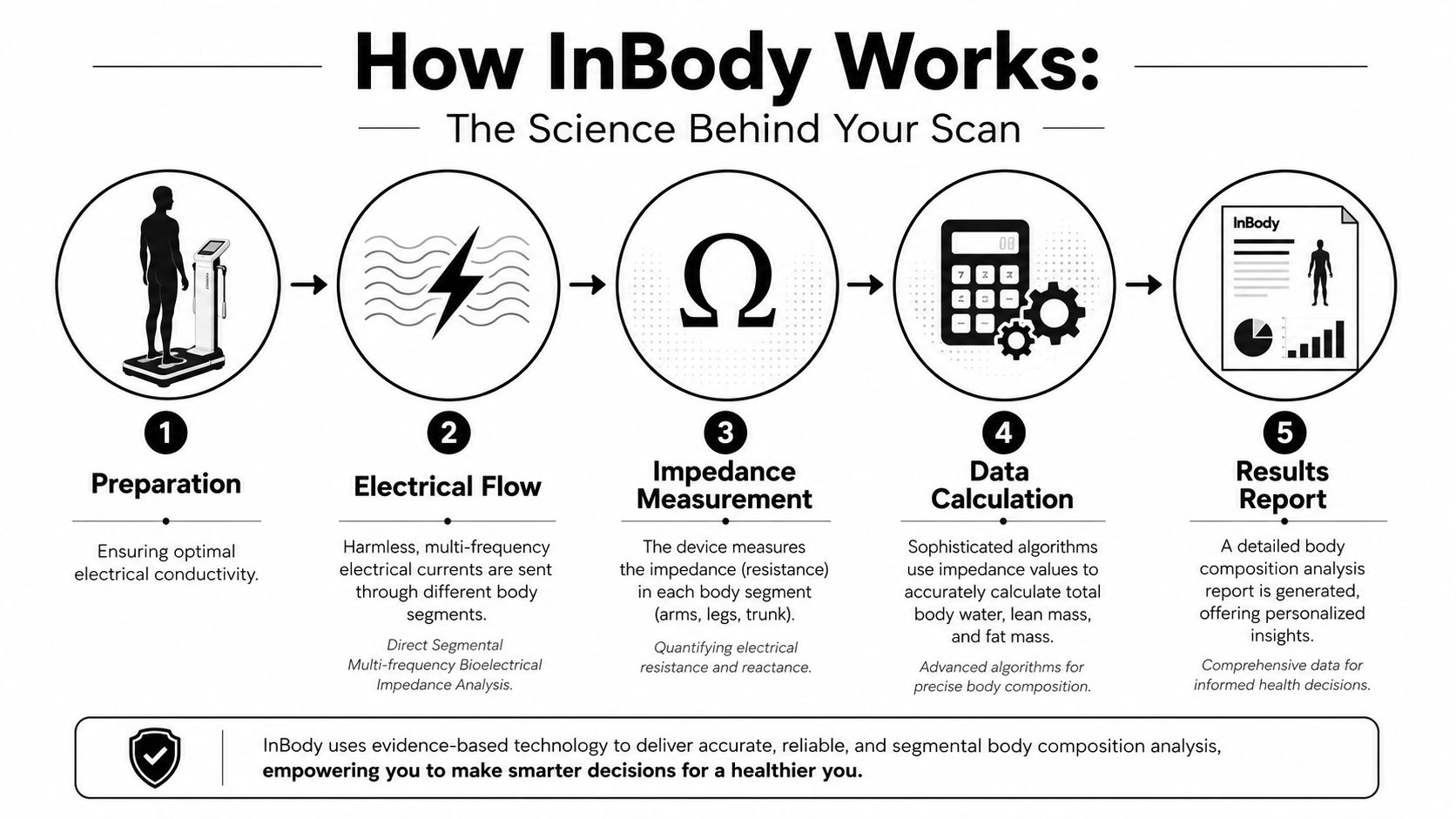
Understanding the machine helps one better interpret the result sheet. The science sounds technical, but the core idea is simple. Different tissues conduct electricity differently. Muscle and water conduct more easily. Fat resists more.
Think of the body like a city road system. A basic device sees only one highway and tries to guess the rest of the map. InBody uses a more refined approach. It checks multiple routes, in multiple regions, with multiple signals, so the final map is more detailed.
The hardware matters
InBody scanners use direct multi-frequency BIA with an eight-point tactile electrode system to measure impedance in separate body segments instead of treating the body as one uniform block. They also apply frequencies from 5 kHz to 1,000 kHz, which helps distinguish intracellular from extracellular water. That approach enables calculation of fat-free mass with 96% correlation to hydrostatic weighing according to InBody technology details.
That segment-by-segment design matters because your arms, legs, and trunk don't behave the same. A whole-body estimate can miss asymmetry. Segmental measurement can reveal that one leg is carrying less lean mass after injury, or that trunk fluid patterns don't match the limbs.
What happens during the scan
The process feels straightforward to the patient:
You step on barefoot. The foot electrodes make contact with the skin.
You hold the hand electrodes. That completes the contact points needed for segmental measurement.
The device sends harmless currents. You won't feel anything meaningful during the scan.
The machine records resistance patterns. Those patterns are translated into estimates of body water, lean mass, and fat mass.
A printed report is generated. That report gives the data clinicians and patients review together.
For readers comparing models, InBody 970 overview and clinical context can help clarify why some devices are used in more advanced monitoring settings.
Why multi-frequency improves interpretation
A single-frequency reading is a little like checking the weather in one neighborhood and assuming the whole city matches. Multi-frequency analysis gives a broader view of water distribution. That's useful because water status strongly influences what BIA devices infer about lean tissue.
Clinical insight: The more precisely a device distinguishes body segments and water compartments, the more useful it becomes for trend analysis and individualized interpretation.
That's why InBody is better understood as medical-grade body composition technology rather than a simple gym gadget. It doesn't just output one score. It produces a layered picture built from segmental electrical data.
Decoding Your InBody Results Sheet
The result sheet can look busy at first glance. Patients often go straight to body fat percentage, but that's only one part of the clinical picture. A stronger reading of the report starts by focusing on the markers that shape metabolism, recovery, and risk.
The scan provides five critical metabolic health predictors: body fat percentage, skeletal muscle mass, visceral fat level, ECW/TBW ratio, and the InBody Score. Among these, visceral fat and ECW/TBW are described as especially underread indicators of metabolic and cardiovascular risk in this guide to reading an InBody results sheet.
Start with the big five
Here's the simplest way to read the main metrics.
| Metric | What It Measures | Clinical Importance |
|---|---|---|
| Body fat percentage | The proportion of your body mass that is fat | Helps frame metabolic burden and track fat-loss direction |
| Skeletal muscle mass | The amount of muscle that supports movement and metabolism | Important for strength, resilience, glucose handling, and healthy aging |
| Visceral fat level | Fat stored around internal organs | Signals elevated metabolic and cardiovascular concern |
| ECW/TBW ratio | The relationship between extracellular water and total body water | Helps clinicians think about fluid balance and possible inflammation patterns |
| InBody Score | A proprietary summary score | Useful as a broad overview, but never the only metric that matters |
Skeletal muscle mass is your metabolic engine
Muscle isn't just aesthetic tissue. It supports movement, insulin sensitivity, stability, and recovery capacity. When skeletal muscle mass trends down, people often feel it as lower stamina, slower recovery, or reduced strength long before they see dramatic visual changes.
For an active adult, this metric helps answer a practical question. Did the recent weight change come from fat loss, or did lean tissue fall too?
Visceral fat matters more than many people realize
Subcutaneous fat sits under the skin. Visceral fat sits deeper around the organs. That's why two people with similar weight can have different risk profiles.
Clinicians pay close attention to visceral fat because it's a metabolic signal, not just a cosmetic one. A patient may feel relatively well, but a rising visceral fat level can tell us to look more carefully at cardiometabolic health, nutrition quality, sleep, and systemic stress.
Patients are often surprised that the most important findings on an InBody report may be the ones they weren't looking at.
ECW and TBW help explain fluid patterns
The ECW/TBW ratio can be one of the most useful and least understood parts of the report. In simple terms, it helps assess how body water is distributed. When that pattern shifts, clinicians may think more carefully about inflammation, recovery status, or fluid regulation.
This becomes particularly relevant in people who feel “puffy,” inflamed, or unusually sore, and in those whose weight changes quickly over short periods.
Segmental analysis shows distribution, not just totals
One of the most practical sections of the report is segmental lean analysis. Instead of only showing total muscle mass, it shows how lean mass is distributed across each arm, each leg, and the trunk.
That can help identify patterns such as:
One-sided loss after injury. A knee, hip, or shoulder problem may reduce loading on one side.
Asymmetry in athletes. Dominant-side development can outpace the other side.
Trunk weakness patterns. Core deconditioning may show up even when total lean mass looks acceptable.
How to read the score without overvaluing it
The InBody Score is useful as a quick summary. Patients like it because it simplifies a complex report. But clinicians don't make important decisions from that score alone.
A strong score can still sit beside a concerning visceral fat pattern. A modest score can improve while the truly important change is preservation of muscle during fat loss. Context always matters more than a summary number.
Understanding InBody Scan Accuracy
A good clinical tool deserves an honest explanation of both its strengths and its limitations. InBody has strong validation, but it isn't perfect. Patients deserve that clarity.
InBody's DSM-BIA technology shows a 98.4% correlation with DEXA, the clinical gold standard, according to the InBody research database. The same body of evidence notes a systematic bias. InBody may underestimate body fat percentage and overestimate fat-free mass compared with DEXA. That's why it's especially useful for tracking longitudinal change rather than relying on a single absolute value in isolation.
Accuracy and reliability are not the same thing
Patients often mix up two ideas:
Accuracy asks whether the number matches a reference method like DEXA.
Reliability asks whether repeated tests under the same conditions stay consistent.
InBody's real clinical value often comes from reliability. If conditions are standardized, repeated scans can show whether muscle is trending up, whether fat is trending down, and whether fluid balance is shifting in a meaningful direction.
Why clinicians focus on trends
A single body fat number can mislead if hydration, recent exercise, meals, or recovery status changed before the scan. A sequence of well-controlled scans is much more informative. That pattern helps clinicians answer better questions.
Is a patient maintaining lean mass during a weight-loss phase? Is fluid distribution stabilizing during recovery? Is the body responding as expected between assessments?
What matters most: InBody is strongest when you use the same device, under the same conditions, over time.
For patients whose scan raises questions that body composition alone can't answer, a deeper diagnostic step may be more appropriate. How an AI full-body MRI works shows why imaging can reveal issues that no impedance-based device can see.
The right conclusion isn't that InBody is flawed. It's that smart clinicians use it for what it does well, then pair it with other tools when the question goes beyond body composition.
How to Prepare for Optimal Results
An InBody scan is only as useful as the conditions surrounding it. If you want the report to reflect your physiology instead of your schedule, consistency matters.
The most practical rule is simple. Prepare the same way every time. That turns each scan into a better comparison point.
The pre-scan checklist that matters
For accurate results, patients should follow the preparation guidance outlined in InBody testing recommendations:
Hydrate normally the day before. Overhydration and dehydration can both distort impedance readings.
Wait at least 3 hours after eating. A recent meal can shift fluid and digestive activity.
Avoid exercise for 1 to 3 days before testing. Training can alter fluid distribution and temporarily change readings.
Stand upright for 5 to 10 minutes before the scan. That helps stabilize body temperature and fluid movement.
Remove heavy accessories. Jewelry and watches should come off before testing.
Skip lotions and keep feet bare. Skin contact matters for clean electrical conductivity.
Timing matters more than people expect
Morning is often easier for consistency because meals, caffeine, activity, and work stress haven't accumulated yet. If you always scan in the afternoon, that can still work. The priority is repeating the same pattern.
People preparing for deeper diagnostics should think this way across all testing, not just body composition. What to expect during a full-body MRI offers a useful comparison. The clearer the preparation, the cleaner the data.
Small changes in preparation can create the illusion of change when nothing meaningful happened physiologically.
What you wear should also be simple. Light clothing, bare feet, empty pockets. The goal is to reduce noise so your trend line reflects your biology, not your last workout or rushed breakfast.
Integrating InBody Scans into Your Longevity Program
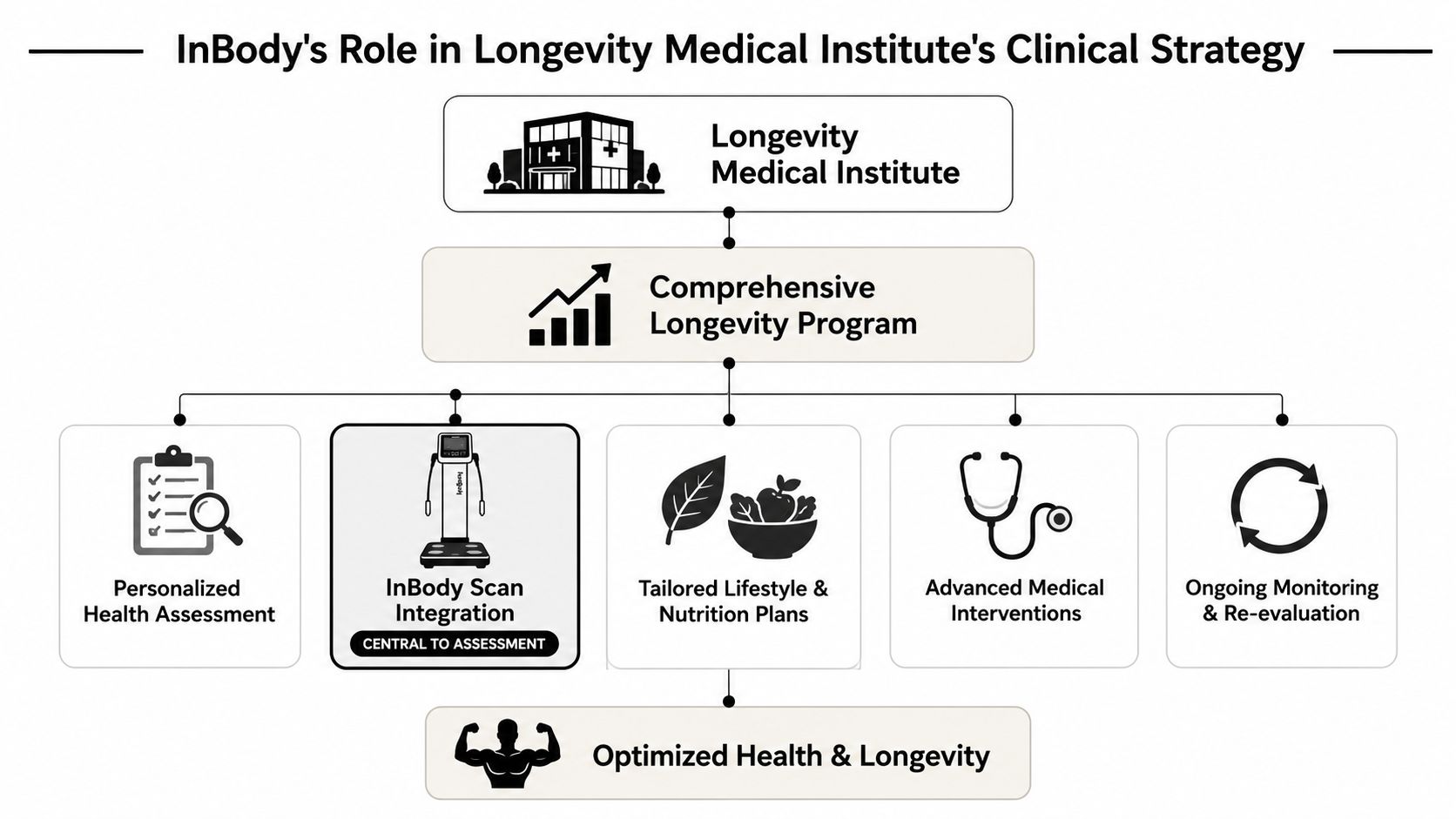
An InBody scan becomes most valuable when it's treated as one clue inside a larger diagnostic puzzle. On its own, it can describe body composition. In a broader clinical framework, it helps shape what to investigate next, what to monitor closely, and how to judge whether a regenerative or longevity strategy is working.
That's the shift from fitness interpretation to medical interpretation.
When the scan raises a bigger question
For patients with chronic pain or orthopedic injuries, a normal muscle mass score can still miss the underlying issue. BIA cannot, however, detect organ-specific pathology, localized inflammation, or the tissue findings that advanced imaging such as AI-enhanced MRI can reveal.
That matters in real life. A person may have acceptable total lean mass but still carry one-sided degeneration, localized inflammatory change, or hidden sarcopenia around an injured region. The scan says, “look closer.” It doesn't say, “nothing is wrong.”
How clinicians connect the dots
Here are common ways body composition findings guide next steps:
High visceral fat pattern. This may prompt deeper metabolic review, broader biomarker assessment, and closer attention to sleep, nutrition quality, and inflammation drivers.
Segmental lean imbalance. This may support a more focused orthopedic, rehabilitation, or movement-based evaluation.
Fluid imbalance signals. These may lead clinicians to examine recovery load, inflammation patterns, and whether other treatments are affecting water distribution.
Muscle loss during treatment. This can change nutrition strategy, exercise programming, and timing of reassessment.
For readers interested in the broader biological context, longevity biomarkers help explain why body composition should be interpreted alongside lab and imaging data rather than in isolation.
Where regenerative medicine fits in
Patients frequently find this confusing. They assume a better InBody score means tissue healing is happening. Sometimes it does. Sometimes it reflects a fluid shift, recovery from under-eating, or better hydration consistency.
That's especially relevant in advanced protocols involving peptides, IV therapies, hyperbaric oxygen, and allogeneic stem cell programs. Body composition can help establish a baseline and monitor trends, but it can't directly show whether tissue-specific regeneration is occurring in a joint, disc, tendon, or organ.
Sleep is another underappreciated factor. Patients trying to reduce fat mass while preserving muscle often benefit from expert guidance on sleep diagnostics, because the recovery environment affects the data we later interpret.
The best use of an InBody scan is not to replace deeper diagnostics. It's to point them in the right direction and help monitor response over time.
Within a sophisticated longevity plan, the scan works like a dashboard light. It tells you where to pay attention. The mechanic's inspection still matters.
Frequently Asked Questions About InBody Scans
How often should you repeat an InBody scan
The recommended frequency depends on the goal. For active fat loss or muscle gain, scans are commonly repeated every 4 to 6 weeks. For patients with Type 2 Diabetes, Chronic Kidney Disease, or sarcopenia, repeat testing may be spaced every 12 to 16 weeks, based on clinical guidance on body composition analysis as a medical tool.
Can hyperbaric oxygen, IV infusions, or peptide protocols affect results
They may. Current guidance supports standardizing conditions, but there's still a meaningful gap in the interpretation of scans around advanced longevity therapies. As discussed in this InBody FAQ overview, no current source clearly connects those specific interventions to BIA measurement error in a way that gives patients precise, actionable correction rules. The safest approach is to keep timing consistent and let your clinician interpret trends cautiously.
Is the InBody Score the most important number
No. It's a summary metric, not the whole story. Clinicians usually care more about the direction of skeletal muscle mass, visceral fat, segmental balance, and fluid patterns than the score alone.
Is an InBody scan safe for everyone
The scan uses a safe electrical current, but patients with implanted electrical medical devices should speak with their healthcare team before testing. That conversation matters more than convenience.
Can one scan tell you whether you need regenerative therapy
No. An InBody scan can support the decision-making process, but it can't show localized tissue damage, inflammatory state within a specific organ, or the structural findings that imaging may reveal.
If you want a more complete view of your health than the scale can provide, Longevity Medical Institute offers physician-led diagnostics and regenerative care in a luxury clinical setting. Patients seeking personalized insight into body composition, imaging, biomarker testing, recovery, and advanced longevity planning can schedule a consultation to explore the right next step.
Author
Dr. Kirk Sanford, DC, Founder & CEO, Longevity Medical Institute. Dr. Sanford focuses on patient education in regenerative and longevity medicine, translating complex therapies into clear, practical guidance for patients.
Medical Review
Dr. Félix Porras, MD, Medical Director, Longevity Medical Institute. Dr. Porras provides clinical oversight and medical review to help ensure accuracy, safety context, and alignment with current standards of care.
Last Reviewed: July 19, 2026
Short Disclaimer
This information is for educational purposes only and is not medical advice. It does not replace an evaluation by a qualified healthcare professional. For personalized guidance, please schedule a consultation.
We do not use autologous stem cells. We use allogeneic stem cells and produce five different types of stem cells in our biotechnology lab, including placental, Wharton's jelly, adipose, endometrial, and dental pulp.