

Red Light Therapy Benefits: A Clinical Explainer
You may be looking at red light therapy because you want something gentler than a procedure, but more substantive than another cream, gadget, or wellness promise. That instinct is reasonable. Many people aren't asking for hype. They're asking a more practical question: what can this therapy do, and under what conditions does it work well enough to justify their time?
That's the right place to begin. Red light therapy sits in an unusual category. It's non-invasive and comfortable, yet it also has legitimate clinical use in skin and hair care, with more limited and condition-specific use in pain and recovery. The difference between a meaningful outcome and disappointment usually comes down to one thing. Precision.
An Introduction to Light as Medicine
Red light therapy is often presented as a beauty trend or a recovery shortcut. In a clinical setting, it's better understood as a form of photobiomodulation, a term that describes how specific wavelengths of light influence cellular activity without heating or damaging tissue.
A useful analogy is nutrition. Food doesn't “force” the body to heal. It supplies raw material and energy so the body can do its work more effectively. Red light therapy acts in a similar way. It doesn't replace your biology. It supports it by giving cells a very particular signal that may improve repair, recovery, and remodeling.
Why patients get confused
The confusion starts because the term covers many different devices, settings, and claims. Some systems are built for dermatology. Others are marketed for full-body recovery, sleep, performance, or general wellness. Those categories are not supported equally.
What matters is whether the light is delivered at parameters that match the tissue and goal. Skin concerns, scalp treatments, and musculoskeletal discomfort don't all require the same approach.
Red light therapy is most useful when you think of it as a targeted tool, not a universal solution.
What red light therapy is best known for
The strongest real-world interest falls into a few understandable groups:
Skin rejuvenation. Patients want help with texture, visible redness, fine lines, and overall tone.
Hair support. Many people are looking for a non-drug, non-surgical way to stimulate follicles.
Pain and inflammation. Active adults often want relief that doesn't depend entirely on medication.
Recovery support. This includes tissue healing and post-treatment calming in broader regenerative programs.
At a higher level, the appeal is simple. It's comfortable, non-invasive, and easy to layer into a broader plan. The science is more nuanced than the marketing, but that nuance is exactly what makes the treatment useful.
The Science of Photobiomodulation
The biological engine behind red light therapy is photobiomodulation. That word sounds technical, but the underlying idea is straightforward. Cells absorb specific wavelengths of light and respond by changing how they produce and use energy.
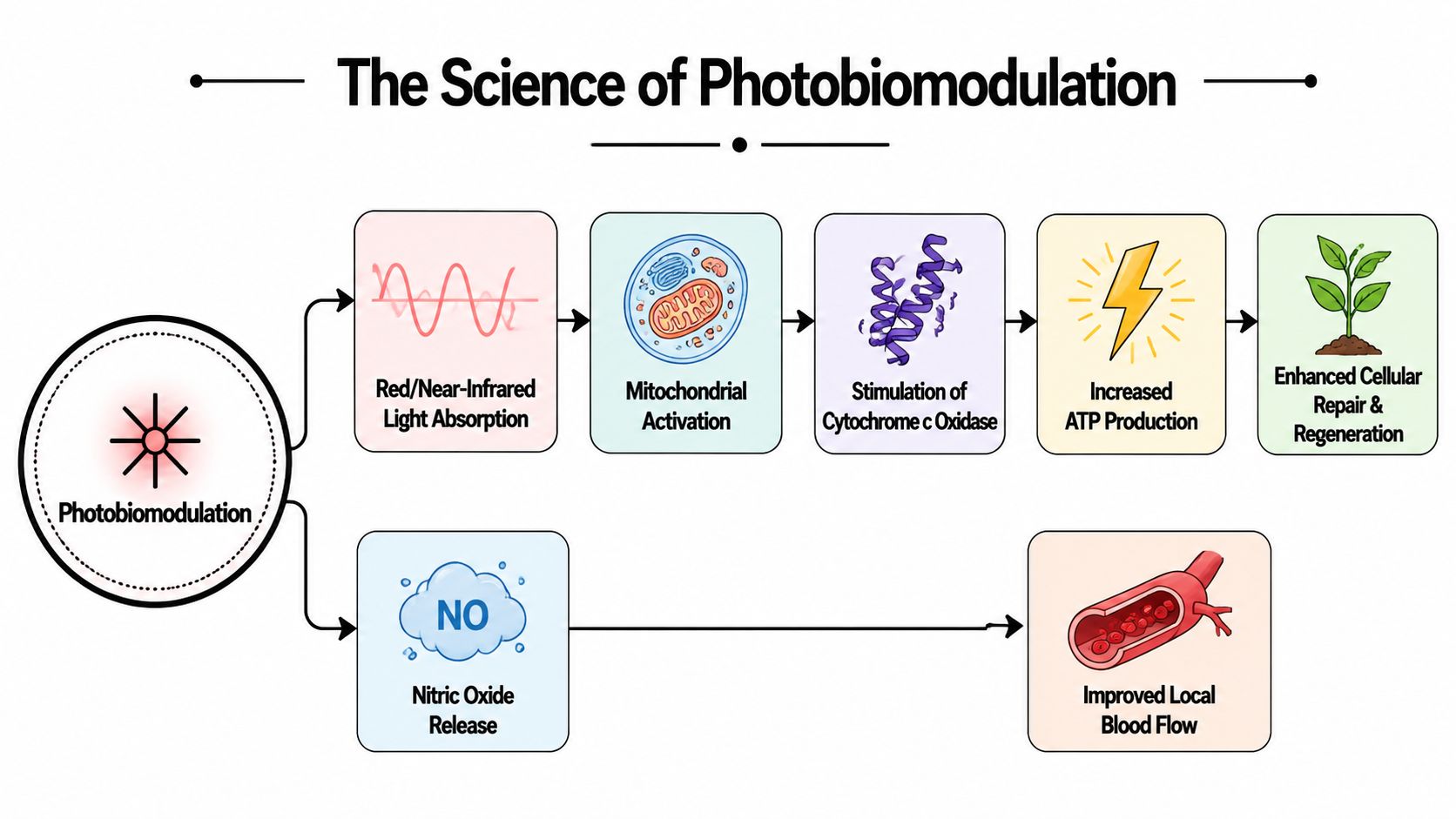
Think of the cell as a rechargeable system
Inside your cells are mitochondria, often described as the cell's power plants. They help generate ATP, the energy currency your tissues use for repair, signaling, and everyday function. When the right light reaches these structures, the working theory is that mitochondrial activity improves, which can support tissue repair and collagen-related remodeling.
That's why red light therapy is so often discussed in connection with healing and rejuvenation. It isn't acting like a peel, laser, or drug. It's interacting with the cell's energy systems.
A second analogy helps here. If your tissues are like a construction site, ATP is the electricity that lets the tools run. The therapy doesn't build the house for you. It helps ensure the workers have power.
Why blood flow and repair matter
Photobiomodulation isn't only discussed in terms of ATP. Controlled-trial literature also describes effects consistent with non-ablative, non-thermal skin rejuvenation and tissue repair. The mechanism is thought to include support for collagen synthesis and local healing responses, which helps explain why patients often seek it for skin quality and recovery-oriented goals. A review indexed at the National Library of Medicine on photobiomodulation and low-level light therapy summarizes this clinical framing and also notes an important caution: short-term safety doesn't automatically answer long-term efficacy questions, and home devices are often less standardized than clinic protocols.
For patients, that translates into a simple lesson. Comfortable treatment does not mean casual treatment. The biology is subtle, and subtle therapies need disciplined protocols.
Where a dedicated protocol helps
The term photobiomodulation is broader than a spa service or an LED mask. It refers to a therapeutic method that depends on wavelength, timing, and tissue depth. If you want a deeper look at how this category is used in clinical practice, our overview of photobiomodulation therapy explains how these principles are applied in treatment planning.
Practical rule: The more specific the goal, the more specific the protocol needs to be.
Clinically Supported Skin and Hair Benefits
A patient looks in the mirror and notices changes that feel subtle but persistent. The skin seems less even. Fine lines catch the light more easily. Hair feels a little thinner at the temples or crown. These are often the concerns that bring red light therapy out of the realm of wellness marketing and into a more clinical discussion, because skin quality and hair density are areas where outcomes can be tracked.
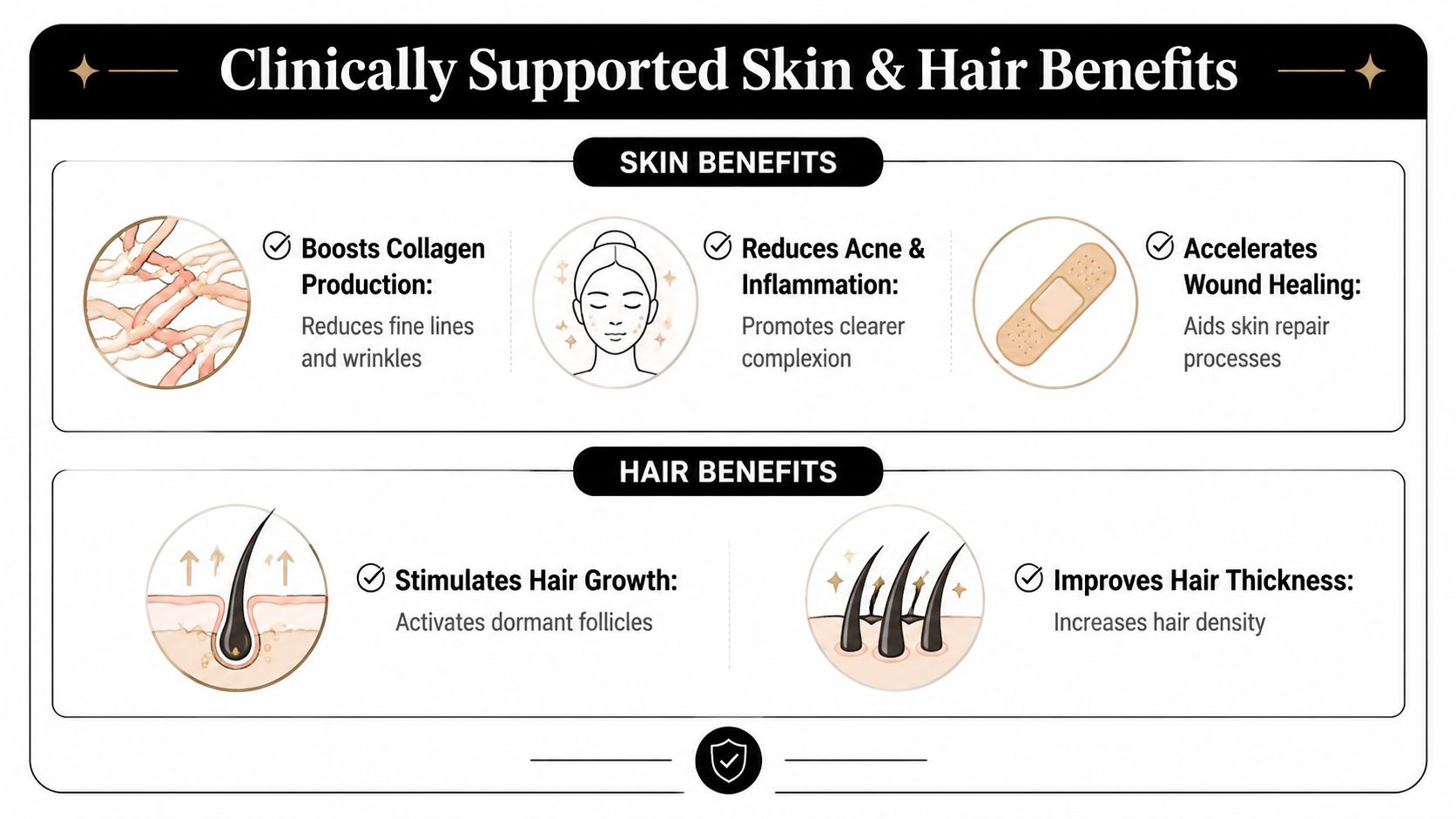
What the skin evidence supports
For skin, the realistic goal is improvement in function and appearance over time. Red light therapy does not act like an aggressive resurfacing procedure. It works more like a steady conditioning program for tissue, where repeated exposure under the right parameters may support smoother texture, more even tone, and a calmer visual profile.
That distinction matters. Patients often expect either dramatic transformation or no effect at all. Clinical skin outcomes usually sit between those extremes. Reported benefits include softer texture, less visible redness, and gradual improvement in the look of uneven pigmentation. A Nature feature on red light therapy evidence and FDA-cleared home devices also describes patient-reported improvement in skin quality and places those observations in the context of regulated consumer devices.
A careful clinician interprets that evidence with restraint. Better skin quality is not the same as a facelift, a laser resurfacing series, or an injectable result. It is closer to improving the fabric of the skin itself, so the surface looks and behaves healthier.
Many patients benefit from consistent support for skin behavior over time, especially when the goal is calmer tone, smoother texture, and low-downtime maintenance.
What this means for aging skin
“Aging skin” is a broad phrase, so it helps to break it into parts. Some concerns come from collagen change. Others reflect barrier stress, vascular redness, or irregular pigment. Red light therapy is most useful as part of a plan for skin quality, especially for patients who want non-thermal support and a gradual trajectory rather than controlled injury.
That makes treatment selection more precise. The question is not whether red light therapy is “anti-aging.” The better question is which feature of aging skin you are trying to improve, and whether the device uses a wavelength and dose that match that goal.
For readers comparing options for complexion, barrier support, and visible texture concerns, our dermatology and skin health services explain where light-based therapy fits within a medically guided plan.
How hair support differs
Hair treatment follows a different logic. Skin improvement focuses on tissue quality across a broad surface. Hair protocols target the follicle, which behaves more like a cycling mini-organ than a patch of skin. The aim is to support follicles that are still biologically active, not to create brand-new follicles where activity has been lost.
That is why protocol details matter so much. Wavelength, treatment frequency, and total dose affect whether enough light reaches the target tissue to produce a useful response. Device category matters too. Caps, helmets, combs, and panels do not deliver light in the same pattern or at the same distance, so equal marketing language does not mean equal biological effect.
FDA clearance adds an important layer of seriousness here because it places certain home-use devices for hair loss and aging skin into a regulated, low-risk category. That does not prove that every product performs well. It does show that the field has moved beyond pure speculation.
A practical summary looks like this:
Skin texture support through gradual improvement in how the surface feels and reflects light
Reduction in visible redness in patients whose concern is overall skin calmness rather than pigment alone
Improvement in the appearance of fine lines and uneven tone with repeated, correctly dosed treatment
Support for hair thickness and length in selected patients using devices and schedules designed for follicular stimulation
Enhancing Recovery Pain and Inflammation
Pain and recovery are where red light therapy marketing often gets ahead of the evidence. That doesn't make the therapy useless in this area. It means you need a narrower, more disciplined lens.
The realistic role in pain care
The strongest summary here is not “red light therapy cures pain.” It's that the therapy appears to work best as an adjunct for certain conditions. Cleveland Clinic notes that there isn't enough evidence to support most claimed uses broadly, while also acknowledging narrower evidence in selected pain-related settings. In that review, evidence suggests red light therapy is a useful adjunct rather than a standalone solution. A review cited there found low-to-moderate evidence for reduced tendinopathy pain only when combined with exercise, and moderate evidence for improving knee osteoarthritis disability and fibromyalgia fatigue, as summarized by Cleveland Clinic's review of red light therapy uses and limits.
That is a much more responsible way to understand the treatment. It may help some patients. It usually shouldn't be the entire plan.
Why inflammation is only part of the picture
Patients often use the word inflammation to mean any soreness, swelling, stiffness, or persistent ache. Clinically, those are different problems. A treatment that calms tissue signaling doesn't automatically rebuild tendon capacity, restore joint mechanics, or correct overload patterns.
That's why red light therapy tends to fit best in layered care:
For tendon pain. It may be more useful when paired with exercise than when used passively.
For osteoarthritis-related limitation. It may support comfort and function in selected cases.
For fatigue-linked pain syndromes. Some patients may use it as one supportive measure among several.
For post-training soreness. Expectations should stay conservative unless there's a structured protocol and clear target.
Patients dealing with persistent discomfort often need a framework that includes diagnosis, movement strategy, recovery planning, and targeted therapies. Our guide to chronic pain treatment options outlines that broader decision process.
A short overview can help if you want to see one example of how these therapies are discussed in a patient-facing format:
What to avoid expecting
The phrase “full-body recovery” sounds appealing, but it blurs together very different goals. Relief from knee discomfort is not the same as better sprint performance. Support for a tendon rehab plan is not the same as a universal anti-inflammatory effect.
If a device promises to improve pain, performance, sleep, healing, and vitality with the same generic protocol, skepticism is healthy.
A more mature way to look at red light therapy benefits is this: it can be useful for recovery and pain in selected cases, especially when integrated into a broader plan. That's valuable. It just isn't magic.
Optimizing Treatment for Real Results
Most disappointment with red light therapy comes from one hidden assumption. People assume all red light is roughly the same. It isn't.
The variables that change outcomes
According to Stanford Medicine's clinical discussion of red light therapy parameters and evidence gaps, outcomes depend heavily on the strength, wavelength, duration, and frequency of treatment. Stanford also notes that the correct parameters are largely unknown for many consumer home devices, and conclusive data is still lacking for claims tied to sleep and athletic performance.
That sentence explains a great deal of the mismatch between marketing and reality.
Here's the practical version:
| Treatment factor | Why it matters |
|---|---|
| Wavelength | Different wavelengths interact with tissue differently and may not reach the same depth. |
| Strength | A weak device may not deliver a meaningful dose to the target tissue. |
| Duration | Too little exposure may underdose the tissue. Too much doesn't automatically improve the response. |
| Frequency | Red light therapy usually depends on repeated sessions rather than a single exposure. |
Why cheap devices often disappoint
A home device may be comfortable, attractive, and easy to use. None of that tells you whether it's delivering a clinically useful protocol. If the output is low, the treatment area is small, or the instructions are generic, you may spend months applying light without reaching the threshold needed for a visible result.
That doesn't mean home devices never help. It means the burden of precision is higher than most buyers realize.
For musculoskeletal goals, this matters even more because tissue depth and rehab timing become part of the equation. If you're comparing self-treatment with a structured recovery plan, our resource on how to heal tendonitis faster shows why dosing and progression matter just as much as the tool itself.
What patients should ask before starting
Instead of asking, “Does red light therapy work?” ask better questions:
What is the treatment target. Skin surface, scalp, joint, tendon, or muscle?
What parameters are being used. Not every protocol is interchangeable.
How often is treatment delivered. Benefits are usually cumulative.
How will success be judged. Texture, redness, pain during activity, or another specific outcome?
Those questions move the conversation from wellness language to clinical language. That's where better decisions happen.
Integrating RLT in Regenerative Protocols
Red light therapy becomes more useful when it is part of a coherent system. In regenerative medicine, therapies rarely work in isolation. They work by improving the environment in which repair takes place.
Where it fits in a broader plan
In practice, red light therapy may be layered around programs focused on tissue recovery, aesthetics, and resilience. A patient receiving procedure-based care, rehabilitation, or regenerative support may use photobiomodulation to help calm local irritation, support tissue readiness, or reinforce a recovery routine that includes movement and metabolic support.
That systems-based approach is especially relevant when care involves biologic therapies. At our clinic, Longevity Medical Institute may incorporate red light therapy within the Longevity Recharge Station and related recovery programming, alongside other modalities used to support cellular health and tissue recovery. In that same ecosystem, allogeneic biologic programs may involve cell types produced in the biotechnology lab, including placental, Wharton's jelly, adipose, endometrial, and dental pulp.
Why combination care makes sense
Think of regenerative treatment as gardening rather than construction. The intervention matters, but so does the soil, oxygenation, circulation, inflammation load, and recovery behavior afterward. Light-based support can complement that environment.
One common pairing in broader recovery conversations is hyperbaric support. If you're interested in how oxygen-based therapies may intersect with biologic treatment plans, this overview of hyperbaric oxygen therapy and stem cells explains the logic behind combining modalities.
Layered therapies don't guarantee a better outcome. They do allow clinicians to address recovery from more than one angle.
Your Red Light Therapy Questions Answered
Is red light therapy safe
Red light therapy is widely considered non-invasive and generally well tolerated. FDA-cleared home devices for aging skin and hair loss have been designated low risk, as noted earlier. That said, “safe” doesn't mean “appropriate for everyone.” Eye protection, skin sensitivity, medical history, and the reason for treatment still matter.
If you have an active medical condition, unusual skin changes, or you're using the therapy around a recent procedure, clinician guidance is the prudent choice.
What does a session feel like
Most patients describe it as easy and relaxing. You're typically positioned in front of a panel or treated over a local area. The sensation is usually gentle warmth or no strong sensation at all.
That calm experience sometimes leads people to underestimate the need for protocol discipline. Comfortable treatment can still be clinically meaningful.
How long does it take to see results
The honest answer is that it depends on the goal. Skin and hair changes are usually cumulative. Pain-related responses may also depend on whether the therapy is paired with exercise, recovery work, or another intervention. If you expect a dramatic one-session change, you'll likely be disappointed.
A better expectation is gradual improvement that can be tracked in a specific way. Less visible redness. Better skin texture. Improved tolerance during a rehab plan. More comfort with a defined movement.
Is a home device enough
Sometimes, but not always. The central issue isn't convenience. It's whether the device delivers the right wavelength and strength with a schedule that matches the treatment target. That's where many consumer experiences go off course.
When should you seek clinical guidance
Seek guidance when the problem is persistent, when the goal is medical rather than cosmetic, or when you want to combine red light therapy with a broader regenerative or recovery strategy. Precision matters most when consequences are greater.
If you're considering red light therapy and want a clinically grounded plan rather than a generic device recommendation, Longevity Medical Institute offers physician-led evaluation and personalized treatment pathways that place light therapy in the context of skin health, recovery, and regenerative care.
Author
Dr. Kirk Sanford, DC, Founder & CEO, Longevity Medical Institute. Dr. Sanford focuses on patient education in regenerative and longevity medicine, translating complex therapies into clear, practical guidance for patients.
Medical Review
Dr. Félix Porras, MD, Medical Director, Longevity Medical Institute. Dr. Porras provides clinical oversight and medical review to help ensure accuracy, safety context, and alignment with current standards of care.
Last Reviewed: June 14, 2026
Short Disclaimer
This information is for educational purposes only and is not medical advice. It does not replace an evaluation by a qualified healthcare professional. For personalized guidance, please schedule a consultation.