

Sports Medicine: A Guide to Advanced Recovery
You've rested the shoulder, iced the knee, finished physical therapy, and followed the standard advice. The swelling improved, but something still isn't right. You can train, but not confidently. You can move, but not explosively. That frustrating middle ground is where many active adults find themselves.
This is often the moment when sports medicine stops being about “getting through it” and starts becoming about understanding why recovery stalled in the first place. In a more advanced model of care, the question isn't only where it hurts. The question is what's happening in the tissue, in the joint environment, and across the rest of the body that's keeping repair from finishing.
Beyond Traditional Recovery
A common pattern looks like this: an athlete tweaks a knee during a turn, or a golfer develops lingering elbow pain, or a runner can't shake plantar fascia irritation. The initial injury may not seem dramatic. Weeks later, though, the tissue still feels unreliable. Traditional care often focuses on reducing pain, decreasing inflammation, and rebuilding strength. That approach matters. It just doesn't always answer why some injuries become chronic.
The newer frontier in sports medicine looks deeper. Instead of treating symptoms as the finish line, it asks whether the tendon, cartilage, ligament, fascia, or surrounding joint environment has entered a meaningful repair process. That's where regenerative care becomes relevant. It aims to support the body's own repair signaling, not just quiet the pain long enough to return to activity.
The shift isn't small. The global sports medicine market is projected to grow from USD 7.30 billion in 2024 to USD 15.25 billion by 2033, with orthobiologics such as stem cell therapies expected to grow at an 8.54% CAGR through 2031, according to Grand View Research's sports medicine industry analysis.
Why the old model can feel incomplete
For many patients, rest and rehab help but don't fully restore trust in the injured area. The reason is often structural or biological:
The tissue healed, but poorly: Fibers may have closed down in a disorganized way.
Inflammation stayed active: Not enough to create dramatic swelling, but enough to block smooth recovery.
Compensation took over: The body protected one area by overloading another.
The diagnosis was too broad: “Tendonitis” or “wear and tear” doesn't always tell you what needs to change.
An integrated pathway combines structural diagnosis, biologic treatment, and performance-based rehabilitation. If you're considering that kind of care, it helps to understand how a dedicated sports therapy program is designed around recovery, movement quality, and tissue resilience rather than pain control alone.
Recovery plateaus often mean the body needs more precision, not simply more patience.
The Evolving Scope of Modern Sports Medicine
Sports medicine used to be understood as a narrow lane. You got injured, saw an orthopedist, completed physical therapy, and returned when pain dropped enough. That model still has value, especially for acute injuries and surgical decision-making. But it doesn't capture what modern patients need when the goal is long-term performance, joint preservation, and healthier aging.
Today, sports medicine functions more like an integrated system. It includes imaging, laboratory analysis, regenerative medicine, physical medicine, rehabilitation strategy, and sometimes metabolic and inflammatory assessment. The focus isn't only on the injured part. It's on the whole biological context in which that injury occurred.
From reactive care to resilience planning
A reactive model asks, “How do we reduce pain so you can get back to activity?”
A modern model asks different questions:
What tissue is failing?
Why did it fail under this load?
What is slowing repair?
How do we lower the chance of repeat injury?
Those questions matter because a chronically irritated tendon, a degenerative meniscus, or early cartilage breakdown rarely exists in isolation. Joint mechanics, muscle imbalance, sleep quality, inflammatory burden, training load, and recovery capacity all influence outcome.
What comprehensive sports medicine includes
In a premium clinical setting, sports medicine may involve several layers of care working together:
| Area | What it contributes |
|---|---|
| Physician evaluation | Clarifies diagnosis, severity, and candidacy for procedures |
| Advanced imaging | Shows structure, tissue quality, and hidden pathology |
| Regenerative interventions | Targets cellular signaling and tissue repair |
| Physical medicine | Restores biomechanics, mobility, and load tolerance |
| Recovery optimization | Supports healing through sleep, oxygenation, nutrition, and inflammation control |
This approach fits not only competitive athletes, but also active adults who want to stay on the tennis court, continue strength training, hike without pain, or protect their joints as they age.
Performance and longevity now overlap
The most interesting change in sports medicine is philosophical. Recovery is no longer separate from longevity. Preserving cartilage, calming chronic inflammation, improving tissue quality, and maintaining muscle function all serve both performance and healthspan.
That's why many patients are less interested in a temporary fix and more interested in a strategy. They want to know whether the plan supports durable movement, not just short-term pain reduction. In that sense, sports medicine has become a form of preventive medicine for people who want to keep using their bodies well for decades.
Advanced Diagnostics for Pinpoint Accuracy
Treatment quality rises or falls with diagnosis. If the diagnostic picture is incomplete, even an advanced therapy can miss the mark. In sports medicine, that happens more often than patients realize. A standard X-ray may show bone alignment but miss soft tissue detail. A routine MRI may identify damage but not explain how the injury behaves under movement. Basic bloodwork can look “normal” while systemic inflammation or poor recovery biology still interferes with healing.
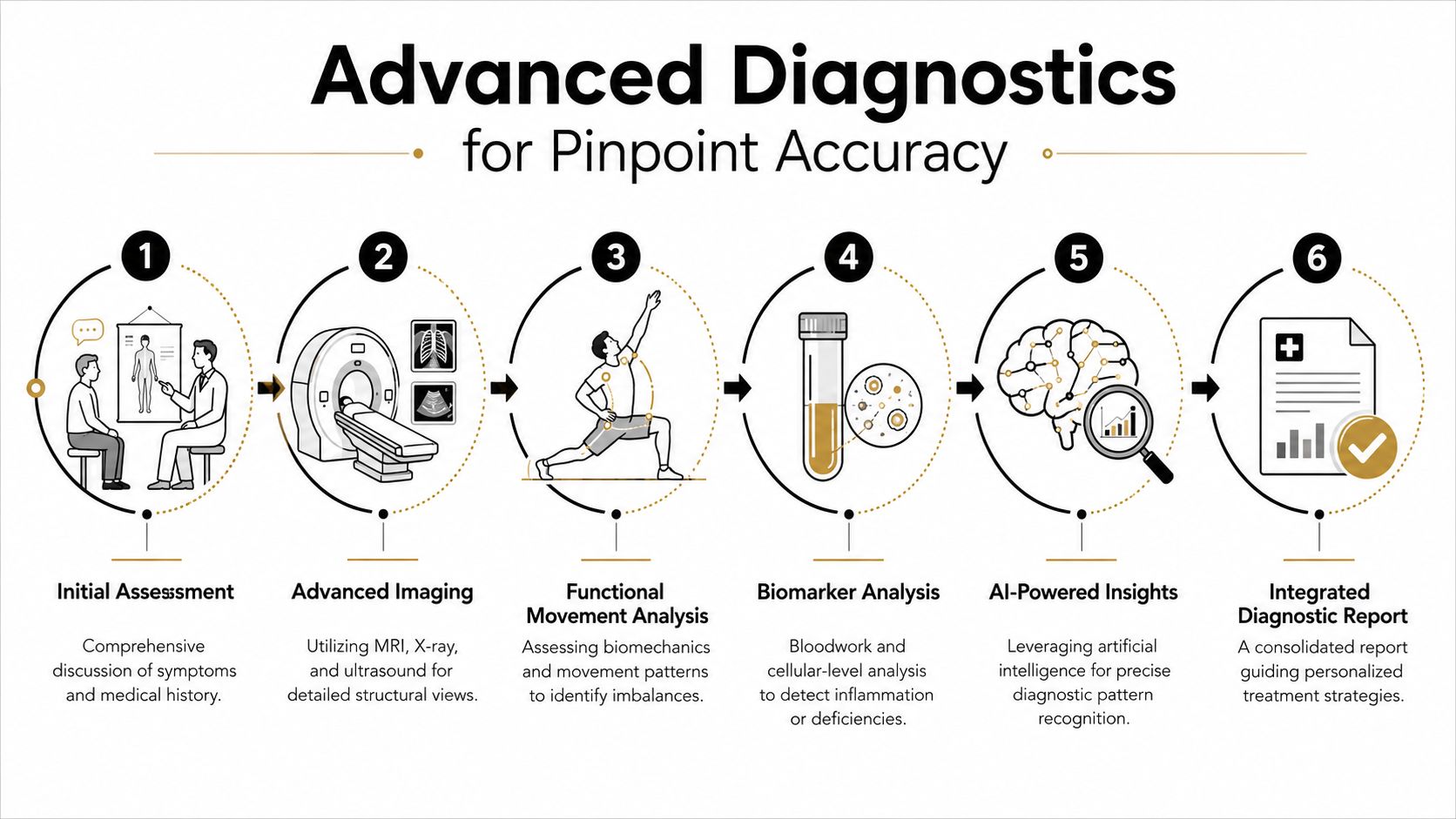
Structural imaging is only the beginning
A precise evaluation often combines several tools because each answers a different question.
AI-enhanced MRI helps identify structural issues across joints, spine, muscle, and surrounding tissues with more advanced pattern recognition.
Musculoskeletal ultrasound allows real-time visualization of tendons, ligaments, bursae, and joint spaces. It's especially useful when a physician wants to see tissue during movement or guide an injection with accuracy.
Functional movement analysis shows whether the body is protecting one area by shifting force elsewhere.
A patient with knee pain, for example, may think the problem is “arthritis.” Imaging may instead reveal a more specific mix of cartilage wear, synovial irritation, tendon overload, and muscle imbalance. Each component changes treatment.
For patients curious about how advanced imaging can shape this kind of assessment, a closer look at how an AI full-body MRI works helps explain why broader pattern recognition matters.
Biomarkers add the missing physiological context
Good sports medicine also asks whether the internal terrain supports repair. That's where in-house biomarker testing becomes valuable. At our clinic, this includes an in-house clinical lab measuring 120 biomarkers, which helps connect local injury patterns to broader signals such as inflammation, recovery capacity, and metabolic stress.
Tissue repair doesn't happen in isolation. A tendon injection may be technically perfect, but if systemic inflammation remains high or recovery physiology is impaired, the result may be less durable.
Clinical insight: The painful tissue is only part of the case. The repair environment matters just as much.
Wearables are useful, but they need interpretation
Patients now arrive with heart rate variability data, sleep scores, training metrics, and recovery apps. That information can be helpful, but only if it's translated into clinical action. A published review notes a significant disconnect between consumer tech and clinical practice, because few resources explain how to convert real-time wearable biomarker data into regenerative treatment decisions. Data-driven clinics are beginning to close that gap, as discussed in this review on AI, wearables, and sports medicine.
A smartwatch may tell you that strain is high and recovery is low. It won't tell you whether your plantar fascia is degenerative, whether your shoulder pain is coming from tendon disorganization rather than impingement alone, or whether your rehab intensity should change after an injection. That interpretation still requires medical judgment.
Why precision changes the treatment plan
Better diagnostics do more than improve labels. They improve decision-making.
A more complete diagnostic workup helps determine:
Whether a patient needs regenerative treatment or a different path entirely
Which tissue should be targeted
Whether image guidance is necessary
How rehabilitation should be timed after treatment
What systemic issues may need correction alongside the procedure
That level of precision is what separates generalized sports medicine from personalized recovery planning.
A New Toolkit for Cellular Repair
Once diagnosis is clear, the next question is which biologic tool fits the tissue problem. This often bewilders many patients. They hear terms like PRP, exosomes, stem cells, and prolotherapy, and assume they all do roughly the same thing. They don't.
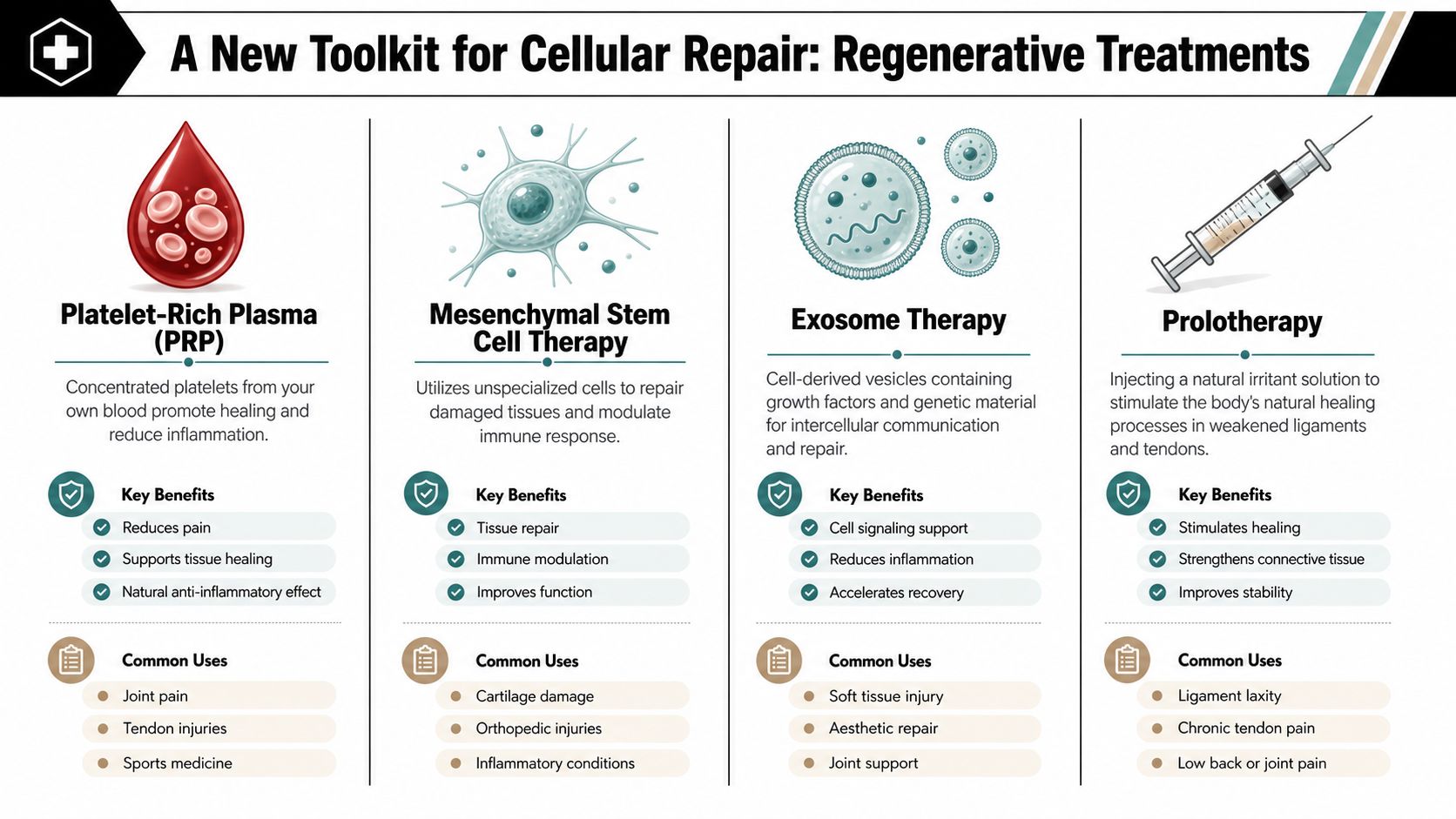
A useful way to think about regenerative therapy is this: some treatments act like a repair alarm, some act like a biological repair team, and some act like messengers that coordinate healing. The art is matching the tool to the biology.
Comparing the main options
| Therapy | Core role | Best understood use |
|---|---|---|
| PRP | Concentrates platelets and growth factors from blood | Useful for signaling early healing support, especially in selected tendon or soft tissue cases |
| Allogeneic stem cell therapy | Provides potent immunomodulatory and regenerative signaling | Often considered when tissue damage is more complex or chronic |
| Exosome therapy | Delivers cell-derived signaling particles | Supports communication, inflammation control, and repair signaling |
| Prolotherapy | Creates a controlled irritant response | Stimulates healing in lax ligaments or chronic tendon dysfunction |
A large meta-regression found that Mesenchymal Stem Cell therapy was the most statistically effective regenerative intervention for pain reduction in orthopedic conditions, outperforming PRP, peptides, and other biomimetic approaches, as reported in this orthopedic regenerative medicine analysis.
Why allogeneic stem cells are different
We don't use autologous stem cells. In our practice, the focus is on allogeneic stem cells, meaning carefully prepared cells derived from donated biological tissues rather than harvested from the patient at the time of treatment. The rationale is consistency, broader biologic potential, and better control over processing.
Our biotechnology lab produces five different cell types:
Placental
Wharton's jelly
Adipose
Endometrial
Dental pulp
These aren't interchangeable. Different cell populations may be selected based on tissue goals, inflammatory patterns, and procedural strategy. In plain language, stem cells rarely work by merely “turning into” a brand-new tendon or ligament. Their main role is signaling. They help regulate inflammation, recruit local repair pathways, and create conditions in which damaged tissue can recover more effectively.
A side-by-side review of exosomes vs stem cells can help patients understand why one may be chosen over the other in different orthopedic settings.
Exosomes as the messengers
Exosomes are tiny extracellular vesicles released by cells. Patients often understand them quickly when described as messengers. They carry signals that influence how neighboring cells behave. In sports medicine, that matters because chronic injuries are often less about one dramatic tear and more about stalled communication inside the tissue.
Research in athletic soft tissue injury suggests exosome-based approaches may help reduce inflammation and support regeneration, particularly in tendon and ligament contexts. Their appeal is that they may provide regenerative signaling without the cellular considerations that come with direct cell transplantation.
This video offers a useful visual overview of regenerative treatment concepts:
Where PRP still fits
PRP remains relevant. It's familiar, widely discussed, and in many cases appropriate. In the verified literature provided here, PRP shows moderate benefit, especially for short-term symptom relief in acute injuries and tendon repair, though long-term durability can vary because preparation methods differ.
That doesn't make PRP weak. It makes it more specific. A patient with a relatively straightforward tendon issue may respond well. A patient with more advanced tissue degeneration, cartilage involvement, or persistent inflammatory dysfunction may need a more complex biologic strategy.
The right question isn't “Which treatment is strongest?” It's “Which treatment matches the tissue problem in front of us?”
Other supportive tools in the regenerative toolbox
Sports medicine rarely relies on a single injection alone. Depending on the case, physicians may also consider:
Ultrasound-guided precision injections for accurate delivery into the target structure
Peptide protocols to support recovery biology
Ozone or other adjunctive therapies in selected settings
Rehabilitation timing adjustments so the new signaling environment isn't disrupted too early
That combination is often what turns an interesting procedure into a coherent treatment plan.
Your Personalized Recovery Blueprint
A strong recovery plan starts before any needle, scan, or procedure. Picture the athlete who has tried rest, physical therapy, and perhaps one injection, yet the pain keeps returning the moment training intensity rises. In that situation, the primary task is not to repeat treatment. It is to map the injury with enough precision to see why the tissue has failed to recover and what environment it needs in order to repair.

What the journey usually looks like
A personalized sports medicine plan usually unfolds in stages. The sequence matters because each step informs the next, much like building an architectural plan before restoring a damaged structure.
Thorough intake and exam
The physician studies symptoms, injury history, training load, movement patterns, prior treatment response, and existing imaging. If part of the picture is missing, further testing may be added so treatment is based on evidence rather than assumption.Root-cause analysis
Structural injury is only part of the story. Healing can also be shaped by inflammatory signaling, metabolic stress, hormone status, sleep quality, and biomechanical compensation. A closer look at root cause analysis testing shows how clinicians connect the painful tissue to the larger biological system influencing recovery.Procedure planning
Once the diagnosis is clear, the treatment plan becomes more precise. One patient may be a good candidate for PRP. Another may need a more advanced biologic strategy involving allogeneic stem cells, exosomes, prolotherapy, or a staged combination designed around tissue quality and performance goals.Recovery support
After the procedure, the tissue enters a new signaling phase. Rehabilitation, load progression, and recovery therapies have to match that phase so the biologic repair process is supported rather than interrupted.
The injection is one component, not the whole strategy
Regenerative treatment works like a biological repair team. The injection may deliver signaling molecules, cells, or matrix cues, but those tools still need the right conditions to do their job. If joint mechanics remain poor, sleep is fragmented, or training load returns too fast, the local repair signal can be overwhelmed by the same forces that caused the problem.
That is why a well-built plan may include:
Physical medicine to improve force distribution and reduce compensatory movement patterns
Hyperbaric oxygen therapy to support tissue oxygenation during recovery
Peptide protocols when clinically appropriate
Nutrition and sleep support to improve the healing environment
Follow-up imaging or exam-based reassessment to measure progress and adjust timing
A physician-led setting such as Longevity Medical Institute may bring these elements together in one place, which helps when a case requires detailed coordination between diagnostics, regenerative procedures, rehabilitation, and performance planning.
Personalization matters even more for female athletes
Female athletes are still underrepresented in parts of the sports medicine research base. That gap affects how treatment plans are built, because ligament behavior, biomechanics, hormonal shifts, and injury patterns may not follow the assumptions built from male-dominant datasets. The American Medical Women's Association review on disparities in sports medicine examines that problem directly.
For women, precision medicine is not a marketing phrase. It is a clinical requirement. The same MRI finding can carry different functional meaning depending on cycle phase, connective tissue behavior, training demands, and prior injury history.
A recovery blueprint should match the patient's biology, the tissue's condition, and the performance goal at stake.
How to Choose a Regenerative Medicine Clinic
Not every clinic offering regenerative sports medicine works at the same standard. Some focus on the injection itself and give little attention to diagnosis, imaging, post-procedure strategy, or laboratory quality. That's risky, because a poorly selected or poorly delivered treatment can waste time, money, and recovery potential.
What to look for first
The most important marker is whether care is physician-led and diagnosis-driven. A clinic should be able to explain what tissue is being treated, why that tissue was selected, how delivery will be guided, and what the follow-up plan looks like.
Look for these quality signals:
Clear medical oversight: Physicians should evaluate candidacy and not delegate complex treatment decisions to sales staff.
Image-guided precision: Ultrasound or equivalent guidance matters when the target structure is small or technically demanding.
Integrated care: Rehabilitation, physical medicine, and recovery support should exist alongside injections.
Transparent protocols: You should understand what product is being used and why.
Laboratory standards matter
If a clinic works with biologics, product quality and processing standards are central. Patients should ask direct questions about tissue sourcing, handling, sterility, and oversight. In settings where biologic products are prepared in-house, licensing and certification standards matter because they speak to process control, traceability, and quality assurance.
Ask practical questions, not just marketing questions
A good consultation should make it easier to evaluate the clinic, not harder. Useful questions include:
Who reviews my imaging and exam findings?
Will the injection be image-guided?
What does recovery support include after the procedure?
How do you decide between PRP, exosomes, and stem cell therapy?
What happens if I'm not a good candidate?
Patients exploring treatment across borders often benefit from a broader guide to what a stem cell clinic in Mexico should offer in terms of safety, transparency, and physician oversight.
A strong clinic doesn't just offer biologics. It offers judgment.
Frequently Asked Questions
Who is a good candidate for regenerative sports medicine
The best candidates are usually active adults with a clear orthopedic problem that hasn't fully responded to conservative care, but who may not want surgery or may not yet need it. Common scenarios include chronic tendon pain, joint irritation, cartilage wear, plantar fascia problems, ligament injuries, and overuse conditions that keep returning. Candidacy depends on diagnosis, tissue status, overall health, and recovery goals.
How long does recovery usually take
That depends on the tissue being treated, the degree of degeneration, and whether rehabilitation is well timed. Most patients need to think in phases, not days. Some feel early symptom changes relatively quickly, while structural remodeling takes longer. In plantar fasciitis, for example, verified data provided here notes that full tissue regeneration after stem cell therapy may require 3 to 12 months, even when symptom improvement occurs earlier.
Are allogeneic stem cell therapies risky
Any medical procedure carries risk, and allogeneic biologic therapies require careful screening, processing, and medical judgment. The key issue isn't whether a treatment sounds advanced. It's whether the case has been properly diagnosed, whether the product has been handled under appropriate standards, and whether the physician is using it in a clinically responsible setting. Patients should always ask how the material is sourced, processed, and selected for use.
Is regenerative treatment meant to replace physical therapy
No. In most sports medicine cases, it should complement physical therapy or other physical medicine strategies. The biologic intervention may improve the healing environment, but movement quality, strength, tendon loading, joint mechanics, and recovery pacing still need to be addressed. The best outcomes usually come from combining regenerative care with a structured rehabilitation plan.
Does this approach only apply to elite athletes
Not at all. Many of the best candidates are not professionals. They're adults who want to keep hiking, lifting, golfing, playing pickleball, skiing, or moving without ongoing pain. Sports medicine today serves anyone who places meaningful demand on their body and wants a more precise path to recovery.
What does the experience look like for patients traveling to Los Cabos
Most traveling patients want efficiency and coordination. They usually need records reviewed in advance, a clear diagnostic plan on arrival, and a schedule that brings consultation, imaging, lab review, procedure timing, and early follow-up into one organized process. Travel-friendly care works best when logistics are built around the medical plan instead of treated as an afterthought.
Is there evidence that regenerative sports medicine improves outcomes
The literature summarized in the verified data indicates that systematic reviews have found regenerative medicine protocols, particularly stem cell therapy and tissue engineering, to consistently shorten recovery times and improve functional outcomes compared with conventional non-surgical approaches for sports injury rehabilitation, as described in this systematic review of regenerative rehabilitation strategies.
If you're exploring a more precise path for injury recovery, joint preservation, or performance-focused rehabilitation, Longevity Medical Institute offers educational resources and consultation options designed to help patients understand advanced diagnostics, regenerative therapies, and personalized recovery planning.
Author
Dr. Kirk Sanford, DC, Founder & CEO, Longevity Medical Institute. Dr. Sanford focuses on patient education in regenerative and longevity medicine, translating complex therapies into clear, practical guidance for patients.
Medical Review
Dr. Félix Porras, MD, Medical Director, Longevity Medical Institute. Dr. Porras provides clinical oversight and medical review to help ensure accuracy, safety context, and alignment with current standards of care.
Last Reviewed: July 17, 2026
Short Disclaimer
This information is for educational purposes only and is not medical advice. It does not replace an evaluation by a qualified healthcare professional. For personalized guidance, please schedule a consultation.
Published under Treatments & Resources at Longevity Medical Institute