

Stem Cell Therapy for Fibromyalgia: A Patient's Guide
Some mornings, fibromyalgia starts before your feet even touch the floor. Your body already hurts. Sleep didn't restore you. Your mind feels cloudy, as if someone turned down the brightness on your thoughts. By midday, ordinary tasks can feel strangely expensive. A grocery trip, a work call, even answering messages can demand more energy than they should.
Many people living with fibromyalgia know this cycle well. They've tried medications, pacing, supplements, physical therapy, sleep routines, and stress reduction. Some measures help. Many help only partially. That's often the moment when regenerative medicine enters the conversation, not because people are chasing hype, but because they're tired of building life around symptom management alone.
Stem cell therapy for fibromyalgia sits in that space between hope and hard questions. It's not a shortcut, and it's not a guaranteed cure. But it does represent a different way of thinking. Instead of asking only how to blunt pain, it asks whether cellular signaling, inflammation, immune balance, and repair can be supported more directly. For patients comparing advanced options, it can also help to review broader chronic pain treatment options in context rather than seeing any one therapy in isolation.
A New Path Beyond Managing Fibromyalgia Symptoms
Fibromyalgia changes more than how the body feels. It changes how people plan, how they work, how they relate to exercise, and how much confidence they have in their own energy from one day to the next.
For many patients, the hardest part is not only the pain. It is the sense that treatment can become an endless cycle of partial relief. A medication softens one symptom but leaves others untouched. A good week is followed by a setback. Over time, “managing” symptoms can start to feel like living inside a smaller and smaller circle.
That is why interest in regenerative medicine has grown. The question shifts from “How do we mute symptoms for a few hours?” to “Why has the system become so reactive in the first place?”
Why a regenerative approach feels different
Stem cell therapy for fibromyalgia is being studied because it aims to influence the biology behind the symptom pattern. The goal is not simple suppression. The goal is to support a healthier internal environment, one that is less inflammatory, less reactive, and better able to recover after stress.
A useful comparison is a piano that has drifted out of tune. The keys still work, but the whole instrument produces strain instead of harmony. In fibromyalgia, many patients seem to live in a state where pain signaling, immune activity, sleep quality, and recovery no longer coordinate well. A regenerative approach is designed to help restore that coordination.
This is also where a clinically driven, allogeneic strategy stands apart from vague wellness claims. At a serious medical institute, the discussion is specific. Which cell type is being used. How are those cells screened, processed, and stored. What evidence supports their immunomodulatory effects. Which patients are reasonable candidates, and which are not. That level of detail matters because advanced care should be built on method, not marketing.
Patients often ask a fair question. If this is not a cure, why consider it?
Because meaningful progress in fibromyalgia often begins when treatment addresses the conditions that keep the body stuck. For some patients, that may mean better sleep and less post-exertional worsening. For others, it may mean clearer thinking, improved function, or more predictable energy. Stem cell therapy belongs in a wider discussion of evidence-based chronic pain treatment options, not as a miracle solution, but as one possible tool within a personalized plan.
A realistic kind of optimism
Hope is appropriate here, but it should be disciplined hope.
The current interest in stem cell therapy for fibromyalgia comes from a plausible biological rationale and from early clinical experience that suggests some patients may improve. It also comes with real limits. Research is still developing. Study designs vary. Outcomes are not uniform. A careful clinic should say that plainly.
That transparency is part of good medicine. Patients deserve more than broad promises. They deserve a clear explanation of what is known, what remains uncertain, and how safety is handled at each step.
The right question is not whether stem cells are “the answer” for everyone with fibromyalgia. The better question is whether a carefully selected, safety-first treatment plan could help this individual patient regain function and quality of life.
The Cellular Roots of Fibromyalgia Pain and Fatigue
A patient sits in front of me and says, “My bloodwork looks fine, but I feel like my whole system is failing.” That sentence captures fibromyalgia with painful accuracy. The problem often does not announce itself on a standard scan or routine lab panel. It shows up in how the body processes stress, pain, sleep, and energy.
A useful way to understand fibromyalgia is to view it as a disorder of misregulated communication across several body systems. The nervous system may become overly reactive. Immune signaling may remain unsettled. Cellular recovery may become less efficient. Instead of one obvious injury, there is a network problem.
Why pain feels disproportionate
One of the best-studied concepts in fibromyalgia is central sensitization. In plain terms, the brain and spinal cord begin to process ordinary sensory input as if it were more threatening than it is. The volume on pain signaling rises, and the filter that should dampen harmless input becomes less effective.
A stereo works as a useful comparison. If the gain is set too high, even a normal song comes through sharp and exhausting. In fibromyalgia, everyday pressure, movement, temperature changes, or exertion can be processed with that same exaggerated intensity.
This also helps explain why pain can feel widespread and why a relatively small physical demand can lead to a much larger flare. The body is not inventing symptoms. It is over-amplifying them.
Why inflammation and repair may stay out of balance
Pain amplification is only part of the story. Many clinicians and researchers also look at the internal environment surrounding that pain. In some patients, inflammatory and immune signals appear to behave like an alarm system that does not fully reset after the initial threat has passed.
That matters because healing depends on timing. The body needs to mount a response, then settle it. If those signals remain noisy, tissues may recover less efficiently, sleep may feel less restorative, and symptoms can become persistent rather than episodic.
This is one reason regenerative medicine has drawn attention in fibromyalgia. Mesenchymal cell therapies are being studied not because they cover symptoms, but because they may influence the signaling environment itself. The interest is scientific, but it should be paired with honesty. Response can vary, treatment methods are not yet standardized, and long-term questions still deserve careful study.
For patients whose fibromyalgia overlaps with severe exhaustion, that same biology often intersects with broader discussions about post-viral fatigue, immune disruption, and impaired recovery. Our page on stem cell therapy for chronic fatigue syndrome explains that overlap in more detail.
Why fatigue and brain fog belong in the same model
Fibromyalgia is often described as a pain condition, but patients usually experience much more than pain. They describe waking unrefreshed, losing words mid-sentence, struggling to recover after mild activity, and feeling as if their internal battery never fully charges.
Those symptoms fit the same systems-level model.
When the nervous system is on high alert and the body is not repairing efficiently, several effects tend to cluster together:
Sleep becomes lighter and less restorative
Energy production feels less reliable
Mental clarity drops under even modest stress
Physical resilience shrinks, so flares happen more easily
A practical way to read this pattern is simple. If pain, fatigue, poor sleep, and brain fog tend to worsen together, the problem is probably broader than one muscle, one joint, or one isolated pathway.
That broader view is exactly why a clinically driven, allogeneic stem cell approach is being explored for carefully selected patients. The goal is not to chase one symptom at a time. The goal is to address the disturbed signaling environment that may sit underneath the full fibromyalgia experience.
How Allogeneic Stem Cells Work to Restore Balance
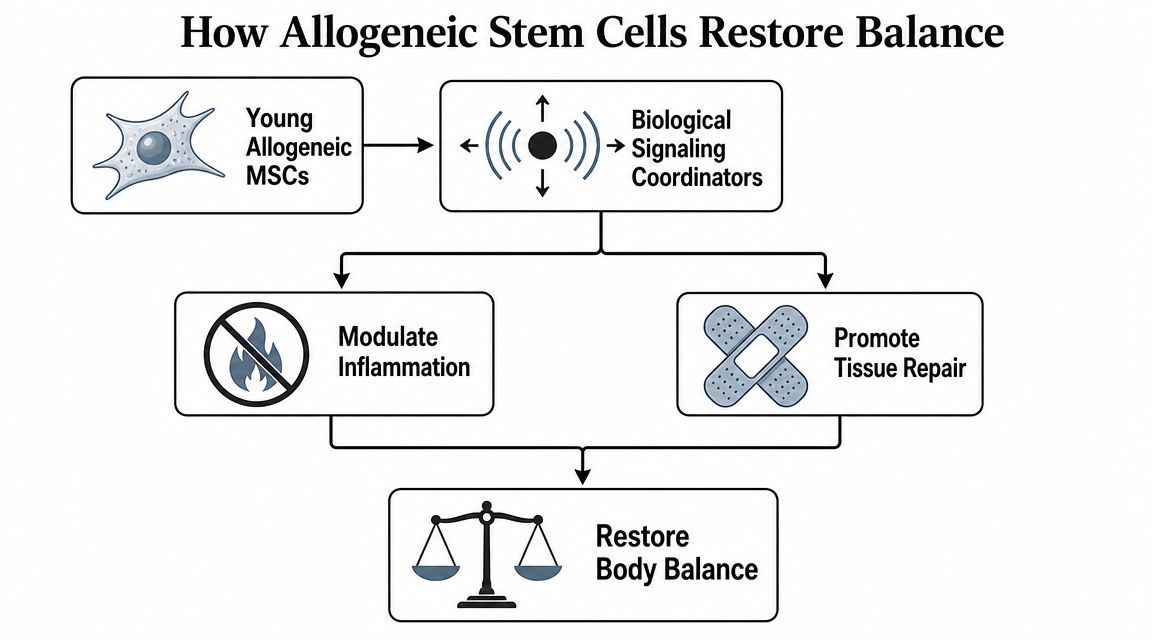
A patient with fibromyalgia often feels as if every control system in the body is turned a little too high. Pain signals fire too easily. Sleep does not restore. Minor exertion can trigger a flare that seems out of proportion to the activity itself. In that setting, mesenchymal stem cells, or MSCs, are being studied less for tissue replacement and more for their ability to influence the biological environment around them.
MSCs work through signaling, not simple replacement
The simplest way to understand MSCs is to view them as active participants in cellular communication. They release signals that can affect immune behavior, inflammatory activity, and the way nearby tissues respond to stress. For fibromyalgia, that matters because the working hypothesis is not a single damaged structure. It is a body-wide signaling problem involving pain processing, recovery, and regulation.
An orchestra offers a useful comparison. If the timing is off across multiple sections, replacing a violin does not solve the performance. The improvement comes from restoring coordination. MSCs are being explored in a similar way. The aim is to calm disruptive signals and support a more organized physiologic response.
That distinction matters. A clinically driven stem cell approach for fibromyalgia is usually designed to influence regulation, not to promise that cells will “become” new muscle, nerve, or connective tissue on demand. If you want a broader biologic primer, our overview of how stem cell therapy works at the cellular level explains those mechanisms in more detail.
Why an allogeneic approach gets attention
This guide focuses on allogeneic treatment, meaning the cells come from carefully screened donor-derived sources rather than being collected from the patient during the same treatment cycle.
That model is attractive for practical and clinical reasons. Donor-derived cells can be prepared under controlled laboratory conditions, checked for quality, and selected as part of a standardized process. Patients also avoid a same-day harvesting procedure, which can matter when someone is already dealing with pain sensitivity, fatigue, and limited reserve.
None of that proves that allogeneic cells are superior for fibromyalgia. The current evidence does not justify that claim. It does explain why experienced regenerative teams often view allogeneic MSCs as a consistent platform for investigational protocols centered on immune and inflammatory signaling.
Why cell source matters, but not in the way marketing often suggests
At Longevity Medical Institute, the biotechnology lab produces five stem cell products used across regenerative protocols: placental, Wharton's jelly, adipose, endometrial, and dental pulp. For fibromyalgia, the important point is not that one source is the answer for every patient. The important point is that different sources may offer different biologic profiles, and physicians may choose among them based on the treatment plan, the patient's history, and the broader clinical picture.
Patients understandably ask, “Which one is best?” In medicine, that is often the wrong question. A better question is, “Which source best fits the goal of this protocol?”
| Cell type | Why physicians may consider it qualitatively |
|---|---|
| Placental | Often selected in regenerative medicine for broad signaling support |
| Wharton's jelly | Commonly discussed for extracellular matrix support and MSC content |
| Adipose | A well-known MSC source in regenerative research and clinical use |
| Endometrial | Used in specialized regenerative settings for its signaling potential |
| Dental pulp | Explored for biologic activity relevant to tissue support |
A careful physician should be transparent here. No cell source has been definitively proven as the answer for fibromyalgia. The value lies in matching the biologic strategy to the problem being addressed, using high-quality cell preparation, clear safety standards, and individualized clinical judgment.
In fibromyalgia, the goal is usually regulation and recalibration. Not replacement.
Evaluating the Clinical Evidence for Fibromyalgia
The most trustworthy answer about stem cell therapy for fibromyalgia is also the least flashy. The evidence is early, limited, and still evolving. That doesn't mean the field lacks promise. It means patients should separate biological plausibility from proven clinical certainty.
What the literature actually looks like
A recent fibromyalgia-focused review describes the field as being shaped mainly by preclinical studies, case reports, and small pilot trials, rather than standard-of-care adoption or large definitive human studies. That same review notes that some early commercial reports described symptom improvements 8 months after infusion, including reduced pain, less stiffness and tenderness, better sleep, and improved work efficiency, while still emphasizing that the field remains investigational.
That matters because many websites jump from “patients improved” to “this works.” Those are not the same statement.
What can reasonably be taken from early reports
Early studies can still be useful. They can tell us whether a protocol appears feasible, whether certain symptoms seem responsive, and whether patients may feel better beyond the very short term.
The evidence gap patients should care about
The biggest gap isn't whether positive stories exist. They do. The bigger issue is evidence quality and durability.
Ask these questions before taking any claim seriously:
Was the study controlled? Without controls, placebo effects and symptom fluctuation are hard to separate from treatment impact.
How many patients were involved? Small samples can be encouraging, but they are fragile.
How long were patients followed? Fibromyalgia often fluctuates. Durability matters.
Which outcomes improved? Pain, sleep, fatigue, and function don't always move together.
Was the protocol standardized? If cell source, dose, and delivery vary widely, comparison becomes difficult.
For patients evaluating clinic claims, this summary of what our published research concluded about stem cell safety can be a useful lens for asking better questions, even beyond fibromyalgia specifically.
Early-stage evidence can justify a careful conversation. It cannot justify certainty.
That's the proper frame. Investigational does not mean unserious. It means the treatment deserves experienced oversight, honest expectation-setting, and disciplined follow-up.
Your Personalized Treatment Journey at Our Institute
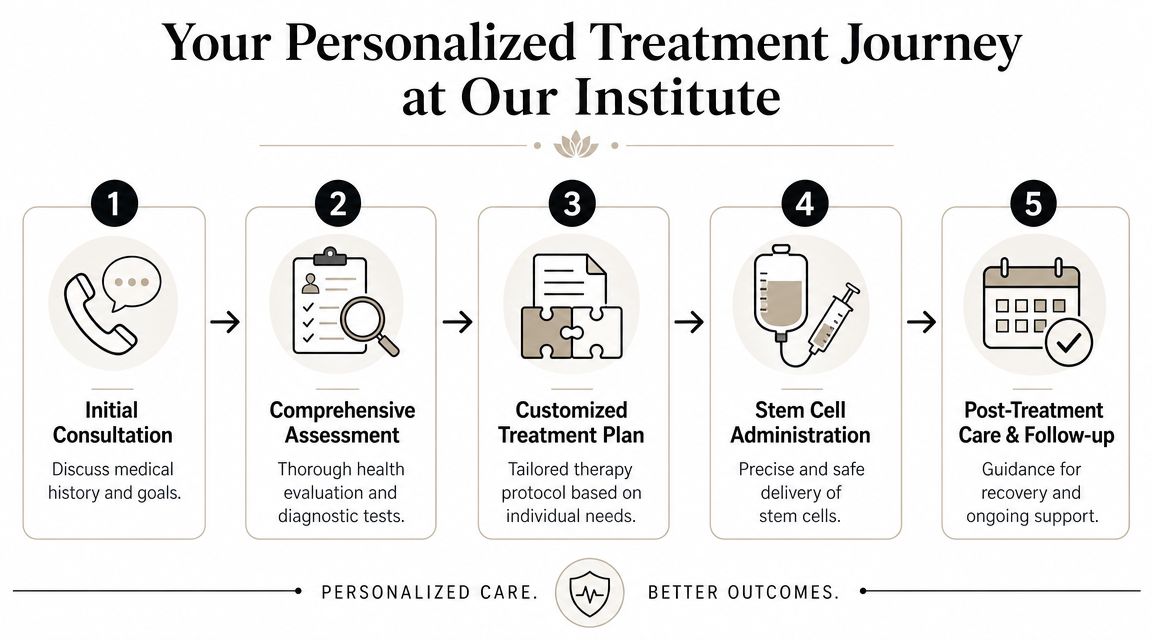
When patients first inquire about stem cell therapy for fibromyalgia, they usually want to know one practical thing. What would the process look like if I moved forward?
A responsible regenerative program should feel less like buying a procedure and more like entering a structured medical pathway. Fibromyalgia is too complex for one-size-fits-all care, especially when symptoms overlap with sleep disruption, chronic inflammation, stress physiology, mood strain, and exercise intolerance.
Step one begins with pattern recognition
The first consultation should not revolve around “How soon can I get treated?” It should revolve around whether treatment makes sense for you.
A physician usually looks at the symptom pattern, previous therapies, current medications, autoimmune history, pain distribution, sleep quality, daily function, and the patient's goals. For some people, the main goal is lower pain. For others, it's clearer thinking, better sleep, more consistent energy, or the ability to exercise without a prolonged setback.
This first phase also includes candid conversation about uncertainty. A systematic review summarized in this article on the promise of stem cell therapy for fibromyalgia and the research behind it confirms that the evidence comes from early-stage studies with small sample sizes. That's exactly why clinics should be transparent and multi-modal rather than simplistic.
Diagnostics should sharpen the picture
Fibromyalgia often lives alongside other problems that can magnify symptoms. That's why advanced assessment can matter.
A personalized workup may include:
Clinical history review to identify triggers, flare patterns, and hidden overlaps
Laboratory analysis to look for metabolic, inflammatory, hormonal, nutritional, or immune clues
Imaging when appropriate to distinguish widespread pain from structural pain generators
Medication and supplement review to identify interactions or confounding factors
Functional baseline tracking so improvement can be measured rather than guessed
At our institute, this process can include an in-house clinical lab measuring 120 biomarkers, advanced cardiovascular review, and a full-body MRI integrated with AI when clinically appropriate. Those tools don't diagnose fibromyalgia by themselves. They help reveal what may be aggravating the fibromyalgia experience.
Protocol design is rarely stem cells alone
The strongest regenerative plans are usually layered. Fibromyalgia affects systems, so the intervention strategy often does too.
A physician-designed plan may combine:
Allogeneic stem cell therapy selected for immune-modulating and signaling goals.
Exosome-based support, when used within a broader regenerative framework.
Hyperbaric oxygen therapy, especially when recovery support and tissue oxygenation are part of the strategy.
Peptide protocols aimed at complementary recovery pathways where clinically appropriate.
Longevity Recharge Station therapies to support restoration and resilience in a structured setting.
Sleep, nutrition, and physical medicine guidance because biologic therapy works better when the body has fewer obstacles.
Not every patient needs every layer. The point is precision, not excess.
Clinical insight: In fibromyalgia, success often depends on reducing the number of things pushing the system in the wrong direction at the same time.
Treatment day should feel controlled and calm
Patients often expect something dramatic. In reality, regenerative treatment days are usually quiet and carefully managed.
A treatment visit may include final physician review, informed consent, preparation of the selected biologic product, and monitored administration. Depending on protocol design, the route may involve intravenous delivery and supportive therapies before or after the procedure. Monitoring continues throughout.
For patients, the visible part is simple. The invisible part is what matters most: sourcing standards, screening, handling, quality control, sterility practices, and physician oversight.
Follow-up is where meaning appears
Fibromyalgia changes rarely unfold like flipping a switch. Progress can be uneven. Some patients first notice sleep shifts. Others feel less post-exertional heaviness, then lower pain, then better concentration.
That's why meaningful follow-up should track:
Pain patterns
Fatigue and stamina
Sleep quality
Cognitive clarity
Physical function
Flare frequency and recovery time
Without follow-up, you're left with impressions. With follow-up, you can assess whether the intervention is changing daily life in a durable way.
Navigating Safety, Logistics, and Your Treatment Decision
Most patients considering treatment in Mexico ask the same three questions. Is it safe? How do I evaluate a clinic? What will the trip involve?
Those are the right questions, and they deserve direct answers.
Safety starts long before treatment day
The safest regenerative programs aren't defined by glossy marketing. They're defined by process.
For fibromyalgia, where the evidence is still emerging, safety matters even more because patients may be vulnerable to overstatement. A responsible clinic should explain what it knows, what it doesn't know, how cells are sourced, how products are handled, who supervises care, and what kind of follow-up is available.
When evaluating options, look for:
Clear medical screening so inappropriate candidates are identified early
Transparent sourcing information for allogeneic cell products
Laboratory quality controls that support product integrity
Physician oversight rather than sales-led decision making
Expectation management that focuses on function, not miracle language
For a practical review of this issue, patients often find it helpful to read whether stem cell therapy in Mexico is safe before comparing programs.
Logistics should feel organized, not improvised
Traveling for care can feel daunting when you're already dealing with pain and fatigue. Good logistics reduce strain.
Most patients benefit from a plan that accounts for airport transfers, lodging proximity, appointment pacing, and recovery support. The setting matters too. If someone with fibromyalgia is exhausted, overstimulated, and trying to coordinate every detail alone, the treatment journey becomes harder than it needs to be.
What should be clarified in advance?
| Decision area | What to ask |
|---|---|
| Screening | What records are needed before acceptance? |
| Scheduling | How many on-site days are expected? |
| Supportive care | Are adjunct therapies part of the plan? |
| Recovery | What should I expect immediately after treatment? |
| Follow-up | How will outcomes be monitored after I return home? |
A short physician discussion can also help ground expectations before travel.
Value is not the same as price
Patients often ask for treatment cost first. That's understandable, but in regenerative medicine, value depends heavily on what surrounds the procedure.
A low-cost offering can become high-risk if screening is weak, data are vague, and follow-up is thin. A more thorough program may include physician evaluation, diagnostics, coordinated supportive therapies, monitored administration, and structured reassessment. Those features don't guarantee a better outcome, but they do make the care model more medically coherent.
The real decision isn't just “Should I try stem cells?” It's “Do I trust the clinical reasoning, quality control, and follow-through behind this recommendation?”
That question protects patients better than any marketing promise.
Frequently Asked Questions
Are allogeneic stem cells used for fibromyalgia meant to cure the condition
No responsible physician should frame stem cell therapy for fibromyalgia as a proven cure. The more realistic goal is functional improvement. That may include less pain, better sleep, more stable energy, clearer thinking, or improved tolerance for daily activity. Some patients may notice meaningful changes. Others may have modest benefit. Some may not respond in a clinically significant way.
How soon do people notice changes
There isn't a single timeline that applies to everyone. Fibromyalgia is variable, and regenerative responses can also vary. Some people first notice changes in sleep or recovery. Others notice a gradual reduction in pain sensitivity or fewer severe flares. The key is to think in terms of trends over time rather than immediate dramatic change.
Why do so many clinics make the evidence sound stronger than it is
Because early positive reports are easy to market. What's harder is explaining uncertainty well. The current literature supports interest and ongoing study, but it does not support blanket claims of established efficacy. Patients should be cautious with any clinic that skips over limitations, avoids discussing durability, or treats anecdote as proof.
What makes a patient a better candidate for this kind of therapy
Candidacy depends on the whole picture. Physicians usually consider the severity and pattern of symptoms, prior treatment history, medical complexity, goals, safety issues, and whether other root contributors need attention first. In some patients, sleep medicine, nutritional correction, endocrine support, or rehabilitation may need to be addressed alongside regenerative care rather than after it.
Why is a multi-modal approach often recommended
Fibromyalgia is rarely a one-pathway condition. A patient may have pain amplification, poor sleep, autonomic stress, deconditioning, and overlapping inflammatory drivers at the same time. A plan that combines biologic therapy with supportive medical strategies is often more rational than relying on one intervention alone.
Is intravenous treatment the only approach discussed in the literature
It's the most concrete model described in the available summaries cited earlier in this article. That doesn't mean it is the only conceivable route in regenerative medicine. It means it is one of the few approaches publicly described with enough specificity to discuss responsibly.
How should I decide whether treatment is worth pursuing
Use a simple filter:
Ask whether the clinic is transparent about what is known and unknown.
Ask whether safety systems are clear before any payment or scheduling pressure.
Ask whether your case is being individualized rather than fitted into a package.
Ask whether outcomes will be tracked after treatment.
Ask whether your goal is realistic, meaning better function rather than a guaranteed cure.
If those answers are solid, you're having a real medical conversation rather than a sales conversation.
If you're exploring whether regenerative care could fit your fibromyalgia treatment plan, Longevity Medical Institute offers physician-led evaluations designed to clarify candidacy, review safety, and build a personalized strategy around advanced diagnostics and allogeneic biologic therapies.
Author
Dr. Kirk Sanford, DC, Founder & CEO, Longevity Medical Institute. Dr. Sanford focuses on patient education in regenerative and longevity medicine, translating complex therapies into clear, practical guidance for patients.
Medical Review
Dr. Félix Porras, MD, Medical Director, Longevity Medical Institute. Dr. Porras provides clinical oversight and medical review to help ensure accuracy, safety context, and alignment with current standards of care.
Last Reviewed: May 26, 2026
Short Disclaimer
This information is for educational purposes only and is not medical advice. It does not replace an evaluation by a qualified healthcare professional. For personalized guidance, please schedule a consultation.