

Stem Cell Therapy for Inflammatory Bowel Disease
Living with inflammatory bowel disease can feel like planning your day around the nearest bathroom, the next medication dose, and the possibility that a flare could interrupt everything. If you're dealing with Crohn's disease or ulcerative colitis, you already know the burden isn't just physical, it's emotional, social, and exhausting.
Stem Cell Therapy for Inflammatory Bowel Disease has become a serious topic because people with difficult, treatment-resistant disease want more than temporary control. They want a way to calm inflammation, protect quality of life, and reduce the cycle of flares, urgency, bleeding, pain, and fatigue that can dominate daily life. That hope is real, but the evidence is also specific, and the strongest signal is not the same for every type of IBD.
Living With Crohn's and Ulcerative Colitis and Looking for New Options
A lot of people reach this point after trying the usual path. They've used aminosalicylates, steroids, immunomodulators, and biologics, yet they still wake up thinking about symptoms before they've even had coffee. Others feel boxed in by side effects, biologic intolerance, or disease that keeps coming back in the same stubborn place.
Why standard care can still leave a gap
Crohn's disease and ulcerative colitis are the two main forms of IBD, but they don't behave the same way. Crohn's can affect different parts of the digestive tract and go deeper into the bowel wall, while ulcerative colitis is confined to the colon and rectum with inflammation closer to the surface. Both can cause abdominal pain, diarrhea, urgency, bleeding, and fatigue, and both can flare unpredictably.
That's where regenerative medicine enters the conversation. It doesn't replace gastroenterology care, and it shouldn't be treated like a shortcut. It does offer a different lens, especially for people with refractory disease, complex fistulas, or a poor response to biologics.
Practical rule: if your symptoms are still active, keep your gastroenterologist in the loop while you explore any regenerative option.
Why people start asking about stem cells
Patients usually aren't asking about stem cells because they want to abandon standard care. They're asking because standard care hasn't fully delivered. In that setting, stem cell therapy, especially MSC-based therapy, becomes a serious research question, not a wellness buzzword.
It also matters to separate IBD from other intestinal problems. Diverticulitis is a different condition, and it belongs in its own guide because the biology, the treatment goals, and the clinical decisions are not the same.
Regenerative medicine belongs in a thoughtful discussion about options, not in a promise of cure. Used correctly, it's a layer worth understanding alongside your existing treatment plan, not a replacement for it.
What Stem Cells Are and Why They Interest IBD Researchers
Stem cells are cells that can help the body respond to injury and inflammation in different ways. In IBD, the type that gets the most attention is the mesenchymal stromal cell, or MSC, because researchers are interested less in replacing bowel tissue and more in changing the inflammatory environment around it.
Why MSCs stand out
MSCs are studied because they appear to modulate immune signaling and help shift the body away from a highly inflammatory state. They don't need to permanently engraft in the gut to matter. Their value is more about what they signal, not what they become.
That's why source matters so much. In regenerative clinics, MSCs may come from bone marrow, fat tissue, or umbilical cord tissue. In a physician-directed setting, donor-derived, or allogeneic, material is often favored for consistency and scalability.
What makes them interesting in IBD
Researchers look at MSCs because they can influence several immune pathways at once. They interact with inflammatory cells, help calm overactive signaling, and may support repair in inflamed tissue through paracrine signaling, which means they release biologically active molecules rather than acting like a direct tissue replacement.
MSCs are studied as immune regulators, not as a magic patch for damaged bowel.
That distinction matters. If you're reading about stem cells for IBD, the key question is never just “What are the cells?” It's also where they're delivered, what they're trying to treat, and whether the trial studied fistulas, luminal disease, or something else entirely.
What the Research Actually Shows So Far
The evidence for stem cell therapy in IBD is real, but it's uneven. The strongest human data is not for generic “gut healing.” It's for a very specific problem, complex perianal Crohn's fistulas, where local MSC delivery has been studied most carefully and is already approved in Europe as darvadstrocel.
| Approach | Indication | Key Evidence | Regulatory Status |
|---|---|---|---|
| Local MSC injection | Complex perianal Crohn's fistulas | Randomized phase 3 data showed meaningful closure outcomes versus placebo, and early phase I/IIa work reported 56.3% complete closure at week 24 with no major safety signals PubMed | Approved in Europe for this indication |
| IV MSC infusion | Refractory Crohn's disease and ulcerative colitis | Small human studies and early pilots suggest possible benefit, including the Crohn's evidence base and the 2024 IV MSC pilot in ulcerative colitis Crohn's IV MSC study, UC pilot | Investigational |
| HSCT | Severe refractory Crohn's disease | Early series and the ASTIC program support a rescue role in selected cases, but the approach is intensive and not routine WJG review, MSC review | Highly specialized |
| Allogeneic MSCs for luminal IBD | Refractory luminal Crohn's and ulcerative colitis | A 2024 review describes controlled studies with early signals, including a phase II Crohn's trial and an ulcerative colitis study using IV MSCs 2024 review, 2018 review | Investigational |
Why the route of delivery matters
Local treatment and systemic treatment are not the same thing. Injecting cells into a fistula tract is a very different strategy from giving them by IV to influence bowel inflammation. That's why the most convincing results don't automatically transfer from one disease form to another.
A 2017 meta-analysis pooling 21 studies and 514 patients found that systemic stem cell infusion produced a 56% clinical response rate, with pooled clinical or endoscopic remission rates of 46% and 15%, respectively Springer review. That's encouraging, but it also shows why this area is still selective, not routine.
The ASTIC trial added another important piece. At 1 year, 44% of transplanted patients were in clinical remission versus 9% in the mobilization-only group, with statistical significance noted in the published summary Springer review. That's a serious signal, but it doesn't make stem cells a universal answer for IBD.
What to keep in perspective
The field has moved from isolated reports into a genuine clinical research area. The first published remission report after autologous stem cell transplantation appeared in 1993, and by 2003 the Chicago group had published the first series of Crohn's patients treated with autologous HSCT as a primary IBD therapy WJG review. But history alone doesn't equal broad effectiveness.
The right takeaway is simple. Stem cell therapy has promising human data, but the strongest use case is still narrow and indication-specific.
Exosomes as Messengers of Regeneration
Exosomes are tiny vesicles cells release to communicate with one another. You can think of them as biological parcels carrying proteins, lipids, and microRNAs that can alter how nearby cells behave.
Why they matter in IBD
In intestinal inflammation, that communication matters. MSC-derived exosomes are being studied because they may carry some of the same anti-inflammatory signals seen with whole-cell therapy, but without introducing intact cells into the body. That makes them interesting for researchers who want a more targeted regenerative signal.
This is also where expectations need to stay disciplined. Exosomes are not the same thing as stem cells, and they are not yet established as a proven IBD treatment in humans. The biology is promising, the logic is strong, and the clinical evidence in IBD is still limited.
If a physician-directed clinic considers exosomes, it's usually as part of a broader, individualized regenerative strategy. For a deeper overview of the topic, see stem cell exosomes.
How to think about them practically
The cleanest way to understand exosomes is to see them as a communication tool, not a replacement tissue. They may help shape the inflammatory environment, but they don't have the same clinical evidence base as the better-studied MSC approaches described above.
That's why responsible care separates clinical interest from published proof. Human studies have not yet established an effective exosome treatment for IBD, so any discussion should be framed as exploratory and individualized, not guaranteed.
How Hyperbaric Oxygen Therapy May Add Another Layer
Hyperbaric oxygen therapy, or HBOT, means breathing oxygen in a pressurized chamber. The increased pressure helps dissolve more oxygen into the blood, which may influence inflammation, tissue repair, and immune activity.
Where HBOT fits in IBD care
For IBD, the interest is mostly in ulcerative colitis and other inflammatory settings where oxygen delivery may support recovery. That doesn't make it a standalone answer, and it doesn't mean every patient should use it. It does mean it has enough biologic plausibility and early human data to stay on the radar.
The most useful way to think about HBOT is as an adjunct. It's a layer that may sit alongside medication review, nutrition support, and regenerative planning rather than replacing them. A useful overview is available in the clinic resource on hyperbaric oxygen therapy and stem cells.
Clinical rule: HBOT should complement existing care, not interrupt it.
The UC pilot literature is encouraging, including a randomized ulcerative colitis pilot and a 2026 pilot in treatment-resistant UC that examined HBOT alongside existing treatment randomized UC pilot, 2026 pilot. Those findings support interest, but they don't prove that HBOT works the same way for Crohn's disease.
What patients usually want to know
Most patients ask whether HBOT replaces medication. It doesn't. They also ask how it feels. It's a pressurized chamber session under supervision, not a home treatment, and any plan should be individualized around symptoms, diagnosis, and ongoing gastroenterology care.
The right use case is careful, layered, and practical. HBOT may add another piece to the plan, but it shouldn't be sold as a cure or as a substitute for disease control.
How LMI Designs an Individualized Regenerative Plan
A physician-directed plan starts with the diagnosis, not with a generic protocol. The team reviews disease location, activity, symptoms, medication history, colonoscopy findings, imaging, prior surgery, and relevant labs before discussing regenerative options.
How the process is built
LMI's approach is layered. That can include allogeneic MSCs made fresh in our in-house biotechnology lab, exosomes, HBOT, nutrition guidance, and targeted supplementation, but only after the team understands the exact pattern of disease and the patient's current treatment context. In practice, that means the plan is shaped by whether someone has fistulizing Crohn's disease, luminal inflammation, ulcerative colitis, or a more complicated mixed picture.
For patients looking for a broader framework around individualized care, this FAQ overview is a useful comparison point for how carefully structured plans are built in regenerative settings.
What happens before treatment starts
Records matter. The most useful documents are recent endoscopy reports, pathology if available, imaging, medication lists, infusion history, and any notes about biologic failure or intolerance. The team can't responsibly discuss regenerative options without those details.
At Longevity Medical Institute, this process is physician-led and integrated with the patient's existing gastroenterology care. The point is continuity, not competition. Regenerative therapies can be discussed as part of a broader plan, while the home GI team remains central to disease monitoring and safety.
Bring the records that show how your disease has behaved, not just how it feels today.
That approach helps keep expectations realistic. It also helps the consultation stay focused on candidacy, not marketing language.
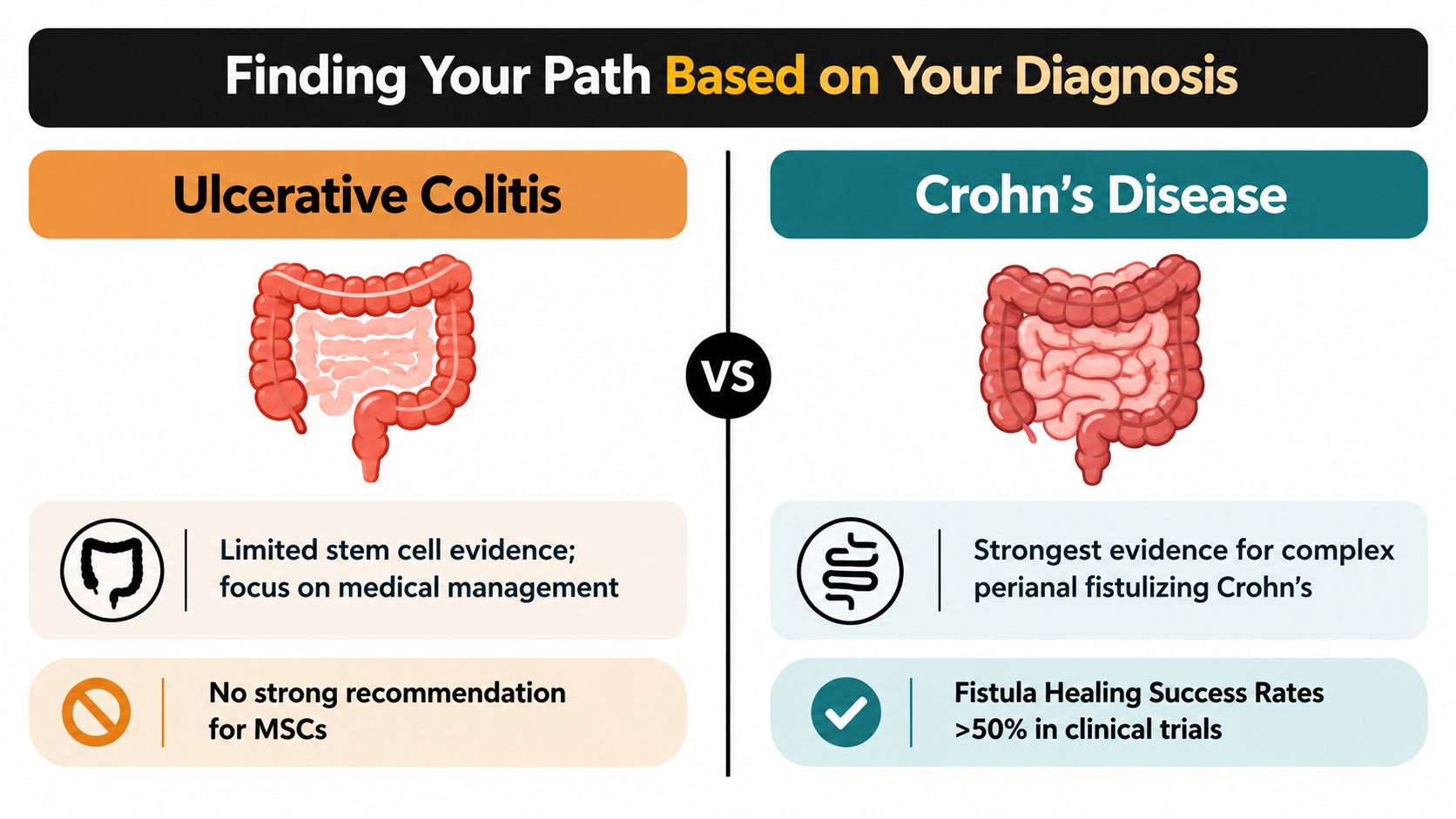
Finding Your Path Based on Your Diagnosis
Crohn's disease and ulcerative colitis overlap in symptoms, but the regenerative conversation is not identical. The strongest stem cell evidence sits with complex perianal fistulizing Crohn's disease, while luminal Crohn's and ulcerative colitis remain more investigational.
If you have Crohn's disease
If your Crohn's includes perianal fistulas, that's the most evidence-backed stem cell use case. If your Crohn's is mainly intestinal inflammation, the picture is different, and the discussion shifts toward investigational MSC use, disease severity, prior biologic response, and surgical history. For a condition-specific guide, see Stem Cells for Crohn's Disease.
If you have ulcerative colitis
For UC, the conversation centers on early IV MSC research and the early HBOT studies. It's still a more experimental space than the fistula literature in Crohn's disease, so the key question is not whether regenerative medicine exists. It's whether it fits your specific disease course, medication history, and current level of control.
How to decide what matters most
Three features usually guide the discussion:
Location: colon-only disease behaves differently from small-bowel or fistulizing disease.
Pattern: inflammatory, penetrating, stricturing, or fistulizing disease each raises different questions.
Current control: if standard treatment is working, regenerative care may not be the next move.
For a broader UC-focused path, see Stem Cells for Ulcerative Colitis.
That's the practical filter. The right plan depends on the exact disease pattern, not just the diagnosis label.
Questions Patients Commonly Ask and Your Next Step
Patients usually want a straight answer about what happens next. The honest answer is that stem cell therapy for IBD is still an individualized, research-informed discussion, and the timeline for improvement depends on diagnosis, route of treatment, and how active the disease is when care begins.
Common questions, answered plainly
What does IBD include? It primarily includes Crohn's disease and ulcerative colitis.
Have stem cells been studied in humans? Yes. Human studies exist, especially for Crohn's fistulas and early systemic MSC work in Crohn's and UC, but the evidence is strongest in specific settings, not as a general cure.
Should I keep taking my medication? Yes, unless your gastroenterologist changes it. Regenerative care is layered on top of conventional management, not used to replace prescribed therapy without supervision.
What are exosomes? They're tiny communication vesicles released by cells, and they're being studied because they may help regulate inflammation.
Where does HBOT fit? It may be considered as an adjunct, especially in ulcerative colitis-focused care plans, but it's not a standalone replacement for GI treatment.
Are donor-derived cells safe? Safety depends on the specific product, delivery route, and clinical context, so it has to be reviewed case by case.
If you're considering this path, bring your colonoscopy reports, imaging, medication history, and any prior surgery notes. A physician consultation can then focus on what's realistic, what's investigational, and what may fit your disease pattern.
Longevity Medical Institute offers physician-directed regenerative care that can evaluate inflammatory bowel disease within the context of your full medical history, current treatment, and diagnostic records. If you'd like a careful discussion of stem cells, exosomes, and hyperbaric oxygen in relation to Crohn's disease or ulcerative colitis, visit Longevity Medical Institute to schedule a consultation and share your relevant medical records.
Author
Dr. Kirk Sanford, DC, Founder & CEO, Longevity Medical Institute. Dr. Sanford focuses on patient education in regenerative and longevity medicine, translating complex therapies into clear, practical guidance for patients.
Medical Review
Dr. Félix Porras, MD, Medical Director, Longevity Medical Institute. Dr. Porras provides clinical oversight and medical review to help ensure accuracy, safety context, and alignment with current standards of care.
Last Reviewed: September 26, 2026
This information is for educational purposes only and is not medical advice. It does not replace an evaluation by a qualified healthcare professional. For personalized guidance, please schedule a consultation.