

Stem Cell Therapy for Mild Cognitive Impairment (MCI)
You may be noticing subtle changes that are easy to brush aside at first. Your keys show up in unusual places, a familiar name takes longer to recall, or an appointment slips your mind even though you remain fully independent. When cognitive testing confirms measurable difficulty but daily functioning is still largely preserved, clinicians may diagnose mild cognitive impairment, or MCI.
That diagnosis can feel both reassuring and unsettling. It is not dementia, and for many patients it is also a meaningful window for action. Stem cell therapy for mild cognitive impairment (MCI) is drawing attention because this stage may offer an opportunity to support brain health, preserve function, and potentially influence disease processes before more advanced decline occurs. The important qualification is that the therapy remains investigational, and human research is still working to define the full extent of clinical benefit.
Understanding Mild Cognitive Impairment and Why Early Action Matters
A 62-year-old notices that she is misplacing her keys, leaving sentences unfinished, and skipping appointments she once tracked easily. Her family sees the changes, but she still manages her finances, prepares meals, drives familiar routes, and maintains her household. A neuropsychologist identifies measurable deficits in memory and executive function, while confirming that her independence remains substantially intact.
That pattern is consistent with MCI, a clinical state between expected age-related changes and dementia. The difference matters. Occasional forgetfulness can occur with aging, stress, poor sleep, or medication effects. MCI involves objective cognitive decline that is more persistent or noticeable, yet daily independence is not lost to the degree seen in dementia. A compassionate explanation of this distinction is available in this compassionate guide to cognitive decline.
MCI does not look identical in every patient
Amnestic MCI primarily affects memory. A person may repeatedly ask the same question, forget recent conversations, or need more reminders for appointments. Non-amnestic MCI may affect language, attention, planning, visuospatial skills, or judgment while memory appears relatively stronger.
The underlying drivers can also differ. Clinicians may investigate early Alzheimer's biology, vascular changes, sleep disruption, metabolic dysfunction, medication effects, mood disorders, and other reversible or treatable contributors. MCI is not a single disease, so a responsible treatment discussion begins with diagnosis rather than with a cell product.
Why timing attracts regenerative research
The therapeutic appeal of MCI is straightforward. At this stage, a patient may still have meaningful cognitive reserve, functioning synaptic networks, and enough independence to benefit from interventions designed to preserve and support existing abilities. That is one reason regenerative medicine continues to attract interest here.
The 2025 systematic review of stem cell therapy in dementia found that human clinical efficacy is still being defined, while also highlighting a favorable safety profile, encouraging preclinical findings, and a strong scientific rationale for continued research (systematic review of stem cell therapy in dementia). The conclusion is that stem cell therapy for MCI is in an early but promising clinical development phase, not yet a fully settled standard-of-care category.
This distinction matters because patients with MCI often face limited conventional options, and existing drug-based approaches may offer modest benefit, eligibility restrictions, monitoring burdens, or side effects. In that setting, it is reasonable for patients and clinicians to explore investigational regenerative strategies carefully, while still keeping established neurological evaluation and risk-factor management in place.
Practical rule: Treat MCI as a reason to investigate broadly and thoughtfully, using both conventional neurological care and responsible review of emerging options.
How Stem Cells and Exosomes May Support the Aging Brain
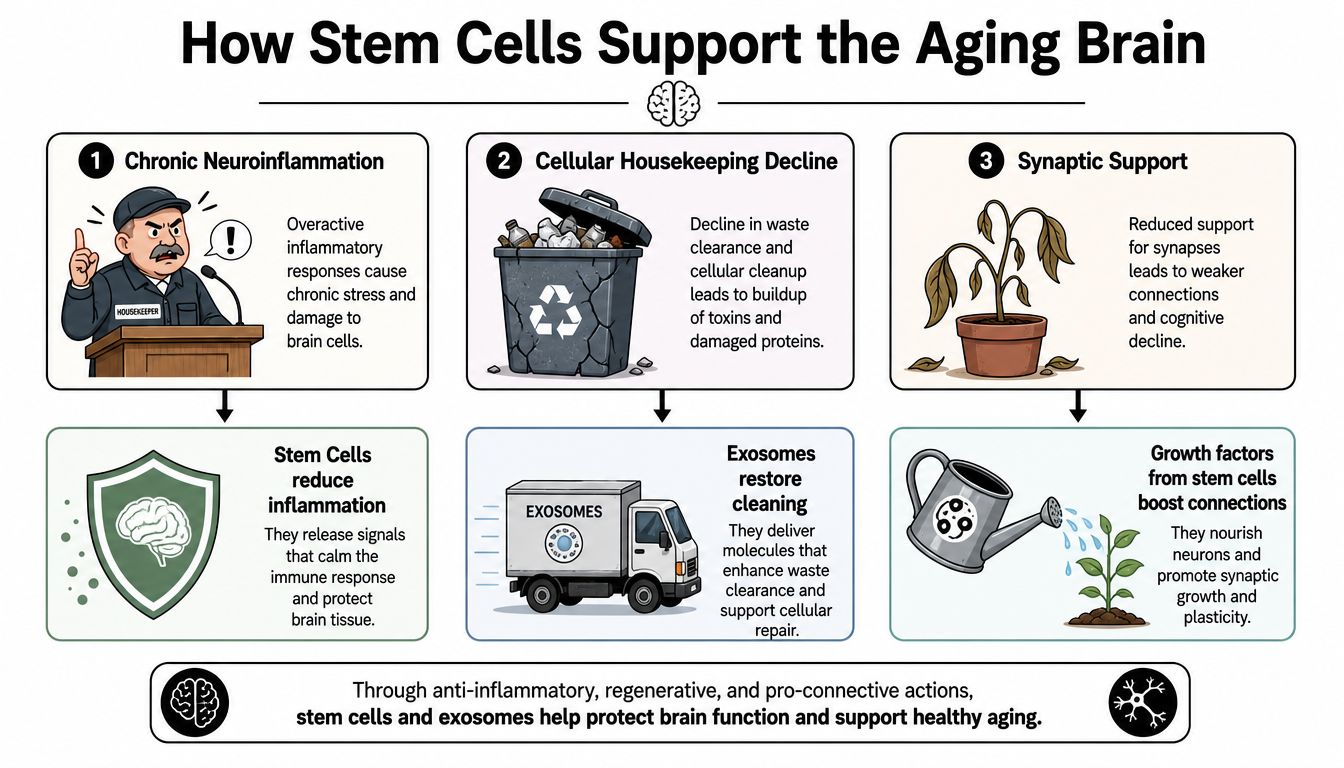
Think of the aging brain as a house that still works but needs better maintenance. One issue may be an overactive housekeeping system, represented biologically by persistent neuroinflammation. Another may be worn wiring, meaning stressed or weakened synaptic connections. A third is reduced access to repair signals that support neuronal survival, resilience, and plasticity.
Mesenchymal stem cells, or MSCs, are not primarily being studied as replacement neurons. Their proposed role is closer to that of a biologically active support system. After administration, the cells release signaling molecules that may influence nearby immune cells, blood vessels, and neural tissue. Researchers are especially interested in paracrine signaling, where much of the therapeutic effect may come from what the cells secrete rather than from permanent engraftment.
The proposed support signals
Early research suggests MSCs may help regulate inflammatory signaling and support the local environment around neurons. Investigators also examine neurotrophic factors such as BDNF, GDNF, and NGF, which are associated with neuronal maintenance, plasticity, and synaptic function. MSC-derived exosomes carry proteins, lipids, and microRNAs that may influence how recipient cells respond to injury, inflammation, and metabolic stress.
Importantly, the therapeutic rationale does not depend on a single mechanism. Researchers are studying a network of possible effects, including immune modulation, trophic support, vascular signaling, mitochondrial support, and changes in how neural tissue responds to stress. For patients and families, the practical takeaway is that these therapies are being explored for their capacity to improve the biological environment in which brain cells function.
This is not usually framed as rebuilding a damaged hippocampus cell by cell. A more accurate analogy is improving the conditions in a garden. Better signaling may help stressed neural circuits function more efficiently and remain more resilient, even if the degree of structural recovery varies from one patient to another.
Why exosomes attract attention
Exosomes are small extracellular vesicles released by cells. Their potential appeal is that they can transport biological messages without delivering living cells themselves. Researchers are investigating whether exosomes can reach the central nervous system after intravenous or intranasal administration and influence microglia, synapses, and inflammatory pathways.
The blood-brain barrier presents a significant challenge for delivering regenerative therapies to the central nervous system, but it has also become an active area of innovation. As part of its Regenerative Neurological Therapy program, Longevity Medical Institute has introduced an intranasal delivery device designed to support this approach, building on methods explored across clinical research. In a 2023 clinical study, intranasal administration of MSC-derived exosomes demonstrated an encouraging safety profile and preliminary signals of cognitive improvement in patients with mild-to-moderate Alzheimer’s disease, supporting further investigation in larger randomized controlled trials.
What the Research Shows for MCI and Early Alzheimer's
A patient may hear that stem cells improved memory in an animal study and reasonably ask whether similar results could occur in MCI. The answer depends on which layer of evidence we are discussing. Laboratory and animal research has produced encouraging findings related to neuroinflammation, synaptic support, and cognitive performance. Human studies remain relatively small and early-stage, but MSC-based therapies have generally demonstrated favorable safety and tolerability profiles in clinical studies to date. While larger controlled trials are still needed to establish efficacy, the field is advancing in a way that supports careful optimism.
A 2025 systematic review identified dozens of encouraging preclinical studies, while concluding that current clinical trials have not yet delivered definitive success for everyone (review of the clinical and preclinical evidence). An improved memory task in an Alzheimer's mouse model is a useful research signal. It does not by itself establish a meaningful improvement in an independent person with MCI, but it does help justify continued clinical development.
The first highly specific human milestone
One registered University of Miami pilot trial, NCT07512362, is designed for adults with MCI or early Alzheimer's disease who already receive FDA-approved anti-amyloid monoclonal antibodies. Its protocol includes one intravenous infusion of 25 million human mesenchymal stem cells, and the estimated study start and primary completion dates are June 15, 2026, and June 15, 2028, respectively.
The study's design shows the current direction of human testing. It is regulated, targeted research that explores whether stem cells may add value to existing care. While it is a small pilot and not a definitive efficacy trial, it reflects growing institutional interest in bringing regenerative neurology into more structured clinical evaluation.
What remains uncertain
Earlier Alzheimer's stem cell trials have offered more reassuring safety signals than efficacy signals, which is still meaningful in an emerging field. In this 2020 study, the authors repeatedly identify timing as a fundamental problem in previous Alzheimer's trials. They argue that by the time dementia is clinically established, substantial neuronal loss has already occurred and may be irreversible. They specifically conclude that sufficiently early diagnosis, including at the MCI stage, could be critical to preventing further neuronal loss and brain deterioration.
A separate MCI study, NCT07214974, uses a prospective, multicenter, randomized, double-blind, placebo-controlled design (ClinicalTrials.gov randomized MCI study). This structure can reduce bias and help separate treatment effects from expectations, natural cognitive fluctuation, and changes in supportive care. It is also exactly the kind of trial design that can move the field forward.
Patients may also ask about complementary options such as hyperbaric oxygen for brain injury. These approaches require separate evidence review and do not demonstrate that stem cells benefit MCI.
For background on cell-based approaches, readers can review mesenchymal stem cell research. The practical question is whether a proposed protocol has a credible neurological rationale, appropriate safety oversight, and measurable endpoints.
The Five Allogeneic Stem Cell Types and Their Relevance to Brain Health
Longevity Medical Institute produces allogeneic stem cell products from placental, Wharton's jelly, adipose, endometrial, and dental pulp tissue. These cells come from donors, allowing manufacturing and quality-control steps before administration. That convenience still requires careful review of product identity, sterility, potency, compatibility, and supporting clinical evidence.
No head-to-head MCI trials show that one source performs better than another. For that reason, clinicians should match source selection to the proposed biological rationale, manufacturing data, patient characteristics, and the limits of available evidence. At the same time, the diversity of cell sources gives the field several potentially useful pathways for continued neurological research.
How the sources are commonly discussed
| Allogeneic source | Why clinicians may consider it | Evidence caution |
|---|---|---|
| Placental MSCs | Young tissue source with immunomodulatory and neurotrophic interest | No direct proof of superiority in MCI |
| Wharton's jelly MSCs | Often studied for paracrine signaling and neurological applications | Human MCI evidence remains early |
| Adipose-derived MSCs | Accessible source with interest in secreted factors and exosomes | Cell behavior depends on processing and product quality |
| Endometrial MSCs | Emerging source with a distinct biological profile | Neurological evidence is still developing |
| Dental pulp MSCs | Investigated for neural-supportive properties in laboratory research | Clinical translation for MCI remains uncertain |
The tissue label provides only part of the picture. The complete product profile includes donor screening, expansion methods, identity testing, viability, sterility, potency assays, administration route, and storage controls. A clinic should explain how those details support the proposed goal and where uncertainty remains.
Patients seeking background can review multipotent versus pluripotent stem cells. This distinction clarifies why MSCs are generally discussed as signaling and immunomodulatory cells, rather than unrestricted replacement cells. For MCI, these five allogeneic sources therefore represent different research pathways, with meaningful potential but not yet establishedly interchangeable therapies.
Patient Selection, Diagnostics, and What a Treatment Protocol Looks Like
A thoughtful evaluation starts by confirming that the patient has MCI and by identifying what may be contributing to the symptoms. A careful baseline also creates a stronger foundation for judging whether any treatment, conventional or regenerative, is actually helping.
The clinical assessment
A neurological intake may include a detailed history, medication reconciliation, neurological examination, neuropsychological testing, and assessments such as the MoCA or MMSE. Depending on availability and clinical context, physicians may also discuss amyloid and tau biomarkers, APOE genotyping, vascular risk, sleep quality, metabolic health, mood, hearing, and reversible causes of cognitive difficulty.
MRI can help assess structural changes and exclude alternative explanations. An experienced team also asks practical questions: Who manages medications? Has the patient fallen? Can they drive safely? Has a family member noticed changes that the patient does not recognize?
A representative care pathway
A proposed regenerative protocol may include:
Preparation and baseline recording, including laboratory review, imaging, cognitive testing, and informed consent.
Allogeneic MSC administration, commonly discussed as an intranasal, intrathecal, or intravenous infusion in investigational protocols.
Exosome support, delivered by a route selected by the treating physician when clinically appropriate.
Cognitive rehabilitation and lifestyle support, because sleep, exercise, hearing, vascular health, and metabolic factors influence daily cognition.
Outcome tracking, using repeat cognitive, functional, neurological, and patient-reported assessments.
These elements describe a clinical framework, not a proven standard of care. The University of Miami pilot's single infusion of 25 million cells and enrollment of participants illustrate why protocols should be discussed as research-informed and individualized rather than universally established (ClinicalTrials.gov trial registration).
Patients traveling to Mexico should plan for transportation, a companion when recommended, medical records, medication lists, and a follow-up schedule before treatment. The regenerative neurological therapy program can serve as a reference point for the kinds of evaluation and follow-up questions patients should raise with any clinic.
Safety, Risks, and What the Regulations Say
Safety deserves as much attention as potential benefit. Earlier Alzheimer's stem cell studies did not report serious adverse events, which is encouraging, though human evidence remains limited. These findings do not establish that every cell product, delivery route, or protocol is risk-free, but they do support the value of continued careful study.
What clinicians monitor
Before treatment, a responsible team reviews infection risk, allergies, cardiovascular history, clotting concerns, immune status, current medications, and the patient's ability to report symptoms afterward. Intravenous administration also calls for observation of infusion reactions and consideration of the theoretical possibility that cells could become temporarily trapped in the lungs.
Other theoretical concerns include unwanted tissue growth and changes in abnormal electrical signaling. These possibilities do not mean harm will occur, but they explain why product records, medical screening, and follow-up matter.
The risk profile depends on the actual product and procedure. “Stem cells” describes a broad group of therapies rather than one standardized medicine. Patients should request product-specific information about identity, donor screening, manufacturing, sterility, and testing instead of relying on general safety statements.
Regulation is jurisdiction-specific
A clinic's location or medical tourism status does not automatically make a stem cell or exosome product approved. In the United States, patients should distinguish FDA-approved therapies from investigational products used in properly registered clinical research. Europe follows its own frameworks for heterologous cell therapies, while treatment in Mexico involves local oversight, including COFEPRIS considerations.
Regulatory compliance does not prove that a therapy improves MCI or Alzheimer's disease. It indicates that applicable legal, manufacturing, consent, and oversight requirements are being addressed. Patients should avoid promises of a cure, guaranteed reversal, or advice to abandon established neurological care.
The stem cell therapy safety information can help patients prepare focused questions. It should supplement, not replace, an independent medical evaluation.
Evidence-Based Care, Clinical Judgment, and Patient Choice
Patients considering stem cell therapy for MCI often hear two unhelpful extremes. One says emerging therapies should be dismissed because the data is incomplete. The other says a promising biological rationale is enough to assume benefit. Good medical decision-making usually lives between those extremes.
David Sackett, one of the founders of evidence-based medicine, famously defined evidence-based care as the integration of best available research evidence, clinical expertise, and patient values. That framework is especially relevant in conditions like MCI, where conventional medicine may not offer a fully satisfactory answer for every patient.
In practice, this means a responsible discussion should include the published data, the physician's judgment, the patient's goals, tolerance for uncertainty, functional status, and willingness to continue standard neurological care alongside investigational options. Evidence-based care does not mean waiting only for perfect data. It means making the best possible decision with the evidence currently available, while being honest about limits, alternatives, and risks.
For patients with MCI, that approach can support thoughtful exploration of regenerative medicine without overstating certainty. It also helps explain why some patients pursue investigational therapies even when large definitive trials are still in progress.
Choosing the Right Clinic and Questions Worth Asking
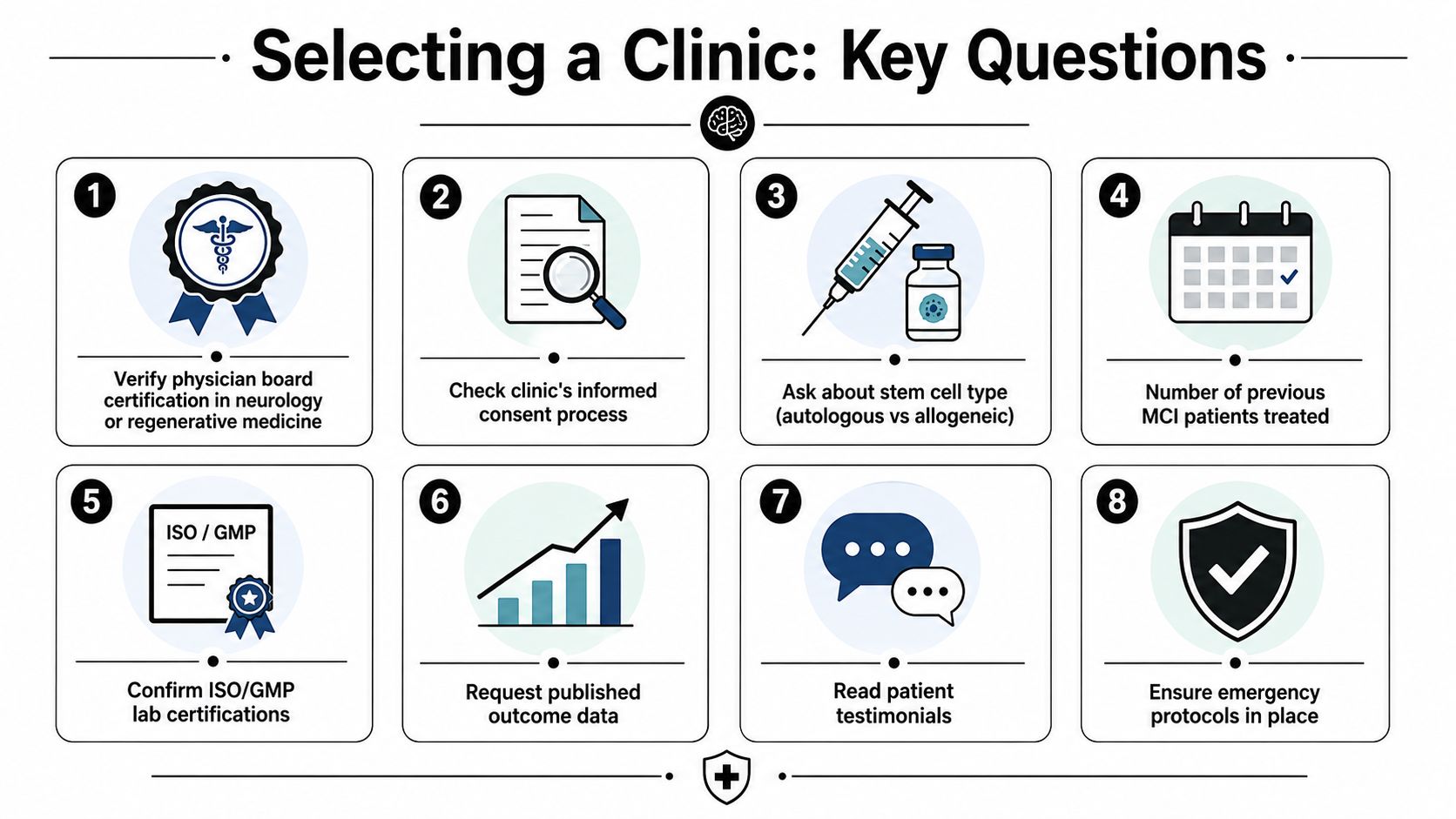
The clinic matters because the quality of the assessment, product handling, consent process, and follow-up can shape the entire experience. A polished facility is not enough. Patients need clear answers that remain consistent across the physician consultation, laboratory documentation, and written treatment plan.
Questions that reveal clinical maturity
Credentials: Who evaluates the patient, and what training does that physician have in neurology, cognitive medicine, or regenerative medicine?
Cell identity: Is the product placental, Wharton's jelly, adipose, endometrial, or dental pulp derived?
Allogeneic sourcing: Where do the donor cells come from, and how are donor screening and traceability handled?
Quality testing: Can the clinic document identity, viability, sterility, and relevant potency testing?
Protocol design: What route, dose, timing, and number of administrations are proposed, and why?
Outcome tracking: Which cognitive, functional, imaging, or biomarker outcomes will be measured?
Contingency planning: What happens if the patient does not improve, develops symptoms, or needs conventional neurological care?
Follow-up: Who provides post-treatment monitoring, and how are records shared with the patient's local physician?
Red flags deserve a firm response
Walk away from guarantees, pressure to pay before informed consent, vague answers about the cell source, and one-size-fits-all dosing. A clinic that cannot explain uncertainty probably will not manage it well after treatment.
Longevity Medical Institute offers physician-led assessment in San José del Cabo, allogeneic products from five cell sources, an in-house clinical laboratory, a COFEPRIS-licensed and ISO-certified biotechnology laboratory, AI-enhanced full-body MRI, cardiac assessment, and structured follow-up planning. Those features are most valuable when paired with transparent consent and realistic expectations, so patients should still request the underlying documentation and ask how MCI outcomes are measured.
A Realistic Outlook on Stem Cell Therapy for MCI Today
A patient with MCI may hear encouraging reports about placental, Wharton's jelly, adipose, endometrial, or dental pulp cells and reasonably ask what they can do today. The answer requires separating promising biology from human evidence that is still developing. Preclinical work suggests possible anti-inflammatory, synaptic, and disease-pathway effects, while current clinical evidence has not yet fully defined efficacy in humans.
The next useful evidence should come from carefully designed trials, biomarker-guided patient selection, consistent potency testing, and treatment plans that combine investigational cells with established neurological care. Early human studies are small and exploratory, but they are also helping refine who may benefit, when intervention may matter most, and how outcomes should be measured.
For a patient considering a protocol, the practical starting point is a confirmed diagnosis and a dependable cognitive and functional baseline. Sleep, metabolic health, approved treatment options, and independent medical advice also deserve attention before treatment. MCI can provide an opportunity to protect function, and regenerative therapy may become an important part of that conversation when approached carefully and alongside evidence-based neurological care.
Longevity Medical Institute offers physician-led cognitive evaluations, advanced diagnostics, allogeneic stem cell and exosome programs, and personalized longevity planning. Visit Longevity Medical Institute to request a consultation about whether an investigational approach fits your medical history.
Author
Dr. Kirk Sanford, Founder & CEO, Longevity Medical Institute. Dr. Sanford focuses on patient education in regenerative and longevity medicine, translating complex therapies into clear, practical guidance for patients.
Medical Review
Dr. Félix Porras, MD, Medical Director, Longevity Medical Institute. Dr. Porras provides clinical oversight and medical review to help ensure accuracy, safety context, and alignment with current standards of care.
Last Reviewed: August 20, 2026
Short Disclaimer
This information is for educational purposes only and is not medical advice. It does not replace an evaluation by a qualified healthcare professional. For personalized guidance, please schedule a consultation.